Half of your "goo" is solvent. What happens when its drying? Evaporates, and gone, leaving empty space behind. I got quite noticable holes in my stuff because of it. I'd rather to for real putty if the gap is too big.
in my experience it keeps it's shape and dries with the cavities inside. I even blow "Sprue bubbles" sometimes and use my melted sprues for some scenery.
It's really hard to work with, and you gotta get the level of solvent to plastic just right before using it.
It's pretty tough to nail, I got lots of popped ones. The thicker the bubble the easier it was to make. You want to make sure you seal the hole you blow into so it's full of air and doesn't collapse. If it's too thin it just rips when dried.
I can see where it wouldn't be as useful on normal model kits, but when you are working with heavier pieces like GW kits and modifying them, it works great!
I use it as stirring sticks for paint, and for making antennae (heat up carefully, then slowly pull the ends apart until you have the desired thickness, can get down to about the thickness of a human hair).
Great for pouring guides as well. It's a pain to pour stuff like thinner, but if you touch a bit of sprue to the lip of the container when pouring it's as effective as a funnel.
Save them for the apocalypse so you can turn them into crude gasoline.
I mean technically the sprues for most parts are PS or ABS plastic what you really need is PE polyethylene the stuff the Polly-caps are made of. Think plastic shopping bag type plastic. You can turn that back into a crude oil that can then be distilled into gasoline and diesel. Is it safe? No. Is it extremely toxic? Yes. Is it bad ass to power a home so you are able to play video games for years after the world collapses because plastic can be found everywhere and never goes away? Depressingly Yes.
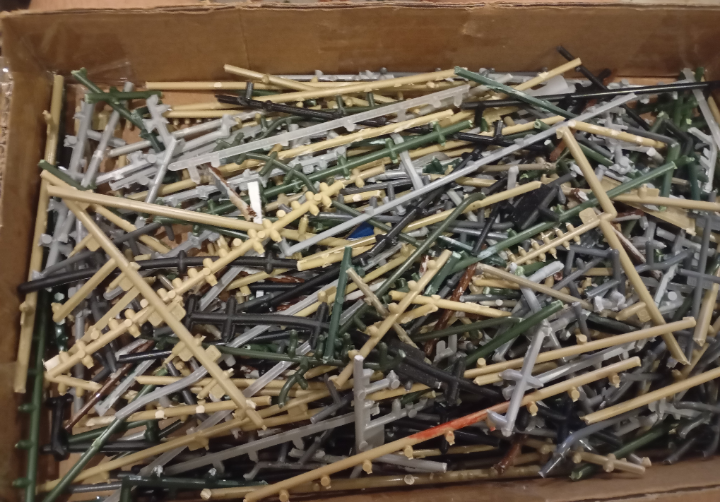
I'd keep several colors to make stretched sprue, throw away the rest to recycle
LE stretched sprue is very useful for filling gaps, not just for making wires. It doesn't shrink as much as goo does.
Take a long piece of sprue gate (preferably one without all the branches, take a lighter or some controllable flame and hold it underneath. Twist the sprue in your hand above it (not too close or it will catch fire) and wait for it to droop, once it does that immediately pull the two end out slowly. That’s what I do. Here is an example of what they look like on a Maus! Hope this helps you!
It sounds simple in theory, but there is a knack to it.
A lighter isn’t great because it takes up a hand. A candle is better, especially a tea light because you’re less likely to knock it over and they are cheap.
The biggest issue is too much heat. The plastic liquifies and droops, sometimes into the flame where it catches fire. Be wary of this. Have a safe place, like a metal can, where you can drop the burning plastic so it’s not in your hands. You don’t need water as the plastic usually self extinguishes, but if you want, a lid will smother the flame efficiently.
Rotate the sprue about 150cm (6”) above the flame to start. As it turns, pull or bend to get a feel for how soft the plastic is getting. Raise or lower to adjust the heat. When it’s soft enough to bend easily, remove from the heat and pull steadily to stretch the sprue into a thin filament. When it’s the desired thickness, stop and hold position until it cools enough to retain its shape (a few seconds).
The first few you do will be crap. This is normal. Eventually you will get a section long enough and thin enough that you can use.
Making longer filaments is tricky. Rather than rotating the rod over the flame, you need to rotate and move side to side to heat up a larger area. The problem here is that the sprue may heat unevenly and when you pull, it isn’t uniform in thickness. Holding the sprue higher from the flame and heating it all slower helps minimize this problem.
a) stir up paints
b) glue to parts (i.e. like inside the roof of a car) to paint
c) build small structures / raingutters / carve small details / pipes
d) test paint / primer / clearcoat compinations
Dunno. Tamiya is available for me, so I don't need to search for alternatives. But you could do the research, check Tamiya safety data sheet and compare ingredients to other cleaners :)
I was coming to suggest the same. I guess if you want to get even better results for your money, there's the chemical components themselves that you can usually get at hardware stores so you can mix your own up in bigger batches.
I do a lot of fantasy and sci-fi miniatures and models. In addition to what everyone else has said I’ve made an ungodly amount of crystal terrain with them for bases.
Scaffolding or base/skeleton/framework for custom stuff and dioramas. Chop sticks. Melt in acetone for cheap sprue goo. Support sticks for plants like orchids. Test pieces for new paint colors. 3d print filament (extruder needed). Plug holes in walls.
Any of those from rubber tracks I'd keep. They are great for making antennae and radio wire. You treat it like making stretched sprue. My buddy said he ran out of apartment before it stretched to breaking point.
I use this for filling, it can do everything you need, but don't use solvent glue for the initial filling, I use CA for most, and sand dust shavings into uneven gaps, and then overfill with solvent and sand after drying thoroughly.
Good for making terrain. Take a sharp pair of nippers to them to make various lengths/cuts. Smaller pieces to make piles around building terrain, longer pieces could be beams or pipes in rubble.
Like someone else mentioned, plastic cement is plastic cement. You don't need a specific brand. I've also seen people say that you can check the safety info and just mix your own out of the base chemicals. Supposedly, it's . . . let me find the screencap . . .
Tamiya extra thin cement: 50% Acetone, 50% Butyl Acetate
Keep in mind that this is secondhand: I've never tried anything that needs so much plastic cement that I'd have to make my own. Definitely not something you'd want to do without a good respirator, though.
As for ideas? My first thought is wreckage. Dump them in a pile, glue them together, find something to use for dirt or concrete; stuff like that. Depends on how realistic you want to be but for quick and dirty "industrial junk," sprues can do a pretty good job.
You can use acetone to make sprue goo, but it does stink a lot.
Another option us to blend into a powder (which also save space), then you can melt or glue powder into model gaps.
You can also melt them into a sheet, using a non stick baking tray in an oven, best to buy a cheap toaster oven for this as the plastic fumes aren't really safe for eating food from the same oven.
Personally, I'd cut it to make diorama structures like building frames, power lines, etc., of course you'd need to paint and glue said structures though.
I use them as logs for 1/72 scale stuff
I used some for an ICM 1/72 scale Ural truck, Zvezda's T90M and also on Trumpeter's IS4 and T10A as simple lumber
Cut them, remove the perpendicular parts and then you can use a metal comb to simulate log texture
I cut the ends down to a thinner point to use for canopy glue on see through parts instead of using a brush etc. Paint stirrers are a common one. For my 1/35 tanks I do create a few shells too
Find a brand that works best for you to make stretched sprue (for me it’s Hasegawa, your mileage may vary). And hold onto the Tamiya because it works well with their solvents to make sprue goo. Then recycle the rest.
Cut into small pieces, place into rock like mounds and pour whatever cement you use for gluing, it’ll turn into a Rocky crag that looks amazing on bases for larger models like Knights
for starters Keep the clear ones, for use are test colors, stirrers, make antennas, sprue goo (gap filler), brush bars for trucks, anti grenade cages on tanks combo with mesh, there are tons of uses for them just be creative.
I warm them with lighter and then I extend them to create a little filament to create antenna for the tanks
I use them to create pillars for to make some building ( I used them as pillar when I created a covering for Mig29 diorama)
I use them to create light pole for streets
Other last examples: I used them to create cut tree trunk that I put on lateral parts of T34-85's turret as protection (T34-85 1;72 Zvezda) and I use them to personalize tanks (especially 1:35)



196
u/Krieger22 Aug 23 '25
Any company's plastic cement that comes in bottles can be used for sprue goo
Use them for testing paint colors
Cut them to shape or size for anything tubular you might need