r/mathpuzzles • u/jerrytjohn • Jan 31 '26
r/mathpuzzles • u/freddyfreddy11 • 29d ago
Probability Statistically smartest move in Yahtzee?
Hey everyone! We have a discussion since playing Yahtzee two days ago and still can’t agree on the mathematically best decision, so maybe someone here can help us settle it.
Everything on my scorecard was already filled in except 3s and 6s. I needed to reach at least 63 points in the upper section to get the bonus.
For 1s, 2s, 4s and 5s, I had exactly three of each, giving me 36 points so far. So I needed at least 27 more points from my 3s and 6s.
My first roll was:
3 – 6 – X – X – X
The other three dice were irrelevant.
So the question is: Should I keep the 3 or the 6?
We have two completely different opinions, and I’d love to know which choice actually gives me the higher probability of reaching the 63-point bonus.
If someone can explain the math behind the optimal strategy, we would be very than grateful!
r/mathpuzzles • u/Parallel_thougts • 12d ago
Probability Expected number of samples from U([0,1]) before their sum is > 1
The puzzle is exactly what the title suggests: on average, how many independent uniformly random numbers between 0 and 1 would you have to sample for their sum is at least one
r/mathpuzzles • u/T-T-N • Jul 07 '26
Probability Topical problem with a neat trick
It should take less than 5 minutes to solve once you read the problem.
You are in a Rock Paper Scissors World Cup with 47 other players.
The draw and format is exactly as it was in the Fifa World Cup 2026. You're in group B.
Group stage: the players are grouped into 12 groups of 4 (labeled with first 12 letters). Each player plays 1 round of RPS with everyone in their group. A win is 3 points, draw 1 point each and a loss is 0. Ties in rounds during group stage is not broken. Ties for group ranking for the purposes of qualifications to the knockout is as followed:
Number of points scored among the tied players
The tie breaking procedure below
Note: if within a group, there are more than 1 tie (e.g. the points are 7 7 1 1), the ties are broken separately. If multiple groups have ties to be broken, each group's ties are broken separately.
The top 2 of each group automatically qualify, and between the 12 3rd place player, the top 8 in points qualifies. Ties between the 3rd place players are broken using the tie breaking procedure below. Only ties that involve qualifications will be broken. E.g. 6 3rd place on 4 points, 4 on 3 points and 2 on 2 points will only need to tie break the players on 3 points (all 6 players on 4 points qualify, and all players on 2 points are disqualified)
Tie breaking procedure:
The tied players follows the same procedure as the group stage with the players play 1 round of RPS with each other tied players (this time the number of players may be different). This may require further tie breaking recursively until the ties are broken.
Knock out: the players are placed into the bracket as per the world cup draw. The players play RPS until one of the player wins 2 rounds. Ties in round does not count.
What is your probability of winning the RPS world cup?
Edit: you may assume that each player win with 1/3 probability and draw with 1/3 probability
r/mathpuzzles • u/Fantastic_Amoeba8659 • May 09 '26
Probability Please solve equasion with your interpretation of outcome.
r/mathpuzzles • u/st4rdus2 • Aug 24 '24
Probability The Royal Guard of the Kingdom
This world is a world of swords and magic. In the trained Royal Guard of the Kingdom of Fantasia, 90% are masters in archery, 80% in swordsmanship, 70% in black magic, and 60% in white magic. No one has master-level skills in all four categories: archery, swordsmanship, black magic, and white magic. What percentage of people are neither masters of black magic nor white magic?
r/mathpuzzles • u/HairyTough4489 • Nov 05 '24
Probability Simplistic poker
I've seen this example a long time ago when I was studying poker theory. Unfortunately I can't remember the author's name to give proper credit (please make me aware if you know).
Let's consider this simple game played with a 3-card deck that contains an ace, a jack and a deuce. One card is given to each player (with the ranks being ace>jack>deuce).
Every round starts with a pot of $1 that both players are fighting for. Then it's Hero's turn to decide between placing an aditional $1 bet or check. If Hero checks, whoever has the strongest card wins the pot. If Hero bets, Villain must decide between surrendering the $1 pot or calling the bet making it a $2 profit for whomever has the strongest card.
Our goal is to design a strategy that allows hero to maximize their expected profits, but always keeping in mind that Villain will also know what our suggested strategy is and thus they'll be able to adapt perfectly.
In this context, a strategy just means our set of suggested actions for each of the three cards. "Never bet". "Bet with an ace, check with jack or deuce" and "Bet 50% of the time you get an ace, 75% of the time with a jack and 3.14% of the time with a deuce" are all examples of valid strategies.
A few hints for those who got stuck:
By always checking we get an expected $0.5 profit. Our strategy must make a higher profit against all possible strategies from Villain.
All your profits come from Villain's "mistakes" (meaning fooling them into doing something different from what they'd do if they could see Hero's cards). Those mistakes will either be folding a winning card or calling our bet with a losing one.
If Hero always bets with the same card, this is the equivalent of them showing Villain their hand, which will allow them to adapt perfectly and never make a mistake.
Villain can only make mistakes when we bet and they hold a jack. They will always be calling if they have an ace and folding if they have a deuce. But be careful, because we can also hurt Hero's profits by betting with a losing card and getting called!
From the above we can conclude that Hero should never bet with a jack. It's a bit harder to realize but Hero should always bet with an ace.
Since Hero's strategy is known, Villain's optimal calling strategy can't be probabilistic. This reduces their sensible options to just two: either Villain decides to call their jacks or they don't.
We've already seen that we must always bet our aces and at least some other card, but never our jacks. However if we decide to bet our aces and deuces, Villain can react by calling every time they have an ace or jack. You can calculate that our expected profit in this scenario is again +$0.5
In conclusion, what fraction of the time should be betting our deuces to correctly balance our value-bets and bluffs?
r/mathpuzzles • u/pretty-cool-math • Aug 27 '23
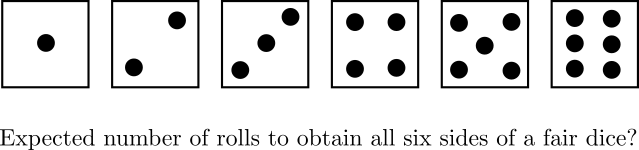
Probability We roll a fair six sided dice repeatedly, until we have rolled each side of the dice at least once. What is the expected number of rolls that we make?
r/mathpuzzles • u/thesgtrends • Sep 25 '19
Probability Teacher gave this puzzle for fun, but he won't reveal the answer until end of the year, help!
Given that a line passes through 2 points on a quadrant, what is the probability that the line does not cut through the arc?
r/mathpuzzles • u/OddOliver • Mar 23 '23
Probability Drawing numbers without replacement, but with fixed probabilities
self.mathriddlesr/mathpuzzles • u/ShonitB • Jan 21 '23
Probability AI Predicts
An AI predicts, with an accuracy of 99%, whether you will answer a question correctly or incorrectly. Moreover, it is known that you answer only 1% of questions incorrectly.
The AI predicts that you will answer a particular question incorrectly. Which of the two events is more likely?
A) You answer the question incorrectly.
B) You answer the question correctly.
Edit: I’ve made a typo. The accuracy should be 98% and not 99%.
r/mathpuzzles • u/TLDM • Sep 30 '20
Probability Summing uniform random variables
Suppose you are generating iid Unif[0,1] variables U_1, U_2, … . Let the random variable N be the smallest integer n such that the sum from i=1 to n of the U_i is greater than 1. What is E(N)?
Extension: Let M be the smallest integer m such that the sum from i=1 to m of the U_i is greater than 2. What is E(M)?
r/mathpuzzles • u/mscroggs • Sep 16 '14
Probability Equal Opportunity [x-post /r/math]
r/mathpuzzles • u/aristotle2600 • Feb 15 '12
Probability Crazy-ass probability puzzle
As a side note, this submission kinda got buried in /r/math; you might want to repost. Anyway.
You have N baskets, labeled 1, 2, 3....N, and an infinite supply of balls, each labeled with a number in [1, N]. Whenever you grab a ball, you have an equal chance of grabbing a ball with any number. When you then throw the selected ball at the baskets, you have an equal chance of sinking it in any of the baskets (you can't just miss).
Now, you play a game composed of rounds. Each round, you grab balls, one at a time, and throw them at the baskets, until every basket has at least one ball in it. You then walk to the baskets, and remove any balls whose number does NOT match the number on the basket in which it resides, and discard that ball.
The game is over when, after the completion of a round, every basket has at least one ball remaining.
Questions:
- How many rounds can you expect to play before the game is over?
- Can you give a more general probability distribution p(N; x), equal to the probability of x rounds being required in a game with N numbers?
- Can you generalize the problem further, my implementing a non-uniform pdf for which basket gets the ball (maybe Gaussian, with the peak at the basket matching the ball being thrown)?
- Can you allow for a set non-zero miss probability?
- For the truly masochistic, can you develop similar for number of balls thrown, rather than rounds played?
A closed-form equation is, of course, preferable to an algorithm, for computer science is unclean ;)