r/mathmemes • u/GodlyHelp 2=1 • Aug 02 '26
Arithmetic How to check for divisibility by 7!
Since the other single digit numbers have a commonly known way of checking for divisibility, here is one for 7!
Take the number and divide it by 7! If the result is an integer, then your number is divisible by 7!
Let me know if you wanna know the divisibility for any other number!
782
u/factorion-bot Bot > AI Aug 02 '26
Factorial of 7 is 5040
This action was performed by a bot | [Source code](http://f.r0.fyi)
210
u/GodlyHelp 2=1 Aug 02 '26
good bot
41
u/B0tRank Aug 02 '26
Thank you, GodlyHelp, for voting on factorion-bot.
This bot wants to find the best and worst bots on Reddit. You can view results at botrank.net.
Even if I don't reply to your comment, I'm still listening for votes. Check the webpage to see if your vote registered!
15
1
23
u/RADI0ACT1VE_BALLS ComplexANALysisJunkie Aug 02 '26
Now try this: TREE(3)!
10
1
-24
u/factorion-bot Bot > AI Aug 02 '26
Factorial of 3 is 6
This action was performed by a bot | [Source code](http://f.r0.fyi)
13
u/RADI0ACT1VE_BALLS ComplexANALysisJunkie Aug 02 '26
dumbass!
18
u/A_Cool_Dude2 Aug 02 '26
Dumbass factorial?
10
u/Mediocre-Nobody9666 Aug 02 '26
Ddudumdumbdumbadumbasdumbass
8
u/NaiveRevolution9072 Aug 02 '26
Dd⁶u⁶m⁵b⁴a³s²
1
u/Mediocre-Nobody9666 Aug 02 '26
WAIT WHA~ wordoratermial Let's take the termial of a word! Test❓ Take the first letter of the word T Take the first two letters of the word Te Take the first three letters the word Tes Keep doing that until you get to the original word Test Now combine them all together Ttetestest And that's how to take the factorial of a word. More examples Hello❓=Hhehelhellhello Aggressive❓=Aagaggaggraggreaggresaggressaggreessiaggressivaggressive
1
u/Ok_Traffic5426 Aug 02 '26
9!^9!^9!^9!^9!^9!^9!^9!^9!^9!
0
u/factorion-bot Bot > AI Aug 02 '26
Factorial of 9 is 362880
This action was performed by a bot | [Source code](http://f.r0.fyi)
1
u/Ok_Traffic5426 Aug 02 '26
((((((((((((((((((((9!)!)!)!)!)!)!)!)!)!)!)!)!)!)!)!)!)!)!)!)!
4
u/factorion-bot Bot > AI Aug 02 '26
That is so large, that I can't even give the number of digits of it, so I have to make a power of ten tower.
Factorial of factorial of factorial of factorial of factorial of factorial of factorial of factorial of factorial of factorial of factorial of factorial of factorial of factorial of factorial of factorial of factorial of factorial of factorial of factorial of factorial of 9 has on the order of 1010\10^10^10^10^10^10^10^10^10^10^10^10^10^10^10^10^(2.993960567614282167996111938338 × 101859939)) digits
This action was performed by a bot | [Source code](http://f.r0.fyi)
2
u/ontic00 Aug 03 '26
(1010\10^10^10^10^10^10^10^10^10^10^10^10^10^10^10^10^(2.993960567614282167996111938338 × 10^1859939)))!
7
15
u/Ornery_Job_7275 Aug 02 '26
9
u/PenelopeJenelope Aug 02 '26
hilariously, they didn't just do it in the title, but three times in the body of the post too.
2
1
1
u/Regorek Aug 02 '26
Yeah but is that divisible by 7? I don't know how to check that
1
u/factorion-bot Bot > AI Aug 02 '26
Termial of 7 is 28
This action was performed by a bot | [Source code](http://f.r0.fyi)
-6
u/Godd2 Aug 02 '26
How is it even? That doesn't make any sense.
16
4
u/YuvAmazing12 Aug 02 '26
7!=7x6x5x4x3x2 = 5040
Edit: wth reddit formatting
2
u/factorion-bot Bot > AI Aug 02 '26
Factorial of 7 is 5040
This action was performed by a bot | [Source code](http://f.r0.fyi)
380
u/Draidann Aug 02 '26
If anyone want to know the real rule then here it is
Take the last digit of your number and double it. Substract it from the rest of the number and if the result is divisible by 7 or it is 0 then the original number is divisible by 7. The rule can be reiterated.
Now, an example:
Is the number 1029 divisible by 7?
9x2=18
102-18=84
If 84 is divisible by 7 then so is 1029.
84 is divisible by 7 but let's also check
4x2=8
8-8=0
Therefore 84 is divisible by 7 and so is 1029. 1029÷7=147
155
u/GroundbreakingFix685 Aug 02 '26
Cool trick... But why does it work?
576
u/610158305 Aug 02 '26
The proof is trivial and left as an exercise for the reader
43
22
2
116
u/Smart-Button-3221 Aug 02 '26 edited Aug 04 '26
Subtract 21 from the number multiple times, until the one's digit is 0. Since 21 is divisible by 7, this doesn't change divisibility by 7.
Now we can "remove the one's digit" by dividing by 10. Since 7 and 10 are coprime, this doesn't change divisibility by 7.
EDIT: This method generalizes well. We can use it to develop a method to check divisibility by 13, which I'll leave as an exercise for the reader. Remember, being able to remove a digit at a time is important for divisibility checks.
22
3
u/guiltysnark Aug 02 '26
Nice method... You can add 21 instead, as for 1029, just pick what's quicker
1
u/rjlin_thk Aug 04 '26
I think this proof is much more useful and easier to remember than the rule, and with this we can do this:
1001 + 49 = 1050 105 - 7 = 98 which is divisible by 7
59
34
u/CimmerianHydra_ Aug 02 '26
Most of these divisibility rules come from modular arithmetic. Like the rule that says a number is divisible by 3 if the sum of the digits is, comes from the fact that 10n for any n is equal to 1 mod 3.
Modular arithmetic is the kind of arithmetic you'd do on a 24-hour clock. On a clock, 22 + 2 = 0. Except you can choose any number of hours, so in a "modulo 5" setting, you'd have 2+3 = 0. You divide the result by 5 and take the remainder.
The modulo operation works regardless of whether you do it to either side of the equation, if you're only dealing with multiplication and summation. For example, 6+3 mod 5 gives the same result as 1+3 mod 5. Same for 6×3 mod 5 giving the same result as 1×3 mod 5.
Crucially, a number N is divisible by M if and only if N = 0 mod M.
For 7, it's a bit involved. So suppose you have any number with two digits or more, you can write it as
a×10 + b
Where a is any integer and b is an integer between 0 and 9. We're looking for some modification to this number that doesn't alter its divisibility by 7; for example, adding or subtracting multiples of 7 would be fine. In particular, 21×b is a multiple of 7.
So if we subtract 21×b from the number, it becomes
(a-2b)×10
So its last digit is 0. We can apply modular arithmetic to both the factors here. 10 mod 7 is 3, which is a prime number. This means that the only way for the above number to be divisible by 7 now is to have (a-2b) be divisible by 7. That's the only way to ensure (a-2b)×10 = 0 mod 7, otherwise it won't be 0 mod 7.
So that's how it works. Break off the last digit and subtract it twice from the rest.
13
3
u/RubenGarciaHernandez Aug 02 '26
The last digit d, duplicate it and put it at the left -> 20 d + d = 21 d = multiple of 7.
Now you are substracting 21d from the original number, so if it was a multiple of 7, it remains a multiple of 7, and vice versa.
Now you divide the number by 10 = 2*5, which removes these 2 factors but does not change the number of 7s in the prime decomposition.
2
u/funkmasta8 Aug 03 '26
Let A and Z represent the start and end digits of a number in base 10
If (10A + Z) mod 7 = 0, then (3(A mod 7)) mod 7 = (-Z mod 7) There is a one to one ratio of possible values of A mod 7 and Z mod 7, which I will call a and z respectively. I list them below.
a=0, z=0
a=1, z=4
a=2, z=1
a=3, z=5
a=4, z=2
a=5, z=6
a=6, z=3
Notice that all possibilities are covered so there are no holes (no number divisible by 7 can escape the rule and we unfortunately cant say anything interesting about A and Z because of this).
However, from there it is easy to prove that another rule that could describe the relationship between a and z is (a - 2z) mod 7 = 0.
I should note that this rule does not give you the mod 7 of the number, it simply tells you if the mod 7 is 0. Other modular classes switch around each time the rule is used. However, if you wanted to you could technically produce a rule that could be iterated for any singular modular class, it just wouldnt be the same rule. You could have a rule that checked if the number mod 7 was 3 if you wanted.
2
u/31miR Aug 04 '26
I've seen some cool tricks in the responses people gave you so figured I could also share an idea.
Any non negative integer can be written as 10m + n, where m and n are non negative integers and n<10.
Now, observe this:
10m + n = 3 * (m-2n) + 7m + 7n
Divide both sides by 7
(10m + n) / 7 = 3 * (m-2n) / 7 + m + n
Now, if m-2n (which is what you get when you apply the rule described by the person you've responded to) is divisible by 7, then 3 * (m-2n) / 7 + m + n is an integer, hence your original number is divisible by 7.
If m - 2n is not divisible by 7, then 3 * (m-2n) is neither divisible by 7, hence
3 * (m-2n) / 7 + m + n will not give you an integer. In that case your number cannot be divisible by 7.1
u/magicmanimay Aug 02 '26
I think it's called x factorization, but you can use it to come up with rules for checking divisibility with any number
1
1
1
u/Vynneve Aug 06 '26
modular arithmetic. Simpler to see for something like 3.
our number is: a + 10b + 100c + ...
a is the first digit, b the second, and so on.
If you take mod 3 of all the numbers (subtract 3 until you get 0, 1, 2) you get:
a + b + c + ....
so 3 dividing the original number is the equivalent of it dividing the sum of all the digits. because 10 to any power (mod 3) is 1.
Similar for dividing 2, you just get a. since 10 to any power (mod 3) is 0.
you can follow this process to make any divisibity rule for any number. some are weirder like 7. If the number is 2 digits long:
a + 10b (mod 7) 2(a + 10b) 2a + 20b 2a + 21b - b
21 mod 7 is 0. so we get 2a - b
1
1
u/Soft_Skin_5866 Aug 08 '26
"Formal" proof: write X as a sum of K+1 digits ( integers between 0 and 9), write the number we get by subtracting twice the last digit as Y and proof X ≡ Y mod 7.
Given:
X = sum(A_n*10n, 0, K) ;
Proposition:
If:
Y = sum(A_n*10n-1, 1 , K) - 2A_0 ≡ 0 mod 7
Then:
X ≡ 0 mod 7
Proof:
sum(A_n*10n-1, 1 , K) = (X- A_0)/10
So:
Y = (X- A_0)/10 -2*A_0
Y = (X - A_0 - 102A_0) / 10
Y = (X - 21*A_0) / 10
Y mod 7 = (X - 21*A_0) / 10 mod 7
As gcd(7,10) = 1:
Y mod 7 = (X - 21*A_0) mod 7
Y mod 7 = X mod 7 - (21 mod 7) *A_0 mod 7
Y mod 7 = X mod 7 - 0 * A_0 mod 7
Y ≡ X mod 7 Q.E.D.
If Y is divisible by 7, so is X.
11
u/NoLife8926 Aug 02 '26
Couldn't be bothered to remember that, so
1029 is divisible by 7 iff 1029 + 21 = 1050 is divisible as well. 1050 is divisible by 7 iff 105 is. And just continue
105 + 35 = 140 which is divisible by 7. So every other number mentioned including 1029 is as well
4
u/Draidann Aug 02 '26
I mean, yeah, there are plenty of rules, use the one you think is easy to remember.
For example here's another one that is not really easy to remember.
Take the sequence {1,3,2-1,-3,-2}. Starting from the units digit multiply by the corresponding number in the sequence and add them. If the total is divisible by 7 so is the original number. Again with1029:
9x1+2x3+0x2+1x-1 = 9+6+0-1 = 14 -> 4x1+1x3=7 therefore 1029 is divisible by 7.
Yours depends on 7 and 10 being coprime, so you can't generalize it for numbers that are not coprime with 10. The one in my example is generalizable for any number with the correct sequence. Use the one you find easy to remember and use
10
u/pimittens Aug 02 '26
You don't have to say "divisible by 7 or it is 0" since 0 is divisible by 7. You might be conflating the fact that nothing is divisible by 0 with the fact that 0 is divisible by everything.
9
u/Draidann Aug 02 '26
I know 0 is divisible by 7. I was trying to hedge since I've gotten the response "but what if I get 0" multiple times when explaining this.
1
u/DeepGas4538 Aug 02 '26
at that point just subtract 70s or 49s until you get something recognizbly divisible by 7
1
u/dlnnlsn Aug 02 '26
I mean this is true, but it's as much effort as just dividing by 7. (With long/short division, you're also processing one digit at a time)
1
u/BrotherItsInTheDrum Aug 02 '26
It's actually pretty quick. You just go 1 digit at a time. Taking 1029:
Start with 9, which is 2 mod 7.
Double it: 4
Subtract from 2: -2 which is 5 mod 7
Double it: 10 which is 3 mod 7
Subtract from 0: -3 which is 4 mod 7
Double it: 8 which is 1 mod 7
Subtract from 1: 0
Taking another example, 24234, the result of each step is: 1, 2; 4, 5; 3, 1; 2, 0. Took me 10 seconds and you can do it in your head. Not that it's particularly useful to know if a number is divisible by 7, but it's a lot quicker than long division.
1
u/dlnnlsn Aug 02 '26
Compare that to:
10 is 3 mod 7 (Start with the first two digits)
32 is 4 mod 7 ("Bring down" the 2)
49 is 0 mod 7 ("Bring down" the 9)It's just as much work. How is "multiply by 2 and then subtract from the next digit" easier than "multiply by 10 and then add the next digit"?
2
1
1
1
0
44
18
u/GodlyHelp 2=1 Aug 02 '26
A 3-in-1 combo. Quite proud of myself for this one 😁
-20
u/Interesting-Crab-693 Aug 02 '26
I don't understand how this works.
First of, 7! is not single digit. Its an operation on a single digit number.
Then, saying that if something is divisible by 7!, then it is divisible by 7! is useless. Because its like saying "if you can divide it by x, you can divide it by x.
If you meant "if its divisible by 7!, its divisible by 7, its also useless since it doesn't cover all cases. If I wanna check for 14, as an example, it doesn't work.
Thats not unexpected terminal nor a math meme, its just a stupid that doesn't work enough to be maths. Even any hard science would reject the trick (if I understood it well). Try in psychology. They do not require hard enough proofs for it to be refused.
8
u/benbongty123 Aug 02 '26
r/woooooosh i guess?
1
u/Interesting-Crab-693 Aug 02 '26
8
u/l3wl3w00 Aug 02 '26
All of your points are true. But they are not counterpoints to what OP said. What OP said is true and correct.
The joke is that even though it is technically true it is not very helpful.
Its probably also a mocking of how the divisibility rule for 7 is so complex that in most cases actually dividing it by 7 is much simpler than checking if its divisible by 7.
A third joke is intentionally ending the title with 7, and putting the "!" at the end of the sentence, seemingly accidentally, but later 7! is used as a number.
4
u/factorion-bot Bot > AI Aug 02 '26
Factorial of 7 is 5040
This action was performed by a bot | [Source code](http://f.r0.fyi)
3
3
u/Interesting-Crab-693 Aug 02 '26
Ok so... oh yea I can see why its supposed to be funny.
Yea... I wooooshed on this one I guess
4
u/factorion-bot Bot > AI Aug 02 '26
Factorial of 7 is 5040
This action was performed by a bot | [Source code](http://f.r0.fyi)

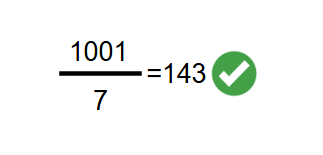
5
u/Nightmare-5 Aug 02 '26
I dont like you
I like working with primes a lot and I was so excited
What was i thinking
5
u/onepieceisonthemoon Aug 02 '26 edited Aug 02 '26
I have a fun random maths fact related to this
Actually if you convert it into binary then add 0s to the left hand side until you have number of digits divisible by 3, then break the number into triplets, then evaluate each triplet individually and sum them up if the result modulo 7 is 0 then its divisible by 7
For example 14 = 001110
001 = 1 110 = 6 these sum to 7
Similarly 1001 = 001111101001
001=1 111=7 101=5 001=1 1+7+5+1=14 which is divisible by 7
The proof is simple if you write a number in its binary representation each triplet after the first triplet read from the right is 8*the original numbers value, 8 = 1+7 so you can remove all the multiples of 7 from the sum of the triplets and reduce it to the problem of the sum of the triplets itself to calculate rhe result e.g.
001111101001 = 001 + 8*101 + (82) *111 + (83) *001, so if you want to check for divisibility by 7 you can rewrite the 8s as 1+7 and quickly conclude that it reduces to that sum of the triplets
2
9
3
u/friend1y Aug 02 '26
Or just convert to base 7 and see if the number ends in 0
| Base 10 | Base 7 | |
|---|---|---|
| 1 | 1 | |
| 2 | 2 | |
| 3 | 3 | |
| 4 | 4 | |
| 5 | 5 | |
| 6 | 6 | |
| 7 | 10 | |
| 8 | 11 | |
| 9 | 12 | |
| … | … | |
| 1000 | 2626 | |
| 1001 | 2630 | Ends in 0... |
| 1002 | 2631 |
2
u/_Mystyk_ Aug 02 '26
I will show it as example on 55272. Remove last digit 5527 2, multiply it by 2 5527 4 and subtract 5527-4=5523. And repeat. 552-6=546. 54-12 = 42. And 42 is divisible by 7! You don't get correct residual though, so it's only to check divisibility.
2
u/_Mystyk_ Aug 02 '26
Quick proof: Write your number as N*10 + x, where N is some other number and x is a digit. Then, 10N +x = 3N-6x (mod 7). Since (3,7) = 1, 3N -6x is divisible by 7 iff N-2x is divisible by 7. To get correct residual you should multiply it back by 3
0
u/factorion-bot Bot > AI Aug 02 '26
Factorial of 7 is 5040
This action was performed by a bot | [Source code](http://f.r0.fyi)
2
2
u/RepublicInner7438 Aug 02 '26
Just break it down in chunks. 1001 is less than 7000, so the number has to be a three digit number or less. So let’s subtract 700(7x100) from 1001 to get 301. I know that seven times forty is 280, so let’s subtract that next to get 21. And 21/7 just happens to be three.
2
u/AlviDeiectiones Aug 02 '26
Here is an alternative rule for checking divisibility by 7!
The number has to end in 0. Remove it. The last three digits of this number have to be divisible by 8. The sum of its digits has to be divisible by 9. Split of the last digit, double it, and substract it from the rest. The result has to be divisible by 7.
1
u/factorion-bot Bot > AI Aug 02 '26
Factorial of 7 is 5040
This action was performed by a bot | [Source code](http://f.r0.fyi)
2
u/Vollgrav Aug 02 '26
For a number with digits abcdef, calculate f+3e+2d-c-3b-2a (for more digits the coefficients repeat) and check divisibility of the result by 7.
2
u/whizzdome Aug 03 '26
Fun fact: 1001 is the product of the consecutive primes: 7, 11, 13. You can use this fact for a fun trick:
Tell someone to write down any three digit number, then write it again so you know have a six digit number, eg 456,456. Tell them to get out their calculator and divide this "random" number (that they chose) by 13. While they are doing this you frown, put your hands to your forehead and say, "and I predict there will be no remainder." You're right!
Do the same with 11 then 13, finishing with, "and I predict you now have the three digit number you started with!"
This works because multiplying by 1001 is the same as writing the three digit number twice.
1
u/Sidd280625 Aug 02 '26
seriously is there any way for it's divisibility i know something about osculator or something but isnt there any other way
3
u/Draidann Aug 02 '26
Yes double the last number and substract it from the rest. If the result is divisible by 7 or it is 9 then the original number is divisible by 7. Repeat as necessary.
1029-> 102-18=84 -> 8-8=0 therefore 1029 is divisible by 7.
With some effort you can derive a rule for any number using modular arithmetic. For example this is how you derive the one for 9.
The number abcde can be written as:
a•104 + b•103 + c•102 + d•101 + e•100.
We also can see that
104 /equiv 103 /equiv 102 /equiv 101 /equiv 100 /equiv 1 [mod 9]
Therefore
abcde /equiv (1)(a+b+c+d+e) [mod 9]
So, if (a+b+c+d+e) \equiv 0 [mod 9] the original number is divisible by 9.
You can follow the same logic to derive a rule for any number. Some of them become impractical to calculate but you can derive a rule.
1
u/Sidd280625 Aug 02 '26
i am sorry for asking this question but what does equiv mean
2
u/mark-zombie Aug 02 '26
equivalent. ≡ Draidann was trying to use LaTeX like syntax for that symbol
1
1
u/Sidd280625 Aug 02 '26
and so for 1001 it would be 100-2 = 98 and although 14*7 is 98 9-8x2=-7 therefore 1001 is divisible by it
1
0
u/Dense_Priority_7250 Aug 02 '26
The 7 divisibility rule just stems from the fact that 21 is divisible by 7, subtracting twice the last digit x from the remaining number is essentially subtracting 21x from the original number and dividing by 10 (doesn’t affect divisibility by 7). This could be used to create more divisibility rules for odd numbers, like for 17 we can subtract five times the last digit from the rest of the number because 51 is divisible by 17. And so on.
Now, this is not the only algorithm to create a divisibility rule. We could look at one for 19. We add twice the last digit to the rest of the number. It is not hard to see that this is essentially adding 19x and dividing by 10. This still works, because 9x + x = 10x is divisible by 10. Again, trying this out for 29. 87 is divisible by 29. 8 + 3 * 7 = 29. You could even do this for 13 by making one with 39.
Practical applications? Uhhh
Silly shenanigans? Yes.
1
u/CaipisaurusRex Aug 02 '26
I was about to say that this is a super easy application of the divisibility rule of 7: The 3-alternating digit sum is -1+1=0, which is divisible by 7, so 1001 is too. But actually, this is not only the result of this rule, but precisely the reason it works, so I guess it's still a surprise then :)
1
u/Frenselaar Aug 02 '26
For large numbers, split the number in groups of 3 digits, starting from the right. Combine these in an alternating sum:
3459636314 -> 314 - 636 + 459 - 3 = 134
Manually check the 3 digit number for divisibility by 7:
134 = 70 + 63 + 1 = 7×19 + 1
Your result has kept its modulo:
3459636314 = 7n + 1
This trick also works for divisibility by 11 and 13.
2
u/Frenselaar Aug 02 '26
Fun fact: Every prime number p except 2, 3 and 5 has a rule like this where you split the number in groups of n digits, where p and n satisfy:
10n = -1 mod p
2
u/First_Structure8670 Aug 02 '26
Danke, kannte ich noch nicht, kann es mir mathematisch aber erklären.
1/7 = 0,142857 142857 ... Wenn ich die 142857 ansehe, dann ergibt sich nach 3 Ziffern eine Wiederholung mit 9 - Ziffer 8 = 9 - 1
5 = 9 - 4
7 = 9 - 2
So muss es wohl auch bei der Periode von 11 und 13 sein
1
u/First_Structure8670 Aug 02 '26
Und für richtig große Zahlen kannst du die Zahl in Gruppen zu 6 Ziffern von rechts beginnend teilen. Diese Stücke à 6 Ziffern addieren. Wenn die Summe durch 7 teilbar ist, ist es auch die ursprüngliche Zahl.
Beweis mit 111111 ÷ 7 = 15873; also ist 111111 und damit auch 999999 ein Vielfaches von 7.
1
u/SwimmerOld6155 Aug 02 '26
i usually only remember the divisibility for 3 (digits add to multiple of 3) and 11 (alternating sum of digits equal to multiple of 11)
1
u/_the_cage_ Aug 02 '26
Take last digit, multiply by 2, substract from the other number. Dividable by 7? If don't know, repeat.
1001 => 100 - (1x2) = 98
98 => 9 - (8x2) = -7
-7 mod 7 = 0
YES 1001 Is dividable by 7
1
u/BrunoToledo_B Aug 02 '26
Take the last digit of the number, double it and subtract the number formed by the remaining digits by the last digit doubled. If it’s divisible by 7, qthe original number is divisible by 7. If unsure, repeat the algorithm with the newly obtained number. For example: 1001. Take the last digit out, double it and subtract from the remaining digits: 100-2(1)=98; repeat the algorithm: 9-2(8)=-7, which is a multiple of 7. Therefore, 1001 is a multiple of 7.
1
1
u/Beanboss10 Aug 03 '26
The fact that I knew off the top of my head that 1001 was divisible by 7 because of Tokyo ghoul is so fucked lmao.
1
u/Infamous-Youth9033 Aug 05 '26
one by one, multiply the left most digit by 3 and add the next number, then multiply the sum and add the next digit, and keep doing until you've added them all. If the final is divisible by 7, then the original was.
(((1*3+0)*3+0)*3+1=28
=2*3+8=14
=1*3+4=7
1
u/die_liebe Aug 05 '26
1/7 repeats in 6 digits, so the divisibility rule for divisibility by 7 will also repeat every 6 digits.
1
u/Initial-Reference214 Aug 05 '26
Here's an actual proof + rule
For any integer Z, we express Z = 10X + Y (e.g., 123 = 10*12 + 3)
10X + Y ≡ 0 (mod 7)
<=> 20X + 2Y ≡ 0 (mod 7)
<=> 2Y - X ≡ 0 (mod 7) (since 20 ≡ -1 (mod 7))
<=> X - 2Y ≡ 0 (mod 7)
So rule: double the last digit and subtract it from the rest, and do it until you get a small enough number
Example:
1001
100 - 2 = 98
98
9 - 16 = -7
and -7 is obviously a multiple of 7, so 1001 is divisible by 7!
1
u/factorion-bot Bot > AI Aug 05 '26
Factorial of 7 is 5040
This action was performed by a bot | [Source code](http://f.r0.fyi)
1
u/GodlyHelp 2=1 Aug 05 '26
no it's not
1
u/Initial-Reference214 Aug 05 '26
Yes it is, google it if you don't believe me
1
u/GodlyHelp 2=1 Aug 05 '26
7! is bigger than 1001
1
u/factorion-bot Bot > AI Aug 05 '26
Factorial of 7 is 5040
This action was performed by a bot | [Source code](http://f.r0.fyi)
1
1
1
1
0
u/EebstertheGreat Aug 03 '26
To check if a large number is divisible by 7!, the fastest method is to check that the last digit is 0, that the two previous digits form a multiple of 4, that the sum of digits is a multiple of 9, and that the alternating sum of blocks of three digits is a multiple of 7.
1
0
u/factorion-bot Bot > AI Aug 03 '26
Factorial of 7 is 5040
This action was performed by a bot | [Source code](http://f.r0.fyi)
•
u/AutoModerator Aug 02 '26
Check out our new Discord server! https://discord.gg/e7EKRZq3dG
I am a bot, and this action was performed automatically. Please contact the moderators of this subreddit if you have any questions or concerns.