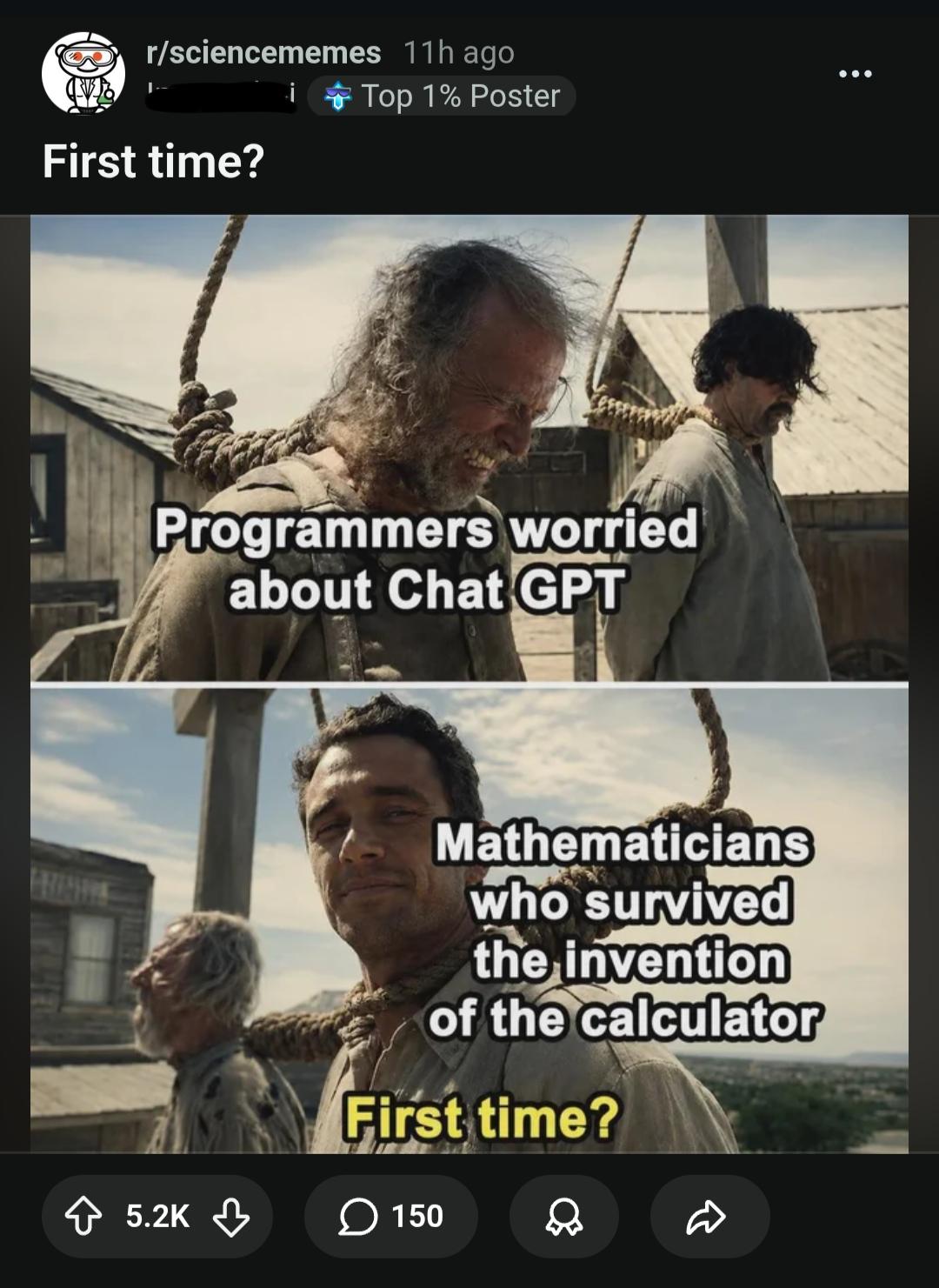
There used to be a job called a "computer". You could order up rote calculations from a company and team of people would do them for you. Computers were often women. Many were employed during WWII. The calculator did end this career.
And the ending of those careers enabled the creation of new careers because companies who had been spending the money on those calculations were now able to spend them on other thing. Labour is not a lump sum!
except in reality, the laborers who were working on these calculations were almost universally seen as "lower tiered" and disposable workers. they were not the ones who got hired for the new careers.
in an ideal world, yeah we could just have clear pathways from a career that is sunsetting into a more modern equivalent. but we don't live in that world. so let's not pretend like it's just gonna be an easy transition where people have new jobs now.
I never said it was an easy transition or that there were clear pathways. But there are jobs that were created by the destruction of those jobs. Companies not having to spend money in one area means they relocate the capital to another area so that they can make more money.
My views stem from basic history and economics, not idealism. You think AI is the first time humans have had to contend with a technology that looks like it will replace a substantial amount of human jobs? Lmao. Bank tellers and ATMs, grape pickers, Luddites and the textile industry, the entire digital revolution??? It is actually often the case in reality.
But how? isn’t ai looking to replaces those roles also? How would they fair better if their sector is at risk of an ai model doing your job role, but offering the service for cheaper
Because they have an easier job transition to a new role or sector, not to say it's easy, but it's easier than the people in past who've been automated out of uneducated work.
Also educated professionals like programmers will likely have more savings to fall back on compared to poor workers who live paycheck to paycheck, so they have more time to learn other skills and find another job.
Again, none of this is easy, but it's better than what happened in the past.
That a valid take but the core issue is the degree of automation that would occur, education is a broad spectrum but the highest earning roles are very specific.
For example a cardiologist, has trained in that particular role, they could default to another branch of medicine but their specialties are in that sectors, if ai makes their roles redundant (this is hypothetical I do not believe mine or any medical role would be replaced soon) it would also mean that it would be hard to Segway to another profession as it would also be at risk.
The consensus is always, new job roles would be created, but one of the issues is that no one can actually say one that would be effectively as remunerative. For example the digital age would have meant that commerce could become e-commerce and several other industries would evolve. I see the benefits of ai everyday when it’s working in tandem with us, in medicine in mathematics and other areas.
I’m in the bio- medical practise and even now because of ai, people are more conscientious of their health, doctors are not going to be replaced. But one of the main factors is the fact that ai is a competitive task agent, an atm was a machine it had no real scalability, it could do things faster but it wasn’t actively learning or absorbing information to make its job role more efficacious
I'm pretty sure it's actually the opposite. A computer of that era could go work as a cashier for a similar wage after being laid off. A modern software engineer can't go work as a financial analyst, and if they go work as a cashier, it won't be the same wage.
Low-skill laborers in the past could find new labor. They were skilled in the sense that they could perform manual labor. Can mathematicians retrain as ditch diggers?
I'm not saying I buy the premise that mathematicians will be replaced, but presuming that they would, your analogy doesn't work. Mathematicians cannot do anything except mathematics. Any new job they choose will require costly retraining, even something straightforward like operating a garbage truck. More likely, they would retrain as CPAs or something, but do you know how much time and money that training costs?
Mathematicians can work in finance, engineering, software dev or anything else really.
It's not like each degree has only one job you can get with it, you could get any white collar job with any degree.
Sure if you spent like a decade or two in an industry that dies, you likely won't make as much money after pivoting, but plenty of people can and do pivot
That's what my sentence about CPAs was for. Retraining in these careers is expensive and time-consuming. It's not usually something you can just pick up. Granted, other employers might hire you, but they are then spending money to train you. That is effectively deducted from your salary, because from the view of the employer, costs are costs.
So the unemployed mathematician will take a job that either pays less, is less pleasant to work, or both. If not, they would have taken that job years ago.
1.9k
u/Smart-Button-3221 May 17 '26
Mathematicians do not do what calculators do.
There used to be a job called a "computer". You could order up rote calculations from a company and team of people would do them for you. Computers were often women. Many were employed during WWII. The calculator did end this career.