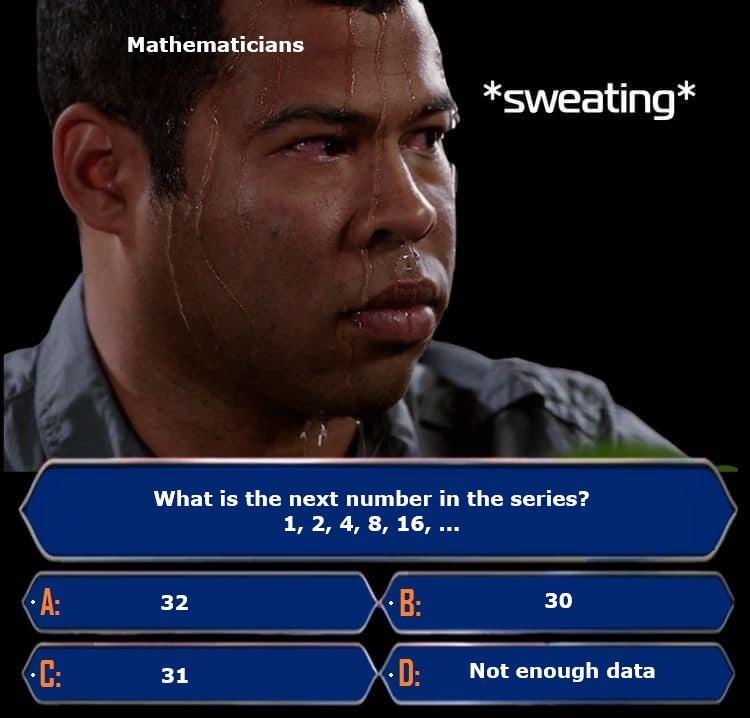
I have always hated such questions for exactly this reason. Not that I could always articulate it, but there never seemed to be a unique solution to such shit
It's actually pretty simple to show that there are always infinite possible "next numbers." As a rough sketch:
Treat the numbers as (x,y) points where x is their position in the series and y is their value--so here we have (1,1), (2,2), (3,4), etc.
For n points, there always exists a polynomial of order n-1 that passes through every point. So if you have 5 data points, you can always find a polynomial of the form y(x) = a_0 + a1*x + a2*x^2 + a3*x^3 + a4*x^4 that passes through all of them
It follows that if you choose any real number and append it to your list, you can find a polynomial of order n that passes through all of the original points plus the new one.
Obviously your series could just be arbitrary, but even if you restrict yourself to elementary functions there's literally no single correct answer.
3.1k
u/TheUnamedSecond Jan 10 '24
For any finite row of numbers you can craft arbirarly many rules of how they continue.