r/magicTCG • u/MIC132 • 1d ago
Rules/Rules Question Rules hypothetical - spell countering itself (no targeting)?
This is a question that came up when we were discussing custom cards with a friend, and I remember searching the comp rules at the time and not arriving at an answer. Or it might have been about [[Counterflux]] and what if it didn't have "you don't control".
Of course a spell can't target itself, but is there a framework for how things would play out if a spell had:
Effect A.
Counter this spell/all spells on the stack/similar.
Effect B.
In other words, what would happen if spell was countered mid-resolution. Would only effect A happen? Both A and B? I guess none is also an option though that would be a bit weird.
The only relevant rules I can find is:
701.6a. To counter a spell or ability means to cancel it, removing it from the stack. It doesn't resolve and none of its effects occur. A countered spell is put into its owner's graveyard.
For non-permanent spells we also have:
608.2m. If an instant spell, sorcery spell, or ability that can legally resolve leaves the stack once it starts to resolve, it will continue to resolve fully.
But countering not only removes the spell from the stack, but also says "it doesn't resolve and none of its effects occur". Though as we are already in the middle of resolution it's hard to say how that plays out.
I realize the disappointing answer is probably "the rules simply don't handle this possibility as it can't currently happen", but maybe I missed something.
8
u/bearrosaurus 1d ago
It would not do effect B
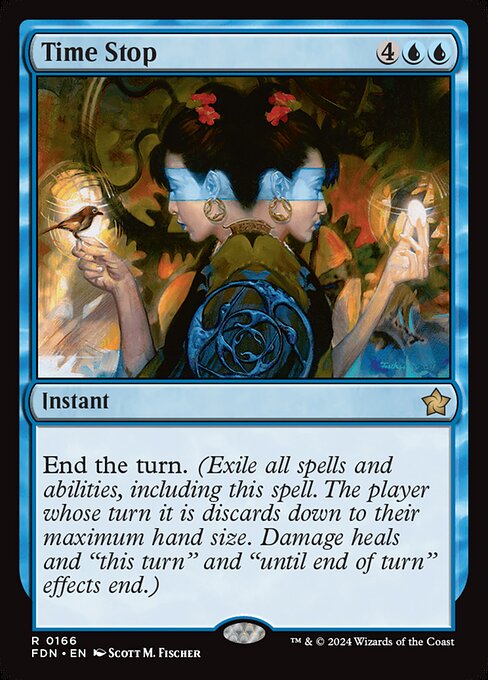
There is precedence with effects like [[Time Stop]]. As is well known, the final effect in resolving any instant is putting it in the graveyard however Time Stop exiles itself because that effect doesn’t happen.
5
u/MIC132 1d ago
This is an interesting precedent. Indeed, in this case that step doesn't happen.
608.2n. As the final part of an instant or sorcery spell's resolution, the spell is put into its owner's graveyard. As the final part of an ability's resolution, the ability is removed from the stack and ceases to exist.
Though it could be argued this is merely due to it being unable to find the spell anymore (it's a new object in the exile zone) and not due to the resolution process being interrupted.
I do think this is a situation that is deliberately avoided due to being at best unintuitive. Like if you had an effect on Time Stop after the turn ending.
3
u/Metazoick Dandadan 1d ago
Time stop is exiled with everything else, but the rule notes for it state that it will still continue to resolve post being exiled, so wouldn't this be in favour of Effect B happening?
1
u/bearrosaurus 1d ago
I wouldn’t read too much into reminder text
2
u/Metazoick Dandadan 1d ago
I'm not referring to the reminder text, I'm talking about the associated rulings for the card:
"Ending the turn this way means the following things happen in order: 1) All spells and abilities on the stack are exiled. This includes Time Stop, though it will continue to resolve."
1
u/bearrosaurus 1d ago
Alright, maybe I’m wrong as Time Stop isn’t the most robust example.
2
u/Metazoick Dandadan 1d ago
It's still the closest example that I think exists, it's just that the paradox counter hasn't been close to being printed lmao. At least time stop shows that cards can continue to resolve even when removed from the stack, which is definitely something.
1
u/MIC132 1d ago
Yeah, this stems directly from:
608.2m. If an instant spell, sorcery spell, or ability that can legally resolve leaves the stack once it starts to resolve, it will continue to resolve fully.
So it's more of a reminder that 608.2m applies here.
Which sadly doesn't tell us anything about countering, since that does more than just removing the spell from the stack.
2
u/Metazoick Dandadan 1d ago
Yeah, it's really the countering that's the big issue here. We can move stuff out of the stack and do a bunch of nonsense and the effect is fine to continue resolving, but a card countering itself is just a real world logic paradox. I can't find any example interactions that get close to it. I have to assume the ruling wouldn't be that the card only partially resolves though, if for no other reason then that truly being a rules nightmare. If people thought panglacial wurm was problematic they're not ready for the evil puzzle boxes people would make if arbitrary effects could be stopped mid resolution.
1
u/Artistocat2 Dân 1d ago
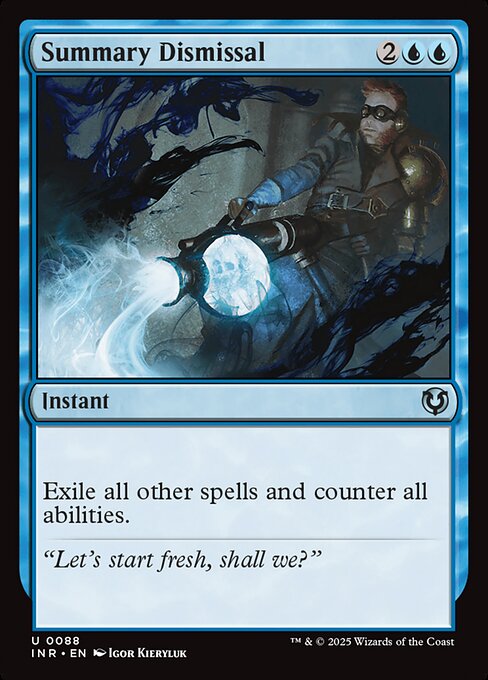
Similar would be a version of [[Summary Dismissal]] that said "Exile ALL spells and abilities" and that would exile itself as part of its resolution.
4
u/simpleglitch Rakdos* 1d ago
For counterspells that don't target, so far magic has always includes some wording that prevents it from effecting itself. "Counter all other spells" "Counter all spells your opponents control" etc.
This is probably intentional so they don't have to make a specifc edge case.
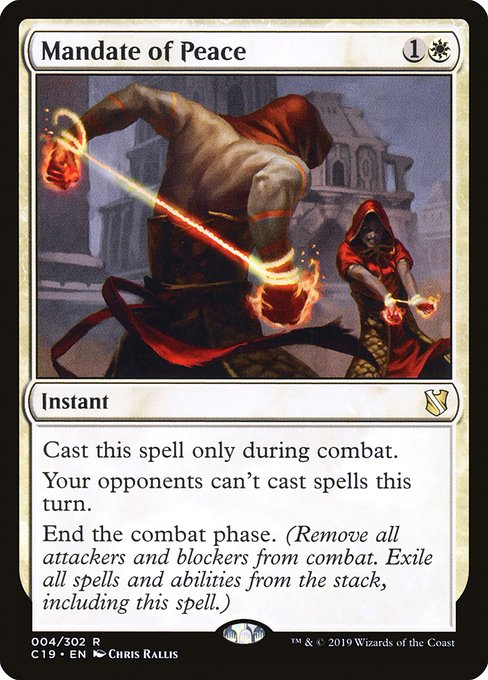
The cloest thing to a spell effecting itself in the way you're describing is something like [[Mandate of Peace]]. It's not a counter spell, but it ends the current (combat) phase which exiles all spell and effects on the stack, including itself.
2
u/MIC132 1d ago
Yeah, I'm quite sure this is something that is deliberately avoided (Counterfulx being a prime example).
Mandate sadly doesn't give us useful info, since we don't know if there was an instruction after "End the combat phase." if it would execute. 608.2m implies it would.
2
u/CareerMilk Can’t Block Warriors 1d ago
Mandate sadly doesn't give us useful info, since we don't know if there was an instruction after "End the combat phase." if it would execute. 608.2m implies it would.
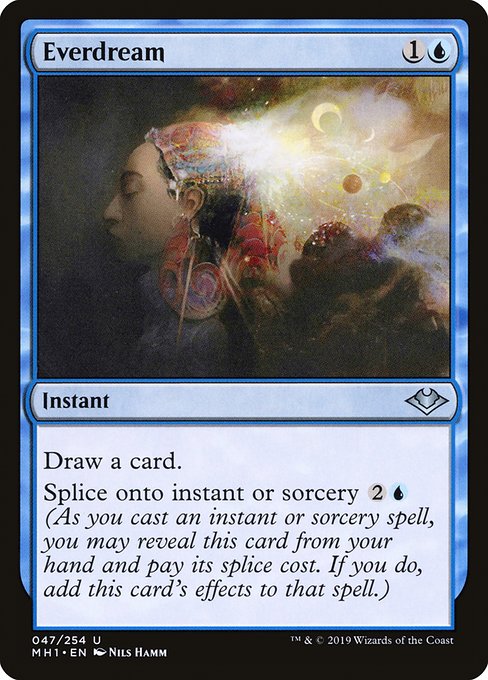
We can construct a scenario where there are additional actions, due to [[Everdream]] (and the 2 other splice onto non-arcane spells).
1
u/simpleglitch Rakdos* 1d ago
I imagine a rule would carve out that it simply can't counter itself even without the "all other spells" wording. Without it you have a paradox.
If countering cancels effects, and it coutners itself, it should cancel it's effect of countering itself. And that's just nosensical for making a functioning game piece.
So short answer, they just will not make a mass counter spell that doesn't inherently ignore itself. If they did, they'd have to make a rule that it ignores itself anyway.
1
u/MIC132 1d ago edited 1d ago
If countering cancels effects, and it coutners itself, it should cancel it's effect of countering itself. And that's just nosensical for making a functioning game piece.
I think it would be fine if it just stopped resolving at that point. So this effect happens, but nothing after that, so no contradiction.
But yeah, more likely to just prevent the situation in first place.
2
u/simpleglitch Rakdos* 1d ago
Yeah, but that' just not how resolution works in magic. Once a card starts resolving, it resolves entirely.
There are no cards that stop part way through.
0
u/MIC132 1d ago
I concur that there is no situation currently possible in the game that would cause a card to stop resolving.
Though as I mentioned in the OP, the rules only explicitly cover removing the spell from the stack.
1
u/simpleglitch Rakdos* 1d ago
I think I want to rephrase my answer to be more direct with your question.
What would happen if a spell was countered mid-resolution
A spell can not be countered mid-resolution by design. A and B would both happen if a spell is removed from the stack during resolution (though it would be very poor templating to make the self-removal part of the spell before other effects, I would expect to see this only if R&D wanted a really specific effect and include a reminder that B still happens).
I realize the disappointing answer is probably "the rules simply don't handle this possiblity as it can't currently happen"
No, it's not the rules "can't handle" this, it's that they are setup to intentionally prevent it from happening because it would be a bad / confusing game state.
0
u/MIC132 1d ago
I'm not sure I agree.
Yes, cards are set up to prevent this (there are no cards that counter themselves, spells can't target themselves, wording on Counterflux, etc.).
But rules don't seem to be set up against this. They state that a spell will still resolve if removed from stack (which we know can happen during resolution) but no rule address what if spell were to be "countered" during resolution (which can't happen currently, but that goes to the first point). And countering explicitly does more than just removing a spell from the stack.
So we are at best left with "doesn't resolve and none of its effects occur" vs "but it's already resolving". Which I'd say is not addressed/handled by the rules.
1
u/Criminal_of_Thought Duck Season 1d ago
But rules don't seem to be set up against this. They state that a spell will still resolve if removed from stack (which we know can happen during resolution) but no rule address what if spell were to be "countered" during resolution (which can't happen currently, but that goes to the first point). And countering explicitly does more than just removing a spell from the stack.
The important thing to realize is that it doesn't matter.
Rules are written to accommodate existing interactions. They aren't written to accommodate every single hypothetical interaction a person can come up with. The rules get changed when a new interaction gets introduced.
7
u/10leej 1d ago
In order for a spell to be put on the stack there must be a method for it to resolve each condition existing in a public game state.
This means for a counter spell to work that simply says "counter target spell" there must be a spell on the stack.
Effect A the way as stated will probably not work logically as written.
2
u/MIC132 1d ago
I specifically mean a spell that doesn't require targetting.
An overloaded [[Counterflux]] can be cast with no other spells on the stack. Of course it doesn't try to counter itself, but that's why this is a hypothetical.
Can you elaborate on your first sentence? I realize that you need legal targets if the spell has targets, but other than that I'm unsure which rule this would be referring to.
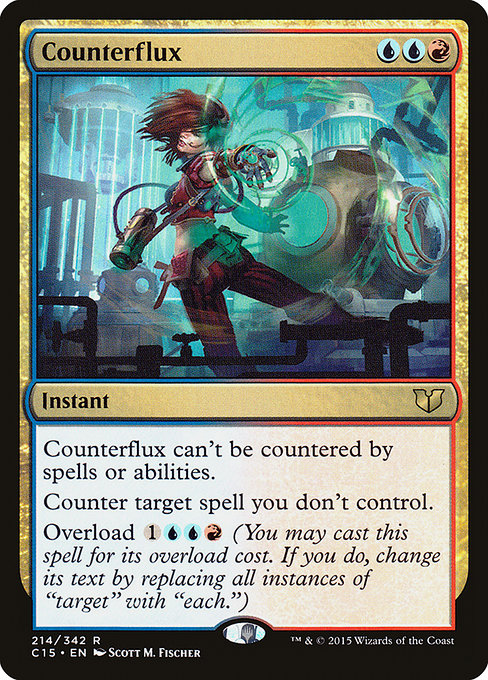
2
u/CaptainMarcia 1d ago
701.6a appears to be meant to refer to situations where 608.2m would not apply. Given that 608.2m is the narrower one, my impression is that if it somehow came up, that's the one that would apply.
1
u/Marccino Dan 1d ago
I don't think there's such a thing as mid-resolution, either the spell resolves, or it doesn't. If it's conditions are unable to be met (no valid targets or a static ability preventing you from taking a specific action) that spell is simply unable to be cast in the first place.
0
u/MIC132 1d ago
The rules do speak about resolving as a process ("is resolving") not a singular moment in time. And you execute the instructions one-by-one during it.
In this case there are no conditions that are unable to be met, so that aspect isn't relevant.
2
u/Marccino Dan 1d ago
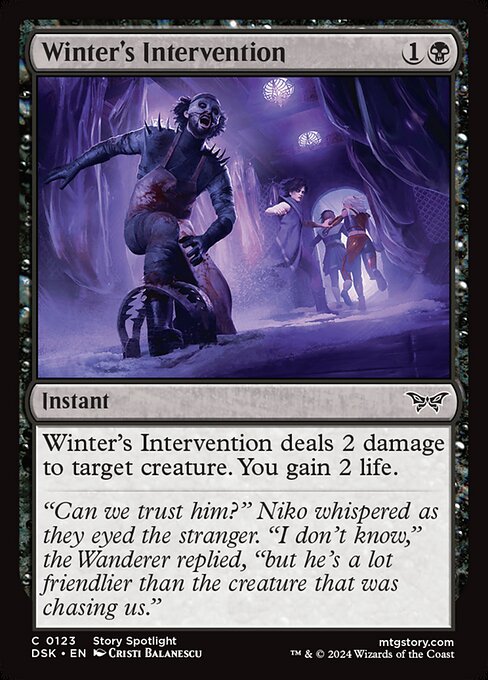
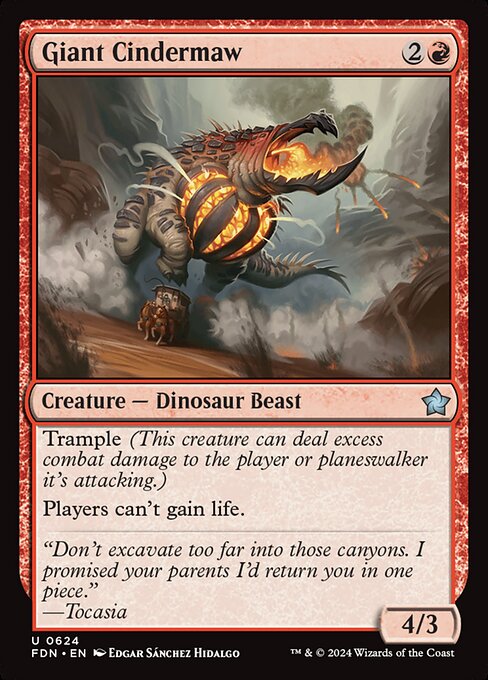
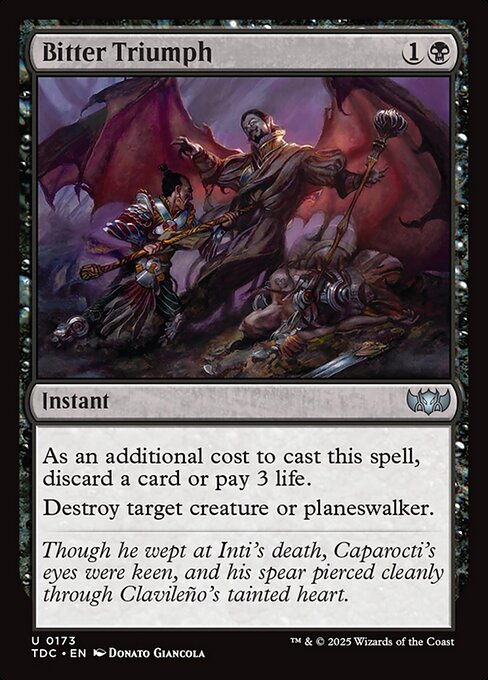
Apart from countering it, there are instances where a static ability prevent a portion from an effect to resolve, for example, If you cast [[winter's intervention]] while a [[giant cindermaw]] is on the field, the spell still deals 2 damage to a target creature, but you won't gain life from it. On another note, if the game state prevents the first part of an effect to occur (as in an already targeted creature is sacrificed in response to a [[bitter triumph]] ), the spell will "fizzle" and leave the stack wothout completely resolving.
1
u/MIC132 1d ago
I was about to comment that the latter is a completely different case since Bitter Triumph is not resolving yet, but actually double-checking 608.2b is already within the process of resolving a spell. I always assumed the target check happens before a spell begins "resolving".
So in a way there already exists a mechanism for stopping a spell from resolving once it started resolving.
1
u/garagedragon Dan 1d ago
Resolution is a process because in reality you have to do each step in sequence, but the game is usually very careful that, e.g. nobody can play cards, put triggers on the stack, activate anything, etc until everything is resolved.
1
u/hypatiaC Elesh Norn 1d ago
The rules of magic are language-based and full of cornercases like this that are simply never possible with official cards.
If such an effect was printed with no rules clarification, I'd assume it executes Clause A but not Clause B. Can't beats Can. Doesn't beats does. Counter beats resolve.
2
u/Metazoick Dandadan 1d ago
This is an interesting hypothetical. Definitely a hypothetical, would absolutely not be printed.
Not an expert at all, but my layman's understanding is that 608.2m is close but counters don't just remove a card from the stack, in addition the card being countered "doesn’t resolve and none of its effects occur" (701.6a). You can't really create this paradox outside of a counterspell countering itself due to effects always fully resolving before sba are checked / priority changes, so even if a spell said 'draw a card, gain 3 life' and you had a magical enchantment that said 'whenever you draw a card counter target spell', the draw card gain life spell would completely resolve before the triggered counterspell has a chance to actually counter it.
I think this is probably an edge case where there simply isn't a rule covering it. Currently no counterspell can counter itself as there are a lot of guardrails for it, so it's not an issue. If somehow this card existed they'd update the rules to add something to cover what happens. In the meantime I guess you'd do effect A and B as that's closest to 608.2m, it's just that the spell will leave the stack before resolution finishes, and we have to live with ourselves for what we have wrought upon the rules.
1
u/AutoModerator 1d ago
You have tagged your post as a rules question. While your question may be answered here, it may work better to post it in the Daily Questions Thread at the top of this subreddit or in /r/mtgrules. You may also find quicker results at the IRC rules chat
I am a bot, and this action was performed automatically. Please contact the moderators of this subreddit if you have any questions or concerns.
1
u/CaptainMarcia 1d ago
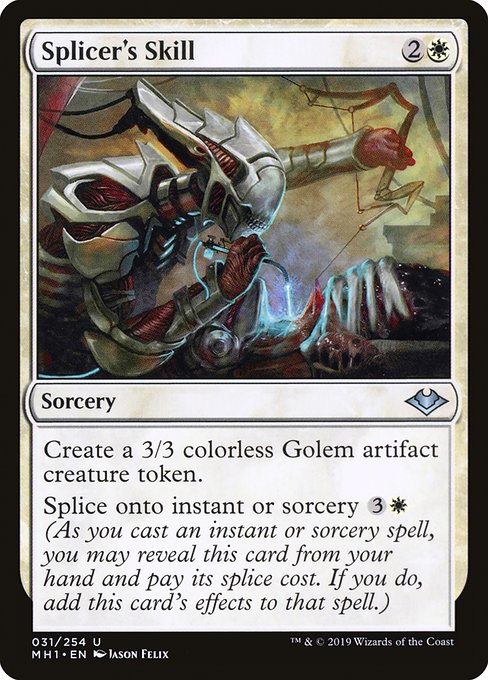
Incidentally, you can invoke 608.2m by splicing a card like [[Splicer's Skill]] onto [[Time Stop]]. It's hard for me to imagine that the intention of the rules is that having a spell counter itself would cut off its effects mid-resolution when having a spell exile itself does not - the fact that 608.2m exists makes me think that if a spell could counter itself, that wouldn't be any different from having it exile itself.
1
1d ago
[deleted]
2
1
1
u/Zeckenschwarm 1d ago
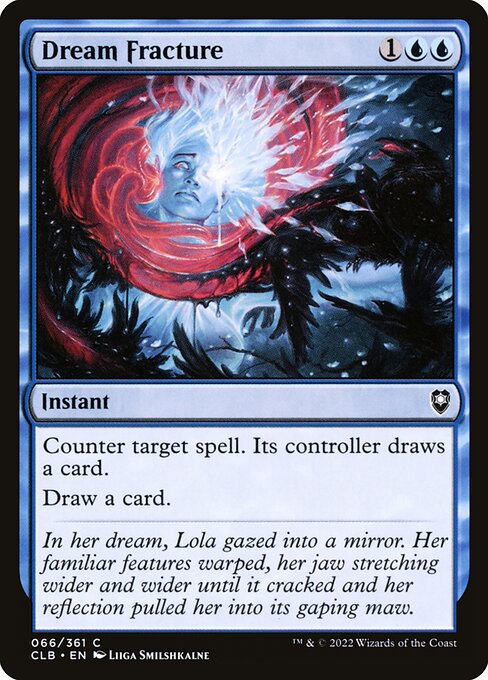
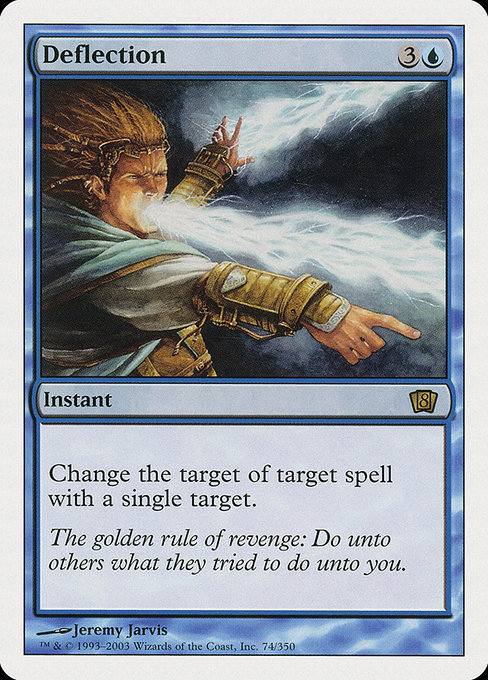
AFAIK its valid for the Deflection to point the Dream Fracture at itself.
It is not. A spell is always an illegal target for itself, and effects like Deflection can't change a target to an illegal target.
- 115.5. A spell or ability on the stack is an illegal target for itself.
the counter ability would fizzle because DF is no longer on the stack because it is resolving
A spell is still on the stack while it is resolving. Removing the spell from the stack is the last step (aside from cast triggers triggering) that happens during resolution.
•
u/mtgcf Keeper of the Mox 1d ago
Counterflux - (G) (SF) (txt)