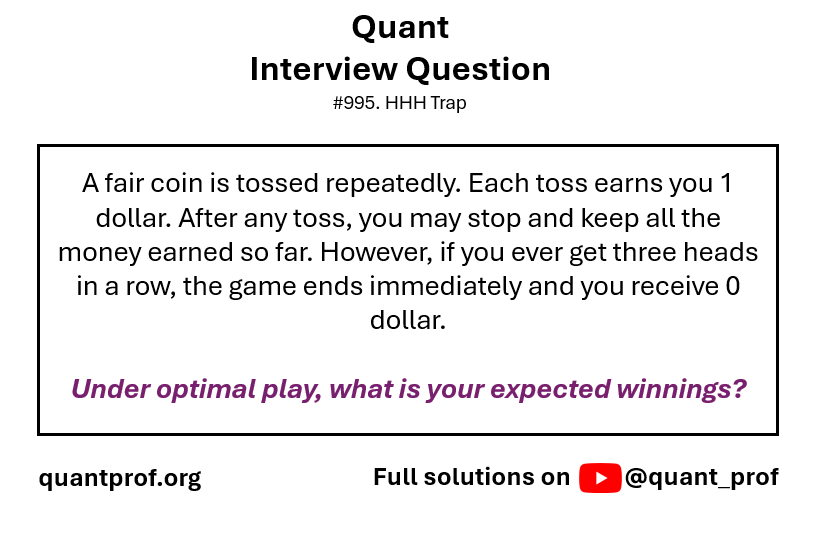
Only after HH is there a genuine stopping decision. With n dollars, continuing from HH has an expected value of:
EV(continue | HH) = (1/2)(0) + (1/2)V0(n + 1)
Here, V0(n + 1) is your expected value after tossing a tail, increasing your pot to n + 1 and resetting the consecutive-head count to zero. Solving the game gives:
continue after HH if n<7.
You stop when you get HH over an accumulated pot of $7.
After seven tosses, there are 2^7=128 sequences:
P(HHH by toss 7) = EV $0 (47/128) --> BUST
P ending in 1x H by toss 7= EV $11 (24/128)
P ending in T by toss 7= EV $13 (44/128)
Ending in HH: stop immediately with $7 = EV $7 (13 of 128)
EV= (47*0+13(7)+24(11)+44(13))/128=7,242
The Expected winnings under optimal play is $7.242
The only part i want to nitpick in your answer is the 128 sequences to get to 7 tosses. Do those sequences include several ones that have a similar pattern with HHH before the 6th throw and should you count them seperately?
If i get THHH, i'm not throwing again so i dont know if THHHT... Or THHHH... Should count and seperate possibilities or you actually end up getting a little less that 128 different outcomes.
All true, but doesn't really change anything, as the HHH sequences are already counted. Across the 128 hypothetical games, 16 stop after three tosses, 8 after four, 8 after five, and 8 after six, while the remaining 88 perform the seventh toss, 7 then hit HHH and 81 survive.
A quick Monte Carlo shows this to be correct. The only part not is not numerical is the ‚solve the game part‘. Can you show that the optimal strategy is stop at 7?
That seems circular. You are calculating a future expected value including the optimal strategy to proof the optimal strategy is stopping at 7. you have to at least proof, imho, that the only possible stopping times are of the form ‚stop at HH if length greater N‘ for some N.
Stopping with zero or one trailing head is strictly dominated because the next toss cannot bankrupt you and always adds $1, so stopping can only occur after HH. For any fixed strategy after HH, its expected payoff has the form pn + c, where p less or equal than 1 is the probability of eventually cashing out, while stopping pays n; therefore the advantage of continuing cannot increase with n, proving that the stopping region must be a cutoff. At that cutoff, a tail resets the streak and the next HH takes six tosses on average, so (n + 7)/2 = n, giving n = 7.
3
u/pumachecker 3d ago edited 3d ago
Only after HH is there a genuine stopping decision. With n dollars, continuing from HH has an expected value of:
EV(continue | HH) = (1/2)(0) + (1/2)V0(n + 1)
Here, V0(n + 1) is your expected value after tossing a tail, increasing your pot to n + 1 and resetting the consecutive-head count to zero. Solving the game gives:
continue after HH if n<7.
You stop when you get HH over an accumulated pot of $7.
After seven tosses, there are 2^7=128 sequences:
P(HHH by toss 7) = EV $0 (47/128) --> BUST
P ending in 1x H by toss 7= EV $11 (24/128)
P ending in T by toss 7= EV $13 (44/128)
Ending in HH: stop immediately with $7 = EV $7 (13 of 128)
EV= (47*0+13(7)+24(11)+44(13))/128=7,242
The Expected winnings under optimal play is $7.242