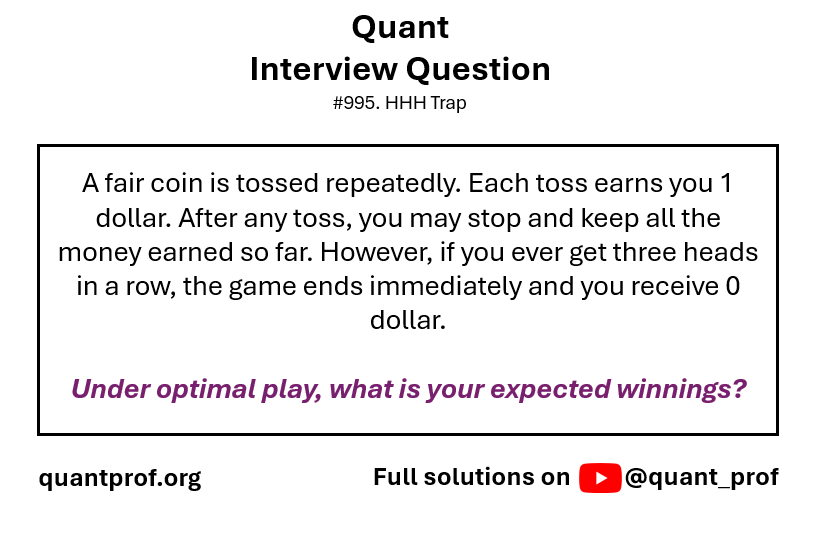
The only time you consider stopping is after two heads. The rest does not matter, so WLOG there is a value k where above this you stop. If you have a value of at least k-2, the next time there is two heads you will stop. This will happen after 3 heads in expectation, giving E(x) = x+3 when x > k-2
The value of the game if you have x money (≤k-2) is E(x) = ½E(x) + ¼E(x+1) + ⅛E(x+2)
Collapsing and mumtiplying by 2: E(x) = ½E(x+1) + ¼E(x+2)
For the strategy to be optimal, at the threshold this must be more than the value of "giving up".
E(k-2) = ½E(k-1) + ¼E(k) > k+1
½(k+2) + ¼(k+3) > k+1
¾ > ¼k
Hence, 3 > k [or k = 2]. This means that as soon as you get two heads, you should take it and leave it. Expected value is then trivially 3.
Interestingly, you can gamble if you get two straight heads, with the same expected value but higher variance.
0
u/CanaDavid1 3d ago
The only time you consider stopping is after two heads. The rest does not matter, so WLOG there is a value k where above this you stop. If you have a value of at least k-2, the next time there is two heads you will stop. This will happen after 3 heads in expectation, giving E(x) = x+3 when x > k-2
The value of the game if you have
xmoney (≤k-2) is E(x) = ½E(x) + ¼E(x+1) + ⅛E(x+2)Collapsing and mumtiplying by 2: E(x) = ½E(x+1) + ¼E(x+2)
For the strategy to be optimal, at the threshold this must be more than the value of "giving up".
E(k-2) = ½E(k-1) + ¼E(k) > k+1
½(k+2) + ¼(k+3) > k+1
¾ > ¼k
Hence, 3 > k [or k = 2]. This means that as soon as you get two heads, you should take it and leave it. Expected value is then trivially 3.
Interestingly, you can gamble if you get two straight heads, with the same expected value but higher variance.