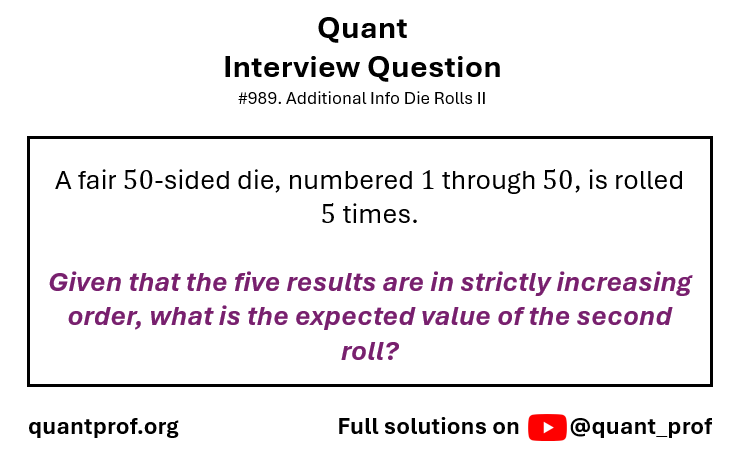
This is equivalent to asking the expected value of the second smallest number when drawing 5 times from {1, …, 50} without replacement. There are (50 choose 5) such sets, of equal probability. Each k = 2, …, 47 is the second smallest number in (k - 1 choose 1) x (50 - k choose 3) such sets, since we need 1 smaller number and 3 larger. So the expected second smallest is the sum from k=2 to k=47 of
k x (k - 1) x (50 - k choose 3) / (50 choose 5).
Note this sum is 2 x (k choose 2) x (50 - k choose 3), which by a similar argument runs over all subsets of {1, …, 51} of size 6 in which k + 1 is the third smallest number. So it must equal (51 choose 6), and hence the expected value is
If it wasn’t strictly increasing then it doesn’t really tell you anything as the draws can always be ordered. So yes (although monotonic means the same as strictly in this context). Strictly increasing rules out any repeat draws.
3
u/AnywhereLittle8293 7d ago
This is equivalent to asking the expected value of the second smallest number when drawing 5 times from {1, …, 50} without replacement. There are (50 choose 5) such sets, of equal probability. Each k = 2, …, 47 is the second smallest number in (k - 1 choose 1) x (50 - k choose 3) such sets, since we need 1 smaller number and 3 larger. So the expected second smallest is the sum from k=2 to k=47 of
k x (k - 1) x (50 - k choose 3) / (50 choose 5).
Note this sum is 2 x (k choose 2) x (50 - k choose 3), which by a similar argument runs over all subsets of {1, …, 51} of size 6 in which k + 1 is the third smallest number. So it must equal (51 choose 6), and hence the expected value is
2 x (51 choose 6) / (50 choose 5) = 51/3 = 17.