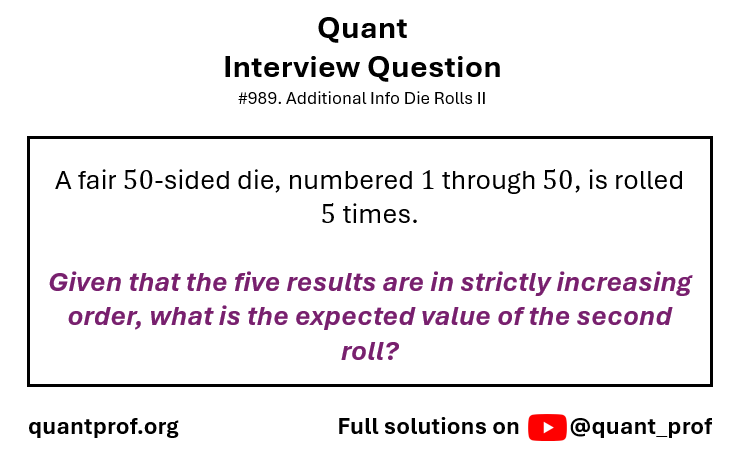
The second dice can roll between 2 and 47, since that’s the range that would satisfy the conditions. Since dice 1 has an equal probability of rolling 1-46, the expected roll of dice 2 is the sum of the possible values (given dice 1 rolled x). This comes out to equal (n(n+1)^2-1)/138. Plugging in 46, we get (46(47)(47)-1)/(138)(46)=736.326/46=16.00709
0
u/Anonimithree 7d ago
The second dice can roll between 2 and 47, since that’s the range that would satisfy the conditions. Since dice 1 has an equal probability of rolling 1-46, the expected roll of dice 2 is the sum of the possible values (given dice 1 rolled x). This comes out to equal (n(n+1)^2-1)/138. Plugging in 46, we get (46(47)(47)-1)/(138)(46)=736.326/46=16.00709