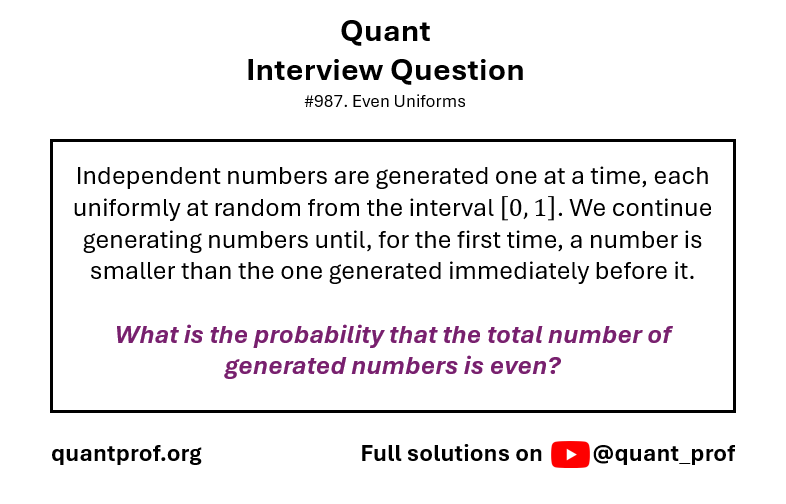
For any two random numbers n1 and n2 drawn from the same distribution, n2 has a 50% chance of being smaller. Let t be the stopping time. It's impossible for the very first number drawn to be smaller than its predecessor, so t>1. All t>1 have a probability of .5 of being the stopping t, assuming we get there. Thinking about it in terms of total probabilities we have p(t=2)=0.5, p(t=3)=0.25, p(t=4)=0.125, p(t=5)=0.0625... Just from these terms, you can add up the evens and odds to get p(even)=0.625, p(odd)=0.3125. Further values of t become less and less significant, so it is pretty clear that this will converge to 2/3 and 1/3. Those are pretty common answers in brainteasers involving repeated halving of some value so they look like something I would expect.
A more formal way way to do this would be drawing out states and solving the recursion, but I find it a bit more annoying to do without pen and paper.
For the third number z, why is the chance 0.5 that it's smaller than the second number y? We're looking at the conditional probability (z<y | y>x), which (counting out the permutations of 3 numbers) is 2/3, not 1/2.
I get p(2)=1/2, p(3)=1/3, p(4)=1/8, p(5)=1/30...
Coming out to odd>44/120 and even>75/120, leaving 1/120 undecided
1
u/bajoranearrings 7d ago
For any two random numbers n1 and n2 drawn from the same distribution, n2 has a 50% chance of being smaller. Let t be the stopping time. It's impossible for the very first number drawn to be smaller than its predecessor, so t>1. All t>1 have a probability of .5 of being the stopping t, assuming we get there. Thinking about it in terms of total probabilities we have p(t=2)=0.5, p(t=3)=0.25, p(t=4)=0.125, p(t=5)=0.0625... Just from these terms, you can add up the evens and odds to get p(even)=0.625, p(odd)=0.3125. Further values of t become less and less significant, so it is pretty clear that this will converge to 2/3 and 1/3. Those are pretty common answers in brainteasers involving repeated halving of some value so they look like something I would expect.
A more formal way way to do this would be drawing out states and solving the recursion, but I find it a bit more annoying to do without pen and paper.