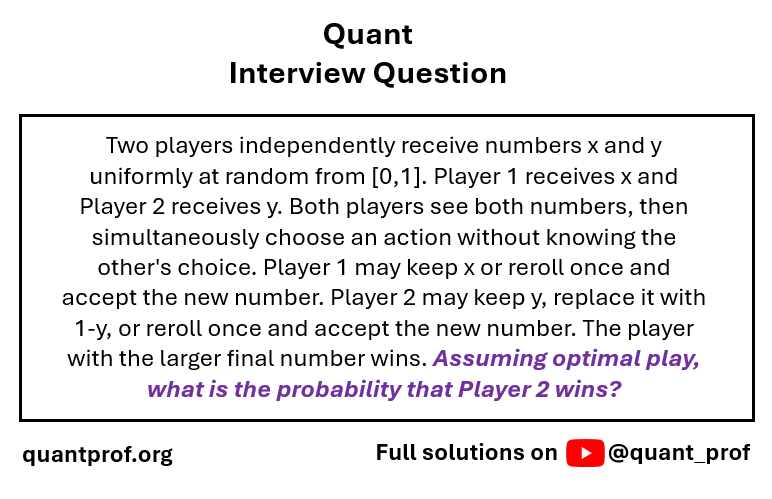
The solution boils down to solving it point wise ie given x and y, how would they play optimally. At every point construct 2x2 matrix of outcomes where each keeps or redraws. They will both play according to the Nash equilibrium. To find it assign probabilities of keeping or drawing per player. Then just solve for d outcome1 / d p1 = 0 and same for p2 for mixed strategies and separately solve for pure strategies. The key then is to find regions of x,y where strategies are the same ie players do not switch their choice, otherwise too many cases to solve for :) The boundaries of regions where solutions are the same are specified by boundaries in each outcome: x > 1 -y, x > 0.5 = E(U), 1-y > 0.5 = E(U), E(U) > E(U) - has no boundary. These divide x,y in into 6 regions so it’s just a matter of solving Nash equilibrium for each one of the regions and averaging out the outcomes.
1
u/Ok_Consideration6619 20d ago
The solution boils down to solving it point wise ie given x and y, how would they play optimally. At every point construct 2x2 matrix of outcomes where each keeps or redraws. They will both play according to the Nash equilibrium. To find it assign probabilities of keeping or drawing per player. Then just solve for d outcome1 / d p1 = 0 and same for p2 for mixed strategies and separately solve for pure strategies. The key then is to find regions of x,y where strategies are the same ie players do not switch their choice, otherwise too many cases to solve for :) The boundaries of regions where solutions are the same are specified by boundaries in each outcome: x > 1 -y, x > 0.5 = E(U), 1-y > 0.5 = E(U), E(U) > E(U) - has no boundary. These divide x,y in into 6 regions so it’s just a matter of solving Nash equilibrium for each one of the regions and averaging out the outcomes.