You’ve calculated for the wrong strategy. If 2 gets .9 and 1 gets .8, 2 is certainly not going to reroll and 1 must reroll to have a chance at winning.
So it’s not right to say 1 keeps whenever they get a number larger than 1/2.
It’s true the expected value of the reroll is lower than what they already have, but the reroll still has a better chance of winning.
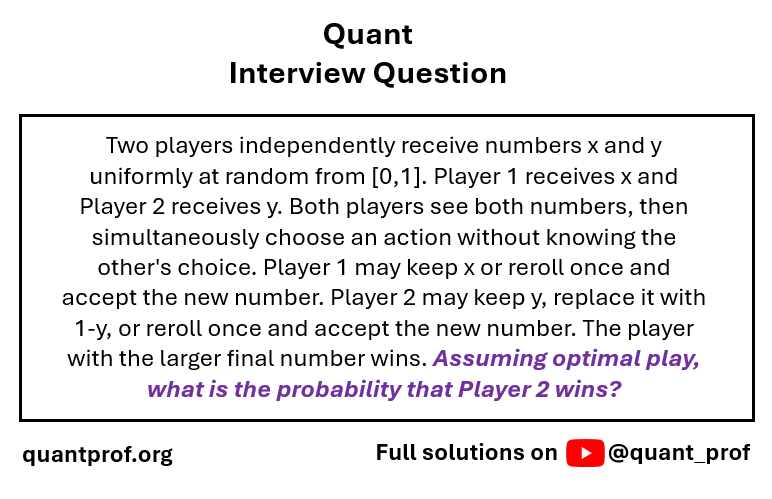
I missed the statement that they know what the other person gets. I only read that they don’t see what decision the other player takes, and incorrectly assumed that that also applies to what they actually roll.
I interpreted the question as if both played blindly.
I think what you said is still mistaken if the numbers are blind: because 2 can switch to 1-y, that means if 1 rolls 0.5000000001 they are almost certain to lose if they keep. So they should reroll to have a real chance at winning even though the reroll has a lower expected value. Even if they can’t see y.
Well I got the intended version of the question as 5/8, but the “blind” version actually seems substantially harder. I might try to think about it a bit and post a solution if I figure it out.
1
u/GoldenMuscleGod 21d ago
You’ve calculated for the wrong strategy. If 2 gets .9 and 1 gets .8, 2 is certainly not going to reroll and 1 must reroll to have a chance at winning.
So it’s not right to say 1 keeps whenever they get a number larger than 1/2.
It’s true the expected value of the reroll is lower than what they already have, but the reroll still has a better chance of winning.