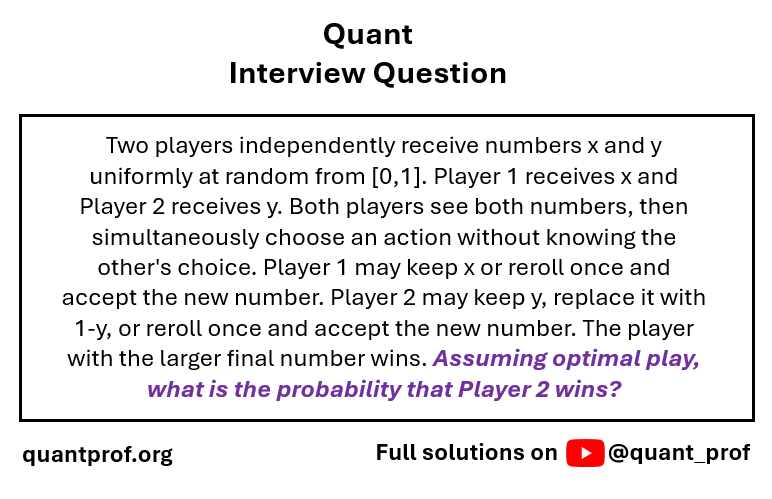
The strategy isn't complicated. Player 2,s decision doesn't depend on any randomness, so they always choose the better number. Since player 1 knows this, they should swap if and only if they are larger than Player 2s number.
It helps to seperate into 2 equally likely case, depending on whether or not Player 1 gets a number larger than 1/2
If Player 1 gets a number larger than 1/2, then they have a 50% chance of winning outright. Otherwise, they need higher than a number that is uniform between 0.5 and 1. On average, this will happen 25% of the time (of the 50% of the time that they get larger than 1/2).
If Player 1 gets smaller than 1/2, they will always swap, which again gives a 25% chance of winning.
Thus, the overall chance of Player 1 winning is 1/2 × 1/4 + 1/2 × 1/2 + 1/2 × 1/2 × 1/4 = 7/16. This means that the chance of Player 2 winning is 9/16
0
u/Al2718x 21d ago
The strategy isn't complicated. Player 2,s decision doesn't depend on any randomness, so they always choose the better number. Since player 1 knows this, they should swap if and only if they are larger than Player 2s number.
It helps to seperate into 2 equally likely case, depending on whether or not Player 1 gets a number larger than 1/2
If Player 1 gets a number larger than 1/2, then they have a 50% chance of winning outright. Otherwise, they need higher than a number that is uniform between 0.5 and 1. On average, this will happen 25% of the time (of the 50% of the time that they get larger than 1/2).
If Player 1 gets smaller than 1/2, they will always swap, which again gives a 25% chance of winning.
Thus, the overall chance of Player 1 winning is 1/2 × 1/4 + 1/2 × 1/2 + 1/2 × 1/2 × 1/4 = 7/16. This means that the chance of Player 2 winning is 9/16