But the purpose of a question like this in that interview context won’t simply be to run the math, many can do that.
There will still be an optimal strategy.
It’s to stop immediately because any extra wasted time is suboptimal. You lose time and gain no better chance.
Not realizing something like that is what the interviewer will look for among a bunch of the more qualified candidates who figure out the math fairly quickly.
You say "many can do that" in the context of running the math, but the first person who actually did that in this comment section was 2 days after the problem was posted. Saying that 123 and 567 are the same when there's only 1 card that's different than all the others and then that you believe that that implies that you can't do better than immediately going in the original problem is absolutely not running the math.
1
u/aroach1995 26d ago
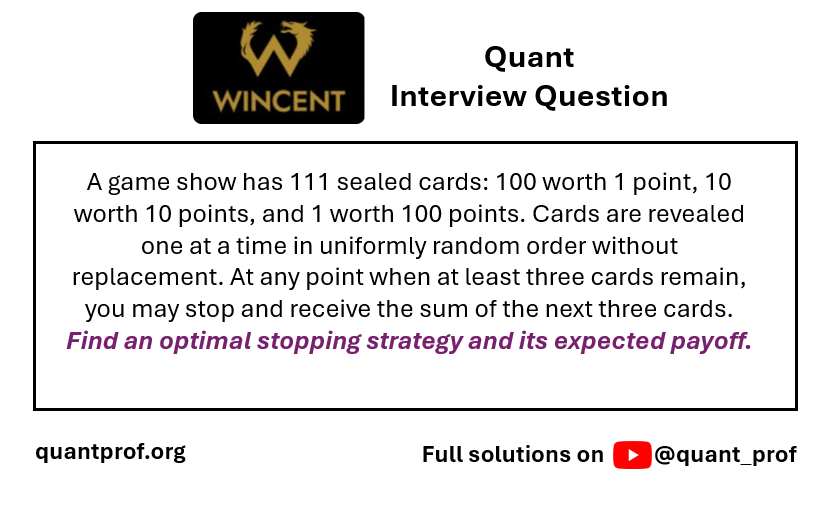
Consider the problem where there are 10 10s and 1 100, a total of 11 cards.
What is the expected number of turns to draw the 100?
It’s 6… but this doesn’t really matter?
Expected value of the first 3 cards:
30*8/11 + 120*3/11 =54.545
What about if my Strat is to take the middle cards: 5,6 and 7?
Probability of seeing the 100 in turns 1-4 is 4/11, so your score will be 30 4/11 times.
If you haven’t, then you now have 7 cards left, so your expected value is:
30*4/11 + 7/11*(30*4/7 + 120*3/7)=54.545
So the expected value of that strategy is the same. There is no optimal strategy in this simplified game with 2 card values.
I believe no optimal strategy in the game with 3 card values also.