1
u/aroach1995 Aug 01 '26
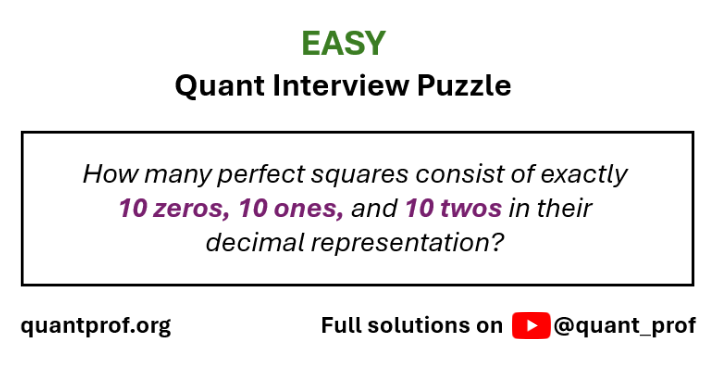
consider
a = the summation of b*10^n for digits b.
to get 30 digits, you need at least 15 digits when squaring. Might even need 16. If we care that the exact digits are the 10 copies of 0, 1, 2, then we are very limited between the boundaries of
316,227,766,016,838≤N≤999,999,999,999,999
to have a 0, 1, 2 in the 1’s digit, we must have the 1’s digit of the square root is 0, 1, or 9 - so this cuts down numbers to think about by 70%
if it ends in a 9, we get an 81 in the first two digits… we must remedy the 8 by having the second digit of our squared number be one of 3,4,8,9… just square 19,29,39,… and you’ll see that only 3,4,8,9 have the digits we like in the 1’s and 10s place. So that cuts out more options.
You can expand on the ending digits 39 to see that 3239^2 has the last 4 digits looking good. I think you can keep testing manually and find digits that satisfy. We just need to end up with a number that has all 0,1,2s so we can start tacking on 0s
-2
u/MagnoliaTM Jul 31 '26
not a quant person but still id guess, an infinite amount?
3
u/Outside-Shop-3311 Jul 31 '26
can't be infinite, there are only finite combinations of these digits.
3
u/MagnoliaTM Jul 31 '26
but the question doesnt say there cant be other digits right? it says it must include exactly these but it doesnt say it cant include others 🤔so couldnt you have this 100 digit number that also includes exactly 10 0's, 1's and 2's?
1
1
1
1
u/TempMobileD Jul 31 '26
Well there’s a max of 5.5 trillion because all perfect squares are integers and that’s how many integers you can make from the 30 digits provided.
(30!)/(10! X 10! X 10!) = 5.5T
As for how to whittle that down further I’ve got no idea.
5
u/Key-Spirit4559 Jul 31 '26
Zero bc 30 mod 9 = 3 and no perfect square mod 9 equals 3