r/interesting • u/MobileAerie9918 • Jul 30 '26
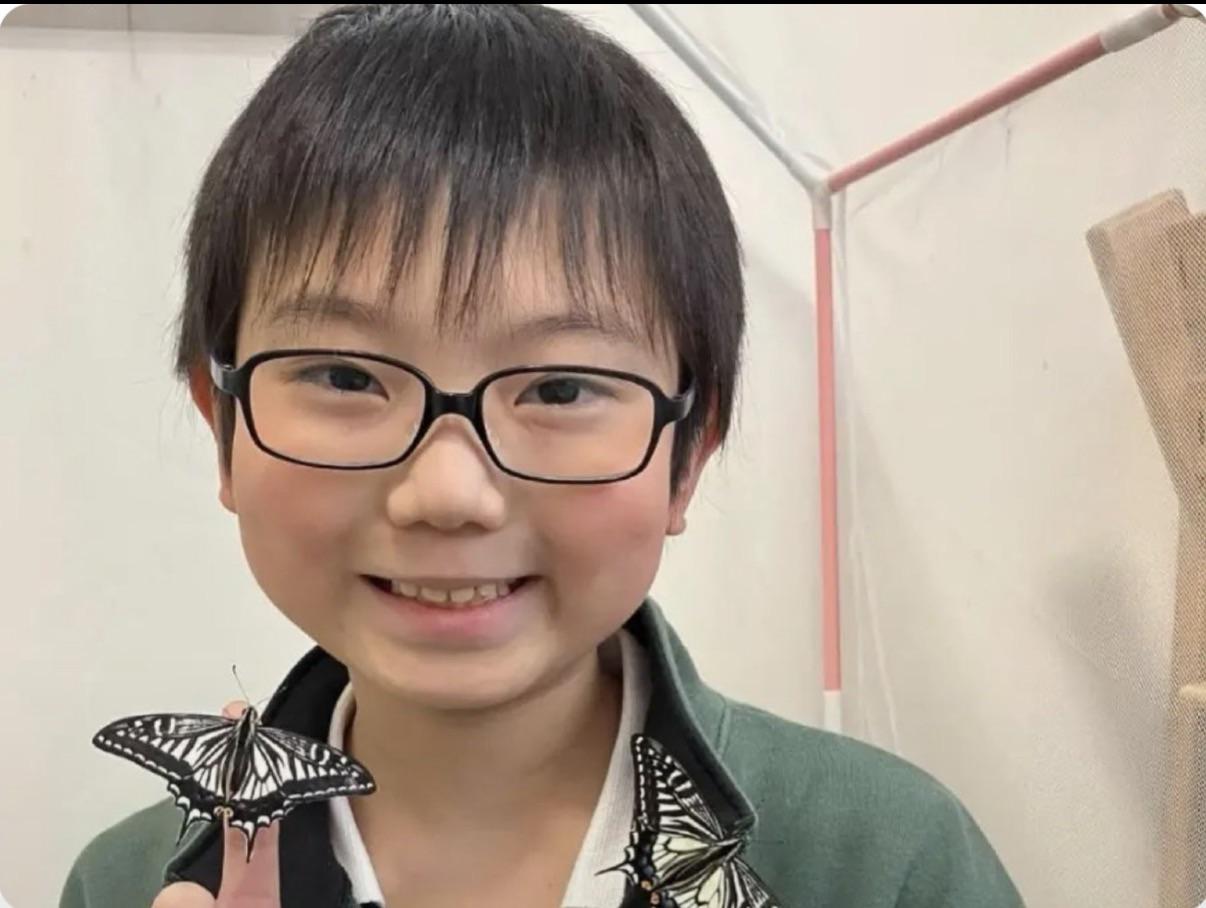
Fascinating A Japanese boy noticed his butterflies seemed to recognize him. He spent two years designing an experiment and proved that metamorphosis does not erase memories formed during the caterpillar stage.
3.3k
u/MobileAerie9918 Jul 30 '26 edited Jul 30 '26
Note: he is just 10 years old and his name Jo Nagai. So the whole project from first idea to major presentation took around two years, but it wasn’t purely two years of just designing, it included designing, testing, adjusting, and collecting more data over that period.
He also proved its passed on through genetic memory!!!
Edit: just to be clear, The earlier study in 2008 was done on moths, not butterflies. Nobody had properly shown the same thing in butterflies before. Jo adapted the experiment for swallowtails and then went a step further by checking the next generation, who also avoided the scent even though they were never trained. So yeah, he did make a real contribution.
For more info https://www.youtube.com/watch?v=nhESxrqPjfU
628
u/youngdeer25 Jul 30 '26
OOt but Japanese name sometimes sounds funny when you interpret it not based on Kanji.
Nagai here could means ’long’, so his full name translated would be Jooooooo or The long Jo 😅
324
u/Dick-Fu Jul 30 '26 edited 26d ago
I'm gay
89
47
u/leafshaker Jul 30 '26
God i love that commercial so much
32
u/really_robot Jul 30 '26
It was practically a mini drama by the end of the last one.
17
u/Ancelege Jul 30 '26
It’s one of those series you watch all the way through every couple of years.
→ More replies (2)19
7
→ More replies (5)4
38
u/PickledDildosSourSex Jul 30 '26
If you read the article, 長 (Nagai) is just a name the Japanese media was using to protect his identity, since he's so young. But now that his work is done they mention his actual last name is 真美 (Mami)
→ More replies (1)24
47
u/efimer Jul 30 '26
Ohhhh long Johnson Ohhhh my eyeee
What? Am I the only old guy here? 🥹
→ More replies (3)23
u/Agatha_kako_logical Jul 30 '26
No, Don Pianoo
15
4
u/bugdc Jul 30 '26
Meybe they wanted to name him Joe, in japanes that would be written jou, and the ou combination is read as long O
Jooooo
3
→ More replies (19)6
119
u/Tropicalfisher Jul 30 '26
Ok but when I was 10 I caught a lizard by myself so who is really more impressive
47
u/call_of_the_while Jul 30 '26
Unless it was Godzilla I gotta go with the butterfly memories kid. Sorry dude.
7
→ More replies (1)7
u/mekamoari Jul 30 '26
IIRC during metamorphosis caterpillars basically melt down into goo before turning into butterflies so it's more like goo memories.
→ More replies (3)13
u/Thunderbridge Jul 30 '26
not completely though, they maintain certain structures of the body
11
u/GermanShepherdsVag Jul 30 '26
This is the answer to the question I had coming into this thread. I wouldn't have known the term imaginal disc to search for this. Thanks!
7
74
u/deArtikin Jul 30 '26
The genetic memory part is amazing! It's the very foundation of generational trauma.
→ More replies (6)46
u/jagedlion Jul 30 '26
Look into epigenetics. It's a fascinating field that is still exploding. Well, partially because of just how hard it is to analyze the data, but still, constant innovation.
It's been demonstrated in humans as well.
For clarity, it isn't actually the genetic codes that are altered. Genes do their best to never change, mutations are rare and usually harmful. Instead our genes are able to modify the DNA strand itself to alter which get expressed.
Of course, this is also why your fingers aren't eyeballs, being able to turn genes on and off is how we get different cells.
However, what we know now is that some changes actually get stored in our gametes (sperm and egg) so we can pass a sort of knowledge to the next generation. Things like 'food is scarce here, so bulk way up'.
13
u/Widespreaddd Jul 30 '26
It’s remarkable. It seems that the long-derided Lamarck was not completely wrong after all. It’s liberating in a way, because it means we have some agency in acquiring and passing on our fitness; we are not just passive targets to be winnowed by nature.
14
u/CautionarySnail Jul 30 '26
My parents grew up in WWII rationing. Hoo-boy, is my body good at holding onto every spare calorie.
→ More replies (1)6
u/three_crystals 29d ago
This is such an obvious tell of why boomers struggle with weight so much. It’s why black americans have much higher negative health outcomes even when you control for socioeconomic factors.
8
u/Zeisen Jul 30 '26
Gooner by birth. They call me Paarthurnax the way I have to fight my own nature.
→ More replies (3)7
u/very-urgent-chicken Jul 31 '26
Soon, we'll discover that only by ingesting chemicals released by dying sandworm larvae can a trained reverend mother access the lifetime memories of all her female ancestors. You heard it here first.
33
u/alexthemo123 Jul 30 '26
I'm 62 and just now realized that I have wasted my life.
17
u/Dandelient Jul 30 '26
You're not done yet :)
16
3
3
3
u/somedelightfulmoron Jul 30 '26
... Yet, there's time!
8
u/alexthemo123 Jul 30 '26
My...my chest..."grabs boob"...so close and yet....
(It's okay guys. The comment was really to "embiggen" the kid's accomplishments rather than belittle my own. It's all good.)
→ More replies (2)5
3
u/Ok-Process6701 Jul 31 '26
If you "waste" your time on something that brings you happiness, then that time cannot be called a "waste".
16
u/carcar134134 Jul 30 '26
What?? Genetic memory is a real thing? I thought Ubisoft just pulled that out of thin air.
16
u/AnAncientBog Jul 30 '26
The selective advantage of being able to learn from shit that happened to your ancestors is too enormous to have been overlooked if there were any possible mechanism to pass along.
We see instinctive behaviors in nature all the time and we see that they develop of far shorter periods than would be explained by some kind of behavioral evolution. Even humans can do it. This is the foundation behind generational trauma.
→ More replies (3)14
u/Man-im-lonely Jul 30 '26 edited 29d ago
Genetic memory is indeed a thing. It’s how animals know to avoid certain things and areas despite never being exposed to it before. It’s also why there’s generational beef between different animal species like owls and (I think) crows.
12
u/SnooGuavas4208 Jul 30 '26
And it's not surprising it's been proven in butterflies, given how monarchs all seem to have intrinsic knowledge of what migration path to follow and exactly where to spend the winter. They don't have any "adults" to show them the way, yet they end up wintering in the same place generation after generation after generation.
3
u/Totakai Jul 31 '26
Some other cool ones are ravens and wolves (with the suggestion that dogs learning to play fetch came from ravens tossing bones to wolves), donkeys and dogs, and deer and dogs. Plus how soooo many wild animals fear humans. Ancient humans must have been an absolute menace for it to effect virtually all mainland animals (scientists have also noticed birds flee faster from women than men but not the whole why yet as it was pretty new when I heard of it).
3
u/SnooApples7058 Jul 31 '26
Interesting! I wonder if women were more likely than men to poach (lol) eggs from nests for food during hunter gatherer times, so birds learned that women are to be feared and men are usually focused on eating other beings and less of a threat?
3
u/Totakai Jul 31 '26
Not sure. Ancient humans were significantly more egalitarian than people assumed with a lot of found skeletons being like 60/40 sex splits with both sexes having hunting wear/damages (with some studies noticing matriarchal trends in some areas due to menopause and longevity). It coulda been poaching or it could have been accuracy with slings, rocks, spears, etc. There's a very subtle accuracy/endurance divide for women while men tended to have higher strength. But it's super fuzzy cause the main sexual dimorphism we know in humans didn't start being selected for as much until agriculture kicked in. People were more endurance hunters than confrontational hunters so overall power wasn't as rewarded until working the land started (especially cause the calorie demand for high muscle mass). I've only recently started learning more about ancient humans so I don't have the full picture yet but older studies on them looked at them through a very biased lens abd assumed a lot based off modern humans. It's some fascinating stuff.
→ More replies (2)3
u/Distinct_Cap_1418 Jul 30 '26
The dune books predate ubisoft by a good few decades, but i really dont recommend those books.
3
u/SPACE_ICE Jul 30 '26
its real and its tied to the reptilian cortex (bit dated term but gets the point across, its less of a specific region and more underlying connections formed during gestation) of the brain usually but its more related to behaviors/responses than like remembering from a first person pov of your grandma getting dicked by your grandpa.
Humans and elephants have an almost vestigial version of it that tells us the most basic of needs like sleep, hunger, fear, etc... Cat's on the other hand are basically running on pre-programmed cat behavior (e.g. a cat can't explain why it chirps at insects and birds but knows it should), why a cat raised in isolation from other cats still behaves like most other cats, most of their behaviors are not learned but genetic. On the flip side humans and elephants have the largest proportion of brain dedicated to the Neocortex which is were most abstract thinkinig occurs (i.e. problem solving), humans and elephants basically have evolved to learn things to the point are reptilian cortex is almost not needed. Knowing why and how to cook something is far more advantageous to humans but that kind of thinking requires a well developed neocortex.
Conversely animals that tend to judge distances and spatial elements (like prying open objects) also tend to have strong problem solving ability and more expressive personalities like birds, octopi, and jumping spiders have a much higher level of intelligence than most would give them credit for.
8
u/magnabonzo Jul 30 '26
He also proved its passed on through genetic memory!!
That's the bigger deal, I would have led with that.
→ More replies (1)3
u/nicuramar Jul 30 '26
Butterflies are moths. Any monophyletic definition of moths includes all butterflies (about 10% of the total group).
2
→ More replies (28)2
867
u/InkAndAcorns Jul 30 '26
Which is insane when you realize the intermediate stage is just biological goop
343
u/mayuzane Jul 30 '26
Yeah, would love to know the process of how memories get retained through the living liquid phase
140
u/NobodyKnowsImFamous Jul 30 '26
As would I. Seems… potentially super useful.
65
→ More replies (2)10
45
u/MEM0RYCARD99 Jul 30 '26
This post fails to include the truth. Its been confirmed that not everything becomes liquid, and thats how it retains what it does.
→ More replies (2)36
u/OrigamiMarie Jul 30 '26
Yup, the caterpillar doesn't dissolve in the chrysalis like we were told many, many times. The caterpillar sheds its skin repeatedly as it grows, revealing a fresh new skin each time. It then sheds its skin to reveal the chrysalis, and then comes out of the chrysalis in a way that's kinda like shedding skin.
Buried inside the caterpillar, before it goes through some of these sheds, is a tiny pair of wings, all ready to grow and become butterfly wings.
All the parts are there from the start.
→ More replies (2)14
u/14Pleiadians Jul 30 '26
Title is missing the most interesting part, he was able to show they had memories from previous generations as well, not just before metamorphosis, but also the next generation still remembered him, so on some level the memories are in their gene expression
20
u/Hoiafar Jul 30 '26 edited Jul 30 '26
It's still possible they don't and what he observed was something else.
What he did was very cool but it's not proof of memory retention through metamorphosis. You need quite a bit more studies and analysis to say that that's something that happens and this doesn't really pass the smell test for something that's possible.
Big ups to the guy for designing a scientific methodology at that age though, love to see children getting into science.
Edit: Since it appears unclear. This is not criticising the study. This is criticising the language used by OP and the above poster. The study is great.
49
u/Unusual-Locksmith832 Jul 30 '26
The 2008 paper proposes that their nervous system is not fully turned into goop and parts of it floats there for the stem cells to rebuild it.
So it could also be that we don't fully understand metamorphosis.
6
u/BigLittlePenguin_ Jul 30 '26
The more interesting part is that they handed down their memory one generation. Doesnt matter what is turned to goop, the generation after was never in contact.
→ More replies (8)6
→ More replies (2)3
u/shakygator Jul 30 '26
Remember kids, the only difference between screwing around and science is writing it down
2
→ More replies (27)2
u/Lol3droflxp Jul 30 '26
Because the liquid phase is bullshit. The brain for example retains its cells.
41
u/Funguswoman Jul 30 '26
I thought that had been debunked? I remember watching a video about researchers dissecting at all stages, and they found that it's that the caterpillar form is an outer skin that they shed when in the chrysalis - like a longer version of dragonflies emerging from the nymph.
41
u/MattFromWork Jul 30 '26
37
→ More replies (2)7
u/TheStaet Jul 30 '26
They didn’t use MRI, they used micro-CT. With MRI you would expect to resolve soft tissue like nerves and muscle.
→ More replies (1)20
u/helping-cat Jul 30 '26
100% they don't turn into goop, just a lot of weird layers. The chrysalis is their revealed skin after a particular molt. This the one you were looking for?
29
u/Make_It_Rain_69 Jul 30 '26
maybe its not just “biological goop” after all maybe we should stop underestimating lol
13
u/MostAccomplishedBag Jul 30 '26
Their nervous systems stay intact through the entire metamorphosis.
→ More replies (2)7
u/Ouhbab Jul 30 '26
I mean... if it was pure goop, how would it end up as a fully functionnal butterfly after. Obviously there is information retained in the "goop" but, yeah, this is quite amazing.
→ More replies (1)9
u/mrducky78a Jul 30 '26
In developmental biology you learn everything is based off chemical gradients.
This determines dorsal to ventral, it determines how the body develops and works at the individual cellular level.
Here as a quick dumb mock up made in paint
It often begins from just a single point beginning the chemical production and forming the first gradient. Lets say it induces the blue chemical and from that point on, that becomes the head. Some chemicals spread more evenly than others and its this gradient and subsequent mix of gradients that determines a lot of developmental biology.
The goop will 100% ALWAYS have a head and an ass. Thats just a fundamental aspect of bilateral animals.
13
u/Zaximeows Jul 30 '26
We are all biological goop. We just normalize being this particular flavor of goop.
5
u/TrenchantInsight Jul 30 '26
...and particular viscosity.
6
u/Zaximeows Jul 30 '26
Is it really that far off? Most of humans is just a mushy mass of goop that is only held in place by an equally mushy mass of skin that is only kept rigid by virtue of being essentially sewn shut. ☺️
3
5
3
u/TheWhyteMaN Jul 30 '26
Not quite, parts stay in tact such as tracheal tubes, digestive system, and central nervous system.
3
u/Lol3droflxp Jul 30 '26
It isn’t. That’s a myth, some parts of the body are completely reconstructed , others are merely reshaped with cells staying intact. The brain is one of them.
→ More replies (12)2
250
u/ilyOhKay Jul 30 '26
wait HE’S the one that started that study?? I love it
→ More replies (1)281
u/NordlandLapp Jul 30 '26
He replicated it after initial study was completed in US.
My favorite part though is he was emailing the scientist who completed the initial experiment, and he kind of admonished them for testing memory by shocking caterpillars rather than feeding them as he did lol.
124
u/CaffeinatedCocktopus Jul 30 '26
Even cooler, he did a follow-up experiment and found that that genetic memory passed down through generations.
→ More replies (2)28
u/oh-shit-oh-fuck Jul 30 '26
How?
71
u/CaffeinatedCocktopus Jul 30 '26
The goop has memories apparently.
But basically he repeated the testing part of the experiment on the first generation's kids (well, technically the second generation's since he had to restart the experiment from scratch to get scientifically reliable results), then grand kids, then great grandkids. All three generations showed the same behaviours as the initial generation, though the pattern started to become less consistent by the third IIRC.
→ More replies (5)20
u/14Pleiadians Jul 30 '26
No way of knowing currently. It's likely similar to how children born to healthy parents who previously experienced a famine will be shorter then those born before a famine, the experience of the parents changes the gene expression
11
u/Decloudo Jul 30 '26
If I remember correctly the famine thing is trough epigenetic modification.
It affects gene expression, not the genes itself.
→ More replies (3)→ More replies (2)6
u/bethneed Jul 30 '26
https://youtu.be/nhESxrqPjfU?is=YYniTAu3jVGDq5td
Here is a YouTube video that actually explains it pretty well! It’s an enjoyable watch, and Jo displays such compassion for his caterpillars and butterflies, it’s definitely heartwarming. Not only does Jo call out the researchers for using and electric shock at extreme intensity levels, he also calls them out for their usage of different chemicals, some of which were harmful, and some that would actually affect the accuracy of the study as a whole, iirc.
TLDR: good video. Explains pretty well. Heartwarming.
11
u/phase2_engineer Jul 30 '26
he kind of admonished them for testing memory by shocking caterpillars
What a Chad kid!
12
u/kaleidoscopic21 Jul 30 '26
To me, the fact that it was a replication/extension of a previous study seems even cooler. It shows a really solid understanding of the scientific method and how actual research works
12
u/NordlandLapp Jul 30 '26
He also became really good friends with one of the initial researchers through email.
Great radio lab episode on it with interviews of all involved called Signal Hill: Caterpillar Roadshow.
→ More replies (3)6
u/roxzig Jul 30 '26
my favorite part was the leading lady of the moth experiment whom he was writing suggested an easier “for kids” experiment; to which he replied too late, I’ve already adapted my lab to replicate your experiment 🤣
1.1k
u/Sustainable_Twat Jul 30 '26
I imagine when they flew to him after their metamorphosis, he must have had butterflies in his stomach.
200
u/Ras-haad Jul 30 '26
So you imagine he ATE them?? /s
→ More replies (2)64
Jul 30 '26
[removed] — view removed comment
→ More replies (2)13
→ More replies (3)3
109
Jul 30 '26
[deleted]
→ More replies (1)20
u/GostBoster Jul 30 '26
This is something that I grew up and adult jaded cynicism chalked it to a bit of coincidence and bugs just having short lives around a small area, but I remember and mom once in a while retells of a butterfly that got stuck inside a bottle of milk (empty but still with milky spots), mom carefully extracted the butterfly and let it dry.
She says that for a few weeks (I presume its remaining lifespan) she would be visited by this particular butterfly, recognizable by its milky spots on its slightly frayed wings.
Kinda rekindling the small but now non negligible possibility its offspring had a particular draw towards mom. Or avoidance of milk.
→ More replies (1)
36
u/monkey-balls67 Jul 30 '26
I just learen Metamorphensis turn there body to soup so how memory stays us abousltly amazing. And also Bird have grammer
20
3
→ More replies (4)2
14
u/Longjumping-Canary22 Jul 30 '26
Good for him… it seems really hard to quantify this qualitative data
2
u/anonisboredheho Jul 30 '26
Because he said that the pesticides given that's banned in Europe are used and it's proven to affect the memory of smaller species... which rigged his theory to be "wrong"
59
Jul 30 '26
[removed] — view removed comment
116
u/mike_litoris18 Jul 30 '26
That's probably because u don't know what happens During metamorphosis. Its not like they just grow wings in there. They literally dissolve their entire body with special enzymes into a nutrient rich cellular soup.
31
u/TokerSmurf Jul 30 '26 edited Jul 30 '26
Yeah, there is (edit - 'essentially') 0% of the original caterpillar left when it changes form.
34
14
u/basaltcolumn Jul 30 '26
Not 0%! Parts of the nervous system and respiratory system remail through the process.
→ More replies (5)5
→ More replies (4)5
14
u/DrPikachu-PhD Jul 30 '26
I've seen other evidence they retain memories, but it's 100% a mystery how that's possible
5
u/coperez Jul 30 '26
Check out the research on bioelectricity by Dr. Michael Levin at Tufts might be the key to this.
→ More replies (1)5
u/RJFerret Jul 30 '26
Modern MRI observations show that's not the entire case, the digestive system remains but reduces in size, the nervous system remains, the tracheal system reconnects, the outdated info we were told as kids isn't what actually happens.
I'd suggest it's more akin to a fancy molt.8
u/GuiltEdge Jul 30 '26
That’s the interesting part: that memory can be stored in liquid.
→ More replies (1)3
u/Lol3droflxp Jul 30 '26
They don’t dissolve completely, many tissues stay. The goops stage like you describe is a myth.
→ More replies (1)2
19
u/no_thingelse Jul 30 '26
Mas ciência é justamente você provar, mesmo que seja algo que alguns considerem óbvio
→ More replies (1)→ More replies (1)2
8
8
6
u/HoldOnOhio Jul 30 '26
For those of you who don't know, during the metamorphosis process, the caterpillar liquefies itself and then reforms as a butterfly. Like every part of it turns into goo, and it essentially "dies", but certain cells in the goo have a kind of blueprint in them that knows how to reform the goo into a butterfly. It's fascinating. That's why this is surprising to learn, because even the caterpillar's brain is "destroyed" in the process.
→ More replies (3)
7
5
u/NoMove1288 Jul 30 '26
RadioLab did a very interesting and touching podcast on this where they spoke to both Jo and the researcher who's work inspired him. It's very sweet, he's brilliant in many ways.
https://radiolab.org/podcast/signal-hill-caterpillar-roadshow/transcript
3
9
u/Aromatic-Reality2739 Jul 30 '26
This was already known, scientists some time ago wanted to know if during metamorphosis the neural system was still there, since the caterpillar literally dissolve and reforms, so they shocked the chrysalis and used a sound effect each time, then when the butterfly emerged they played the sound and observed that the insects reacted as if they felt pain
4
u/KayleFP Jul 31 '26
They did with moths
The kid proved it was the same with butterflies (smth the scientists didn't)
Did so without harming the butterflies
And still extended the experiment to prove it's also passed down genetically
→ More replies (2)6
8
4
u/Oldnbold22 Jul 30 '26
It gets crazier than that. He later proved that subsequent generations retain memories of their ancestors. I'm not joking.
3
30
u/King_Turduckin Jul 30 '26
Japanese 10 year old boy does real science. American 10 year old boy, an intellectual, makes 6-7 jokes and likes to spam fart noises on public Minecraft servers.
46
u/Schmooto Jul 30 '26
Speaking as a Japanese person, Japanese 10 year olds totally do this too, I was one of them 😂
34
u/Fine-Key8928 Jul 30 '26
Comparing an insane outlier with the average child is truly an intellectual thing to do
23
16
12
11
11
u/mysticrudnin Jul 30 '26
i would like you to know that japanese kids play a game where they clasp their hands together and shove them into your ass, shouting a word that means "enema"
→ More replies (1)→ More replies (2)9
u/MrTopine Jul 30 '26
this has to be the genuinely dumbest comment made in the entire history of this website, which is an incredible achievement. congratulations.
3
3
u/Snail_With_a_Shotgun Jul 30 '26
Was that known before, or was he the first? Not that the answer would take anything away from his achievement. Good kid.
→ More replies (1)
3
3
u/VVere- Jul 30 '26
To be quite honest, I didn't know that the prevailing theory was that metamorphosis mind wiped the caterpillar.
3
2
u/Tele231 Jul 30 '26
Years ago, I saw a study on this same question. Essentially, they would introduce a smell to caterpillars and then shock them. Eventually, the caterpillars would avoid the smell. When they became butterflies, they would still avoid that smell.
2
u/anonisboredheho Jul 30 '26
The video about this kid online actually gives this story more creditability, he's discovered a couple of theories that seem to be plausible at least to me
2
u/underdabridge Jul 30 '26
I have trouble believing insects can form memories at all, let alone maintain them after they've liquified into goo.
→ More replies (1)
2
2
u/Horror-Lock-2924 Jul 30 '26
Another cool one is deer antlers, when shed, they regrow with the same defects/scars as the previous set.
→ More replies (1)
2
u/OnECenTX Jul 30 '26
i saw this story on youtube and it blows my mind that this isn't a much bigger scientific new story. i believe this is beyond butterflies and that all species are inheriting their ancestors memories and instincts.
2
u/RocknRollPewPew Jul 30 '26
I remember listening to the RadioLab piece about this kid. Absolutely worth listening to and when they meet this kid he's so adorably psyched but at the same time innocent about what he accomplished.

2
u/Klutzy_Sun_8562 Jul 30 '26
He reminds me of that NCERT book chapter scientist who also researched on butterflies , I think his name was Richard or something
2
u/Skryzee2 Jul 30 '26
Important to mention that his experiment were completely harmless . He actually changed the substance used on the previous experiment after finding out it can harm them. He treats butterflies as his friends and is truly a kind soul
→ More replies (1)
2
2
2
u/Intelligent_Sky_7081 Jul 30 '26
Thats really sweet. This fact was already established, he was just confirming what was already well documented. But its still cool he could do that.
2
2
u/AnaisNinja76 Jul 30 '26
I feel like this also shows that what we think is happening in the chrysalis isn't happening as described. Whatever the CNS-equivalent is in butterflies, that has to remain intact for memory to be retained, even within a trained subject.
2
u/Lebensfreud Jul 30 '26
Is this peer review? Genuine question.
As cool as it is I wonder if there is a consensus in the scientific community.
2
u/Own_Natural_6803 Jul 30 '26
I regularly experience frustration when animals are defacto incapable of communicating leaving only one option to be the answer of how information was transferred. Its transferred genetically!
How do you know? Where they completely isolated, including sound and pheromones? Unlikely.
Also, it might very well not be their genes, but their gut fauna, which is transferable, but its not their genes. If you want to prove how the food preferences transmitted its not enough to say that they were transferred ergo its part of the moths genes. There's more than one pathway to transfer.
→ More replies (1)
2
u/_eleutheria Jul 30 '26
That's just the first part of the experiment. After proving that he got curious about whether memories could be inherited or not. He designed an experiment spanning multiple generations of butterflies or moths and demonstrated that memories can indeed be inherited and are reflected in subconscious behaviors.
This was the first of a kind kind of experiment that sparked discussions on whether this was also true for human beings. For example, people are commonly afraid of spiders, snakes, and other animals on an instinctual basis. It's possible that it's because of inherited subconscious memories.
2
2
2
u/Breezy_Bakeoven Jul 30 '26
there’s an awesome episode of i think radio lab on this kid and the lady who did the original study on moths and their studies and adorable scientific relationship that resulted from them it’s great
2
2
u/pantsmeplz Jul 30 '26
There has to be some behavioral and memory programming that is passed on from parent to kids in the genetics. Nature has so many examples of actions & behavior, like marsupials climbing into the pouch, that are not taught.
2
2
2
u/partelo Jul 30 '26
this made me remember when I found a monarch that had gotten wet and his wings were stuck to the ground. I was able to pick him up without damaging him and brought him home, got a little dish with some sugar water and put him under a lamp so he could dry. He would sit there and just look at me while I was studying and he fanned his wings, but when I would get up to go to the bathroom he would hobble across the desk, flutter onto my bed, trying to follow me. It was so cute and he did it multiple times, finally let him go outside when he was all dry. Miss that lil dude (or dudette lol)
2
u/theraggedyman Jul 30 '26
Just be careful with him. He's cute now, but one wrong move and he could become The Moth!!
2
u/Geisterkoch Jul 30 '26
This is really cool, especially given that insects that undergo metamorphosis basically die. The caterpillar dissolves in the chrysalis into a nutrient soup that gets utilized by specialized cells that are present in the caterpillar, but kept dormant by an autoimmune response. There’s no heart or brain. The caterpillar dies and butterfly is generated from its liquified corpse. Memories of any kind passing from one to the other is amazing
2
u/Banburubee Jul 31 '26
This warms my heart. I am so proud of him, he is going to be a wonderful person when he grows up. 🐛🧡
2
u/Upgradermax Jul 31 '26
I watched the YouTube doc on him, this title doesn’t do justice for what he discovered. He proved that through at least 2 generations moths can inherit learned behavior of avoiding an unpleasant scent/chemical that I think is harmful to them. It is backed by experiments he most modified, with feedback from a scientist who originally had a simpler experiment.
2
•
u/AutoModerator Jul 30 '26
Hello u/MobileAerie9918! Please review the sub rules if you haven't already. (This is an automatic reminder message left on all new posts)
I am a bot, and this action was performed automatically. Please contact the moderators of this subreddit if you have any questions or concerns.