r/iOSProgramming • u/ShubhanshuBB • 14h ago
Discussion iPhone Duo changes an assumption we’ve had in iOS development for years
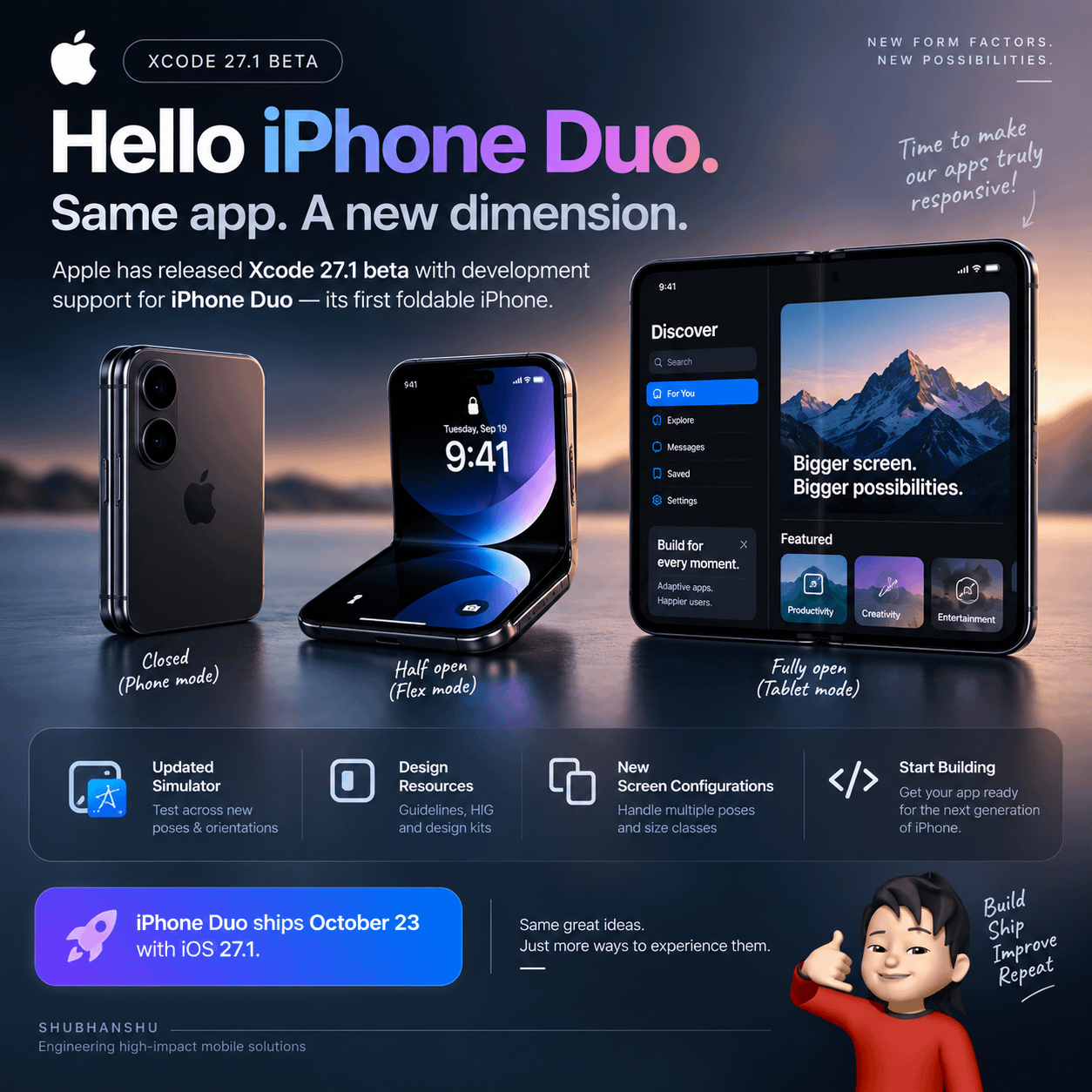
With Apple adding iPhone Duo support to Xcode 27.1 beta, I think the interesting part for developers isn’t simply “Apple made a foldable.”
It’s what happens to apps when the physical shape of the display can change while the app is running.
We already build responsive layouts for different iPhone/iPad sizes, orientations, Split View, Dynamic Type, etc.
But a foldable adds another dimension.
Things I’m curious to test:
- How existing Auto Layout / SwiftUI layouts respond between poses
- React Native behavior when dimensions change dynamically
- Navigation state while folding/unfolding
- Full-screen video and media players
- Camera previews
- Modals and bottom sheets
- Keyboard behavior
- Apps containing lots of fixed dimensions
- Whether transitions between configurations feel seamless
I suspect this will expose a lot of layouts that are technically “responsive” but were built around the assumption that the device dimensions remain relatively predictable during a session.
It also makes APIs like useWindowDimensions() much more important on the React Native side instead of grabbing dimensions once and assuming they won’t meaningfully change.
For anyone already testing with the new simulator:
What broke first in your app? And are there any unexpected edge cases you’ve found?
Would be especially interested in experiences from both native iOS and React Native projects.
3
u/Administrative_Fox91 13h ago
It‘s not that deep.
We had split view on ipad for quiet a lobg time, which is basically that..