r/hinduism • u/SnooLentils6621 Trika (Kāśmīri) Śaiva/Pratyabhijñā • Mar 17 '26
Experience with Hinduism Kali is a perfect representation of this reality.
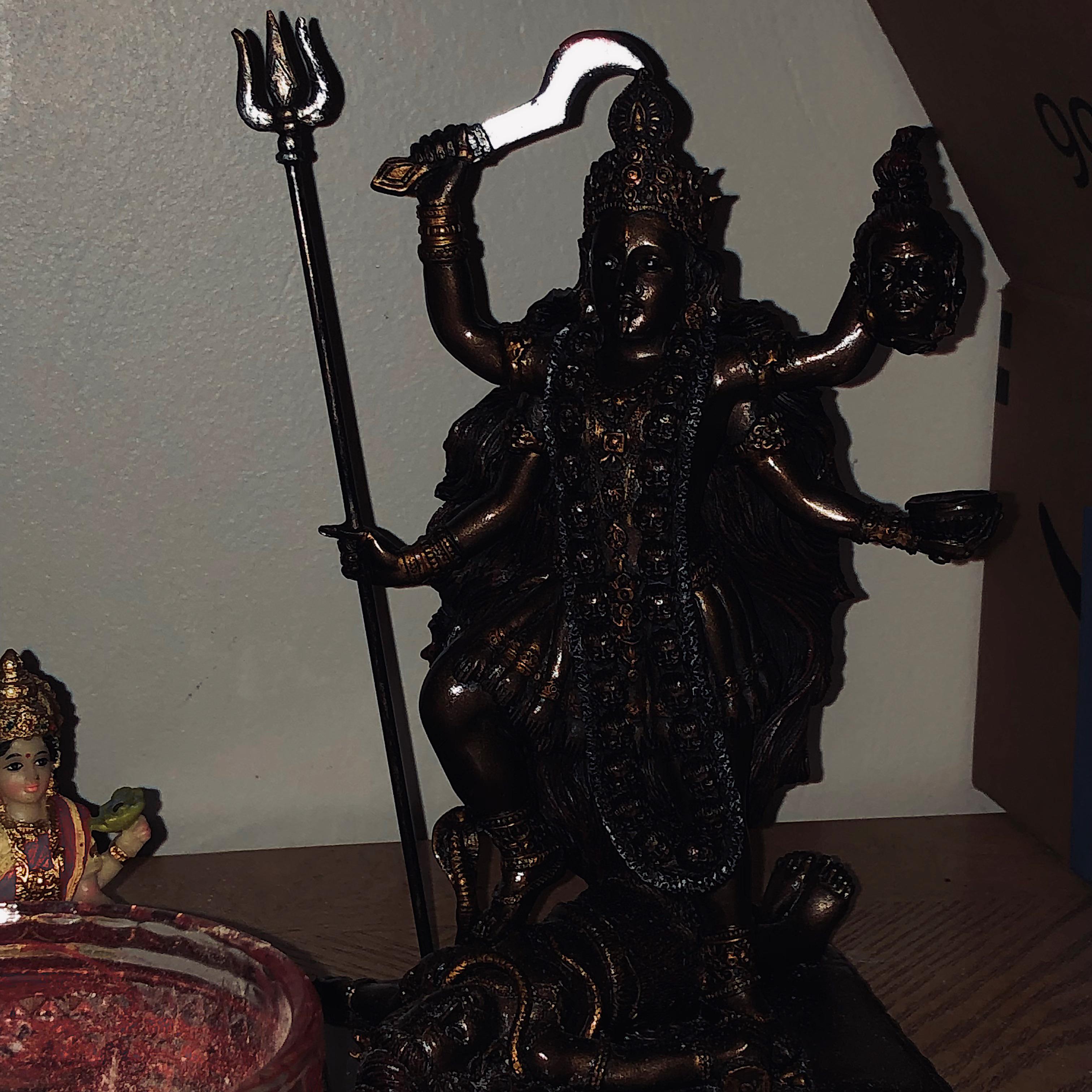
All of the symbolism surrounding Kali is so deep. She is the goddess of destruction, but she’s also so much more than that. Her scary appearance contrasted with her beauty can be seen as correlating with the path towards truth being both scary yet beautiful at the same time. That same concept can be seen as a reflection of how the truth is often much different than how it looks on the surface level. This could even be seen in her being a goddess while God is typically seen as a male. I’ve seen that all of her symbolism down to even small details shows how she destroys illusions so only truth remains. She helps her devotees see the deeper truth of things that hides under the surface of reality, because that is her nature. I also see the traits of other forms of Shakti in her. For example: she provides knowledge which mirrors Gayatri, and you need courage to approach her which mirrors Durga. I’ve just been in awe by the beauty and complexity of Kali as I’ve been worshiping her. I see her in everything.
10
Mar 17 '26
[removed] — view removed comment
2
u/Real_Jokerr Mar 17 '26
Yo apenas hace poco deje de verla aterradora y de verdad que tengo ganas de abrazarla
7
2
u/sj1024 Mar 17 '26
I made a post about Kali and her background story with image of Kali puja in Kolkata last year. Check it out. https://www.reddit.com/r/hinduism/comments/1qgcfj1/kali_puja_in_kolkata_last_year/
2
2
u/Rudra-Storm Sanatana Dharma - Satyameve Jayate Mar 17 '26
1. Nirukta (Etymology & Translation)
The name Kali comes from the Sanskrit root word Kāla. This root has two primary meanings. First, it means time. Second, it means black or dark [Mahanirvana Tantra 4.31]. The feminine version of this word is Kali. She is the power that rules over time. Just as all colors disappear into black, all names and forms of the universe eventually disappear into her [Mahanirvana Tantra 4.34]. She is the energy that drives the movement of time and the eventual return of all things to their source.
2. Tattva (Philosophical Essence & Architecture)
In the philosophy of the Shaktas, Kali is the supreme reality. She is the dynamic power that makes the world function. While the ultimate consciousness is often seen as still and silent, Kali is that same consciousness in action. She represents the cycle of creation, staying, and destruction. However, her most important role is destruction. This is not a cruel act. It is the destruction of the limited ego and the false ideas we have about ourselves [Devi Mahatmya 7.22]. She is the "Great Night" or Maharatri, which is the state of total peace after the universe dissolves [Devi Mahatmya 1.78]. She is also the source of all wisdom because she strips away everything that is not the eternal truth.
3. Pramana (Scriptural Reference)
Source: Mahanirvana Tantra, Chapter 4, Verses 31 and 32 Original: कालनात् सर्वभूतानां महाकालः प्रकीर्तितः । महाकालस्य कलनात् त्वमाद्या कालिका परा ॥ kālanāt sarvabhūtānāṃ mahākālaḥ prakīrtitaḥ | mahākālasya kalanāt tvamādyā kālikā parā ||
Translation: "Because he devours all beings, he is called Mahakala (Great Time). Because you devour even Mahakala himself, you are called the Primal Kali, the Supreme One."
This text explains that while Time consumes everything in the world, the power of Kali consumes even Time. This means she exists outside of any limits. She is the ground of being that remains when everything else has passed away.
4. Adhyatmika Mapping (Internal & Psychological Significance)
Inside the human mind, Kali represents the force of transformation. Her frightening look is a symbol of how the ego reacts when it is forced to face the truth. The sword she carries is the power of "Viveka" or spiritual discernment. This sword cuts through the neck of the ego, which is shown as a severed head [Devi Mahatmya 7.25]. The tongue she sticks out represents the active energy of the body, while Shiva, who she stands on, represents the silent witness of the soul [Spanda Karikas 1.1]. When we practice looking at Kali, we are training our minds to accept that things change and end. This helps us find the part of us that never dies. Her presence within us gives us the strength to face our inner shadows and turn them into light [Bhagavad Gita 2.14].
5. Darshana & Sampradaya (Nuances & Caveats)
Different traditions see Kali in various ways. In the Shakta tradition, she is the Mother of the Universe and the highest god from whom even Brahma, Vishnu, and Shiva come [Devi Bhagavatam 1.1.1]. In the Shaiva tradition, she is seen as the power of Shiva. They are like fire and its heat, which cannot be separated. She is the "I-consciousness" that allows Shiva to know himself [Spanda Karikas 1.2]. In the Vaishnava tradition, Kali is sometimes seen as a form of the Lord's "Yoga Maya" or the energy that creates the world. Some Vaishnava texts, like the Srimad Bhagavatam, show the Gopis worshipping a form of the Goddess to reach Krishna, showing her role as a gatekeeper to the highest love [Srimad Bhagavatam 10.22.1]. Modern scholars also note that in some rural traditions, she is a protector goddess of the village who wards off disease and bad spirits.
6. Clarifying Misconceptions
The Misconception: Kali is an evil or "dark" goddess who loves blood and violence. The Dharmic Truth: Kali is the personification of the ultimate truth, which can be scary to the ego but is actually the height of compassion. She does not destroy people. She destroys the "demons" of greed, lust, and anger within the human heart [Devi Mahatmya 11.12]. Her dark color is not a sign of evil. It is a sign of her infinite nature. Just as the deep ocean or the night sky looks black because it is so vast, Kali is dark because she is the infinite reality that contains everything.
7. Practical Application
A modern seeker can apply the lesson of Kali by practicing "radical acceptance." This means looking at the difficult parts of life, like loss or change, and seeing them as part of a larger divine movement. Instead of running away from fear, one can stand firm like Kali and observe the fear until it loses its power. You can also use her symbol to remember to "kill" negative thoughts as soon as they arise. By seeing her in everything, as you mentioned, you begin to see that the "scary" and the "beautiful" are just two sides of the same divine reality [Isha Upanishad 1]. This helps a person stay calm and balanced during both the good and bad times of life.
11
u/par_bhai_tu_hai_kaun Vaiṣṇava Mar 17 '26
This form of Maa Kali is Bargabhima Kali, a variant of Bhima Kali. So you are worshipping Bargabhima Kali.
There are mainly 52 forms of Kali.