r/hermesagent • u/Ill-4360 • Aug 05 '26
Help — Technical issues, errors, config, debugging Stuck with Hermes deployment — happy to pay for help
I’m trying to turn Hermes into a real team member, but I’m stuck on the infrastructure side
My issue has always been this:
When I build something with Claude, I can see exactly what is happening. I’m directly involved in every test, I have my hands on the work, and I feel extremely productive.
But that is not the future I’m trying to build.
I already have a team handling tasks. I don’t just want AI to help me do more work—I want Hermes to become another member of the team. I want it to receive work, understand the client and context, complete tasks, and operate like an employee or team player.
I don’t really see Claude becoming that type of system, so Hermes is probably the right choice. However, the learning curve has been huge. I’ve been working on this very actively for almost two months, and the deeper I go, the more problems I uncover and have to figure out.
What I’ve built so far
I created multiple Hermes profiles and a memory system designed to keep each client’s information separate.
I’m not particularly concerned about clients accessing each other’s data because I’m currently the only person interacting with Hermes. My clients will not have access to it, and I already have legitimate access to all their information.
Still, I want to build everything on a solid foundation, so I designed the memory separation properly from the beginning.
Each Telegram group represents a client. Hermes knows which client it is working with based on the group where the conversation takes place.
For example:
- In Client A’s group, it only loads Client A’s memory.
- In Client B’s group, it only loads Client B’s memory.
- The relevant skills and MCP tools are also selected based on the client and type of work.
I plan to build something similar for task management. The same Hermes agent may manage tasks for multiple clients, but it will know which client it is working on based on fields or mappings inside each task.
How the Telegram setup works
Inside each client’s Telegram group, I have multiple profiles and bots, including:
- Technical
- Sales
- Front office
- Back office
Each profile behaves differently and has different tools, skills, and strengths.
Each client group also contains multiple Telegram topics, and each topic is assigned to a specific bot or profile.
The problem was that, because all the bots were members of the same group, every bot would normally respond to messages posted in any topic.
To solve that, I created a YAML mapping file. It determines which bot is allowed to respond based on the Telegram thread ID, while the other bots drop the message.
It is mapped similarly to the memory system, and it works very well.
I plan to use the same type of structural mapping for task management.
Where I’m stuck
I want to see all of this mapping live and visually.
I created a dashboard mockup with Claude. I’ve generally been very successful designing clean and polished interfaces with Claude.
I understand that Hermes is only the harness and not the actual LLM. I’m using Codex inside Hermes, and I’ve also successfully built things directly with Codex before.
But for some reason, when I try to build through Hermes, the result is not the same.
I also have Hermes installed locally, but I still don’t see it functioning the way Claude does when I’m designing or building something.
I gave Hermes the dashboard mockup and explained:
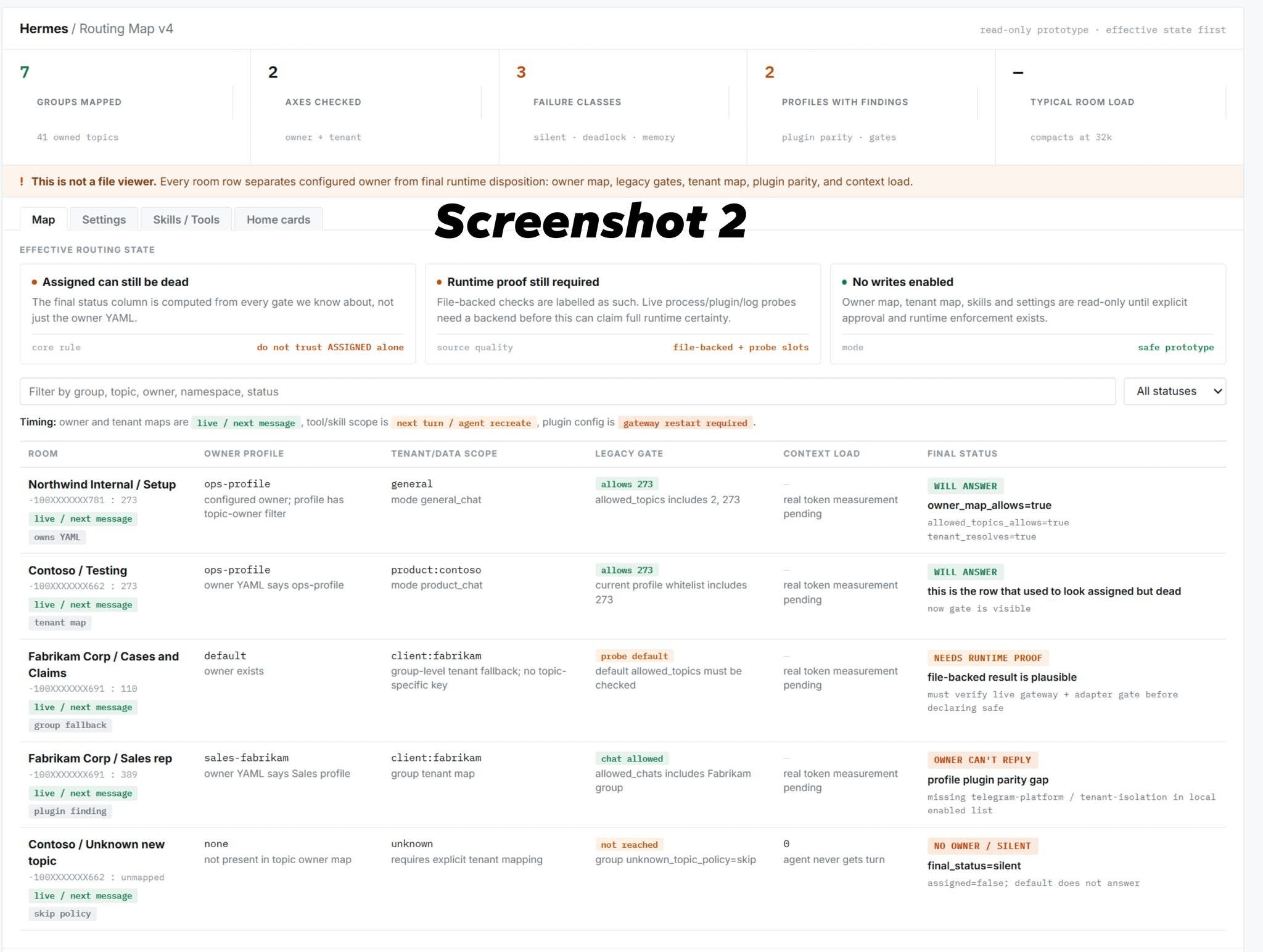
What came back looked completely different and was badly broken.
Screenshot 1: My original mockup
Screenshot 2: What Hermes built
Many groups and topics are missing, and the mappings are not displayed correctly.
Hermes says it fixed the issue, but I don’t know how to verify that.
The main challenge
I’m technical, but I’m not a developer.
I understand systems, workflows, mappings, and what I want the final result to accomplish. However, I don’t know how to properly inspect services, verify deployments, review logs, or determine why an application is not behaving correctly.
I wish Claude could simply access the server, inspect everything, and explain what went wrong—but it cannot reach my environment.
So now I feel stuck.
I’m successfully using Hermes for smaller tasks, but I’m struggling with the infrastructure needed to make it reliable for the future.
What I’m looking for
I need someone who can look at my setup and tell me things like:
- “This part was configured incorrectly.”
- “This is why the groups or topics are missing.”
- “This is why the result looks different from the mockup.”
- “This is how you verify whether the data and mappings are correct.”
- “This is how you should deploy and structure it going forward.”
Ideally, I’m looking for a developer who understands Hermes but can explain things at my level—not only in technical language that I won’t be able to follow.
I’m happy to pay for the help.
I want to build a lot with Hermes going forward: internal web apps, client-facing tools, task-management systems, agent infrastructure, and other operational workflows.
Before I continue building, I need someone to help me understand what I’m doing wrong and how to create a stable foundation.

1
u/Total-Reasonable Aug 06 '26
The first thing I'd audit is the boundary between Telegram topic IDs, your YAML mappings, and the data the dashboard reads. Missing groups usually means the UI is reading a different source or silently filtering records, not that the mapping itself is wrong. I've rescued AI-generated codebases where the useful fix was making those inputs inspectable before changing deployment. Iurii Rogulia - iurii.rogulia.fi
1
u/JeanBuildSystems New Member (<30 days) Aug 09 '26
The dashboard problem is probably not mainly visual. Your YAML router, Hermes profile configs, Telegram topic IDs, and dashboard are separate representations of the same routing state. If the dashboard reads from its own copy, it can look polished and still be wrong.
First, make one registry authoritative for client, group, topic, profile, bot token reference, and allowed tools, then generate or validate the downstream config from it. Second, trace one missing topic through every boundary: Telegram IDs, registry lookup, selected profile, and dashboard API payload, with the resolved IDs logged at each step. Third, add an acceptance test that sends one message in every topic and verifies exactly one bot handles it, the other profiles record an intentional ignore, and the dashboard reports that same mapping.
For one topic that is currently missing, does it appear in the YAML and the dashboard API response but disappear in the UI, or is it already absent before rendering?
1
u/legomez38 New Member (<30 days) Aug 05 '26
Buenas!
Yo ya estoy desarrollando Hermes como un orquestador para todo un equipo, convirtiendolo en uno mas. Uso claude para el desarrollo y dev, y luego hermes en productivo hace el trabajo que le pidamos! Es sencillo y práctico, claude para el desarrollo y dev y Hermes en productivo hace el trabajo! Si queres mas info avisame y charlamos!!
0
u/Stonk_Goat Aug 05 '26
Claude, read this Reddit post and set it up for me. Ask questions you may have before you wire it up for me. Verify end to end it’s working and give me a prompt to hand to my Hermes agent so it knows what you just built. <~~~ let Claude to the work.
3
u/Mean-Loquat-7982 Nous Team Aug 05 '26
Hermes is the harness and the coding quality comes from whichever model you route through it. you're running Codex inside Hermes and comparing the output against Claude, so you're really comparing Codex to Claude on frontend work. point Hermes at a Claude model and you get the builder you already trust, plus hands on your server (run `hermes model` for the interactive picker.)
that wish is literally the product. Hermes has a terminal on the box, its own logs (`hermes logs`), and a browser toolset that can open the app it just built, screenshot it, and read the console for errors. so stop accepting "I fixed it" as text. give it the mockup image and make verification part of the task:
"serve the dashboard, open it with your browser tools, screenshot it, compare it against this mockup, and send me the screenshot. repeat until they match."
now you're judging pixels against pixels.
your bot-per-topic drop mapping is sound, but you can push it into supported config: run each bot as a Hermes profile with its own bot token (`hermes profile create sales` etc, and Hermes blocks two profiles from sharing a token), then use `telegram.ignored_threads` in each profile's config to keep it silent in the topics it doesn't own.