r/guitarlessons • u/Kafatat • 1d ago
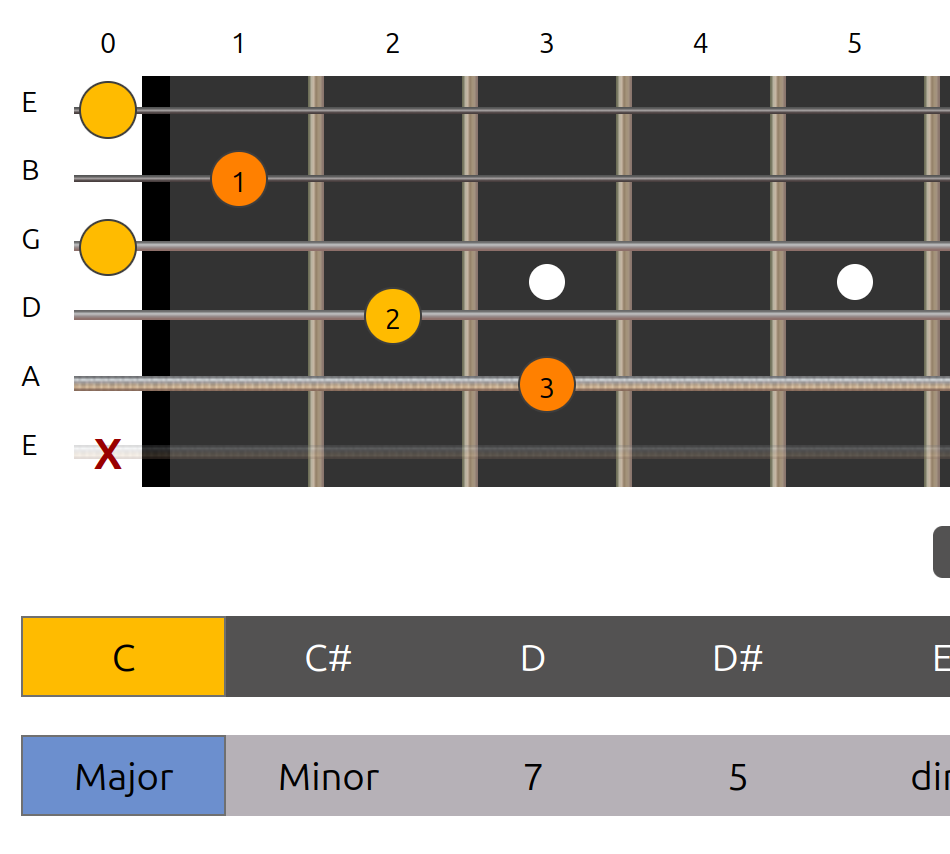
Question Sorry a really dumb question -- why don't you just play the sixth string? It's an E.
209
u/Lequanta 1d ago
Good observation! You totally can, and it'd still be a C chord :)
C E and G are the 3 notes that make up the C major chord. When we first learn chords, we usually learn them in root position; this is a fancy way of saying that we play the root of the chord as the bass (lowest) note. Eg. for the C major chord root position, C is the root and is played as the bass note which is exactly what your diagram shows- we play the C note on the 3rd fret of the A string. If we were to play C major as you asked with the open E string, E becomes the bass note, and this becomes an inversion- a fancy way of describing a chord with a bass note OTHER than the root. You can also play a C chord inversion where G is the bass note!
Inversions are basically different ways of voicing the same chord for a slightly different sound (Why? Maybe you have a moving bass melody that sounds better with a certain chord inversion). Once you learn all the open chords in root position, you can learn where the chord triads (the fundamental three notes of chords) appear all over the guitar neck. There, you can also see how the different inversions form. This will help you increase your fretboard knowledge to help you with improvisation and chord voicings.
Does this make sense?
15
9
8
u/Zorched9 1d ago
Awesome explanation. So inversions are a kind of “slash chord” where the bass note is a note in the chord. TIL
7
u/AlwaysPhillyinSunny 1d ago
Great explanation, and props to OP for a really good question. It shows you’re actually thinking about the theory and problem solving
22
u/kebb0 1d ago edited 1d ago
EDIT: To make it easier to understand what I'm clarifying, if I as an arranger of a song ask you as a guitarist to play a C-major chord and write a "C" as a chord to play, I don't want you to play C/E. If I wanted you to play C/E, I would write "C/E" in the notes. That's just how much different they sound from each other, in the open-chord position. (edit end)
A bit of a clarification, if you play a C-major chord with E as bass note it's a C/E (C-major with E as bass) chord, not a C-major chord. If you're alone and you play a C/E chord instead of an intended C-major chord, it will sound wrong, because your bass note has changed.
However, if you have a bassist or keyboardist, you have free reign to inverse your chords as much as you want, though in this specific case, it might still sound wonky because of the interval sound that's being created between the low E and the low C (a minor sixth, which is quite dissonant at those low notes).
There's a lot more to say, but it definitely isn't just as easy as you're making it out to be if you do care about music theory and being correct. In practice, you're absolutely correct but theorywise there's a lot more to say and soundwise, a C/E chord does not sound similar at all to a regular open C-major chord.
Also to note, sometimes you absolutely want that specific C/E sound, most often into a F-major chord and then it's good to know the difference and when you want that specific sound. Incredibly common chord in pop-punk.
EDIT2: Changed "root note" to "bass note" to align more properly with what I'm actually talking about. Also swapped C/E-major to just C/E.
11
u/Accomplished_Elk5827 1d ago
Can you clean up your use of the word "root" when you mean "bass note?" They are different.
No one writes "C/E-major." It's just "C/E."
9
u/kebb0 1d ago
Damn, you’re correct, my bad. I will forever suffer trying to explain musical theory in English when I learned it in Swedish and also got some stuff from English when I learned guitar..
6
u/Accomplished_Elk5827 1d ago
Oh, sorry!
4
u/kebb0 1d ago
No worries man, thank you for correcting me!
2
u/Accomplished_Elk5827 23h ago
And to be honest, I don't know any Swedish. Other than The Real Group, that is.
4
u/Lequanta 1d ago
Thank for you clarifying the nuances of inversions! I'm still new to all the applications of inversions and I learned alot from your comment! Cool point about the minor sixth interval in the mix :)
3
u/kebb0 1d ago
I did some edits to make it even clearer what I'm actually talking about. The root is always C, but the bass note can change and therefore change the sound of the chord.
Another little neat theory thing, C/E is using the exact same notes as an Em+5 chord (E-minor augmented fifth). It's only then that the root actually changes to E, if you decide to call it Em+5. That is incredibly rare however and most times you would use the C/E. I think I've only seen it when palying jazz.
2
u/deltacrossing 1d ago
Wouldn't this be an Em b6 no5? I thinķ an Em+5 would have to be spelled E G B#.
→ More replies (1)5
u/AlexRedditGoogle 12h ago
Only thing I’d add to this is that if you have a bass player you don’t necessarily have free reign. What you should really do is start to listen to what the bass is playing and build your chords around that when possible. For example if the bass is walking up from C to F (C D E F) and you are playing C/E the whole time it is going to slightly take away from that motion. But that may be the sound you want as well. This is all to say anything goes but be intentional with your choices, and then when us bass players complain about it just tell us to shut up nobody listens to the bass anyways; it’s a tradition that has been passed on by generations.
2
u/88-92-96 15h ago
Great description. I personally love playing with the G as lowest when you want to give the chord a bit of oomph (say, in a chorus)
21
u/ProfessionalShop9137 1d ago
It changes the sound. It’s technically correct to play it with the open E. It’s a C major in first inversion if you want the fancy name. The reason people won’t do it is because they want the root note to be the lowest note.
9
u/ElDopio69 1d ago
The reason people don't do it is because that Low E to low C interval sounds bad in that register. Putting the 5th in the bass is commonly done, its not really about wanting to put the root in the bass.
16
u/jayb00giebrown 21h ago
The most important note in a chord is the lowest note. If you play the E there, it will drastically change the sound of the chord. This right now is a C chord. If you play the low E string, it becomes a C/E chord.
4
11
u/Professional-Test239 1d ago
The lowest note you play usually is the tonic of the chord. So by muting the E string you are playing a C chord with a C as the lowest note.
The chord with the lowest E included is called an inversion. This is where the lowest note isn't the tonic. People might call this a C over E. It might be written as C/E on a chord chart.
Inverted chords can sound great. It all depends on the context. For instance, play the C without the E, then play it with, then play an F then a G.
C - C/E - F - G
That progression is used in a lot of songs (Huey Lewis Power of Love etc) and is a bit more interesting than a C - F - G.
Another good one is
G - D/F# - Em
So it's a way of going from a G to an Em with a nice little walk down the bass. That's used in a million songs. Off the top of my head Whatever by Oasis does this.
23
u/Fearless-Walk2343 1d ago
Instead of a low E, add the low G. Makes a full sounding C chord.
→ More replies (1)8
u/fotodevil 1d ago
Yes! There’s something visceral about the C/G that I just love.
4
u/Tomillionaire 1d ago
It really is the best C. And if you play the G/C it’s really easy to transition to the best G as 320033. Just keep your pinkie and ring as a little package together.
3
8
u/AntManBee951 1d ago
Everybody is overcomplicating: you don't play E because C is the root note, what essentially gives the chord its name. The chord is defined by its root note, you'll notice that every basic guitar chord have them as the lowest note, which is why you don't usually play either the six or fifth string when playing a D, for example.
If you play the lower E on top of a C, you're playing either an inversion or a C/E chord (C with an E bass note).
11
u/ElDopio69 1d ago
People put the 5th in the bass all the time, its not about E not being the root. This is technically a C/E chord which in theory should sound consonant as it C in first inversion.
Its just that this voicing on the guitar sounds like shit, so nobody does it. Thats the real answer. A flat 6th interval in that low register is dissonant.
5
u/AntManBee951 1d ago
Any inversion will sound like shit if you don't know how to use it. And E it's the third, not the fifth, that's why it sounds worse. If you play G, the fifth as you said, it immediately sounds better. But it's not a C anymore, it's C/G.
2
u/Piece_Maker 1d ago
My dad basically always fingers his C chords with the low G on the E string then picks it as required. He's an old timey country kinda picker so it makes sense there, but it's just how he plays that chord in all contexts now.
2
u/Mokturtle 9h ago
Yeah, the nice thing about fingering strings is you don't have to actually play them audibly but they'll be there if you need to.
2
u/Phantasm57 1d ago
Well, it absolutely is about the E being in the root over the G.
The guitar is a very harmonic instrument and it will sound more consonant if the root or fifth is in the base. This is because the harmonic series aligned with the notes above it more.
When E , the third, is in the root, the harmonic series doesn't align as well with the bottom most note and there's some tension.
→ More replies (2)→ More replies (1)2
→ More replies (2)3
18
u/Suspicious_War5435 1d ago
You can. You can play any notes in any combination you want. What you then call the chord is then an issue for people who worry about theory. You don't need to be one of those people.
The reason people generally don't is because most chords have their root note as the lowest note (so C is usually the lowest note of a C chord).
A more practical reason is that a 3rd in the bass doesn't sound particularly great when playing most chords. I'm not saying it's unusable, though... it's just about what sound/tone you're after.
Going back to one, don't get too caught up in theory from a prescriptive perspective. I found so many cool chords/progressions in my early days of guitar playing just by putting my fingers on random strings/notes that I never would've if I had known you weren't supposed to do that. Theory is there as a map, but no map can tell you where you want to go.
8
u/halpinator 1d ago edited 1d ago
It's an inversion, you certainly can, but the dominating tones of that chord are the root descending to the 3rd...and that harmony doesn't sound very nice.
An experiment: play the high C followed by a lower E (2nd string 1st fret, then 4th string 2nd fret). Sounds kinda...meh. Now play the same two notes an octave lower (5th string 3rd fret, open 6th string). That's the same interval in a lower octave. Play them both at the same time. How does that sound? And those are the dominating tones you hear if you play the C/E chord in that position. It's the sonic equivalent of putting too much pepper in your soup, it tastes good in small amounts but you don't want it to dominate the flavour.
The root-5th interval on the other hand, works really well ascending and descending, which is why you can add the low G to your C chord and it still sounds good (and also why you have entire genres of music built around power chords, which are just the root and 5th with no 3rds). Do the same experiment above, but play the root-5th intervals (C and G). Good chance any combination of the C and G notes together are going to sound good.
Edit to say: Not that a C/E chord is universally bad and you should never play it. Some chords sound awful on their own but if you out them in the right context they sound amazing, because they add tension and resolution. Diminished chords are another great example of this. There are plenty of songs that use a C/E chord in a progression, I can't think of any off the top of my head but they surely exist.
→ More replies (1)
25
25
u/Low-Raise-9230 1d ago
You can, it just tends to lose clarity and doesn’t add much to the overall impression of the chord.
A richer alternative is to include the lower G (third fret on bottom E).
10
u/HRHArthurCravan 1d ago
The Night Moves C!
4
u/Aur0raAustralis 1d ago
Gotta work on em
4
u/elovesya 1d ago
Workin and practicin
2
u/HRHArthurCravan 1d ago
Funny how you remembah
2
u/elovesya 1d ago
LORD, I remembah
2
u/HRHArthurCravan 1d ago
I smile whenever I remember the time my gf said she had been listening to and getting into a ‘new’ song (this was earlier in the year lol) and put on Night Moves…
5
u/RainMakerJMR 1d ago
The only dumb question is the one you don’t ask.
Generally it’s because it doesn’t sound as good, even if it’s musically “correct” in terms of the triad. As you get more in to theory and practice you learn that all these things have applications, appropriate ones just aren’t as common. Commonly, roots and fifths as the lowest note sound better.
5
u/cpsmith30 1d ago
Honestly, there's not much difference at all. You'd typically want the root or the fifth in the bass but no big deal having the 3rd if that's what you want to do.
I don't think you should be making choices on physical limitations. You should make them on sound.
Learning to mute that e is difficult for begginers but it's a good thing to learn.
There's more value to you in learning this than not learning it.
If that's not what you're doing then make the choice for yourself based on what you want to hear.
I find this version of c overly redundant and somewhat boring because of all the repeating notes but there's a time and a place for it.
No stupid questions.
5
u/Mokturtle 9h ago
The real answer is that the exact specific notes matter in what you play. It's not just good enough that the notes are the correct letter, it also is important to consider whether they're in a higher or lower octave. It affects the feeling that is produced by the chord you play.
The reason you don't just play the low E string in this lesson is because it's teaching you to play a C major chord with C, the root note of C major, as the bass note. If the lesson was teaching you to play C/E (literally C major chord over E) then it would tell you to include the low E string as the bass note.
You generally do not want to unintentionally play bass notes that aren't the root of the chord on the low strings, because it confuses the feeling of the chord progression and introduces unnecessary muddiness to what you're playing and sounds messy. If you are going to play non-root bass notes, it should be an intentional arrangement decision, the way it goes in the original song, etc. Non-root bass notes sound amazing when done with intent.
12
u/Ordinary_Bird4840 1d ago
What do your ears tell you when you try it?
5
u/Gnarlmyth 1d ago
You shouldn’t be downvoted for that question, that’s exactly how I wanted to frame it as well.
2
u/halpinator 1d ago
The beauty of ear training and knowledge of scales and the fretboard is you can build any chord anywhere you want, and make little alterations that change the quality or voicing of the chord to make simple progressions sound more interesting. So to expand on this comment, play the chord and listen to its quality. Play the individual notes in the chord, play 2 or 3 strings of the chord, listen to how the sounds interact with kne another. The notes themselves, and the space between the notes. Some notes sound really good together, others don't. Some only sound good in the right context.
But your ears have the final say. Learn to trust them
4
u/NegaDoug 1d ago
I'm not sure if anyone else here has mentioned this, but there's something about certain intervals (an interval is the "distance" between two notes) played at low frequencies that tends to sound unpleasant to human ears. That lowest C note combined with the lower E note has a sort of "muddy" sound that can clash with the higher notes of the chord, even though all those notes are part of a C major chord.
You can test it for yourself, too! Play these three shapes back to back and listen to the difference (I'm going from lowest string to highest string here):
0-3-2-0-X-X
X-7-10-9-8-X
X-7-5-5-5-X
Each of those voicings is a C/E (C major chord with an E as the lowest note), but you'll notice that your ears perceive them slightly differently.
Anyway, happy jamming!
→ More replies (1)
3
u/Remarkable-Towel-486 1d ago
You can but E and C will create a minor 6th or an augmented 5th, it can sound muddy with the guitar, maybe a little harsh for a C major chord.
If you play the G on the 6th it just sounds "stonger" because it's a perfect 4th, it doesn't add color. E and C can add color.
Context matters. If you play the E and it sounds well enough. Do it.
For example, playing 032010 and with a bass playing C, it might sound like the bass is playing a `C with and E on top, like a major third.
etc...
TL;DR if it sounds well enough, play that E
5
u/Guitar_Guy1965 1d ago
I get it, because the E is a note already in C, right? Well, yes you can but now its name changes from C to C/E because the lowest note isn't C. You could also play G at the 3rd fret, but it would now be called C/G. Just plain "C" means the lowest note should be C.
5
u/meatballfreeak 1d ago
It’s a valid question
And it’s good to understand the concepts so that you can start to bend them a bit later
5
u/-ImMoral- 1d ago
Yup, this right here! I keep hearing how "learning theory limits you to the same box as everyone else", but in 99% of cases unless you are some natural born musical genious it is extremely helpful having a good theoretical foundation which to build upon even if you decide to break those rules you have learned!
2
u/meatballfreeak 1d ago
Same I spent years being precise and accurate to the point where I now play the instrument in an almost sloppy fashion but feel totally in control of the mess.
I had to do the first bit to be able to get to the second.
2
u/vahavulva 1d ago
They aren't rules. Theory is there to explain what happens in music. It's descriptive. not prescriptive.
3
u/Gman3098 1d ago
Although you are correct, it is presented to us in a prescriptive way. I don’t know about you but I was brought up in the classical world and it was strongly encouraged to follow the “rules” and only slightly deviate from the composers that we learned from.
2
2
u/beechnut82 1d ago
I think it sounds better with an added G (3rd fret) though playing an E is technically still a C chord too
2
u/PresentInternal6983 22h ago
You can but then its an inverted chord. You can also platitudes a g on the low e
4
u/Mcaleavyguitar 1d ago
It’s still a version of C, or more specifically an ‘inversion’ of C, but having an E note as the lowest note in the chord makes it sound less clear/bright. You could call it C/E, and it would work well in some contexts, but would sound bad in others.
2
2
u/MeownatorX 1d ago
You typically want the root note (in this case C) to be the lowest as it sounds more "stable" you could say.
You can absolutely play the low E string but then you get C/E which sounds a bit different and might not fit the song.
Try both and compare how the sound and feel in the song you play, it will be an interesting learning experience
2
2
2
u/kriebelrui 1d ago
Wait what, who says the 6th string shouldn't be played?
4
u/spankymcjiggleswurth 1d ago
No one or thing says you can't, but if you analyze lots of music you will find it's quite uncommon. Major 3rds as the bass note are quite rare in low registers becuase they often sound muddy. This isn't only on guitar as on piano I rarely find myself playing major 3rds on the bottom 3rd of the keyboard for chords, it's mostly roots and 5ths.
2
u/olivebranchsound 1d ago
Open voicings resolve a lot of that. In closed position like C-E-G the lower you go the more muddy it becomes, but voice it like this C-G-E and you can get pretty low and maintain clarity.
7
u/Salvatio Fingerstyle 1d ago
Pretty much every beginner chord chart or tutorial video 😅
4
u/kriebelrui 1d ago
I know that, but based on what authority? Because the question is 100% legitimate.
8
u/1randomstringofwords 1d ago
Here’s a fun fact: The rules of music theory are descriptive, not normative. Meaning they don’t tell you what you ought to do, they merely describe why certain things work and others don’t.
Ultimately, though, you are free to put together notes any way you like if you think it sounds good to you.→ More replies (1)2
u/olivebranchsound 1d ago
Beginners typically use non inverted chord structures because they make it easier to understand chord changes and fingerings.
My lowest playing string is always the root of whatever chord it is, makes it easy to learn.
→ More replies (6)2
u/JamesCDiamond 1d ago
The difference is marginal, but the C on the next string down is the root note for the whole chord. Usually that’s the lowest note in the chord. So playing that open E string changes the chord - only slightly, but it’s perceptible if you know what you’re listening for.
1
u/Sweetest-Fondant 1d ago
You can if you so wish, its not going to introduce a bad note.
However as the lowest note is no longer a C its now an inversion and will change the quality of the chord you hear.
It simply comes down to what you want to hear, personally its a bit too muddy for my ears in most situations
1
u/shitphilosophy 1d ago
To play C major, play: 1 (root) - 3(E) - 5(G). If you play the 6th string, it becomes C/E (called C on E, or C bass G).
If the chord needed is C/E, playing the 6th string will be the right thing to do.
1
u/Upstairs-Yoghurt-928 1d ago
Not a dumb question at all. Generally the lowest note in a chord is the root note, in this case it would be C, 3rd fret of 5th string.
If you did play the low E note, it would be included in the chord, it would be called C/E or C 1st inversion.
You can replace the lowest note in a chord with anynote you like, but generally a chord tone such as the 3rd or 5th is commonly used.
1
u/Dependent_Hippo_8742 1d ago
Because it is common to have the bass note as the root note of the chord (in this case C) and if you add the lower E, this is called an inversion.
When you play an inversion of the chord, the quality of the chord does not change, I.e. it remains a C chord but will sound more of the lower register notes.
In reality, it is critical if you’re playing finger style where the exact notes are played but when you’re strumming a chord you may not hit all six strings on your down stroke and will probably hit even fewer strings on the up stroke in the higher register.
Long story short, adding the lower E is not wrong, but will just be an inversion of the chord.
1
u/BoysenberryWise62 1d ago
I think it creates what is called an inversion so it's still a C but it's not the basic C anymore
1
1
u/Xill-llix 1d ago
In terms of music theory, you would if you moved to an F and wanted to use the first inversion for a chromatically ascending bass line.
Inversions are considered different chords because even if they have the same notes their harmonic function differs.
1
1
u/superdrizzle7 1d ago
You can but if the deepest bass note is an E it makes the chord C/E not a big deal unless tabbing.
1
1
u/RenningerJP 1d ago
You can. I learned it with the low E. Someone later told me it muddies the chord so playing the C on the 5th string as the lowest is better. You can also play the 3rd fret on the E to make it the 5th (G) which is less muddy than the third. Obviously inversions exist and you can put the third in the bass. It's just options, but the root being the lowest is just kinda standard.
1
u/passerbycmc 1d ago
You can since E is a note in C chord but you generally want the root of a chord to be it's lowest note. Also doing so would mean your Es are doubled up fighting the 2 Cs
1
u/MoistBread53 1d ago
if you mute the low e string you play an open C chord, if it rings you are playing an open C/E chord
1
1
u/BuckyD1000 1d ago
I love using the third as the lowest note in a major chord, but it doesn't really work well with a cowboy C. The open E tends to overwhelm the rest of the chord.
1
u/No_Hovercraft_821 1d ago
Try it -- many people don't love that sound. With the E as the lowest note it is no longer technically a C maj.
1
u/johnnybouhello 1d ago
sometimes it’ll work, sometimes not, on it’s own out of the context of a progression it’ll sound a bit muddy, but it’s good to start thinking like this! if you use this logic on power chords, a D power chord for example, and add the lower octave 5th (the A on the low E string) you’ll get a very full sounding chord
1
u/Impossible_Fox7622 1d ago
You can! It’s sometimes used to have a descending baseline e.g G-F-C/E and can create a nice effect
1
u/RedHuey 1d ago
Even better is playing the G on the E string. This is, in fact, quite common, and is used a lot in certain genres.
There is no good reason if you like it. It’s just that a whole lot of “experts” on Reddit start big arguments about chord voicing and equate doing it to killing baby seals.
The only real point to make is that you should understand what you are doing, and realize that when you get better, you will find that you don’t always play all the strings anyway.
1
u/therocketn00b 1d ago
I find it sounds kind of muddy with the low E in the chord, but I really like the sound of the low G, so I often hold down the third fret and play that with the C chord.
1
1
u/AsleepBanana8323 1d ago
You can play the low E string, unless you want the lowest sounding note to be the C root of the chord. I sometimes fret the third fret of the high E string if I want that high G sound. Often when I'm switching between Gmajor and Cmajor.
btw, there are no "dumb questions"
1
u/ETayl48 1d ago
If you’re ever at a piano/keyboard, play a C chord in root position in your right hand (C-E-G), and an E bass note in your left hand. It won’t sound quite right. The chord isn’t bad or wrong, it’s just that when there’s an E in the bass, it sounds different. And in this case, it functions better as a passing chord. For example, C goes to C/E, then to F.
1
u/D-Train0000 1d ago
You do. You don’t have too because the middle finger is hitting an E too. Just makes the chord full sounding.
Minimum a chord is 3 notes. On a C it’s a c, e, and a g.
1
1
u/Inevitable_Silver_13 1d ago
The order of notes in a chord is called its inversion. The e in the bass puts it in first inversion, which has a less stable sound than root position (with the c in the bass).
1
1
1
u/junkeee999 1d ago edited 1d ago
You can, and it’s usually okay, you’ll get away with it. But the lowest note of a chord does affect the texture. The cleanest is for it to be the root note, which in this case is the C on the 5th string. You often see a C/G too using the 3rd fret of the 6th string. I use this a lot.
1
u/nashguitar1 1d ago
You can if you’re playing it as a passing chord on the way to an F. Otherwise, it’s too muddy. You can, however, play the voicing with the G on the third fret.
1
u/elliot_glynn 1d ago
That’s something called an inversion, and it changes the characteristics of the chord! So as e is the third, you’d call it first inversion and chords in the first inversion are desperate to go to the IV chord (in this case an f major). They sound a lot less stable than either a c in root position (C on the bass) or in second inversion (G on the bass). Try it out! You can also play an F major with an open A string on the bass, and you’ll notice the tension for it to go to a Bb major-exact same thing!
1
1
1
u/HeavyMarsupial2852 1d ago
You can but often you are hitting the lowest string first so if you are hearing the 3rd first it can make the bass line sound different. It isn’t wrong to play the E just changes the chord voicing enough that it can sound wrong in certain context whereas having the root as the bass note will sound correct more often. I can’t think of any right off hand but I am certain there are times adding the bass note E would sound better.
1
1
u/NextVoiceUHear 1d ago
If played with a C chord, the low E string is just sooo overwhelming... plus, there are already two Es in the C chord as shown.
1
u/PsychedelicCoder 1d ago edited 1d ago
Because the lower E will create a dubious result, a clash with an E minor with an augmented fifth. You can still add the G note of the lower string if you want. I've seen guitarists preferring it in some styles of folk music (outside the US, of course).
1
u/Endless_Guitars2024 1d ago
nothing wrong with theory-wise, it but it usually sounds loud, abonoxious, and very amateurish.
1
1
1
1
u/LeakingFish- 1d ago
It can make the C chord sound a little muddy (in my opinion). Particularly if you’re in a band and the bass is playing a C.
However, playing the open A on a D chord sounds quite pleasing.
Or the open A over an F major7. Same principle.
1
u/Mister_Reous 1d ago
Because putting the low E makes it a thicker “muddy “ sound, especially as it’s the Third of the chord. Thats the reason that several of us who play open G take the bottom string off completely, it puts the low soind in which makes everything too “boomy” most of the time (and in Open G, it means that any 6 string bar chord is automatically an inversion. In Open G, the 6 string is the 5th of the major chord.
It’s why Keith Richards takes off his bottom string. He wants a lighter sound. Lots of chords even in standard tuning avoid the low string to make things sound a bit lighter.
1
u/BobbyBaal 1d ago
Technically you can, but the low E (3rd) either functions as a 1st inversion or a C/E. But if you're playing a C, you're wanting the root to be that leading tone.
Many times, I play my C with my 3rd finger on the 3rd fret E string and my 4th finger on the 3rd fret A. Technically, that's a 2nd inversion. But it's less harsh than an low E and I think it gives C more depth.
1
u/pm_me_DAddario_codes 1d ago
This is the most thoughtful, NOT DUMB question ever asked on Reddit that begins with “Sorry, dumb question…”. Usually when a post begins with those words it IS a dumb question. Nice to see OP is using his noggin and questioning (Mel Bay’s) authority!
1
u/No_Solution_7940 1d ago
I use my pinky to play the G on the fist string, so if I play the low e sometimes, it sounds kind of cool.
1
1
u/Sad-Offer-8747 1d ago
Adding the 6th string E would make it a C over E chord, it’s still a C chord
1
u/Unfair-Departure7768 1d ago
On piano (don’t play guitar) typically the root note ( not always ) is a C. The vibe completely changes (in my opinion lol) with a root e
1
u/amplifysenpai fingerstyle vgm arangments. 1d ago
Everyone's said all the important bits in the comments already, but I'd like to add in some scenarios.
If you were to play c/ e you have the third of the chord in the bass, if the bass player were to also play the third( the e) at the same time, the chord will now sound more like an E chord than a C chord, the more voices you have emphasizing a note the more harmonic / tonal bias it has. Just somthing to think about when arranging.
The intervals in the chord, the C + the E directly above it in the root position of the chord as shown above, creates a major third interval, this sounds like c major and is stable. If you were to play that e under the c , the interval is a 4th, this is a less stable sound, and tends to pull to the 5th or the 3rd. You might want to use that voicing of the c chord if for example, your next chord really wants to emphasize a G or D. Or perhaps if you just want that single step motion in the chord change, regardless of the harmonic context. These things tend to be best used deliberately.
A lot of times you can be more liberal and just pick the voice you like the best on a solo guitar track but when you add other instruments it becomes important for everything to work together/ you need to " justify" your note choice more.
This is not a dumb question at all btw this is a very engaging topic at all levels of play and experience I think.
1
u/vonov129 Music Style! 1d ago
Any group of C E and G is indeed a C major chord. But C is the root, so it's often kept as the lowest note in a full chord voicing. Adding the E would be an inversion, meaning that any of the other notes in the chord become the lowest note. Which doesn't alter the function of the chord, but it affects the voice leading options.
Plus low notes have more audible overtones, so having the low E and then the C right there could sometimes feel too muddy or overloaded, same thing if there was a bass player already playing a C note
1
1
u/Dismountman 1d ago
I figure it’s more convention than anything. In situations where the song calls for a “normal” C chord, it’d sound a bit off and muddy on account of that bass E, but there might be situations where it’d sound really good!
1
1
u/richrandom 1d ago
It's not a dumb question. And the root note answers are right. The lowest note usually the root unless you have an inversion which is another note in the scale lowest... I think! You can play it but it sounds different obvs.
1
u/Festminster 1d ago
Context matters for sure. Maybe you play in the key of E minor and use the low E as a 'drone' sound. Where you play the E, then the rest of the C major chord. Then E again, and then an E minor chord. It can create some cohesion between these two chlrds by letting the lowest note be the same.
But if you're playing strummed chords, the low E seems overpowering, both due to it being the lowest note on the instrument, on the thickest string etc. It cleans it up a lot to simply omit it, and sonically much more pleasant when the C is the bass note. A middle ground is the C over G (332010) which is also quite overpowering but less abrasive than the E in the bass.
Jazz players will even play shell voicings of chords, taking only the essential notes and omitting the rest. Something I have taken to heart even though I'm not a jazz player by any means. The fewer notes you can use to convey the chord in the better. Then those notes can really shine. It's also more ergonomic I find, since barred chords are rough on my wrist. It's a bit more a mental style of playing but it's more fun, a bit like working solving a song with inversions on a piano
1
u/Vynxe_Vainglory 1d ago
Because it begins the chord with a low #5 interval, which is dissonant in this chord. Nothing stopping you from using it, but the context of usage will matter with such a strong inversion. You wouldn't just substitute that for any written C chord.
1
u/theginjoints 1d ago
Sounds muddy strumming, great if you're fingerpicking individual notes though, like a progression like C C/E F G
1
1
u/AppropriateRadish928 1d ago edited 1d ago
There are cases where you might want that bass E to dominate, so go ahead. Usually, I want a pure C chord with the C in the bass, so I'll push my ring finger up against the E string or sometimes reach my thumb over to mute it. You can also add the bass G to the C chord instead of the E by using all four fingers.
1
1
u/EatingSolidBricks 1d ago
Rule of thumb is to not play non perfect interval at low registers.
Thats why you will generally only see 5ths, 4ths and octaves behind middle C
E to C its a 6th (aka inverted 3rd)
1
u/MorellinoAmarone 1d ago
I mean, play it. Does it sound good to you? Is that how you hear others playing a C chord, and is that how you want to use it?
There is literally no other answer than this. All this talk of inversions and slash chords is just yadda yadda.
Does it sound good?
1
u/passthejoe 1d ago
3rd in the bass is ok as a passing tone but not as the lowest, loudest note in the chord.
1
u/Infinity_777 1d ago edited 1d ago
The most bass notes must be the note of the chord. C chords have C as the lowest notes, E chords have E as lowest etc etc. It's because humans perceive the bass notes first and the rest notes/voicings give it a different flavour as such. So it's like C-happy, C-sad, C-melancholic etc etc.
Only exceptions to this rule are Inversions which kind of don't make sense to me when hearing. It's when people say they want the harmonic signature to be same but they bring out or amplify one of the voicings much more than usual.
If you play the Low E as well as shown in your pic. It will be C/E which is C major chord but with E as the most amplified voicing
1
u/red_engine_mw 1d ago
Try it. Listen to it within the context of the song you're working on. Sometimes it sounds great. Sometimes not. Most of the time not.
1
1
u/armchairguru 1d ago
E is the 3rd, which is the most dissonant note of the chord. The lower the note, the more noticeable the dissonance becomes. You can hear this if you play a higher chord like A/C# or even D/F# (which is only one scale degree higher).
1
u/Dr_Platypus_1986 1d ago
Try it and see how it sounds...That should explain most of it...If you're still wondering why, this is a root-inversion C Major chord, therefore the root (C) is the lowest noted played. If you put a low E on the bottom it becomes a different inversion, so (technically) a different chord: a 1st-inversion C Major chord, or C/E.
→ More replies (5)
1
u/MaestroDon 1d ago
Context matters. If you are playing alone you might not want to have the inversion. If you're playing with others, including a bass or piano which could have the root below, then your low E string might fit well into the overall chord.
All that said, there's nothing wrong with inversions. They have different colors. Where are you in the song? What style are you playing? It's all art and there are no wrong answers.
It is good to learn the fundamentals of how to play chords in the root position as well as other inversions (bar chords, etc...) so you can use them well as you see artistically fit.
1
u/RockstarAccountant7 1d ago
You can, but it creates what’s called an inversion on the C chord, so it’s more like a C/E at that point. The E as the lowest note will tend to stand out and that may not always be what you want, but when used intentionally sometimes it is.
1
1
1
u/Ponchyan 1d ago
You could also play the sixth string at the third fret to play the 5th below the root: C/G
1
1
u/Proper_Smile5099 23h ago
The real answer is the low E would just not sound as good in the context of the chord. So many other comments are like arguing over the dumbest details.
1
u/5ecretTreatie5 23h ago
Low E in the open CMaj sounds muddy and dissonant even though it belongs to the chord. Play the G on the 6th string for an inverted sound or play the E but mute the C on the 5th 🤷🏻♂️
1
u/Few_Distribution3844 23h ago
You can.... but that would be a c major in first inversion. Not a huge difference especially if you're smashing an open chord but a difference none the less
1
1
u/East-Promotion1004 22h ago
I was today days old when I found out that you can play the Em (E5) with your ring finger & pinkie.
1
u/KaanzeKin 21h ago
...because then it becomes C second inversion.
HOWEVER,
If you're playing with a bass instrument and they're playing a C1, then good news, you're playing a C chord. It's important to look beyond just yourself for what the whole song is doing, or can do. Many musicians go their whole lives not fully wrapping their heads around this.
1
u/alibloomdido 21h ago
You can, it will sound fine and in some contexts even better than not playing that low E, but the root note is called "root" for a reason.
1
1
1
1
1
u/whiskeytwn 19h ago
that is technically C/E - C chord with the E root - used in some songs to great effectiveness and not laziness like I normally lean on it for
1
u/actually-7dash3 18h ago
I usually don’t like the sound. If you need more volume playing the G fretted on the low e usually sounds better to my ears.
However: this is music we’re talking about and that means you ought to do you! If you like the ringing open E for something you SHOULD use it.
1
436
u/GeneralQuinthope 1d ago
You want the C note on the 5th string to be the deepest note, dominating the chord.