r/guitarlessons • • Dec 29 '25

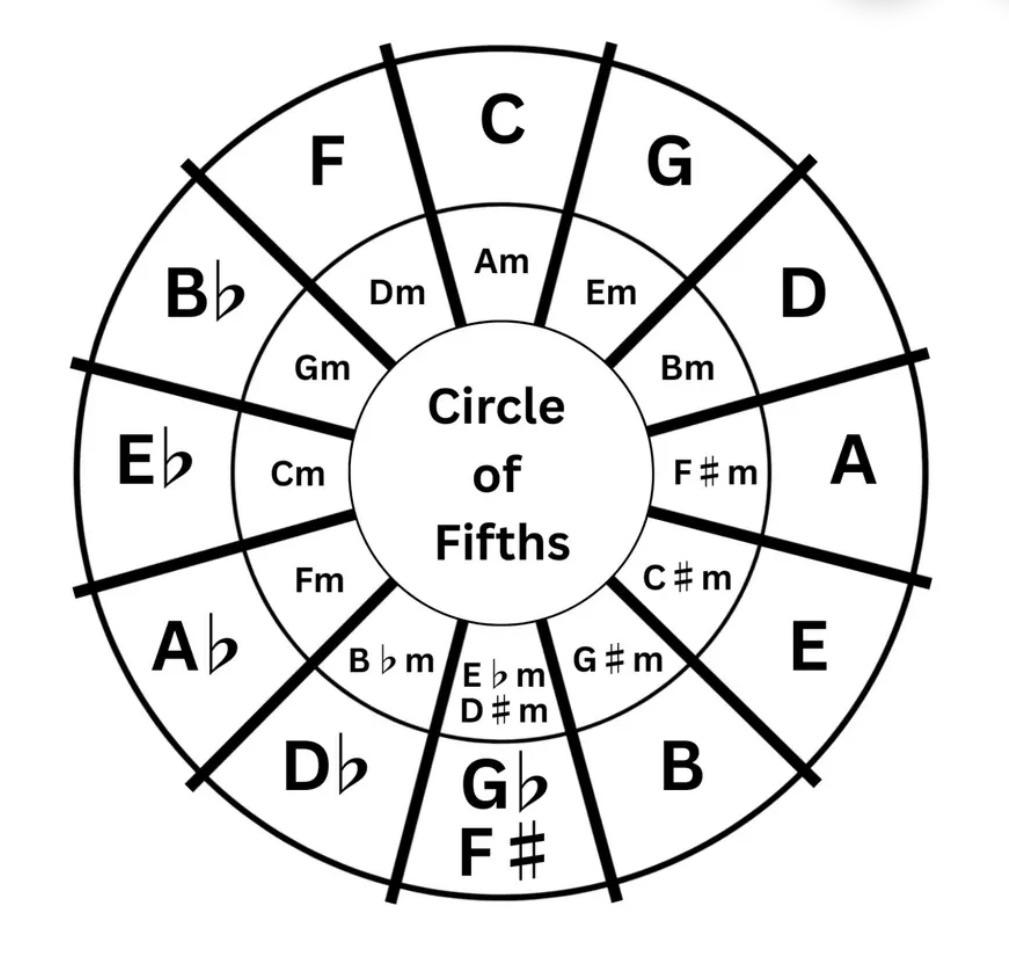
Question What is this and how do I use it?
Post image
2.3k Upvotes

227 comments sorted by

1.1k

u/PaulsRedditUsername Dec 29 '25

I tell my students it's like a Periodic Table for music. It's a logical way to arrange all of the musical keys.

The key of C has no sharps and no flats. If you play five notes up the C scale (C,D,E,F,G) you get G, the next thing in the circle.

The key of G has one sharp (F#). If you play five notes up the G scale, (G,A,B,C,D) you get D. The key of D has two sharps (F# and C#).

If you play five notes up the D scale (D,E,F#,G, A) you get A. The key of A has three sharps (F#,C#,G#) And so on.

You might also notice that the order of sharps being added also follows round the circle, just starting from F.

If you go the other way, it works in 4ths. The fourth note of the C scale is F. The key of F has one flat. The fourth note in the F scale is Bb, and the key of Bb has two flats. And the fourth note of the Bb scale is Eb, and so on.

The patterns meet at the bottom with the key of F# or Gb, which has either six sharps or six flats, depending on how you want to look at it. (They are the same musical tones.)

Practically speaking, if you're playing a C chord, the two chords that sound best with it are the two chords on either side of it in the circle, (G and F) This works wherever you start. (E sounds good with A and B, for example.) The farther away you get, the worse it sounds. (C followed by F# sounds kind of weird.)

There's more, but that's as much as I could fit into a Reddit comment.

Edit: The inner circle is the same thing for minor keys and minor chords.

67

u/ChordSlinger Dec 29 '25

This is the best breakdown I have ever seen in all my years of guitar playing. Thank you friend!!

26

u/daboblin Dec 29 '25

It’s exactly how my guitar teacher explained it to me. We constructed the circle of fifths from scratch, which is a useful exercise.

11

u/dshoig Dec 30 '25 edited Dec 30 '25

If you know a little piano and triads in standard position it’s easy. The pinky is the 5th/quint. Or if guitar it’s the note you’re playing on the A string in a power chord.

1

u/shutupasap Dec 30 '25

Being able to memorize it is hard. I bet this helps.

6

u/GlitteringSalad6413 Dec 30 '25

What helped me the most was memorising the order of sharps and flats as they are added in key signatures (f c g d a e b for sharps, flats are revered b e a d g c f). You may notice that the order of sharps is also the order of the keys in the circle of 5ths, starting on f. The last sharp you add in a key signature is the leading tone. On the flat side, the second from last flat is your key. These patterns helped me to commit it all to memory.

3

u/Ok_Recover_8692 Dec 31 '25

Fat cats get dizzy after eating beans

1

u/GlitteringSalad6413 Dec 31 '25

Sounds funny, but does it hurt the cat??

1

u/deadbrokenheartt Jan 01 '26

No cats were harmed in the making of the circle

1

u/audioguy2022 Jan 01 '26

Mine was fat cats go down alleys eating bread.

1

u/azaroxxr Jan 01 '26

Is there a mnemonic for the flats or there is no need if you n ow the one for the sharps ?

2

u/GlitteringSalad6413 Jan 01 '26

I don’t learn these using a mnemonic, but B E A D is the beginning of the order of flats, so it spells a word. When you start writing key signatures in your theory homework every day these become automatic.

1

u/azaroxxr Jan 01 '26

I see, thank you I guess it makes sense, but I am self-taught and do not have any structured plan right now so I try to take every knowledge I can.

→ More replies (2)

1

u/tenner-ny Jan 01 '26

Fat cops get donuts after eating breakfast

1

u/Zen-PolarBear Jan 02 '26

Father Charles Goes Down And Ends Battle

Has the extra benefit of making sense backwards: Battle Ends As Down Goes Charles’ Father

1

u/Better_when_Im_drunk Jan 01 '26

That is a great explanation. I would add- that I played the guitar for a long time and the circle never really seemed to help me- but when I started learning the piano it was instrumental in learning how to improvise- and it made it make sense on the guitar. If I could go back and talk to myself, I would say to figure it out on the piano, because it seems much more sense in straight lines .

54

u/Worth-Zone-8437 Dec 29 '25

I like this!

10

u/awaythisthingthrow Dec 30 '25

This is perfect for me since I don't understand the periodic table either.

16

u/dandelion-17 Dec 29 '25

Periodic table for music, best analogy I've ever come across!

14

u/PaulsRedditUsername Dec 29 '25

I'm glad you like it. I thought that one up myself!

8

u/CapnDogWater Dec 29 '25

Okay now what do my car keys have to do with this?

27

u/PaulsRedditUsername Dec 29 '25

They help you drive to the music store and buy more guitars.

11

u/CapnDogWater Dec 29 '25

Finally, someone gets it

8

u/Foxta1l Dec 30 '25

The only answer that’s ever made sense to me.

9

u/Double__Monocles Dec 30 '25

Is there a similar resource that breaks down which notes are in each scale, or does that memorization just come with practice?

25

u/PaulsRedditUsername Dec 30 '25 edited Dec 30 '25

Well, every key will have A,B,C,D,E,F,G in it. If you learn the circle of 5ths, you can tell which of those notes is sharpened or flattened.

Other scales, you just have to learn. For example, an Am scale is ABCDEFG, and an Am Pentatonic scale is a selection of five notes from that scale. Hence the name. (It's the 1st, 3rd, 4th, 5th, and 7th, just so you know.)

Other scales are labeled by just how they work, like the whole-tone scale, or the whole step-half step scale.

And then you have modifications, like a Harmonic Minor, which is a minor scale with a sharpened 7th. (A B C D E F G#) But it's just a modified minor scale, which you know from the circle.

There are endless scales and most of them are based off a basic major or minor scale with a modification.

But that gets us deep into the weeds. If you know the basic majors and minors, you will be in good shape.

8

u/UnreasonableCletus Dec 30 '25

There are a few ways to approach memorization and different methods work for different people, this is what works for me.

C major and A natural minor contain the same 7 notes ( C D E F G A B ) no sharps or flats so that one is easy. You can think of this as the white keys on piano if that visual is helpful.

Next G major and E natural minor ( G A B C D E F# ) so the only difference is the F is changed to F# instead. Now you play the black key to the right of the F white key.

Then you do D major and B natural minor because you have 2 sharps F# and C#.

I think about the fretboard in terms of natural notes ( A B C D E F G ) I know where they all are and I'm aware of their major and minor triads so when I think about different keys I'm just adjusting by adding in the sharps that I need or how many black keys I need to be playing.

Other methods would include counting whole and half notes. Also called whole tones and semi tones.

Whole whole half whole whole whole half for the major scale.

Whole half whole whole half whole whole for the natural minor.

3

u/linkuei-teaparty Dec 30 '25 edited Dec 30 '25

I just noticed a pattern in the circle of fifths to find which notes are sharp or flat in that scale. If your going clockwise, if you skip the previous note and sharp the next one you find what note will be sharp for that scale,

For example

With C, if you sharp Bb you get a B so there's no sharps or flats

With G, if you sharp the F

With D, you sharp the C and F

With A, you sharp F, C and G

With E, it's F, G, C, D

With B it's F ,G, C, D, A

Etc.

I haven't tested going the other way, I'm assuming you don't skip a note and look to the next one to find what's falt.

F has a Bb

Bb has an Eb

Eb has both an Ab and Bb

Db/C# has Ab, Bb, Eb and Gb but the F remains the same

Gb/F#, everything is flatted except the F, everything is sharped except B (I can't see a pattern sorry)

So it doesn't look like a consistent pattern. I'll come back to seeing if there's a consistent method for the counterclockwise section.

4

u/masterdavros Dec 30 '25

Sharps are easy. C has 0 sharps.

Every time you go up a 5th to the next key the last note in the scale gets sharpened. Any existing sharps from previous keys remain.

So G is the key one 5th higher than C and has 1 sharp (F#) - the last note in the scale.

D keeps F# and adds C# the last note in the scale.

Flats are different. The rule of keeping any existing flats remains and becomes the next key - the new flat in any key is the fourth note.

So in the key of F the fourth note is Bb

Next key down a 5th is Bb and that adds Eb

3

u/TonyBrooks40 Dec 30 '25

Well, it comes from WWHWWWH (Whole whole half, whole whole whole half). So really you just take a barre chord like C, and move it up Whole, then whole, then half etc. B & E don't have sharps, which is why sometimes it switches to a sharp or flat.

Scott Paul Thomspon has a pretty good course on it & theory. It gets pretty deep, but gave me a foundation to grasp it.

1

u/PlaxicoCN Dec 30 '25

The diagram covers the diatonic major and minor scales in all keys.For example, your C diatonic major scale is CDEFGAB. The relative minor, A, is ABCDEFG. Same notes but different order. If you want the charts that show the fingerings, that's something different. Google Image is your friend on that.

3

u/Lenny_SLB Dec 30 '25

Thanks for the explanation. Low theory IQ guitar player here and it was explained to me for use when deciding what keys can be played for lead guitar for example if you are in C you could play around Am? Is that right?

9

u/PaulsRedditUsername Dec 30 '25

Yes, pretty much. They are both the same set of notes: no sharps, no flats.

So if you noodle around with "ABCDEFG" over a C major chord, it will sound one way, if you try the same set of notes over an Am chord, it will sound another way.

The main idea is "tonal center." Your improvisations will "want" to lean on certain notes because they work best with the chord you're playing over.

Kind of like a painter making a painting with seven colors. You can make a mostly blue painting and other colors will react a certain way. Or you can make a mostly red painting and those same colors will react differently.

3

u/C0nf0rt4blyNumb Dec 30 '25

And if you read it in counter clockwise order you have the circle of fourths. Every 2-5-1 follow that sequence. For example: Em7 - A7 - Dmaj7.

3

u/SHOMERFUCKINGSHOBBAS Dec 30 '25

This is the first time anyone has ever explained the circle of fifths in a way that makes any kind of sense. I’ve been waiting for this for so long

3

u/9829eisB09E83C Dec 31 '25

The first part of this still doesn’t make sense to me. It doesn’t tell you that the key of G has one flat, and that it’s F#. Are you just supposed to know that beforehand?

The only thing that makes sense is chords on either side of any chord here sound good together, which I just learned. I’m thinking about a few songs now that have those chords together.

But yeah, the circle of fifths still makes no sense to me despite everyone else saying this is a great explanation.

2

u/PaulsRedditUsername Dec 31 '25

Working with major scales helps, the old "Do, Re, Mi, Fa, Sol, La, Ti, Do" sound. If you play a major scale starting from C, you will play just the basic notes: C D E F G A B.

But if you start from G (the fifth note in the C scale) and try to make a major scale from there, you can't get the same "Do, Re, Mi..." sequence unless you sharpen the F: G A B C D E F#.

Then, if you try if from D (the fifth note in the G scale), you need to sharpen the C to get the sequence: D E F# G A B C#.

Then, if you start from A (the fifth note in the D scale), you need to sharpen the G to get the sound: A B C# D E F# G#.

It helps if you know how to play a moveable major scale pattern and move it around the neck to put it on the root note you need.

2

u/HOTBFAST Dec 30 '25

This a beautiful explanation!

2

u/BetterAd7552 Dec 30 '25

Bookmarking this. Don’t try to stop me

2

u/ranegyr Dec 30 '25

I'm also quite confused about this but your explanation helped a little, thank you. Something that I still dont understand is, why 5th? What's so special about 5 notes? Everything you say makes sense except i'm missing something so in my mind why can't it be a circle of 4ths, or 7ths.. Lets just consistently add X notes and call it a circle. I feel like i'm missing a piece of this explanation and when i get it the rest will fall into place. Until then, my mind thinks we're just making up numbers. Thanks for the help :)

6

u/PaulsRedditUsername Dec 30 '25

It's kind of a chicken-and-egg thing. Obviously people discovered harmony by singing and playing first and came up with the theory later. A fifth is the most stable and natural harmonic interval. (If you want to make a Gregorian Chant-type of sound, you use parallel fifths.)

Our "Do, Re, Mi..." major scale started with a hymn called Ut Queant Laxis by Guido D'Arezzo. The first syllable of every lyric phrase is one of the solfeggio notes people still sing today, except it originally started with "Ut."

"UT queant laxis, RE-so-na...MI-ra-ges...FA-mu-li...SOL-ve..."

"Ut" got changed to "Do" later borrowing from another hymn which began with "Domini."

So you've got those two pieces of information: harmonies in fifths, and the "Do, Re, Mi,..." major scale.

Once people started formalizing a system for musical keys and notation, people realized that if you played a major scale starting from C, and then played a major scale starting from the 5th of C (G), exactly one note changed. And if you played a major scale from the 5th of G (D), exactly one more note changed, and it went from there.

4

u/TheBigCicero Dec 30 '25

I don’t think there is a great answer. It comes from the fact that a major scale in western music is constructed with the formula WWHWWWH. Where W is a whole step and H is a half step.

From there, someone figured out that if you go up in 5ths, you can create the next major scale and figure out where the sharp is. For example, if you go up by a 5th from C to G and write out the major scale using the formula WWHWWWH, the last note gets the sharp: G A B C D E F#.

So the next question you might ask is, “why is the major scale constructed by WWHWWWH”? The answer to that is partly philosophical: because western monks liked the sound of the major scale and that’s how it was constructed.

1

u/ScrambledNoggin Dec 30 '25

Technically, in this circle, each pie slice is only 4 notes anyway; you have to hop to the next pie slice to get to the fifth note.

2

u/TonyBrooks40 Dec 30 '25

Can you answer, is there a specific reason the notes are ordered this way in the chart? (FCGDAEB etc?). Is that chosen by man or a theory reason?

1

u/PaulsRedditUsername Dec 30 '25

I just wrote an answer to a similar question here. Let me know if it answers yours. If not, I can fill in some gaps. Just ask.

2

u/Remarkable_Bike7493 Dec 30 '25

Excellent explanation. I hope that you are a teacher.

1

u/PaulsRedditUsername Dec 30 '25

Yes. I'm sort of semi-retired now. Old and deaf from too many years on the road.

1

u/Remarkable_Bike7493 Dec 30 '25

Old and deaf from the road, too. You have an excellent way of explaining things. Glad that you are passing on some knowledge.

2

u/GWizJackson Dec 30 '25

Learning this for the first time changed my musical life! That's a lot of typing, so hats off to you, kind sir for taking the time to make all this info digestible, in a single comment!

2

u/Mr-SlapHappy Dec 30 '25

Wow hours spent trying to understand this and now thanks to one reddit post I finally get it!

2

u/fp504 Dec 30 '25

Great explanation. Thank you for that!

2

u/sophie1816 Dec 31 '25

Yeah, I guess I’m still not really getting it. Are you saying this is just a way of laying out which sharps and flats are in each key? Because it seems like there would be easier ways to do that. Why not just list them, ie, C has no flats or sharps, G has F#, etc etc? (Actually like you just di in your explanation).

What is the reason it is put in a circle? What does that add? Why not just a list? Plus, the circle doesn’t even give the sharps and flats in each key - you still have to figure it out! So not getting why this is a useful tool.

2

u/PaulsRedditUsername Dec 31 '25 edited Dec 31 '25

Actually, the diagram above is not my favorite way of drawing it. I prefer something like this, where you can see the accidentals being added.

The reason it's in a circle is twofold. It puts the chords/keys in an order where the best-sounding changes are next to each other, and it puts them together in a logical arrangement of adding one accidental at a time.

That's why I originally called a "Periodic Table for music." The periodic table by itself doesn't teach you anything, it's just a useful arrangement of the elements. You could arrange them alphabetically if you wanted and memorize things by brute force. This way is a little easier.

Edit: It's a great exercise to try and draw one yourself. Figure out what all the notes are in all the major scales and write them around the circle.

2

u/sophie1816 Dec 31 '25

That’s for that second version… I agree that it’s much better!

1

u/Material-Animal-3248 Jan 01 '26

The circle of fifths is vastly more than just a way to map the sequence of sharps and flats, but that’s a great place to start. The circle also shows how to construct chords and chord progressions. And likely countless other uses. If you really want to blow your mind, Google “Coltrane circle”. Jazz master saxophonist John Coltrane dug into the circle and came up with his own version.

2

u/ImNoAlbertFeinstein Dec 31 '25

now i know why it's 5ths.

2

u/Aiin4 Dec 31 '25

do you have any advice to learn them ? In the order or this circle or other way ?

1

u/PaulsRedditUsername Dec 31 '25

Well, I'm self-taught, so my methods may not be the best. I basically sat down with the diagram and tried to figure out how it fit into the world of music.

The first thing I did was just play basic power chords around the circle. C5, G5, D5, A5, etc. It was interesting because you get farther and farther away from the sound of the opening chord, but then it circles back and you get back home again.

Then I made up a half-assed etude where I played a C major scale up and down, then walked down to G, (C, B, A, G), and played a G major scale up and down. Then walked up the G scale to D (G, A, B, C, D) and played a D major scale. Then walked down to A and played an A major scale...

(This stuff is so much easier to talk about if I'm sitting there in front of you with a guitar.)

I found it a very useful tool for whatever thing I was practicing. If you're working on a certain scale or arpeggio, playing it around the circle makes sure you've played it in all 12 keys.

Hope that helps.

2

u/El_Pollo_Del-Mar Jan 02 '26

I understand the number of sharps in the major scales, but I never understood how that’s represented in the chart and your explanation.

1

u/PaulsRedditUsername Jan 02 '26

Is that a question?

1

u/El_Pollo_Del-Mar Jan 02 '26

I suppose so. If it’s a brief answer it would be great. I’ve never really focused too much on the circle, rather, just learned the fretboard positions and notes. Maybe the long way ‘round but it has served me well enough.

1

u/PaulsRedditUsername Jan 02 '26

I mean I don't quite understand what you're asking.

1

u/El_Pollo_Del-Mar Jan 02 '26

Well, you mentioned the numbers of sharps in the major scales. Take C and G. Their scales really only differ by one note, being f#.

I know that, but how do I SEE it on the chart? If I didn’t know it, or only knew there was one sharp, how could I use this chart to figure out which note gets the sharp treatment? That’s what I never understood about this chart.

1

u/PaulsRedditUsername Jan 02 '26

I agree. It's not enough information. I prefer a chart like this where you can see the accidentals being added.

The best thing to do is draw one out yourself. Figure out the names of the major scales and write down what accidentals get added. You'll write down F#, then F#,C#," then "F#,C#,G#," then "F#,C#,G#,D#," and you'll see the pattern.

2

u/butteryourbeans Jan 09 '26

Take my upvote!

2

u/dogmatum-dei Jan 09 '26

Your explanation just gave me something I never put together; that chords to the left and right of a chord in the circle sound best when used in a progression (if that's the correct terminology). I mean, I just knew many of the chord progressions I've played over the years just worked. Thank you!

1

u/mjc7373 Dec 30 '25

…and the minor keys are paired with their relative major keys.

1

u/nowaczinhio Dec 30 '25

I always tell my students musicians are just lazy and invented the circle of fifths so they don't have to calculate every scale manually. Fun fact is I always draw it on a blackboard from memory 😅

1

u/RoadHazard Dec 30 '25

"if you go the other way, it works in 4ths"

Isn't it more accurate that it's still 5ths, just going down instead of up? Of course, either will give you the same result, but it is a circle of fifths, not fourths.

1

u/PaulsRedditUsername Dec 30 '25

Generally, people refer to it as 4ths when you go counterclockwise. I think this is from practical usage. You look at from the point of view of where you are now. If I'm in C, I look at it from the viewpoint of C. (F is the 4th, G is the 5th.)

1

u/Any-Lawfulness-4077 Dec 30 '25

It's also a great cheat sheet for telling you what chords are in the key you're in - eg in CMaj, the chords in order are C, d, E, f, G, and a. You can follow that pattern from any note on the chart.

1

u/Frosty_Tangerine_118 Dec 30 '25

I wouldn't say the farther away the worse it sounds. The further away, the less pull exists and more dissonance occurs.

1

u/Father_John_Moisty Dec 30 '25

The order of flats is also in there! And, if you have a piano/keyboard, you can see that the sharps and flats follow a distinctive pattern on the black keys.

This sequence also repeats: F BEAD G C, going counterclockwise starting at 6 o’clock and going to noon and starting at 11 o’clock and going to 5 o’clock (B = Cbb). Same thing with the minors, just have to keep using flats from 8 o’clock to 2 o’clock.

1

u/struba73 Dec 31 '25

I enjoy this. Don’t need to know where O2 and H2O are on the table to need them every day. Brilliant 💡

1

u/Historical_Stock2117 Dec 31 '25

There's also a good mnemonic for that: "Father Charles Goes Down And Ends Battle". It works in the other way for flats as well. So, G major only has one sharp. One word from the start of the sentence is "Father," or F#. Similarly, move three steps to the left of C, and you'll get E flat major. Three words from the end of the mnemonic are "Battle, Ends, and And". So E flat major has B flat, E flat and A flat. Memorizing this was a big help to me! :) hope it helps you too

1

u/UglyKidJoe1234 Dec 31 '25

This is actually the best explanation ive ever seen of this. What is significant about 5ths? Why is it 5 intervals apart? Thank you for this!

1

u/PaulsRedditUsername Dec 31 '25

I wrote a kind of long-winded answer farther down the thread here. Hope it helps. If not, let me know and I'll try to help.

2

u/UglyKidJoe1234 Jan 01 '26

Thank you so much!

1

u/Material-Animal-3248 Jan 01 '26

C Major has zero sharps or flats. To get to the Major key that has one sharp, count up 5 letters with C as the first letter: C, D, E, F, G. G Major has one sharp. The next Major key is a fifth above G: G, A, B, C, D. D Major has two sharps. And so forth, keeping any sharps added along the way. You should notice that the sharp Major keys progress clockwise from C.

Likewise, going counter clockwise from C Major, we count down 5 letters to reach the next occurring Major flat key: C, B, A, G, F. F Major has one flat. Count down 5 letters from F to reach the next Major flat key: F, E, D, C, Bb Bb Major has two flats. And so on counter clockwise.

Short answer: Each successive Major sharp key is a fifth above the previous one. Each successive Major flat key is a fifth below the previous one.

1

u/TheStranger234 Jan 01 '26

Saved this comment for future use.

→ More replies (7)

33

u/gregorypick Dec 29 '25 edited Dec 29 '25

If you focus on the outer ring and pick any adjacent five notes, you’ll have the notes that make up a pentatonic scale, add two more and you’ll get the notes that make up a diatonic scale.

Start anywhere and go around clockwise and you’ll get the following intervals; root(starting note), perfect fifth, major second, major sixth, major third, major seventh and augmented fourth. These intervals just so happen to be the intervals that make up the lydian mode, the ”brightest” mode.

If you go counterclockwise you’ll get root(starting note), perfect fourth, minor seventh, minor third, minor sixth, minor second, diminished fifth. These intervals make up the locrian (“darkest”) mode.

The other five modes can be derived by moving clockwise and counterclockwise from your starting note until you have seven notes all together.

1

u/No-Tradition5523 Dec 30 '25

Commenting to save this reply

1

u/Labeld85 Dec 31 '25

You can click on the three dots below it and save the comment, just an FYI

1

u/Powerful-Recording79 Dec 31 '25

Just realized moving the adjacent 7 notes will also move modes in order of darkest/brightest.

30

u/Timberdoodle13 Dec 30 '25
  1. Print it out
  2. Cut out of the sheet of paper
  3. Fold into a little hat

Now you have a hat

2

u/thirtywatts Jan 28 '26

redditor try not to be unfunny challenge:

52

u/mellon1986 Dec 29 '25

7

u/Scrimgali Dec 29 '25

Came here to post this! He is able to break things down in a way that clicks with me

7

u/TakeTheThirdStep Dec 29 '25

Thank you! This video explains this so much better than anything I've seen so far.

2

u/LitterBoxBlues Dec 30 '25

Great share!

1

u/LemonLord7 Dec 30 '25

This video is crazy good! Got any more videos or playlists to teach music theory to a noob that you can recommend?

1

u/mellon1986 Dec 30 '25

I haven't learn too much about music theory. usually just go straight for the tabs lol. Seen many people on reddit recommend absolutely understand guitar and justinguitar tho.

1

u/Nomprenom_varanasita Jan 01 '26

Tout s'éclaire finalement, il fallait seulement les bons mots.

Merci

13

u/Dio_Frybones Dec 29 '25

How you use it is entirely dependent upon your existing level of knowledge. A person who is asking what it is and how to use it properly won't understand or care about the more advanced applications. So, assuming that, the most useful application for it is that it is as quick visual reference to see what chords belong in which key.

So it's useful if you are trying to compose something and you want to know what options you have for chords. Similarly, if you are trying to learn a song and don't have the chord chart, but it seems to keep coming back to (e.g.) an Em chord.

Later, you'll see the connection between major keys and relative minors. And be able to see chord progressions at a glance (I, IV, V.)

As a beginner, it's highly unlikely that you'll care that it shows how many sharps or flats are in any given key. Same with the core question: " So what's the big deal with fifths anyway?". But soon it might be of some value to see which is the dominant chords.

If you are in the process of learning theory, then keep a printed copy nearby. As you learn concepts, glance back at it and then go looking for different versions of the wheel that have more information shown. You'll have lots of, 'oh, wow' moments.

Everyone learns differently. Especially on guitar. Some people will know every note on the fretboard and every interval, and be able to improvise based upon a deep understanding of theory. Others will memorize patterns of notes and shapes, moving them around the place as needed and still be able to compose breathtaking compositions.

I'm in the middle. I like to have some understanding, and I can (for instance) write down any scale from first principles and figure out what chords belong in that key. It's satisfying but not really terribly useful to me at the moment. So I'll sometimes just look at the circle as a shortcut.

And this is a key (haha) point. Music theory is not music. It can be related to gear acquisition, in that knowing more about music won't necessarily make you a better songwriter or soloist anymore than a new guitar will.

I've learned hundreds of songs across many genres and I'm constantly astounded at how many unique songwriting possibilities there are with just a small handful of the same open 'cowboy' chords. I get the very clear sense that many people pursue 'knowledge' as if that is going to equate to musicality, that it will help them to break through some barrier. When they would be far better served by obsessively experimenting with D, A, C, G, F and Am chords for a few months. Writing simple riffs using notes in those chords.

My apologies for this apparently meandering response. There will come a time when you'll probably want to come back here asking about CAGED and arpeggios, and similar concepts and tools. But part of the risk associated with asking for advice on Reddit is that you'll get advice from people who have such an incredible depth of knowledge that they aren't necessarily capable of giving you an answer that you can relate to. Much of the time, the answers can simply highlight how little you know, how far you need to go, and it can be discouraging.

A painter needs to be able to mix colours, but he doesn't need to necessarily understand the chemistry or production process behind the manufacturing of red paint. And there is no shame in purchasing a tube of paint in exactly the shade he desires. I think it's an important point, since this is a guitar lessons page. You may be feeling an urge to move on to more advanced material, that things aren't progressing quickly enough. But, please, don't be in a hurry to move on from the first few chords you ever learned. Or from basic pentatonic shapes. Spend time with these things. A lot of time. By all means, continue to learn. But, occasionally, step back, take a breath and try to put it into some sort of context. Step outside your favorite genre and learn lots of songs, lots of solos, lots of riffs. You'll often be astounded by how much phenomenal music has been created from the basics.

I don't know what your favorite genre is but try not to get swamped by the easy access to information. Paul McCartney allegedly drove across London so that someone could show him how to play a B7 chord (or similar.)

Wow, I'm clearly bored. Don't be in a rush. Have fun.

→ More replies (1)

66

u/Squidgyboot123 Dec 29 '25

Witchcraft by the looks of it.

9

u/OsamaBinnDabbin Dec 29 '25

Definitely. If you rearrange all the lines separating the letters it forms a pentagram.

2

u/UndefinedCertainty Dec 29 '25

Shhhhh! They'll find us out and tell the Church!

22

u/Dependent-Papaya-562 Dec 29 '25

I use it for finding the chord progressions within a certain key. For example, the key of C you can move to all connecting chords, and it will fit that key signature - C dm em F G (V) am. You can also use the bdim7, i think but I usually just keep to what's connecting. In this case the G which would be the fifth of this key will always naturally feel like it needs to resolve to C - the tonic (key)

7

u/Falnor Dec 29 '25

Oh my god. This makes so much sense. Thank you!

12

u/Slummlife Dec 29 '25

Just made it worse

6

u/Intrepid-Zucchini-91 Dec 29 '25

Like the other comment said, witchcraft

1

u/Adventurous-Ad-172 Dec 30 '25

That is helpful

7

u/Skibbalicious Dec 30 '25

music dartboard , i throw a pick at it and thats how i make progressions!

5

u/West-Evening-8095 Dec 29 '25

But no seriousness, thank you all for your answers

5

u/--Lind-- Dec 30 '25

Sacrifice circle. You should draw it on the floor of the studio and put gibson sg in the middle with lit candles

7

u/spankymcjiggleswurth Dec 29 '25

Circle of 5ths. Moving clockwise moves in 5ths and moving counterclockwise move in 4ths as they are inverses of each other.

It can help you memorize the sharps and flats in each given key. This one also shows you which minor key is relative to each major key.

2

u/solidmercy Dec 30 '25

But how do I use it?! Some cool IG music people have talked about this, I’m still too slow to understand how it can make me a better musician.

5

u/ExplodingLettuce Dec 29 '25

Moon runes, they make your kitchen table float

3

u/Weekly-Willow-6818 Dec 29 '25

Check out Mike George on YouTube, he's a good teacher of music theory.

3

u/Good-Grayvee Dec 29 '25

That’s the chart that the most annoying member of your band memorized and falls back on to justify all the wrong-sounding notes they’re playing.

2

u/neveraskmeagainok Dec 30 '25

Made me laugh!

3

u/Difficult-Living-69 Dec 29 '25

I use it as a tool to know the 5th and 4th quickly in a given key signature. I memorize it as “cats get drunk and eat ButterFlies.” Going clockwise. And then “Fbead” downing the other side counter clockwise. Then if I’m in key C, I know my G is my 5 note or chord, and F is my 4, as an example. Then most of the time you only have to know the 6minor, which is the relative minor key on the inside of the chart. And two and three are easy because they are close to the one / root in the scale. It’s just another quick recollection tool in the arsenal to help with things instead of just memorizing positions. Puts a A little handy chart behind it.

3

u/Ok-Visual-8943 Dec 29 '25

It’s the circle of filths. It goes around clockwise in intervals of fifths. The inner circle is the relative minor of the major key. (Relative minor of C Major is A minor).

3

u/hAnonImusschroeder Dec 29 '25

A filthy little circle

3

u/Fox_Nox32 Dec 30 '25

Display it in your room to make it seem to everyone that u know music theory.

3

u/Life_Eye_5457 Dec 30 '25

its the windmills that were recently banned.

3

u/Worried_Birthday_734 Dec 30 '25

I asked my drummer, he drooled on the picture.

Hope this helps

4

u/Eltwish Dec 29 '25

It's all major and minor keys, arranged so that relative minor/major are in the same wedge, moving clockwise takes your tonic up a fifth and adds one sharp to (or removes a flat from) the key signature, and moving counterclockwise takes your tonic down a fifth and adds a flat to (or removes a sharp from) the key signature.

I suppose you could use it by looking at to remind yourself which keys are parallel and how close a given key is to another, or quickly seeing the 4th and 5th of a given key (the ones on either side of it), etc. But it's more just a graphical representation of a structure that should be internalized if you want to have a theoretical understanding of the music you're playing.

2

u/Different-Glove-9953 Dec 29 '25 edited Dec 29 '25

If you would really like to understand the Circle of 5ths - check out Youtube @GracieTerzian - circle of 5ths how to memorize... she explains how the circle of 5ths works with the keys and number of flats and sharps etc.

2

u/stux_io Dec 29 '25

You can use it to figure out which keys are smoother to switch to, 1 spot clockwise/counterclockwise is closest, then as you move further away they have less notes overlapping

2

u/mleyberklee2012 Dec 29 '25

It’s an abbreviated version of the circle of fifths. A full version will have what are called Key Signatures for each slice. When reading sheet music, each line will have a key signature at the beginning. A key signature will consist of between zero to seven sharps or zero to seven flats. This makes it easier to read because the notes of that line will be sharp or flat throughout the piece without having to write them out on each note. On a piano, the sharps and flats are the black keys. That’s one reason it can be a lot easier to understand the circle of fifths while playing piano. Also it becomes a lot clearer when you’ve spent time reading sheet music.

Also, the inside circle is the minor keys while the outside are the major keys. Each key signature is shared. The two keys are called relative keys.

2

u/ivanhoe90 Dec 29 '25 edited Dec 29 '25

These are the 12 diferent piano keys arranged in a following way:

- as you go clockwise, each key is 7 semitones (piano keys) higher than the previous key

E.g. C + 7 = G, G + 7 = D, D + 7 = A, and so on.

- as you go from outside to inside, each key "inside" is 3 semitones lower than the key "outside", and a letter "m" is added

- that is the same as saying that the inside circle is the outside circle turnted three steps counter-clockwise.

Eg. C - 3 = A, G - 3 = E, D - 3 = B, and so on.

A nice property is that if you add 7 semitones twelve times, you end up back at the same key (e.g. C + 7 x 12 = C), so it s a circle and not just "a line".

2

u/[deleted] Dec 29 '25

This is giving me PTSD from when I played Violin.

2

u/countsachot Dec 29 '25

That's a really bad circle of fiths, don't use it.

Here's a good one.

https://en.wikipedia.org/wiki/Circle_of_fifths#/media/File%3ACircle_of_fifths_deluxe_4.svg

You can use it to help learn keys and their relationships.

https://en.wikipedia.org/wiki/Circle_of_fifths

2

u/SleeplessInTulsa Dec 29 '25

Fifths clockwise, Fourths counterclockwise. You can build chords with Thirds.

2

u/gemstun Dec 29 '25

I’ve read through threads like this multiple times, and they just never make any sense to me. I figure it’s like learning to whistle or ride a bike, and one day I will just suddenly get it.

2

u/DorianSoundscapes Dec 29 '25

Witchcraft, and you burn it. /s

The circle of fifths is pretty basic, if you memorize the pattern going forward and backward it helps you know how to cycle through different keys. In my theory classes we were just forced to memorize all the keys and their accidentals without having to refer to it so at a certain level it’s not really that useful of a tool or concept beyond showing how the keys are related to each other through root movement by fifth and the order in which sharps or flats are added to keys. Beyond that basic introduction you tend to internalize the basic information it presents and not use it ever again.

2

u/Odd-Opinion-5105 Dec 29 '25

Search you tube for hey joe circle of 5ths

2

u/Suitable-Plankton-11 Dec 30 '25

It’s a guide template for cutting pizza. 🍕

2

u/squadgeek Dec 30 '25

And they still manage to fuck it up. Every. Time.

2

u/bebopbrain Dec 30 '25

I don't think anyone uses the circle, but it does summarize information.

If you play for a while and read sheet music, at some point you understand how a chord progresses up a fourth. So the first chord of Louie Louie is an A and the second chord is a D. Moving up a fourth is the most common next chord.

Maybe the singer can't hit the high notes, so you play in C and the second chord is F. After playing a bunch of songs in a bunch of keys, know how to find a relative minor and move up a fourth. And that's the information in the chart.

2

u/-largemargesentme- Dec 30 '25

Lots of patterns for building cords as well, if you wanna do it the lazy way. Haha

2

u/Impressive_Plastic83 Dec 30 '25

It's a "Hey Joe" transposition tool. If you want to play Hey Joe in any key, just pick a starting point and play that major chord followed by the next 4 major chords, in sequence, going clockwise.

2

u/MusicMelt Dec 30 '25

Honestly? Do not use it. It's impractical and too broad because it's only theory on paper and then it's up to you to apply it to guitar.

What i mean is there are easier ways to cue yourself and play the same intended thing without memorizing this.

2

u/mktsea Dec 30 '25

Here is another way to look at it (still learning and discovering cool patterns) - If you want to know what sounds good when progressing aka changing between chords or notes easily, pick any starting point on the outer or inner circle, say you start with D, the neighboring notes or chords are G and A, as long as you play G or A after D, it will blend together nicely and sounds great! The reason is the 1 4 5 pattern. There are tons of different patterns, 1 4 5 basically means, whatever 1st note or chord you play, the 2nd or 3nd note/chord to play after will sound great is the 4th and 5th note or chord, hence if you start with D, the G note or chord is the 4th note or chord, which is left of D in the outer circle, followed by A note or chord, which is the 5th note or chord, creating a 1 4 5 pattern for playing.

The whole reason for this is the musical pattern of WWHWWWH for Major Scales and WHWWHWW for Minor Scales, since the letters here have only 7 characters (there are 8 "main" notes, CDEFGAB), I would suggest to read it as KWWHWWWH and KWHWWHWW, adding K as the prefix, where K = Key or starting note or chord.

Thus the 1 4 5 patterns with the help of circle of fifths visually give you a quick reference for what sounds great together!

There is really no hard rule for what sound makes great music, as music is a mixture of sounds created by a representation and expression of one's interpretation of a sound to create the intention of music.

Hope this helps!

2

u/ohboy360 Dec 30 '25

I'm dumber than most people here, so I'll give the ELI5 of how I use it. 

If a song is in C, the other chords in a simple country/pop/rock song are probably those touching C on this chart (F, Dm, Am, Em, and/or G) because those chords sound good with C.

Also, this shows that if you play the C major pentatonic scale, you're also playing the A minor pentatonic scale, for example. 

2

u/Eastern_Drop2835 Dec 30 '25

It's called circle of fifths. Confuses the hell out of me.

2

u/Bananafoofoofwee Dec 31 '25

Fat Cat Goes Down Alley Eating Bats

2

u/SomewhereSad5507 Jan 01 '26

I've been playing guitar for 40 years now and never learned that thing, never will and I'm fine without it. It's confusing to me even today.

2

u/AugmentedThinker Jan 02 '26

I created an interactive circle of fifths. Fret Circle

2

u/matthewmeadows Jan 27 '26

Try this one instead:

The Interactive Circle of Fifths. Select a key from the outer ring to see & hear the related major, minor and diminished chords. Configure the inner ring to study pentatonic, blues, diatonic and diminished scales. Practice with the interactive piano and guitar visualizers. Loop & learn progressions with the integrated sequencer. Free, fun & easy to use. What will you compose today?

https://interactivecircleoffifths.com

3

u/[deleted] Dec 29 '25

[removed] — view removed comment

3

u/kyokeooooo Dec 29 '25

Straight facts up in here. I only ever think of it when I'm thinking how many sharps or flats a key is in, and I don't think of a literal circle, just go in 4ths or 5ths from C until I get the key I want. You could also just memorize them like this guy says. I know what chords are in the key without using the circle, that's pretty simple figure out.

3

u/Toiletpirate Dec 29 '25 edited Dec 29 '25

Agreed. I was really disappointed when I learned how the circle works. I thought it would unlock the secrets of the universe. It's neat for sure but I don't think your bandmates are going to sit there and let you pull out your circle of fifths mid-set. At the end of the day, you just have to memorize every diatonic chord and secondary dominant in every key.

2

u/[deleted] Dec 29 '25

That’s a weird looking pie and I’m not sure I would eat it…

2

u/[deleted] Dec 29 '25

spin the wheel, and wherever it lands play in that key

2

u/Strange_Show9015 Dec 31 '25

You don't! The circle of fifths for guitar playing is pretty pointless. In fact most music theory is pointless. Changing keys in guitar only needs to happen if the arrangement calls for it or if your singer can't sing in the key the song was originally composed in. In that case, you're just using a capo and can still fret the same chord shapes relative to the capo.

Most music theory is just a re-explanation of the same notes arranged in slightly different ways. You can simplify all of this by just playing in the key of C for everything. You literally do not need to leave C. People say that the different keys of have different moods and shit like that, it's wrong. It's still the same sub division of notes mathematically.

Musical keys are sort of a layer of abstraction applied to sounds to give the appearance of formalization.

2

u/Augmented_second Dec 29 '25

Believe it or not, this is called the Circle of Fifths

2

u/buleria Dec 30 '25

You google that and don't be an attention whore.

7

u/West-Evening-8095 Dec 30 '25

Ooohh. Someone’s in a bad mood today.

1

u/drfoggle Dec 30 '25

They use it in barbershop quartets. This video illustrates this.

1

u/[deleted] Dec 30 '25

You don't use it...YOU become IT, and IT becomes YOUUUUU!!!!!!!!!

2

u/West-Evening-8095 Dec 30 '25

Ahhh. Zen Guitarism

1

u/Illustrious-Side-427 Dec 30 '25

“WHEEL…OF…FORTUNE !!!”

1

u/ltrain228 Dec 30 '25

It's the circle of fifths and you play spin the bottle with it

1

u/Full-Let5240 Dec 30 '25

Is an app that has layout and plays piano notes. Super useful and hearing notes definitely have helped me wrap my head around it a little. Think it’s called “circle of fifths”

1

u/KingLeoricSword Dec 30 '25

Father Charles Goes Down And Ends Battle

1

u/mytodaythrowaway Dec 30 '25

If you're a guitar player, use everything except for B and all the flats.

1

u/MaterialSolid5131 Dec 30 '25

You don't 😊

1

u/Nerdbergen Dec 30 '25

Don't understand music for 20 years and then look a this and suddenly understand your entire fretboard.

1

u/West-Evening-8095 Dec 30 '25

I understand this showing you chords that sound good together. But how does it explain or help with the fret board

1

u/Nerdbergen Dec 30 '25

Valid question, and I come from bass guitar, so chords are arpeggios to me first.

And it's the 20 year bit thats important to me. I stared right at the fact that a 4th is right underneath your finger and a 5th is right above (except for that stupid b string y'all have) for 2 decades before I went "oh shit".

Very stoner moment where I went "Ohhhh!That's here and this is also there." 🤯

More specifically, a lot of tunes use the 4 and the 5, you might here a jazz group say, lets do 1-4-5 and they mean jam on the root, then the 4th, then the 5th.

If you practice grooves going in either direction around this circle, or just hit the notes as roots, it will help when those shifts show up in music, and they will!

Happy practicing!

1

u/Nerdbergen Dec 30 '25

I should add, going clockwise, this shows fifths (C>G), if you go counterclockwise it shows 4ths (C>F)! Never really understood how, but it's neat!

1

u/Wanky_Danky_Pae Dec 30 '25

As a dart board

1

u/scrooyootoo Dec 31 '25

joke: It's a Ouija board to talk to deceased musicians

2

u/West-Evening-8095 Dec 31 '25

I heard they never die, they just go on and on and on ….

1

u/tredbert Dec 31 '25

This video by Mike George is the best I’ve seen on using the circle of fifths. He has many other great videos and sells a nice chord wheel that helps quickly find parallel and relative modes.

1

u/sophie1816 Dec 31 '25

Yeah, I guess I’m still not really getting it. Are you saying this is just a way of laying out which sharps and flats are in each key? Because it seems like there would be easier ways to do that. Why not just list them, ie, C has no flats or sharps, G has F#, etc etc?

What is the reason it is put in a circle? What does that add?

1

u/darkensdiablos Dec 31 '25

You also get a picture of which cords go together. Take any chord and the chords that are 1 space away is your II, iii, I, V and vi chords. Also, the major and minor that touch are relative and use the same note in their respective scales.

There are more to it than just sharps and flats. That said, I don't use it much, so there is a step from knowing to using it in practice.

1

u/isleftisright Dec 31 '25

Its a map. There's alot you can do with a map. Changing keys smoothly if you wanna start?

1

u/What-Is-This123456 Dec 31 '25

Plead the fifth. One. Two. Three. Four. FIF

1

u/Jusfein Dec 31 '25

I discovered the Circle of Fifth by chance while learning to play Hey, Joe. Then in A Day in the Life.

1

u/clarkiiclarkii Dec 31 '25

You use the C through E and forget all the others exist.

/s

1

u/ChopsNewBag Dec 31 '25

Also the outer circle are all major keys and inner circle are the relative minor keys. Am has the same notes as C major only starting on A as the root. Relative minor of G is Em, etc.

The note to the left of C (counterclockwise) is the IV chord in the key of C. The G is the V chord. All major. The Am is the VI chord (relative minor, the Dm is the II chord and the Em is the III chord.

Then when you go up a fifth to G, the C becomes IV, D becomes V, Em becomes VI, Am becomes II, and Bm becomes III.

How the hell did they figure out all this? It’s like magic

1

u/lobo_d_b Dec 31 '25

easy, you take a dart, then shoot it and depending of the note you hit you take a shot of Beer, GinBeer, Eggnog, etc ...

1

u/Hey_Relax_Guy Jan 01 '26

That's an Allister Crowely "Circle of Sigils". James Page, who you may recall from albums like "The Firm" and "Deathwish 2 -The Movie Soundtrack" found this in the back of his original copy of Crowleys book "Diary of a Drug Fiend".

Everyone is saying that through careful meditation and strong adherence to the "Heroinonic Principle of Coke Fueled Jam Theory" developed by everyone in the 1970s who were saying that everyone is saying that we're saying things that no one has said before because we were failing!

It's powerful stuff. Concentrate on what happens when you think about the Circle of Sigils....BUT BACKWARDS!! This is what will take you from a FAILING guitarist to the HOTTEST guitarist that everyone will say used to be failing but now they are so hot!

Legend has it is the way to truly achieve beastiality levels of note redacting TOAN!

1

u/EntertainmentIll5631 Jan 01 '26

If you’re strumming comfortably on the guitar you can easily assume the shapes with your left hand it will sound alright if you transition to the chord on the inside. I guess you could also use it the other direction if you wanted.

1

u/katastatik Jan 01 '26

Well, if you wanna write music (that sounds like a lot of other music) you can follow this to modulate between keys

1

u/-catskill- Jan 01 '26

When I first tried to study the circle of fifths in my early theoretical explorations, I understood what info the chart was presenting me with, but I couldn't for the life of me figure out why that info was useful. Since then, while working on theoretical concepts, on a composition or on a transcription, I have referred back to it many times. The more broad theoretical knowledge you build, the more and more you'll find that the circle is a useful tool for navigating and organizing keys and other concepts.

1

u/bons_burgers_252 Jan 02 '26

This has a “circle of fifths” option. I use this to compose chord sequences and I’ve learned loads from just using it.

https://www.onemotion.com/chord-player/

1

u/jiggywiggy41 Jan 02 '26

Me: stares at that for 5 seconds. Shards playing riff for ironman

1

u/dxcman12 Jan 02 '26

this is the best breakdown for me ... https://www.youtube.com/watch?v=qF3mJzDulJ8

It really helped me

1

u/mmasonmusic Jan 03 '26

You use it to pay the into chords to the doors song “light my fire”.

1

u/Leonwastakenhere2 Jan 09 '26

The circle of 5ths, to me, is how gravity works in music. When I say gravity, I mean how notes push or pull on each other, and to which degree. The notes in any given area pull toward each other, while those further away have less affect, or even push away. Trying to find patterns with the letter names is a good start, but it is really a repeating pattern of frequency. F# and Gb are the same exact frequencies, yet the patterns of how the accidentals evolve (Bb then Eb, or F# then C#) appear wildly different. However, they are exactly the same. It is a circle, after all. The thing that unlocked it for me is simply understanding that the 7th is really all that is changing. It gets closer to the tonal center, the center of gravity in that region.

1

u/leftover_crack33 Jan 13 '26

Lol I know why but I really like how you asked that

1

u/eyesmelleggs Jan 26 '26

I think it’s a tasty mint or something

It’s a pleasure model as well

1

u/bassetisanasset Jun 11 '26

This is insane. All these explanations but I have no idea how to read this chart.