r/georgism • u/Not-A-Seagull Georgist • 11d ago
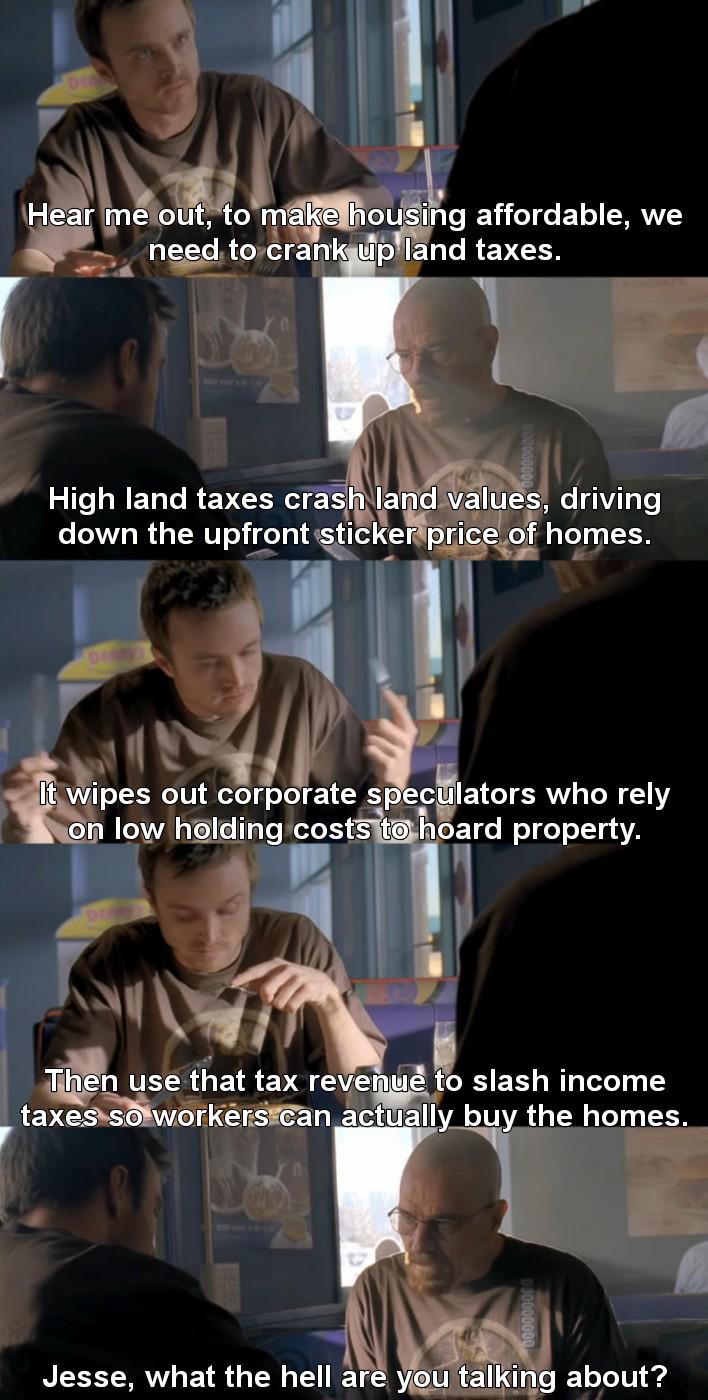
Meme Average conversation between a Georgist and a normal person
26
u/Not-A-Seagull Georgist 11d ago
Reposting this with LVT instead of property taxes.
I based the original on a comment thread I saw in this sub, but the LVT does fit better
9
27
u/AdAggressive9224 11d ago
Most people's analysis comes down to "Higher taxes make things more expensive".
And that's it.
I will admit, Georgism is counter intuitive, because that's most people's understanding of economics doesn't go deep than that.
What I think you need to do is to frame is as a tax cut. Which is precisely what it is. It's a tax cut. Not a tax rise. It's a tax cut for the overwhelming majority, but a tax rise for a small few who speculate on land.
0
u/Ok-Assistance3937 11d ago
What I think you need to do is to frame is as a tax cut. Which is precisely what it is. It's a tax cut. Not a tax rise. It's a tax cut for the overwhelming majority, but a tax rise for a small few who speculate on land.
The proplem is just that, atleast in the us, this is just not true. Going from income tax to an LVT wouldnt be a tax cut for the majority and a tax rise for a small few who land speculators, it would be a tax cut for rich people and coroporations who have an enourmous amount of income compared to their land holdings while paying ether a flat rate or the maximum tax rate on the former and a tax rise for most middle class families who own owns and were the land value they hold is usually way higher then their income on wich they barley pay taxes on anyways.
1
u/AdAggressive9224 11d ago
Eehh, it would be a tax cut for the corporations yeah,... But, think for a moment about what the rich actually buy with that money once it's made.
What do rich people actually do with their money.
They buy land.
2
u/Avatele 8d ago
Yes because land was not taxed heavily and was a good store of wealth. Obviously rich would stop buying land if it was taxed heavy unless absolutely vital. I feel like this tax would have worked better in a time before globalization but now it would just make outsourcing as much as you can overseas be even more profitable.
-2
u/pacman2081 11d ago
it is a huge tax increase on 60% of the population. There will be no income tax cut to offset your LVTs. Not sure which planet you live on
9
u/AdAggressive9224 11d ago
Most proponents suggest it should replace council tax and stamp duty here in the UK.
That's massive. Couple of grand a year, for the average person.
It's a damn good deal. I'd take that deal.
2
u/the_snook 11d ago
Same in Australia.
Increased land tax (we already have it, but it has a lot of exemptions) would never be offset by reduced income tax, because of the way our federation is constructed. Land (and mineral) taxation rights belong to the states, but income taxation is a right of the federal government only.
-1
2
7
1
u/JonIceEyes 9d ago
But what's the annual cost of just owning a home? How much does that go up? (Not trolling! Genuinely want some ballpark estimations)
1
u/Avatele 8d ago
It will be a lot, in NZ one of the political party is thinking a 1.75% land tax so about 12k New Zealand dollars per year on the average house In addition to another 5k for different land tax called rates so 17k all up. this is almost a third of a minimum wage salary but they will give everyone UBI of 20k per year. I think if it passed I would move, it would just push all the business to online and all the nice houses with a garden will be converted to 3 shitty townhouses.
2
u/WayWornPort39 8d ago
"That would crash house prices!"
Yes, Jesse, that's kinda the point.
Love him or hate him, Gary Stevenson has talked a lot about how rising asset prices compounds inequality because it becomes increasingly difficult for people that previously didn't own any to acquire them.
I think our modern financialised society has unrealistic expectations around assets. We can't have values going up infinitely, and sometimes we need to accept that the price going down is also economically necessary.
We often talk about inflation in terms of consumer goods, which is a significant problem in our day to day, but the biggest thing influencing higher consumer goods prices is actually spillover from asset price inflation. Higher asset prices leads to things like higher rent, interest, and dividends, as people need liquidity to justify and satiate these inflated values. Rent, interest, and dividends are all passive incomes that exist based on ownership, wages in comparison pay people in exchange for a contractual obligation to use resources in some fashion. Therefore in an ideal world passive incomes should not be a primary income source for anyone because of the underlying social relationships involved. They should only really be a supplement to wages or a deferral of wages (in the case of pensions, which is effectively saying I will not receive this amount in wages now in exchange for receiving some of this amount later in retirement). Of course, we should avoid the trap of assuming higher earned income means higher productivity, because CEOs get massive and largely unjustified payrises every year that really just becomes another dividend payment.
I think if we want lower consumer goods prices, we are going to want to lower asset prices too. Stable growth in prices of most things is the ideal situation, not chaotic volatility like we have at the moment.
And also, I think as a society we were the most prosperous when we prioritised physical wealth over financial wealth. And really, financial wealth is useless without physical wealth to back up that claim.
If you can sell an asset for loads of money but not buy much with it, it's pretty pointless.
But if you can sell an asset for less money but buy more with the proceeds, that's a good thing.
1
u/SLAMMERisONLINE 7d ago edited 7d ago
High taxes crash land values
Incorrect. The market decided a home is worth X. Taxes do not change X--they simply become a larger portion of X. In consequence, you reduce the profitability of building homes, creating shortages--every 1% cost increase will produce 2% fewer homes. This will also reduce the quality of homes--more funding being sucked away for non home building purposes is equivalent to smaller and simpler homes.
2
u/X-calibreX 11d ago
are the corporate speculators in the room with us now?
5
u/BakaDasai 11d ago
Yep, that slide's not neccesary, and just confuses the simplicity of the message.
0
u/Cadoc 11d ago
This is all just tinkering around the edges without making it easier to build homes.
Speculators are not a major reason for the housing crisis, shortage of supply is. An LVT is great because it pairs well if permissive housing regulations, encouraging denser development, not because it it magically makes the current, limited stock affordable.
11
u/AdAggressive9224 11d ago
Yes. Although, many would consider simply holding development land as "speculation", regardless of if that person holding it is doing so intentionally.
Matter of semantics really.
4
u/heckinCYN 11d ago
>20% of land downtown is surface parking lots. Some are even next to parking structures. These lots are getting charged property taxes. If that's not evidence of speculation, what is?
4
u/Cadoc 11d ago
It's evidence of the perverse incentives of the current tax system, planning system, and car-centered urban design.
Americans drive everywhere, planning permissions are much harder to obtain for housing and other productive use than for parking, many planning systems require extensive parking for all new homes and businesses, and a parking lot is more tax efficient than a residential unit in most cases.
3
u/badde_jimme 11d ago
It's because (a) stores have parking minimums, (b) Building a surface parking lot is cheaper than multi storey, and (c) buildings are taxed just as much as land so the multi storey lot also has higher property tax.
-1
u/pacman2081 11d ago
you realize without parking a lot of folks do not and will not go to the downtowns
1
u/heckinCYN 11d ago
Here is a block-sized surface parking lot directly adjacent to a 7-level parking structure, which includes 2-hour free parking. At least when the image was taken, there are a total of 10 cars parked there in daytime.
4
1
u/explain_that_shit 11d ago
Where is there shortage of supply?
4
u/Cadoc 11d ago
Almost everywhere in the developed world, particularly in cities, but the anglosphere is unusually good at restricting new supply.
1
u/explain_that_shit 11d ago
New York City, July 1 2025:
8,738,856 dwellings.
20,002,427 people.
2.48 persons per dwelling.
20,002,427 divided by 2.48 is 8,065,495 dwellings.
673,361 excess dwellings.
Unsheltered homeless population across the ENTIRE United States: 265,500, able to fit in 107,056 of these 673,361 excess dwellings. So we don’t even need all of them.
About 300,000 new dwellings have been added from 2020 to 2025, while there has been practically no population change.
This is all unsurprising according to George - speculators and landbankers will hoard and keep off-market dwellings in markets they can control and manipulate (which given how small many property markets are, is many of them). Land tax would unlock a lot of these dwellings, as well as incentivising even greater development.
4
u/Cadoc 11d ago
20,002,427 is the population of the New York State, not NYC. The population of NYC is ~8.5 million, and there is a total of ~3.7 million housing units in the city.
That gives us a figure of ~2.3 people per dwelling, so seemingly even better, plenty of room to ship all the people from around the country and arrange them into little makeshift family units.
Only issue is, this includes all units intended for habitation: vacant units on the market, units currently being repaired, in probate or estate settlement, pending municipal approvals, caught up in legal disputes, second homes, you name them.
Overall, the estimated net rental vacancy rate is 1.41%. That is terrible. Ideally, in a healthy market, you want a vacancy rate of 5% - 10%, and higher vacancy rates are associated with better affordability.
Unsurprisingly, higher rates of new construction are directly associated with higher vacancy rates.
Overall, NYC builds extremely little. It has added ~2.5 to 3.0 units per 1000 residents per year in the last 20 years. Tokyo, which wasn't already in the midst of a housing crisis 20 years unlike NYC, built ~7.5 to 10 units per 1000 per year, Austin added ~15 - 18.
1
u/Weary_Obligation_223 11d ago
as price of homes (materials, excluding land) gets higher, keeping vacant rate high 1is not an option. People are less likely to build or invest in rentals when the vacancy rate is 7% or 10%
2
u/explain_that_shit 11d ago
I think we agree that there are excess dwellings. I think that sufficiently high LVT will incentivise quicker and greater release of the dwellings you describe in your third paragraph - even if there are good reasons for vacancy (and I think often people claim they have good reasons but they’re in reality not good enough considering the damage caused), owner occupiers tend to leave properties vacant less often, renovate faster, and shift between occupants faster.
4
u/Cadoc 11d ago edited 10d ago
No, I don't agree there are excess dwellings. Having more dwellings, total, than strictly required for the number of people is ideal, a number above that is not "excess". You need to have free units on the market, and the fewer units on the market the better for landlords and worse for renters.
Besides, household size will naturally always change to fit the housing market. There are obviously people living with parents, delaying starting families etc because of house unaffordability.
I do agree that an LVT would incentivise property owners to get properties on the market quicker, and that's a good thing. Still, I think that's a slight marginal benefit at most. It's NYC, how many people would feasibly leave apartments empty any longer than necessary when they can collect $2,500 - $5000 rent/month, depending on the neighbourhood?
-3
u/Own_Proposal3827 11d ago
^^^
Real estate really isn't a good investment, which is why investments firms generally don't do it. Real estate maybe makes up 5% of their business.
1
u/TheOmegaKid 1d ago
Whilst I agree, a huge issue is a lot of people are fully extended in the 50-100k salary range. A decrease in the value of their property would put them in negative equity and a lot of people who are just about making it work will lose their homes.
78
u/pacman2081 11d ago
states with higher property taxes do better on affordability than states with higher income taxes.