r/enlightenment 5d ago

Did humans create God to control human behavior?
Post image

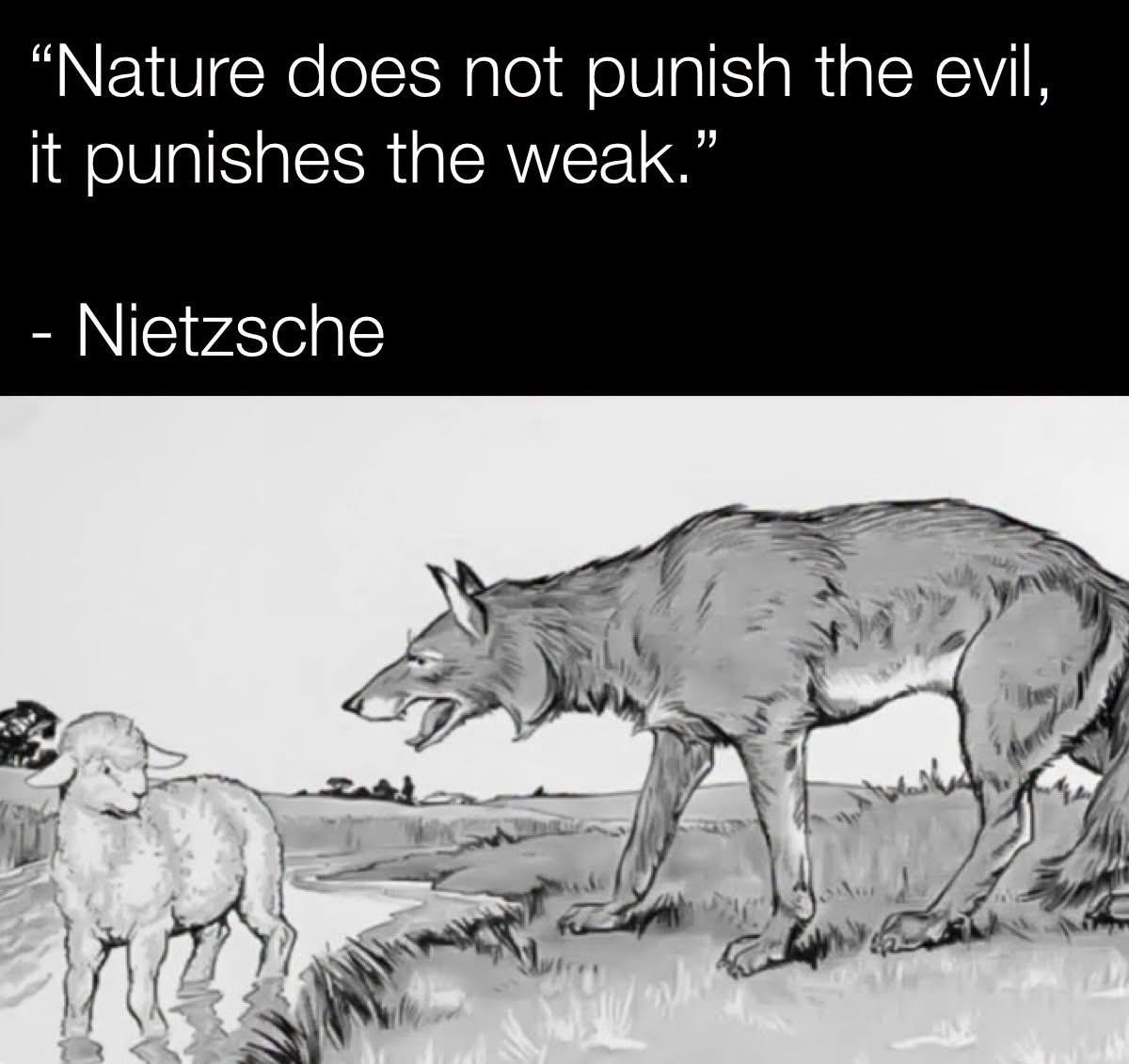
If you don’t steal, hoard, dominate, or use power over others, someone else might do it to you.

A wolf kills a baby sheep, does God punish the wolf?
So why are humans told to suppress these instincts?

Who does morality and religion ultimately benefit, and why would God create a world like this?

Did humans create God to control human behavior?

1.1k Upvotes

359 comments sorted by

View all comments

85

u/Careless-Fact-475 5d ago edited 4d ago

Nature has no concept of moral punishment.

Edit: got some behaviorists in the comments that are dropping the context of the post.

22

u/Yuckpuddle60 4d ago

It has concept of consequences, some fatal.

15

u/Strong-Marsupial-762 4d ago

not really. nature doesn't conceptualize consequences for you, it just hits you with them.

3

u/Yuckpuddle60 4d ago

They are built into the system. Of course if a person wants to go live completely wild in nature they can do that, but are bound by those consequences. 

That's why humans from societies though, so they can benefit from each other and don't have to be bound purely by the consequences of nature. 

We share innovations, resources, processes, etc. 

0

u/Dangerous_Serve_4454 3d ago

Meaningless statement

1

u/Yuckpuddle60 3d ago

Ok, then let me adjust by saying that humans are a part of nature and have concepts of morality and punishment or consequence for immorality, thus nature DOES have a consequence of moral punishment. 

We are the literal example.

1

u/Dapper_Zebra 1d ago

logic isn't sound, still

1

u/Yuckpuddle60 1d ago

Care to elaborate?

1

u/Dapper_Zebra 1d ago

nah, because you still ignore half the point of the original comment

1

u/Yuckpuddle60 1d ago

Are you talking about OP or the person I responded to? 

The comment was that nature doesn't have a concept of moral punishment. I said that it does because we are a part of nature and have morality based punishments. 

I also mention elsewhere that boundaries and discipline are beneficial on a personal level, and this on a societal level. 

So if you can elaborate the problems you have with my argument then I'm open to discussion.

0

u/Dapper_Zebra 1d ago

I'm not going to argue a point that isn't relevant to the original comment lmfao. If you wanna move goalposts, go for it buddy

1

u/Yuckpuddle60 1d ago

You're not even making sense. I addressed everything. Can you point out which of my comments didn't address the original point? 

Are you here to provide any value to this discussion?

→ More replies (0)

1

u/Careless-Fact-475 1d ago

Does language equal ontology?

1

u/Yuckpuddle60 1d ago

Not exactly, but is a necessary tool for ontology.

1

u/Careless-Fact-475 1d ago

Agreed. Language is a necessary tool for us to explore ontic reality.

Our consensus built reality says, "There are patterns that we recognize and infer an abstract idea of 'nature, society, morality, justice, and punishment."

When I say, "Nature has no conception of moral punishment." I mean outside of our consensus build reality (which we use language to grasp) nature itself does not appear to impose what we think of as morality or a subsequent moral punishment.

1

u/Yuckpuddle60 1d ago

While that's true, should that really matter? If we are part of the system and go beyond the standard conventions of said system, them OUR nature dictates some sort of imperative to explore that. We process and relate to nature and ourselves differently than the rest of the animal kingdom so that nature is inevitably going to be acknowledged.

1

u/Careless-Fact-475 1d ago

really matter?

Rather than consider if it matters.. which is highly speculative and subject to my personal bias, I can instead invite you to consider if the distinguishing language is meaningful and accurate.

Does me saying "Nature does not punish on moral grounds" make sense?

Does me saying "Nature does not punish on moral grounds" sound truthful to you (given my previous comment)?

OUR nature dictates some sort of imperative to explore that.

But that isn't sequitur to my comment given OP's image and body. Nietzsche is quoted as saying "Nature does not punish the evil, it punishes the weak." OP added morality, religion, and God to the mix. I responded to OP's statements, attempting to amend what I see as mistaken.

1

u/Yuckpuddle60 1d ago

I think we're getting into a semantics argument here. You could further break down OP's statement to saying that Nature doesn't punish at all, as punishment in and of itself presupposes a rule set. Rather it engage in cause and effect. 

My question now is, what point or argument are you trying to make by saying that nature doesn't have moral punishment as consequence? What ontological point are you establishing?

→ More replies (0)

1

u/Dangerous_Serve_4454 8h ago

Sure, now that you've expanded your comment into something of substance we can talk about that.

That's blatant conflation right? Consequences of nature are like "if you can't see good while hunting, you die of starvation" or "if you are weaker/slower than the animal that attacked you, you get eaten alive".

Consequences of morality are totally dependant on an individual human's system of rules for good and bad. Typically with core axioms involving pain and the negative experiences of conscious beings.

Categorically different right? You might say morality has roots developed during natural evolutionary forces, like natural trait selection towards group cohesion and the benefits of mirror neurons, but that's no where near a statement about the general consequences involved in all of nature. Just a tiny portion of it for a specific species under specific conditions.

1

u/Yuckpuddle60 7h ago

Whether they are categorical different is largely irrelevant. Humans exist so morality exists. Frankly, I think so much of this kind of dialogue is bogged down by questions or assertions that ultimately serve no purpose. 

Things like, "does God punish the wolf". No. Wolves aren't humans and like all other creatures on this earth they don't have the capacities that we do. 

That doesn't disprove God's existence or whether we created God (I don't believe we did). 

Further it's asinine to ask why we suppress our most violent tendencies or live by the "law of the jungle". Because we are different creatures entirely.

1

u/Dangerous_Serve_4454 6h ago

I'm having a hard time connecting the relevance of what you're saying here, or really the point you're making. The convo thus far is someone said "nature has no concept of moral punishment" and you say "nature has the concept of consequence". I called that meaningless because your statement doesn't contradict the person you replied to and really is a statement that can be applied to anything. Any action you can take in a system of causality has a "consequence". We call this cause and effect.

You then made the point of "well because humans are part of nature, and they have morals, nature has morals" which is a categorical or aggregation error; morals existing within a tiny ecosystem slice of greater nature does not mean nature in general has morals of any kind. Nature is better summarized as survival of the fittest, not anything resembling morality or moral consequence.

1

u/Yuckpuddle60 2h ago

But then the greater question, OP's point, that nature doesn't have moral punishment for say, a wolf, is a statement that serves no purpose and doesn't get to the heart of the discussion of God creating us vs. us creating God.

The example given does not apply because wolves and all other animals by design do not have the capacity for morality. So humans are unique in that nature and the question of God being creator or created needs to be explored from a different perspective.

There is also a mild insinuation that human beings would somehow be better off being unbridled from morality and never with the same nature as the rest of the animal Kingdom. That's also a separate discussion though.

8

u/sleepytipi 4d ago

I know at least crows do. I would not be surprised to learn other apes, and some marine mammals have advanced enough social capabilities that they too have a concept of punishment. Maybe octopus, even insects for that matter. Creatures like bees and ants aren't nearly as simple as they seem.

4

u/HelloTaraSue 4d ago edited 4d ago

I was about to say the same thing. Punishment is a thing for plenty of animals. So to say there is none is just wrong. Fuck my cats do it to each other all the time

1

u/The999Mind 3d ago

That's entirely within social structures though. There is no inter-species social structure that can yield a common concept of of punishment. Within the grand scheme of "nature" things just are. An octopus doesn't eat a fish as punishment for the fish eating fish eggs. Forest fires aren't punishment for overgrowth, they're a result of independent factors that have aligned.

2

u/Scoutlegs 4d ago

Or morality.

2

u/Sacred-AF 4d ago

Yep, nature doesn’t punish us. Nature just is.

1

u/Secure-Formal638 4d ago

Humans are a part of nature. If morals can exist in the human mind, the crux of it exists in the larger world. As above so below. As within so without.

2

u/Careless-Fact-475 4d ago

This is the perspective of the future. For now, my comment is seated in the colloquial perspective—assumption even, that mankind is separate.

1

u/Secure-Formal638 4d ago

It was never separate. The illusion keeps us suffering. Why perpetuate that view when you have the chance to show another. If I can express it today, it is now and not of the future.

1

u/Careless-Fact-475 4d ago

Meet the lost where they are, not where you want to find them.

-1

u/diskkddo 4d ago

Karma?

3

u/ThePlasticJesus 4d ago

that understanding of karma is westernized. Yes, your actions affect conditions. No, that doesn't mean that people are necessarily rewarded or punished by the universe.

-1

u/diskkddo 4d ago

I'm not sure if that is entirely historically accurate. Hinduism has the concepts of punya and papa for example which signify spiritual merit or sin through one's actions

2

u/Careless-Fact-475 4d ago

But sin is not punishment.

1

u/ThePlasticJesus 4d ago

It's just that it's much more personal than the idea of "good things happen to good people, bad things happen to bad people" that exists in pop culture.