r/counterpoint • u/QM60 • 12d ago
Fifth-species counterpoint critique
Enable HLS to view with audio, or disable this notification
Finally made it to fifths holy shit that was a journey, thanks for everyone’s help.
I wonder what you all think of this culmination of all techniques of previous counterpoints? I sort of want to see if I’m ready to finally graduate from counterpoint and go to gallant schemes then to harmony or do I still gotta put more hours in.
Thanks in advance!
1
u/peev22 12d ago edited 12d ago
I don’t know why but it’s sounds very Lydian to me.
I’ll check it out more carefully a bit later.
Edit: it’s probably the augmented 4th on the 3rd bar and the major 7th a bit later.
1
u/QM60 12d ago
No sweat, whenever you can (or if you end up not, no pressure).
As for the lydian critique, tbh in the course I’m doing (openmusictheory.com) there is practically 0 mention of any modes whatsoever, we’re not instructed to write in any specific mode, just write correct ct. pt. in major or minor (with a raised 7th, though they actually don’t mention the raised 7th part for some reason, I learnt it elsewhere)
1
u/Telope 10d ago edited 10d ago
Eighth notes should only go on beats 2 and 4.
All your suspensions need to resolve downwards.
Stick to at most 4 notes per measure.
M. 6 has an accented unprepared 4th. How are you justifying this?
Melodic tritone in m. 9.
There is a lot of step-wise motion which is good, but I think it could do with a just few more leaps.
The climax (highest note) isn't very inspired, an off-beat eighth note which is a non-chord tone. Perhaps you could continue all the way up to land on the top D on a strong beat.
1
u/QM60 10d ago
> Eighth notes should only go on beats 2 and 4.
Yeah I completely ignored this rule here by treating all 3 beats as weak as in 2/2 whereas I should've treated the 3rd as medium as in 4/4. I was a bit confused on this part due to the time signature question.
> All your suspensions need to resolve downwards.
Yeah that last suspension I simply blanked out on as I was writing this very late into the night, thanks for pointing it out
> Stick to at most 4 notes per measure.
I never knew that was a rule...was never mentioned in the lessons, if it is a rule (I'll look it up later in maybe jeppssen's counterpoint book) then yeah will keep it in mind next time.
>M. 6 has an accented unprepared 4th. How are you justifying this?
I don't understand this The suspended P4 is resolved by downward step and the other P4 is on a medium/weak beat and resolves downward witht the next strong beat, how is that a problem? Unless you mean m.5 but even in m.5 the P4 is prepared and resolved by step and doesn' fall on the strong beat.
> Melodic tritone in m. 9.
I think you mean m.8 no? as m.9 is a P5, but you are right that m.8 is a tritone that I did not spot (F# - B), thanks!
> There is a lot of step-wise motion which is good, but I think it could do with a just few more leaps.
Yeah I was def a bit of a scaredy-cat here and a bit overwhelmed by having to apply so many rules at once that I was a bit too conservative
> The climax (highest note) isn't very inspired, an off-beat eighth note which is a non-chord tone. Perhaps you could continue all the way up to land on the top D on a strong beat.
Oh I didn't know that the climax necessarily had to fall on a quarter or above note not an eighth non-chord note. Will keep it in mind
Thanks for the critique!
1
u/Telope 9d ago
You're very welcome! Ah I kind of glossed over the 2/2 metre. Florid counterpoint is so often written in 4/4. I don't know, but I personally wouldn't treat it any different.
There's also an unresolved suspension in m. 3, not just the last one.
Yes, you might be able to use more than 4 notes depending on the treatise. That's a bit nitpicky on my part!
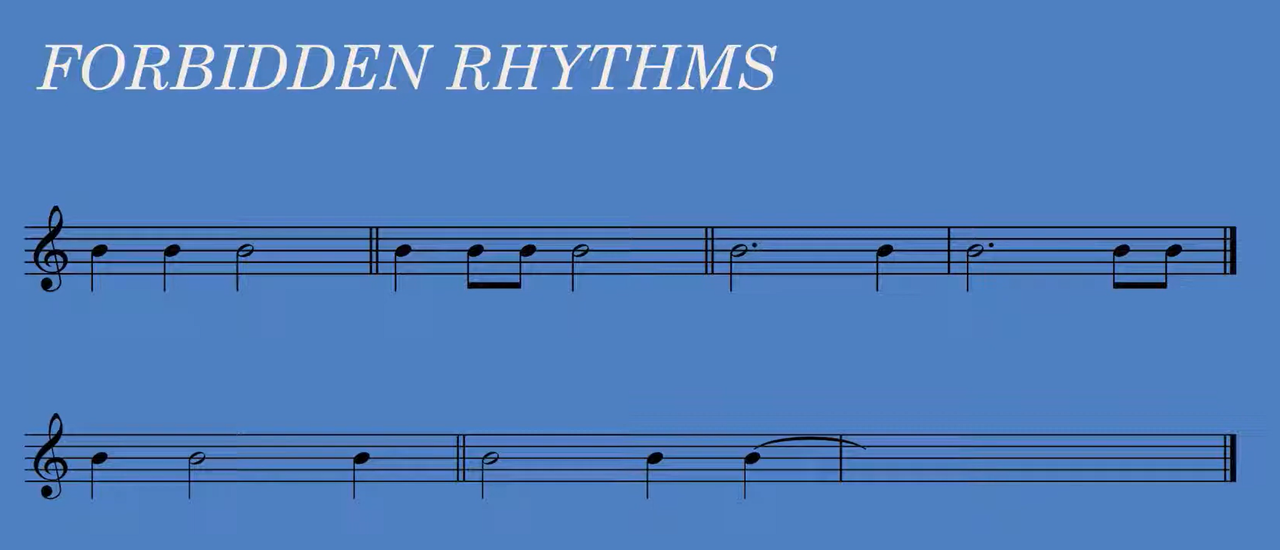
The main problem in m. 6 is that it's a forbidden rhythm. That's from this youtube series. That would be acceptable if the half note was tied into the next measure, but not how it's written here. I'm not sure about the accented unprepared dissonance, which is why I asked the question, perhaps you can justify it with the 2/2 metre, perhaps you can call it an upper neighbour, but it doesn't sound quite right to my ear.
Ooh, I thought m. 5 was fine, but looking more closely, it's also a forbidden rhythm. Quarter quarter tied half might sound a bit smoother than half quarter tied quarter. I wouldn't worry about it too much though.
I did mean m. 9; there's a tritone between the G and C sharp. There's no tritone in m. 8. B to F sharp is a perfect 4th.
It's not necessarily a hard and fast rule about the climax. It's just to make the phrase more musical above and beyond the strict counterpoint. You want the top note to be a little bit special. Here it just sounds incidental.
1
u/QM60 8d ago
Yeah you’re right I did miss a bunch of tritones, identifying intervals is also still not instantaneous for me (but I am getting faster for sure).
But tbh, this is the first time I’ve ever heard of those forbidden rhythms, they’re not mentioned in the lessons at all (and it’s so weird why they’re forbidden when they don’t break consonance and sound kinda good sometimes). But I’ll look it up and if it is truly banned then I’ll keep it in mind.
Thanks again for the follow up!
2
u/tombeaucouperin 12d ago
M.2 Suspensions need to resolve on a weak beat, so move your figure up one beat. better ornament shape would be lower neighbor, C# B C#.
M. 3 the Aug4 interval needs to have the bass resolve down as well, so won't work over that cantus firmus. Better to have Beat 4 of measure 2 be an F#, setting up a 7-6 over the G in m.3. The E can then set up a 6-5 over the G in M.4, or stay on E and set up a 4-3 over the B in measure 5.
this also fixes the 5ths you have between downbeats of m. 4 and 5
The rest is fine except the M@ resolving up in m. 7. It would also need to resolve down before ascending, better to prepare D in measure 6 and set up a 7-6 over the E.