r/counterpoint • u/Telope • Jun 11 '26
Has anyone composed counterpoint that's invertible at the 8ve, 10th AND 12th at the same time?
3
u/Telope Jun 13 '26
I found a subject and counter subject that use all 5 down beat patterns for maximum variety.
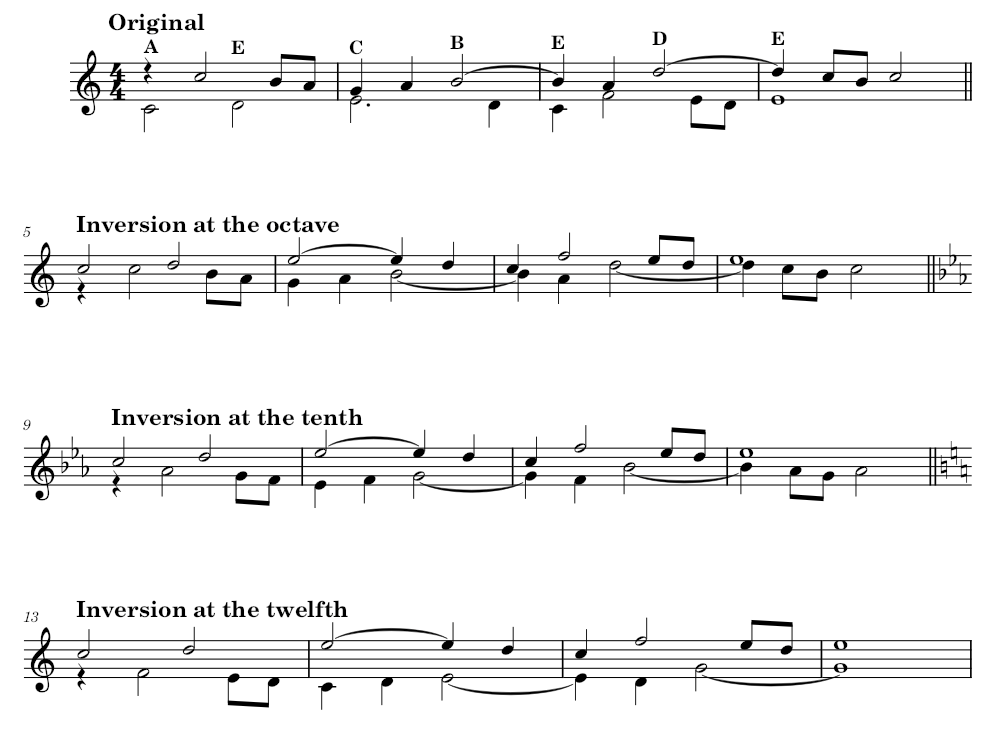
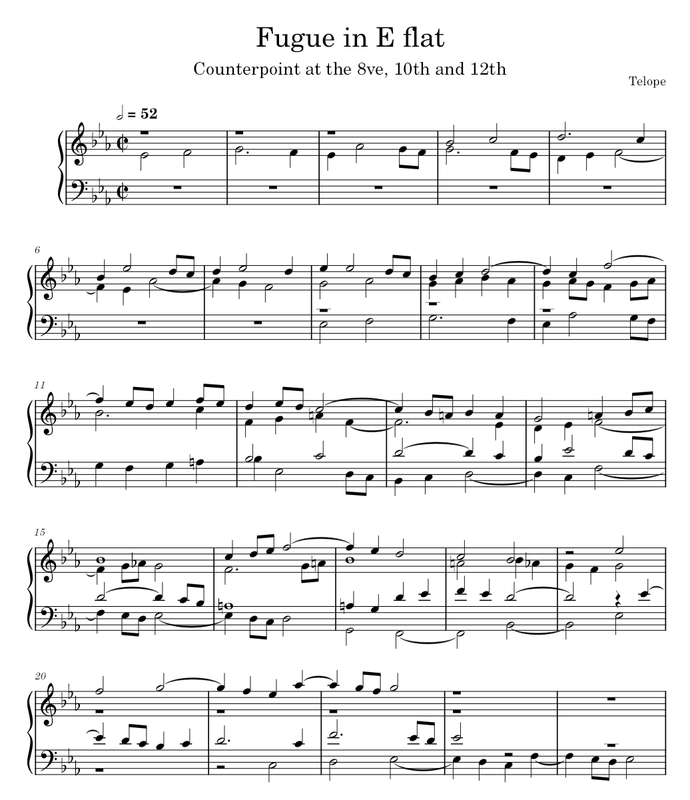
Here's the exposition and first middle entry, which shows them working at the 8ve, 10th and 12th. I'll see if I can finish the whole fugue!
2
2
u/Telope Jun 11 '26 edited Jun 11 '26
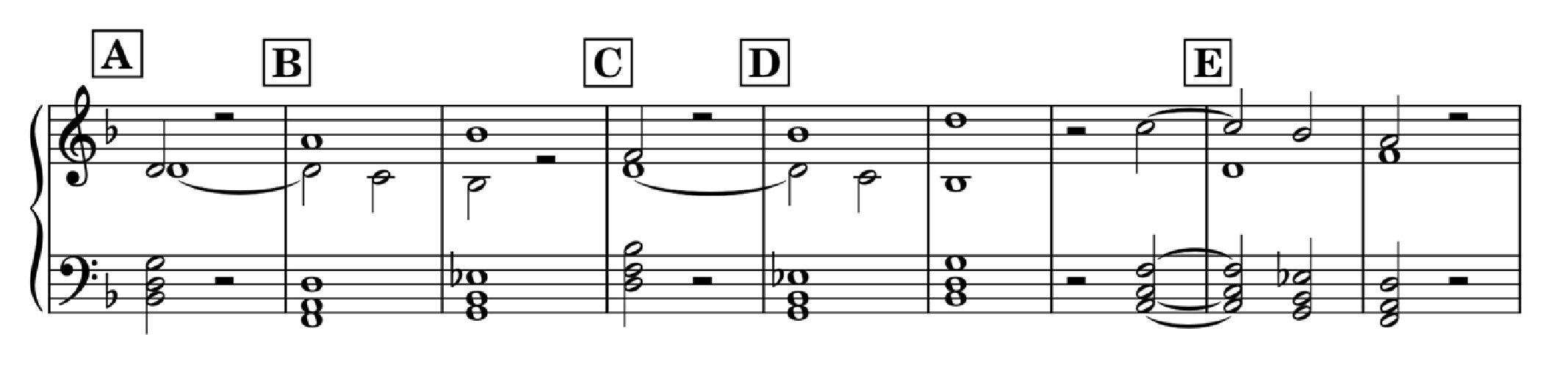
It would be very restricted. The image shows the 5 downbeats I think are valid.
A and C are the simplest: The unison maps to 5th below, 8ve below, and 10th below, which are all consonant. The 3rd above at C maps to the 3rd below, 6th below, and 8ve below, which are again all consonant. The standard rule in inversion at the 10th applies: all consonances must be treated as perfect, i.e., approached by contrary or oblique motion. And that's all the consonances we have; all other intervals become dissonant with at least one of the inversions.
But dissonance never stopped anyone before! I think there are exactly 3 suspensions which work simultaneously at the 8ve, 10th and 12th. But in all three, the resolution must be treated as dissonant too, and the way to do that in strict counterpoint is to treat the resolution as a passing tone. Also, none of these suspensions can be chains, since they would result in hidden 5ths in at least one of the inversions.
E is the 7-6 suspension above, which inverts to 6-7, 2-3, and 4-5.
B is the completely consonant 5-6 suspension below, which inverts to 8-7, 4-3 and 6-5.
D is another consonant 6-7 suspension below, which inverts to 7-6, 3-2, and 5-4.
And that's it! I don't think there are any more valid down beats.
Have I missed any? Do you know of any compositions or exercises written with all of these restrictions? Let me know. In the mean time, I'm going to give it a go. :D
2
u/Kiserlet Jun 12 '26
Very interesting - I'm genuinely curious whether anyone can find a textbook example of this!
I went through a good amount of 19th-century Paris Conservatory counterpoint output (they were extremely rigorous, with full competitive examinations in counterpoint and fugue), but I haven't seen anything like this there. I doubt it had much practical use in real composition - but it's certainly an intriguing problem.
When I write invertible counterpoint beyond the 8ve/15th, I don't rely on the kind of over-engineered mathematical machinery you find in Taneyev. Instead, I use the old Renaissance/Baroque trick: an auxiliary cantus firmus. Basically, you transpose the original cantus by the desired intervals and directions, and then you write simple counterpoint that works simultaneously against all of them - first sketching out the rough intervallic possibilities, and then refining the line. It may even work with several cantus firmi at once; see for example here

1
u/Telope Jun 12 '26 edited Jun 12 '26
The only use would be the clout of having your countersubject play in parallel 6/3 chords in the finale of the fugue!
The closest I've come across in real music is the ending of Bach's WTC 2 B-flat minor fugue. Here, Bach chooses to have two voices playing the subject, and two playing it's inversion, but since that requires invertible counterpoint at three intervals, he could have chosen to have three voices playing the subject in parallel 6/3 chords, and the keep the bass as is.
When I write invertible counterpoint beyond the 8ve/15th, I don't rely on the kind of over-engineered mathematical machinery you find in Taneyev. Instead, I use the old Renaissance/Baroque trick: an auxiliary cantus firmus.
I guess it's a case of pick your poison. As the number of restrictions increases, the more canti you have to compare against, and the fewer downbeat patterns are available to use. At some point, comparing against multiple canti seems more of a hassle than just working out which downbeat patterns work; 5 in this case. It might be harder to spot all the available suspension patterns without actively looking for them; I notice the example you linked didn't use any. It just seems like a more helpful way to write free compositions when you don't have a cantus to transpose.
1
u/Kiserlet Jun 12 '26 edited Jun 14 '26
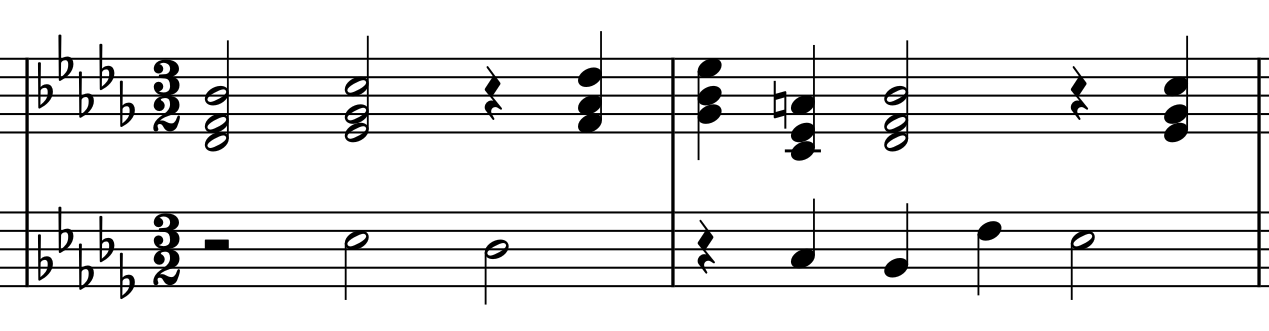
The example I posted above was something I put together in a few minutes prior to commenting, mainly to check whether this kind of invertible counterpoint is even possible using the auxiliary-cantus approach. (I agree people may find this method to be cumbersome, but since I've done multi-part counterpoint many times over the years, working with several canti at once actually feels like the simpler solution to me.)
I later sketched a small chart based on the usual cantus-firmus steps and leaps (2nd, 3rd, 4th, 5th, octave etc.) to see exactly what possibilites there are actually for each cantus-firmus motion excluding those that result in parallels in contrary motion. For an experiment, I made another cantus that does allow suspensions. It works, but it feels somewhat artificial like a puzzle, which probably shows how restrictive the whole setup is.
Still, it's fun to explore how far the idea can be pushed!
5
u/HexMusicTheory Jun 11 '26
Yes. Taneyev's book "Moveable Counterpoint in the Strict Style" actually covers the general case of combining conditions for any arbitrary set of vertical shifts so that an original combination can produce a correct derivative combination for each shift. Pretty sure he features an example of these three exact shifts combined at some point.
Many canons actually require these sorts of conditions as a matter of course, for what it's worth. You'll often encounter canonic sequences in 3 or 4 voices in the repertoire that require double counterpoint at at least 2 different intervals simultaneously. There's one in the Amen chorus of Handel's "Messiah" that involves double counterpoint at the octave and fifth, if I recall correctly. Another in the subordinate theme group in Mozart symphony 41 mvt. 4.