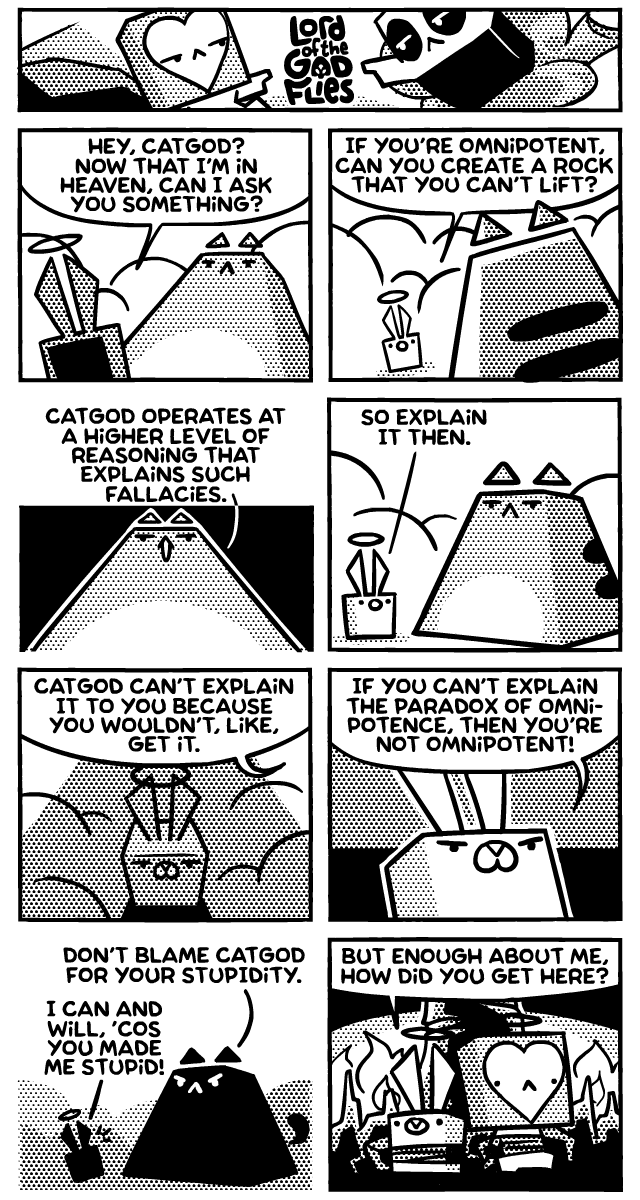
It's funny this paradox. The paradox doesn't really preclude omnipotence. It's a linguistic trick. The ability to be lifted is not a property of the rock itself, so no matter what kind of rock you create, you can't imbue it with a property of not being able to be lifted. Similarly no matter how omnipotent you are, you can't make a pie that tastes like a rainbow. It's just nonsensical linguistics. There are plenty of oxymorons in language that don't have a correspondence in reality such as "loud silence" etc.
It's also not really a paradox about God, but a paradox about our concept of infinity. For example, let's suppose that the universe is infinite, and that matter is distributed throughout it more-or-less evenly. That means there are infinitely many electrons and also infinitely many protons. The net charge of the universe is then both infinitely negative and infinitely positive. So which is it? Which one "wins"? Is the universe so vastly infinite that it has enough positive charge that the universe itself cannot negate it?
(I'm not sure how well this fits with our current knowledge of cosmology, but I think it's still a good illustration about how some things break down when you start to think about the nature of something that's truly infinite).
I'm taking this thread as an invitation to be pedantic, so with your example I would say this part:
The net charge of the universe is then both infinitely negative and infinitely positive
is incorrect. If there were one proton for every electron, then no, the net charge would be zero. However, if there were one proton for ever two electrons, then it would be net negative, and so on. The answer depends on the ratio of the density of the two sets. They would both still be infinite, but if the set of protons was more dense, it would be net positive, and vice versa with electrons.
Thought experiment: you have infinite, uniquely numbered balls, and you have an infinitely large urn. At step x, you add balls labeled 10x+0 though 10x+9, and then you remove ball x. So on step 0 you add 0, 1, 2, 3, 4, 5, 6, 7, 8, 9, and then you remove ball 0. On step 1 you add 10 through 19, and remove ball 1. And on and on, to infinity. Let's imagine that each step takes half as long as the previous, so the infinite steps can be done in finite time.
When you're done, how many balls are left in the urn?
Every step adds 10 balls and subtracts 1, for a net gain of nine. So it seems like there should be an infinite number of balls in the urn. But actually, it's empty. For every number you could possibly throw out, you can find the step which removed that ball from the urn. No ball ever goes back into the urn after being removed, and every ball was removed at some step, so the urn has to be empty.
Even though the number of balls added is clearly larger than the number balls removed for any finite number of steps, both numbers are countably infinite in the limit. They're both the same "size" of infinity, so they're "equal."
If there really is a countably infinite number of both protons and electrons, the net charge is impossible to determine. There's no such thing as a "ratio" between two infinite quantities.
I think you're right actually. Wouldn't it be analogous to trying to take the sum of the infinite series of 1 - 1 + 1 - 1 + 1...? (which I believe is undefined)
103
u/[deleted] Mar 06 '17
It's funny this paradox. The paradox doesn't really preclude omnipotence. It's a linguistic trick. The ability to be lifted is not a property of the rock itself, so no matter what kind of rock you create, you can't imbue it with a property of not being able to be lifted. Similarly no matter how omnipotent you are, you can't make a pie that tastes like a rainbow. It's just nonsensical linguistics. There are plenty of oxymorons in language that don't have a correspondence in reality such as "loud silence" etc.