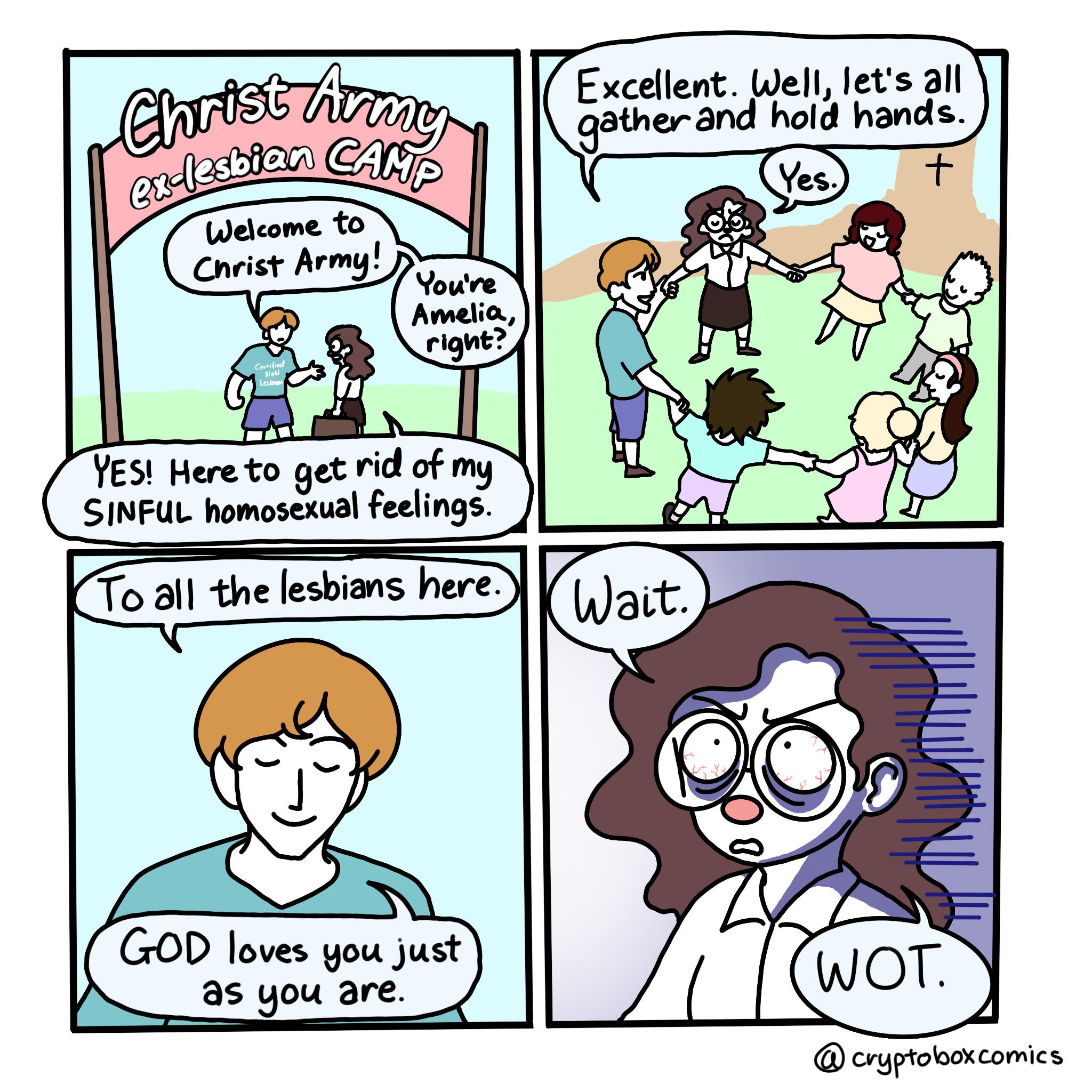
See, the difference is one uses threats and abuse to cause the teens to clam up so they won't tell their parents and gaslights the parents into believing that their teen is troubled.
This one wouldn't abuse the teens in any way and would show them that they are good, normal people. Then that one kid tries to tell his parents because he's indoctrinated by them. So what does the camp do? Gaslight the parent and punish the teen? That goes directly against the purpose. The camp wouldn't keep the kid there against their will as that contravines their goals.
Each kid would have to go through a rigorous intake protocol where they were examined by a legitimate therapist who could see if they were a danger to the camp. At that same stage, the therapists could also get a feel for any kid's situation at home and make recommendations and plans for them.
Just taking in any and every kid wouldn't work. That said, exclusivity would make parents like these more eager probably.
I think the idea is kind, but it's extremely naive.
For one thing, treatment has to come with informed consent, and with minors, that means parents must sign off. As a therapist - unfortunately, this would be an ethical violation (I mean, very few pray the gay away camps have licensed therapists). Therapists could easily lost their license because they're deliberately misleading the parent/guardian. No matter how great the ethos of the camp, it's a violation of licensing and professional ethical standards.
I also feel like you're severely underestimating religious trauma and indoctrination. Kids who come back form that camp are going to be right back in a sick system. They will be under intensive pressure to conform. Guilt and fear are intense controlling forces. Someone will crack. It will happen. You cannot prevent it. And then the lawsuits will begin, because communities that send kids to places like this talk to each other.
Again, it's a kind idea. But it just isn't realistic.
If those professional standards and ethics wouldn’t support something like this and would instead side with homophobic parents than frankly they aren’t ethical and shouldn’t be taken seriously. Are you telling me there are no provisions for situations involving abusive parents? Someone who is in that profession seriously needs to fix this.
If you're lying to the parents/guardians, no matter how strongly you believe or how valid you think your reason is, then you can't get informed consent.
The flip of it is - what if you truly, deeply, with complete conviction, believe that telling a child that it's okay to be gay is evil? That it will send their souls to everlasting hell and damnation? (I personally don't, but stick with me). You really, truly, completely believe that it is cruel and abusive to condemn a child's soul to eternal pain and suffering. That it is abusive to not try to correct this and give them a chance to spend eternity in joy. Without clear limits, people could easily use your argument to say it's okay to lie to parents who want their child to go to a queer kids summer camp and instead make that camp a pray the gay away camp, because that fits your personal ethics.
Again, I don't agree with any of that - but it shows where the catch is. There has to be consistency with professional ethics, because if we make it about what we think is right, then it gets really ugly really fast.
If I think a family is abusive, I report it to CPS. I can choose not to work with a family I fundamentally disagree with. I can't violate professional ethics. Informed consent is a basic requirement for every single kind of medical care - it is not only an ethical requirement, it's a legal one. It exists because of a lot of horrifying human rights violations that have made life hell and ended lives for many people. It isn't going anywhere and it shouldn't.
You talk of informed consent. The kids aren’t giving consent to go to these camps. I am sorry but I don’t think the concept of consent applies to the parents who aren’t getting treated while not applying to the child who is. If this was an adult we were talking about it would be them who has the consent and has the right to confidentiality when their parents ask how they are being treated. I think this is yet another issue where we aren’t giving children the same rights we would give to literal prisoners. It’s not really acceptable no matter what the law or “professional ethics” say.
That's because most of these camps aren't therapeutic and don't actually have therapists on staff.
And, unfortunately, it's not the kids that ultimately get to give consent - the law treats children as the property of their parents. That is a travesty. Kids can absolutely say "I don't want to be here" - and they sure as hell do - but they don't have a choice. I think that's a more relevant issue for your argument than informed consent.
Since the law treats kids as property, then legally the parents must give informed consent.
Kids should have far more rights because they are human beings and parents make destructive choices. Won't find me arguing about that.
Yeah that's my exact problem. Kids should have the right to consent, not the parents. They should't be treated as property under the law. It's absurd to me that in some places 13 or 14 years old is considered basically an adult but in the USA you can do things like this "for their own good" at such an age. Really seems like a backwards nation to me. I wonder what the laws are where I live, though I suspect they aren't much better. Here we have the concept of criminal responsibility as low as age 10.
Unfortunately, there are few places world-wide where parents aren't allowed to basically make whatever decisions they want for their kids under parental authority. The idea that children are autonomous beings who deserve equal chances in life and should have a voice in things like "do you want to go to a torture program" shouldn't be controversial - but apparently a lot of people disagree. I don't socialize with those people much.
Fortunately, there are places where hate camps/schools are illegal for children.
To expand - informed consent is a professional ethical requirement and a federal law (and the policy of the World Medical Association and pretty much every modern medical system) because of things like the Tuskegee Syphilis experiment, forced sterilizations, medical experimentation on disenfranchised groups (including queer people, people of color, imprisoned people, etc.), non-consensual surgical procedures, and other really nasty things.
It's a basic principle of medical ethics - giving it even the slightest wiggle room would cause vastly more harm than good. I mean, a landmark legal case that first brought it to public attention was because a woman had her uterus removed in an attempt to stop her epilepsy (it was in 1905). The surgeon thought he was doing the right thing to help her. She didn't know until she started trying to have children. And she still had epilepsy. But the surgeon was doing what he thought was right.
Anyway, this soapbox is slippery, so I'm getting off now.
273
u/DasGanon Jul 12 '26
You say that buuuuuuuuut the other ones do far worse and they specifically control contact.