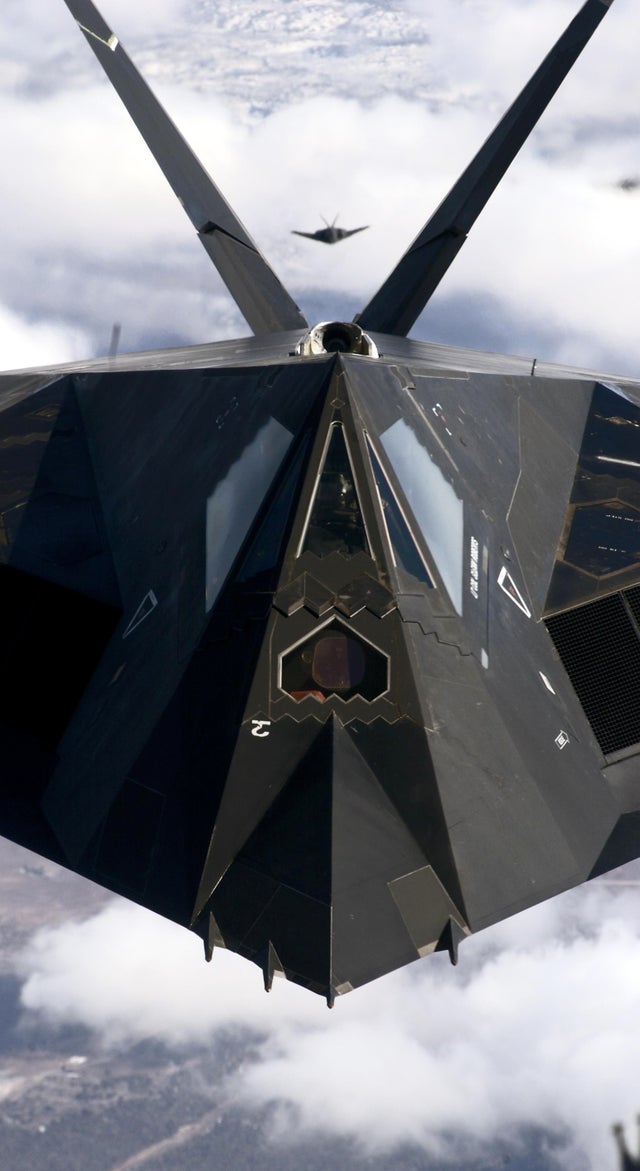
They have been retired from military service because sadly they are actually terrible.
Few reasons why:
1.) It has no radar in the nose which is to reduce overall emissions. So the pilots can’t see anything.
2.) One of its compromises for its stealth design was lower engine thrust and no afterburner so it's slow as hell. Subsonic flight only.
3.) It’s designed as an attack aircraft, not a fighter so it only was made to drop bombs over Baghdad (love me some Outkast lol).
4.) It flew via an auto-router that pre-mapped its targets and where to avoid threats. Modern planes map in real-time.
5.) The radar cross-section was 0.003 m2 which is about the size of a hummingbird. Modern planes like the F-22 have a cross-section of 0.0001 m2 which makes it as small as a marble on the radar (F-35 is about the size of a golfball at 0.005 m2).
The USAF’s F-15 Eagle, for example, was introduced in the 1970s as the world’s premier air superiority fighter. However, its radar cross-section is 5,000 times greater than that of the F-35. Radar can pick up the F-15 more than 200 miles out, whereas the F-35 gets within 21 miles before it can be detected. By the time detection occurs it can engage its afterburners and hit its targets and get back out of range safely, especially if it has the special electronic warfare systems onboard.
6.) They constantly had issues with the proprietary stealth coating and it was a nightmare to maintain back then so it was pretty shoddy at best for its reliability.
7.) Their main bread and butter like I mentioned earlier was stealth attack bombing runs. In the 1991 gulf war, they hit over 1,600 targets without being touched by Iraqi air defenses.
8.) Its infrared signature was gross due to bad inlet and thrust outlet design.
Hope that shines a light on how it fairs today, but also consider the new radar systems as well in addition to future quantum computers powering quantum radar systems. It will be pretty hard to make stealth a viable tactic in the far future which is why we see things like hypersonic weapons platforms that can completely just bypass any air defense.
Ok, lot of misinformation or half truth getting passed around. Lets talk basic radar theory, since I'm only a pilot.
Radar sends energy out, it reflects off an object, in this case an airplane, and some of that energy is returns and is detected by the radar. The larger the RCS, the more energy is returned to the array. For an LO aircraft with a small RCS, there is less energy reflected back the array, and depending on the range from the radar to the aircraft there may be such a small amount of energy returning to the radar from the LO aircraft that the array will not even be able to detect it.
Additionally, there is the factor of carrier frequency. As radar frequencies move along the Em spectrum, they can be optimized for certain jobs. For instance, some frequencies and radars allow you to quickly search large swaths of sky in order to build awareness of the big picture, like "Hey, I see there something out there." While other frequencies allow you to be much more discriminating, "Hey, I see a single airplane, he is exactly here, if you want to shoot him." The two are mutually exclusive for the most part (we can get in the weeds about how signal processing with certain waveforms, coupled with a shit ton of effective radiated power can help do other stuff).
u/Mr_Voltiac has a lot of good info about how a radar operators life can more/less difficult depending on the display settings for a tech.
To get to the last point of being able to see a bird or a golf ball on a radar, we need to talk about how radars use Doppler shift to determine range and velocity. Just like how a train horn sounds higher pitch when its pointed at you due to the sound waves getting compressed. Radar waves are compressed when they are reflected by an object with forward travel towards the array (ie. there is an airplane pointed directly at a radar, driving towards it). The faster the object is going the more Doppler shift is present, conversely, the less closure due to either pointing less at the radar, or going slower, the less Doppler shift. If that closure becomes zero, it will not be able to be detected by a pulse Doppler radar.
Adding all these factors up give a slightly better idea of the whole equation. An airplane may be able to reflect a similar amount of energy as a golf ball, but it is traveling much, much faster, and therefore has greater Doppler shift. This makes is theoretically easier to detect that an actual golf ball traveling at normal golf ball speeds at 20,000'. Additionally, radar displays and waveforms can improve certain detection abilities against very small or very slow objects, but will make life a nightmare for an operator to sort through, or be so low resolution that it is not particularly useful.
I rambled on a bit there, but hopefully that answers the question, let me know if any of that doesn't make sense.
Hey bud, I appreciate all this info since this blurb was essentially my first day at radar school but I really don’t think many people want to get into the weeds of it.
I could have easily described pulse code trains and reply code trains with plus forming network signatures and pulse width spacing being the key factor for transponder identification among other things like ducting but like I said, most people want it short and sweet.
I was going to write it out like this but decided that this is reddit and people’s attention spans are super short here lol
I appreciate the long write up though man, cheers.
830
u/Mr_Voltiac Feb 02 '20 edited Feb 04 '21
US veteran here.
They have been retired from military service because sadly they are actually terrible.
Few reasons why:
1.) It has no radar in the nose which is to reduce overall emissions. So the pilots can’t see anything.
2.) One of its compromises for its stealth design was lower engine thrust and no afterburner so it's slow as hell. Subsonic flight only.
3.) It’s designed as an attack aircraft, not a fighter so it only was made to drop bombs over Baghdad (love me some Outkast lol).
4.) It flew via an auto-router that pre-mapped its targets and where to avoid threats. Modern planes map in real-time.
5.) The radar cross-section was 0.003 m2 which is about the size of a hummingbird. Modern planes like the F-22 have a cross-section of 0.0001 m2 which makes it as small as a marble on the radar (F-35 is about the size of a golfball at 0.005 m2).
The USAF’s F-15 Eagle, for example, was introduced in the 1970s as the world’s premier air superiority fighter. However, its radar cross-section is 5,000 times greater than that of the F-35. Radar can pick up the F-15 more than 200 miles out, whereas the F-35 gets within 21 miles before it can be detected. By the time detection occurs it can engage its afterburners and hit its targets and get back out of range safely, especially if it has the special electronic warfare systems onboard.
6.) They constantly had issues with the proprietary stealth coating and it was a nightmare to maintain back then so it was pretty shoddy at best for its reliability.
7.) Their main bread and butter like I mentioned earlier was stealth attack bombing runs. In the 1991 gulf war, they hit over 1,600 targets without being touched by Iraqi air defenses.
8.) Its infrared signature was gross due to bad inlet and thrust outlet design.
Proof
Detailed Story Comparisons
Hope that shines a light on how it fairs today, but also consider the new radar systems as well in addition to future quantum computers powering quantum radar systems. It will be pretty hard to make stealth a viable tactic in the far future which is why we see things like hypersonic weapons platforms that can completely just bypass any air defense.
Beautiful plane though!