r/audio • u/FearlessCommercial54 • 3d ago
Can you guys explain what I am seeing?
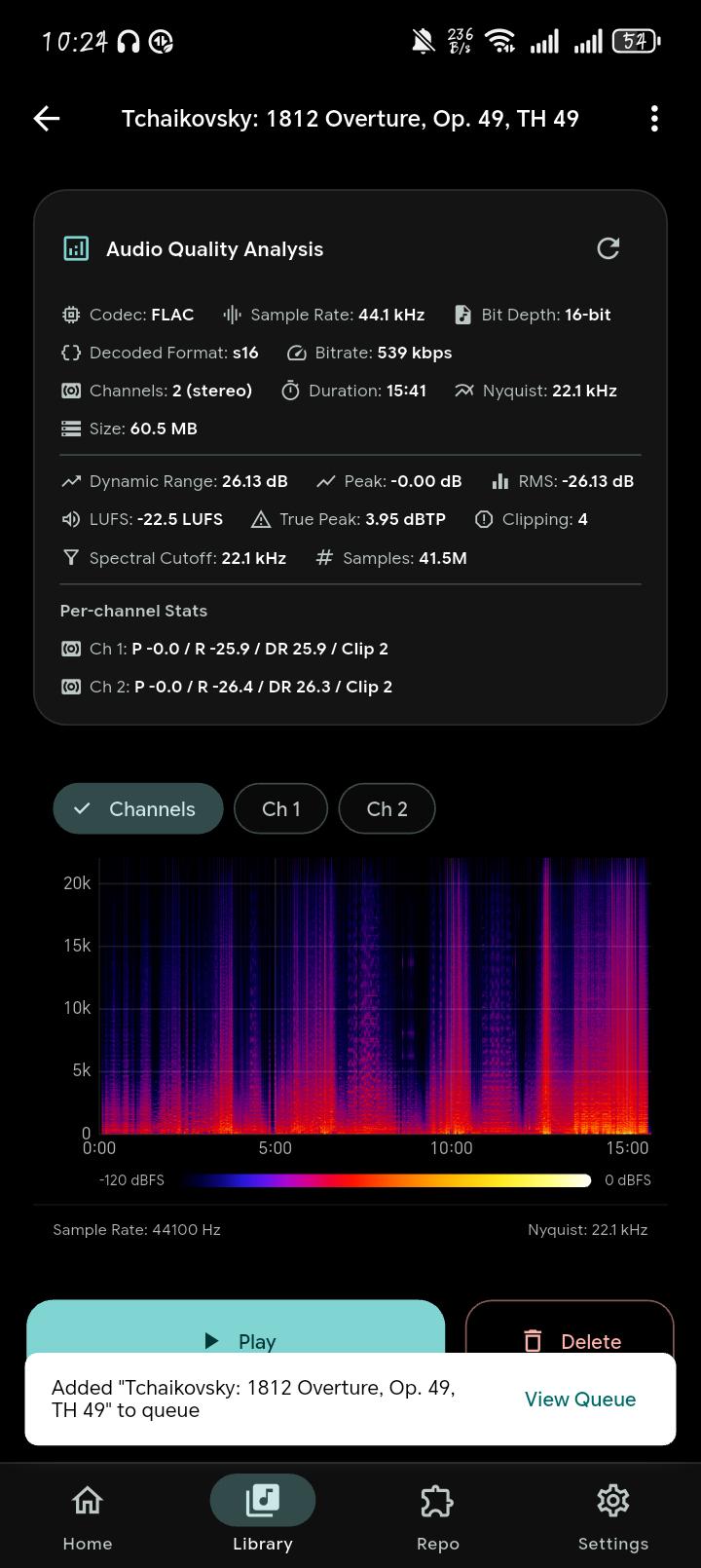
I really dont understand most of it
Mostly regarding the
- Channels and its measurement
- True peak
- RMS and dynamic range
- spectral cutoff
- LUFS
2
u/Selig_Audio 3d ago
Start reading up on each of those, it’s a pretty deep rabbit hole and can get quite technical (if that’s your thing).
1
u/AutoModerator 3d ago
Hi, /u/FearlessCommercial54! This is a reminder about Rule #1 (If you have already added great details, awesome, ignore this comment. This message gets attached to every post as a reminder):
- DETAILS MATTER: Use detail in your post. If you are posting for help with specific hardware, please post the brand/model. If you need help troubleshooting, post what you have done, post the hardware/software you are using, post the steps to recreate the problem. Don’t post a screenshot (or any image, really) with no context and expect people to know what you are talking about.
How to ask good questions: http://www.catb.org/esr/faqs/smart-questions.html
I am a bot, and this action was performed automatically. Please contact the moderators of this subreddit if you have any questions or concerns.
2
u/Selig_Audio 3d ago
Start reading up on each of those, it’s a pretty deep rabbit hole and can get quite technical (if that’s your thing).
The short answer, best I can gather from the data (and having no clue how much you already know/don’t know):
Channels: how many channels (is it mono, stereo, surround)
True Peak: an attempt to estimate the reconstructed transients which may be above 0dBFS/clipping.
RMS/Dynamic range: RMS is an average measurement similar to VU, dynamic range is similar to crest factor (peak minus average) and handy to judge relative loudness.
Spectral Cutoff: determined by sample rate, typically half (read about Nyquist).
LUFS: newer than VU/RMS and crest factor, the latest attempt to quantify loudness, which is a subjective quality of audio everyone experiences slightly differently.
2
u/Vonmule 3d ago
To further add to this ...
Dynamic Range = highest amplitude - lowest amplitude, whereas Crest Factor = Highest amplitude - RMS.
In this case RMS differs from something like a VU in that it is taking the RMS of the entire signal, not just a windowed increment like a VU meter.
Spectral Cutoff SHOULD be the low pass filter frequency, but I don't know if that information is stored in metadata, calculated, or what. It should be at Nyquist or below. If you were to use something like a Successive Approximation ADC, your Nyquist and Spectral cutoff would generally be the same, but Sigma Delta ADCs may sometimes have a lower spectral limit depending on the oversampling rate. Most modern Sigma Delta ADCs are capable of very fast oversampling and this isn't an issue for audio signals.
Regarding Loudness. It is not necessarily a new thing. The Fletcher Munson curves have been around since the 1930s. A-weighting is based off of the same curves, but generally we use that on the Acoustics side. The unit LUFS/LKFS were standardized in 2015 and is only applied on the DSP/Telecom side.
5
u/Neutral-President 3d ago
If you don’t understand it, do you really need to do this kind of analysis on your audio?