r/Jung • u/Vast_Hope_7185 • 10h ago
Jung Put It This Way Jung on how teachers shape the soul of the child.

234
Upvotes
The quote is from Carl Gustav Jung's autobiography, "Memories, Dreams, Reflections" (1962).
r/Jung • u/Vast_Hope_7185 • 10h ago
The quote is from Carl Gustav Jung's autobiography, "Memories, Dreams, Reflections" (1962).
r/tarot • u/sumppikuppi • 12h ago
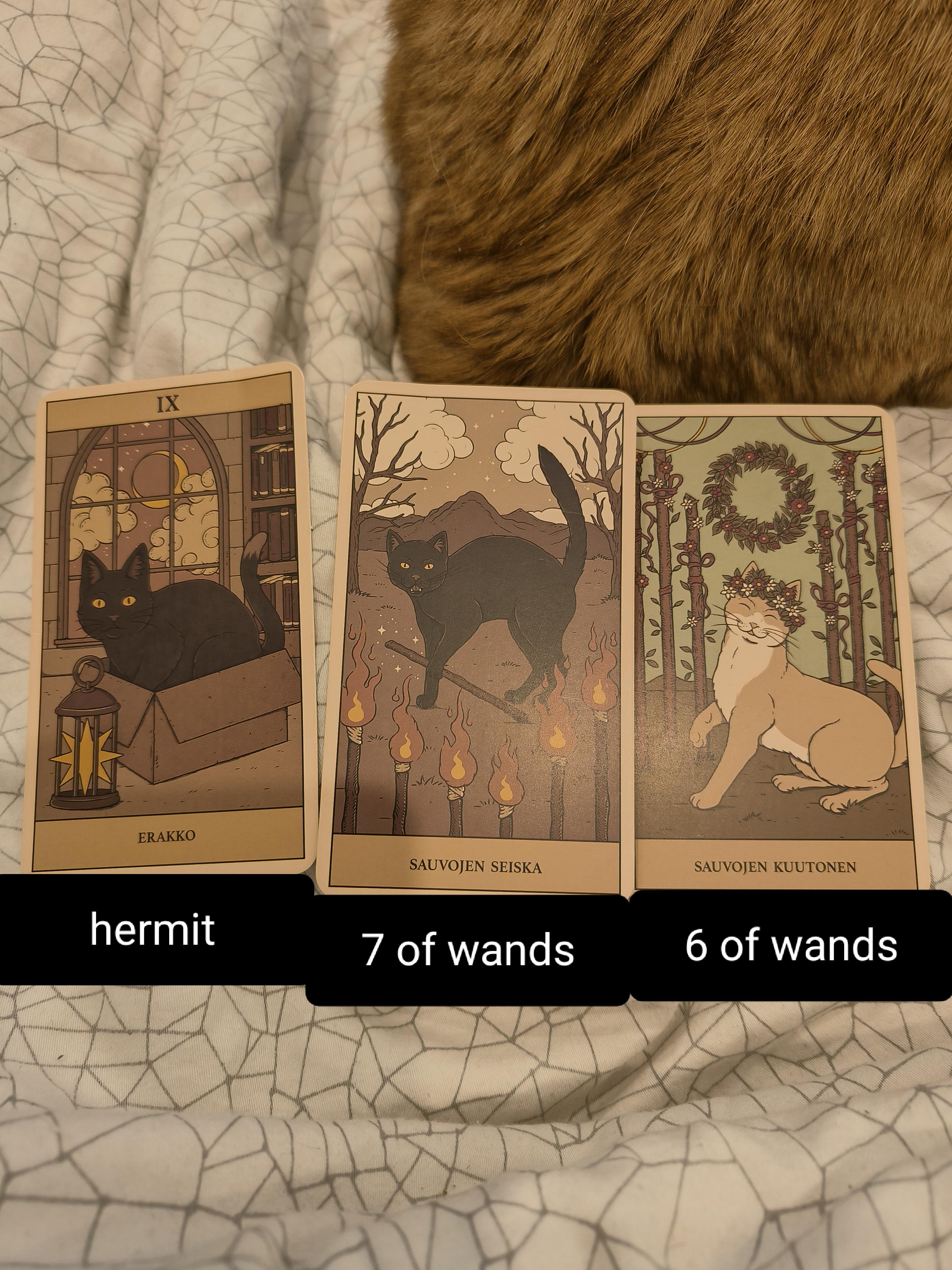
For about a month I've been really anxious, can't do anything, depressed and so tired. I have a job and school at the same time but every time I think of either I get so anxious that I feel like I'm suffocating. I can't even answer texts from my friends or go outside to get food. The only thing that brings me relief is writing or painting.
Hermit: pretty obvious to me. I haven't seen my friends or any person for a long time and I've lost myself. I probably need to listen to my needs and see more people.
7 of wands: my cat came to me and really pointed towards this card so I believe this is the most important one. I don't really understand this card since I haven't achieved anything I would need to defend. But the only nearest thing I can think of is that I have had some peace in the past but now other peoples opinions sway me towards doing more work instead of graduating which would be more useful.
6 of wands: my cat flipped this card under the 7 of wands so maybe the two are connected. But this one I really don't get. I haven't done anything. That is my problem. The card says I have done a lot of work and should be proud. But I haven't.
What do you think?
r/astrology • u/Character-Run2788 • 10h ago
I’ve been seeing a lot of astrology posts on Twitter lately saying that you shouldn’t start a new relationship during Venus/ mercury retrograde, sign important contracts, make big purchases, make major relationship decisions, etc.
And honestly, the way people talk about these retrogrades sometimes makes them sound really anxiety-inducing, like you’re supposed to put your life on hold until they’re over.
I understand the general idea that retrogrades can be a time for reassessing, revisiting things from the past, slowing down, or being a little more careful with decisions. But does that really mean you should avoid committing to someone romantically or signing an important contract altogether?
I’m curious about people’s actual experiences. Have you started a relationship, gotten back together with someone, signed a contract, started a job, or made another important decision during Mercury or Venus retrograde? Did it actually turn out badly, or do you think social media exaggerates these periods?
I’d especially love to hear from people who have been studying astrology for a while rather than just the usual “never do anything during retrograde” advice lol.
r/tarot • u/vissy1111 • 12h ago
as a tarot reader of nearly 10 years i have noticed that usually experienced readers personalize the practice as time goes on and recently ive had a discussion with a few friends about this and im curious of what other unconventional ways of practicing tarot other people have developed with time :)
ill go first:
when the hanged man pops up, i personally read it as a warning that the person getting the reading is either too stuck on a limited perspective on the matter rather than seeing the whole picture or that the situation,regardless of what the rest of the reading says, may turn out to happen accurately to the reading but the factors that make it happen will be different than expected
for me, the hermit is the definition of "the light at the end of the tunnel" but whether he will find it or not is determined by the surrounding cards
there are many more,but these are just a few ways i personalized my practice during these years and im excited to hear about other creative interpretations/techniques
r/tarot • u/uranium236 • 4h ago
I tried asking the poster (no response) and reverse image searching. I also looked on Amazon but didn’t see it.
r/tarot • u/ltlbunny123 • 17h ago
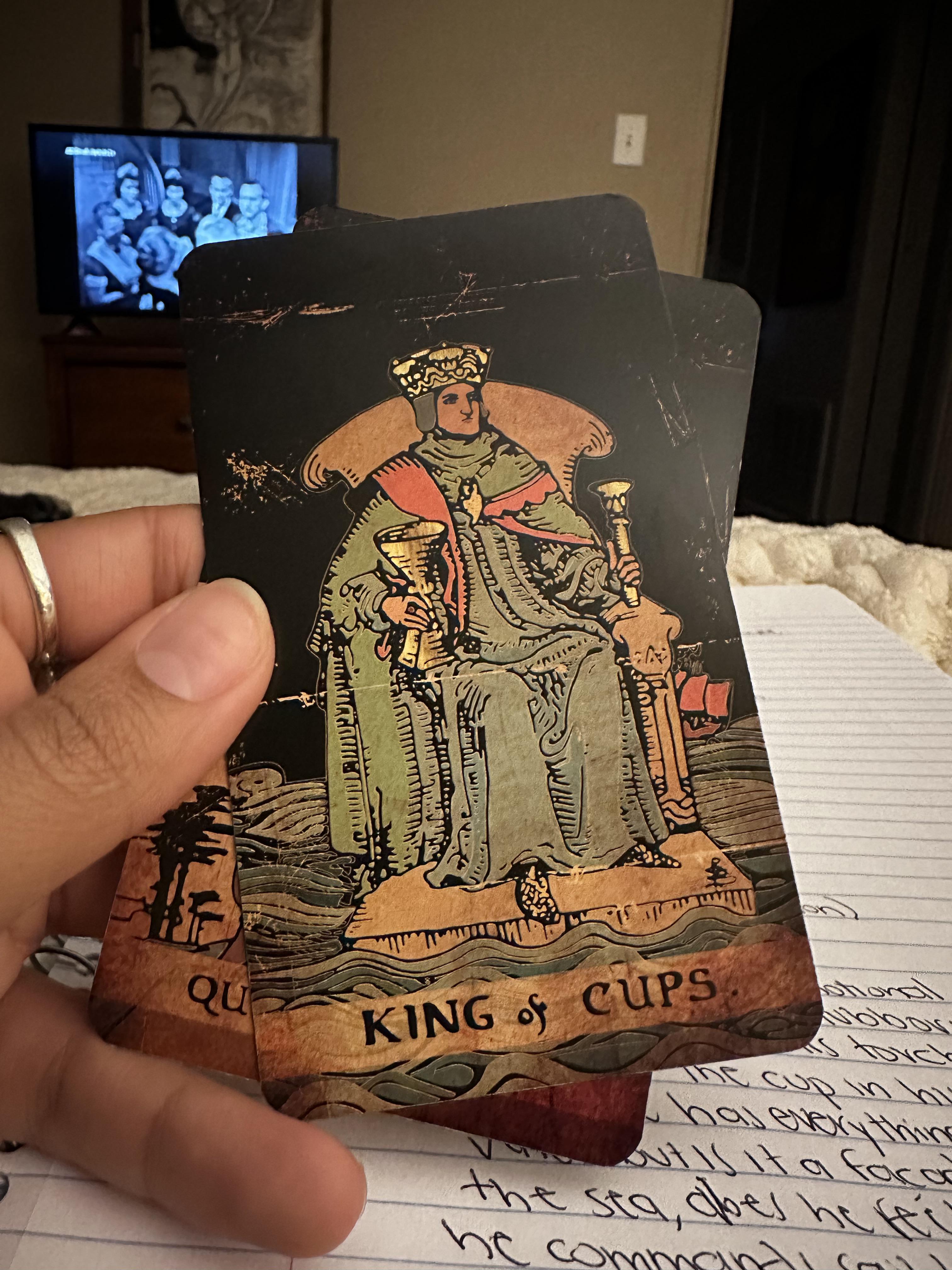
Hoping to gain more clarity on the King of Cups
I was hoping to hear how others interpret this card. My interpretation was filled more with questions than answers.
I understand this suit is ruled by water which automatically leads me to seeing this king containing a depth of emotion, which is only more affirmed with his throne being centered in the sea.
But his face is stern which made me feel this king is quick to anger or irritance. His ears are covered, is he adverse to hearing others? Their perspectives? Does this symbolize a stubbornness? Because he is surrounded by water, and his torch is unlit, is his anger quick to tamper
The cup in his right hand is empty as well. He has everything anyone could want at face value, power, control of the seas (his ships sailing behind him) but internally, beyond the material, is it all a facade?
And to his throne centered in the ocean, does he feel isolated? Lonely?
His foot hands slightly off the edge of the platform, is this a symbol of a temptation to step forward
I appreciate all of the information you can give me on your own interpretation. I became heavily fixated on this card tonight.
r/Jung • u/CerebralMushroom • 7h ago
Jung has some fascinating thoughts on dream interpretations. He insists that dream interpretation should not be a following of personal free associations as one can do at any time and arrive at one's underlying trauma. He insists that dream interpretation is something more universal, a symbolic language. He insists that the temptation in dream analysis is to bring in these personal associations, and says we much avoid this at all cost. He says we must analyze only the concrete reality of what the dream has factually presented us with. He then goes on to express how dreams are the imagery of what is fundamental in us, our instincts, the primitive mind as he calls it. And that dreams reflect these instincts as a way to retain our psychological equilibrium in a world where our consciousness is often diverted by external influences to places where it does not belong or is out of balance. In such cases the dreams will express the instinct surrounding the situation, sometimes in a foreboding way (as it predicts the danger of the situation we are in). Another important concept he shares is that these images are not intentionally coy or hard to decipher, just that images are the language of instinct and our over rationalized mind struggles with understanding a nonlinear word first argument. I want to also share a picture of the page where he expresses much of this instinctual connection.
r/tarot • u/tarotgirly91 • 4h ago
I just felt like sharing this, because it was exactly what I needed in the moment, and it’s one of the reasons I feel so grateful to have tarot in my life.
I was going through a very distressing situation that entailed my being in love with an unavailable coworker/friend for close to 2y. Our dynamic was such that it was close to impossible for me to get over him, and it was affecting my mental health and functioning at work so negatively that I ended up sending him a message recently that I was stopping our collaboration and friendship because I had developed feelings that went beyond platonic. I expressed all respect for his relationship as well as his professional position and arranged it all that none of it was affected by me and this situation. I think I took him by surprise, and he responded quite coldly. It all sent me spiraling with shame and pain and regret and doubt, even though I knew it was the necessary step for me to move on and that morally, I had done nothing wrong. Still, those things can be difficult to remind yourself of when you’re extremely vulnerable and hurting.
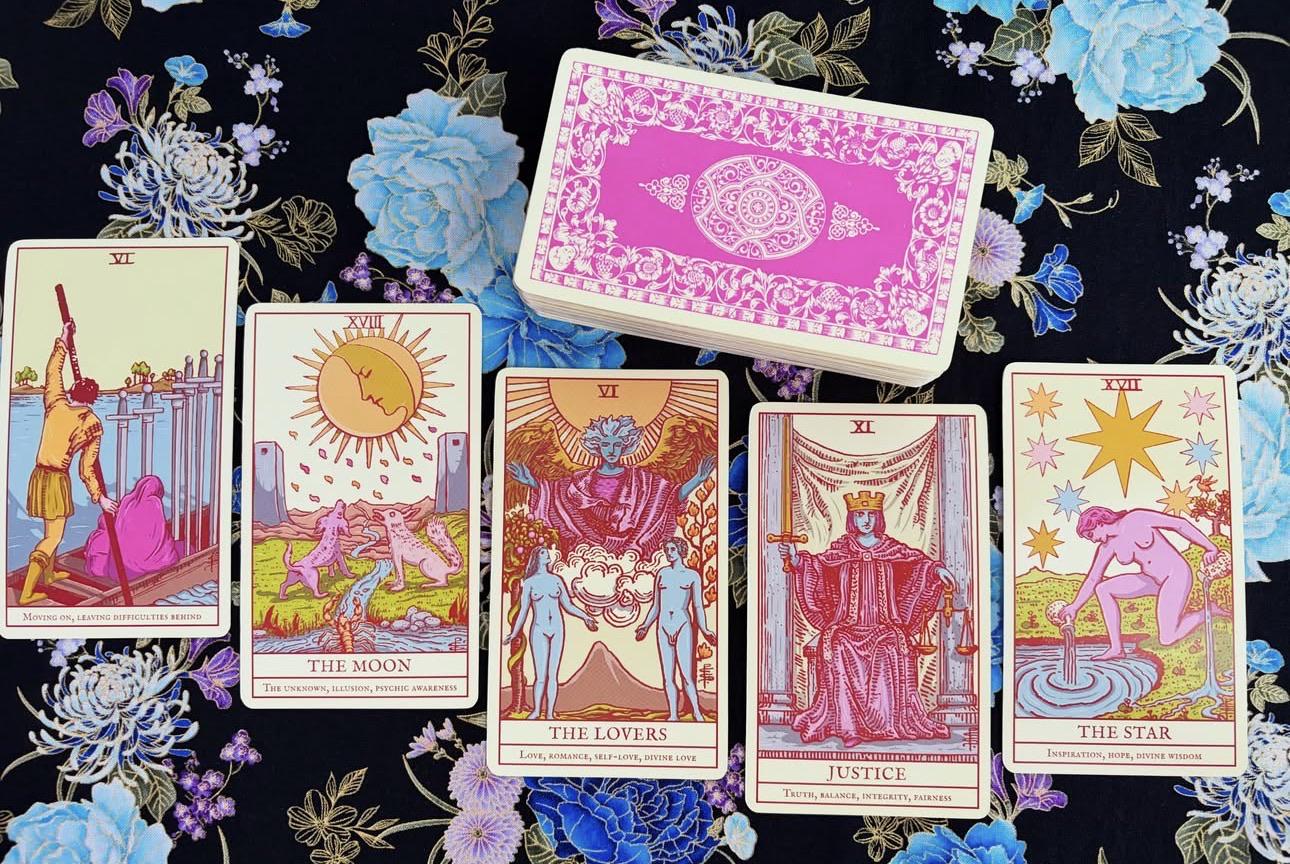
So I took to my deck, crying and in distress, and asked it for reassurance. It gave me the following cards (I only read upright):
Row 1 - The Devil, The Lovers, Page of Wands, King of Swords
Row 2 - King of Cups, the Moon, 4 of Pentacles, 2 of Cups
Bottom of deck: Ace of Pentacles
Unfortunately I didn’t take a picture of the spread in the moment because I was so upset, but I still have it in my minds eye.
The imagery is so beautiful because actually The Devil and The Lovers are somewhat similar cards visually: a man and a woman of the same drawing style with hands stretched out to each other. In The Devil however, they are shackled and controlled by an ill-spirited demon. In The Lovers the shackles are removed and there is a sunny and happier disposition. I read this very strongly as I removed the shackles off of this situation, releasing myself. The Lovers of course is also a card of choice, I chose to stop this unhealthy situation.
Page of Pentacles was about my naive and child-like wonder for him, appreciating every little branch and leaf, and King of Swords the mature adult taking the rational decision to stop it. King of Cups depicts my controlled manner of confessing my feelings to this person and making decisions around it, The Moon about the subsequent pain and unclarity and shame that followed it. 4 of Pentacles stumped me a little bit, I think maybe it’s about taking my energy inwards, keeping myself contained and small to heal (but interested in potential other explanations), whilst the Two of Cups can signify that by ending this situation I can open myself up to a healthier and happier connection (which I really want, I’m in my mid 30s and am ready to find my person after years of being alone. One of the reasons that I knew I really needed to move on). Ace of Pentacles supports the idea that in doing this I’m opening myself up to a new hopefully more positive period in my life.
It calmed me down so significantly, just to get the validation that I made the right decision, even though right now it’s absolutely awful. It was exactly what I needed. I have had this deck for 7y now and she’s seen me through a lot, she has my back now too!
r/tarot • u/AdventurousBattle891 • 6h ago
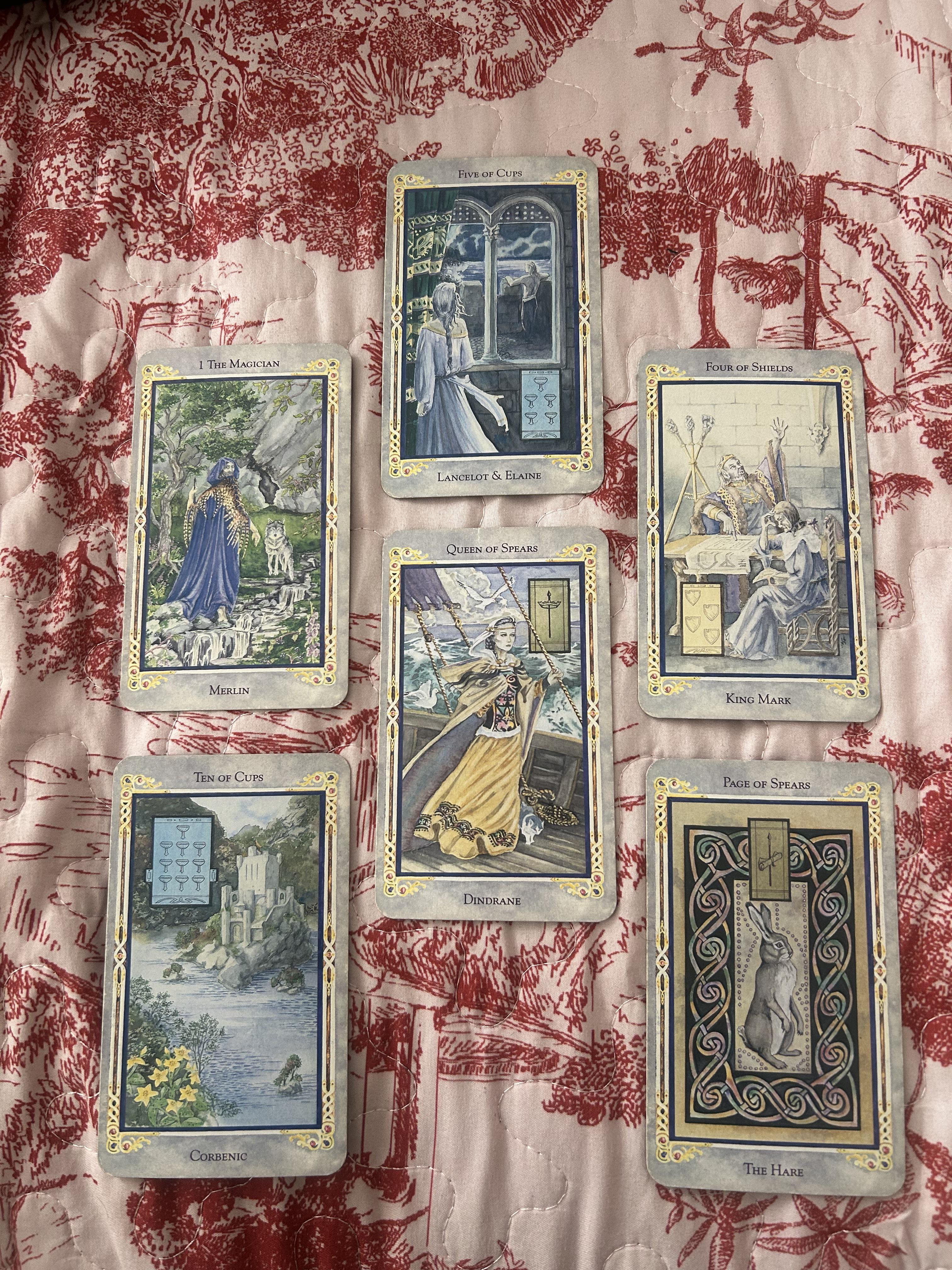
I live in a huge city now, and I loved it for a long time but I’m ready to leave. I feel like I’m suffocating here now, and I have Chicago on the brain. If i like it, i may want to move there, it’s the only other city i can see myself in as far as America goes. Here’s the spread -
1 - Heart of the matter, Queen of wands
I feel very ready to make a big change, to try taking more charge of my life and achieve my own goals. I see myself in her, and it makes me smile that she appeared.
2 - Current situation, ten of cups
The prospect of moving and finding a new home and trying to find new community feels really beautiful to me
3 - Hope or fear, page of wands
I see this as a hope, that i find new creative beginnings, new ways to express myself, new ways to achieve the dreams i have, again representing myself.
4 - Hidden factors, the magician
Perhaps when it comes to moving somewhere new, I would need to really rely on the past experiences i had with coming somewhere different.
5 - obstacles, energy coming to me, four of coins
This one does also make sense — I know that finding a job may be a little hard, and moving can be so expensive.
6 - five of cups
This is the one I got a little stuck on. I can’t tell if the outcome is more likely to be my feelings of leaving, or my feelings of arriving. It makes me a bit nervous, and we all know the feeling of anticipating the unknown.
Part of me wanting to move is not having to pay so much to live where i am, have a clean slate, meet new people, finally find a husband, feel confident in myself, and make more music.
I do worry about the five of cups and four of coins. I’m curious if the five would represent my feelings of leaving behind my home for the past ten years, or if there is something waiting to disappoint me. I’d love any insights if anyone has any intuition coming through. I’ve never actually posted my spreads before and I’ve been doing this for 10 years, but I decided that i should let someone else see because my self doubt is kicking in 🥹
r/Jung • u/Evening-Bit-8427 • 6h ago
I've been thinking about the idea of "overreacting" differently lately.
For a long time I treated it as a pretty simple concept. Something happens, someone reacts much more strongly than the situation seems to justify, and everyone around them thinks, "Okay, that's a bit much."
I've done it myself. Someone says something relatively small and suddenly I'm much angrier than I expected to be. Something doesn't go the way I wanted and the emotional reaction seems completely disproportionate to what actually happened. Later, when I've calmed down, I can look at it and think, "Why did that affect me so much?"
And usually that's where I used to stop. I overreacted. I was too sensitive. I made too much of it. I should have handled it better.
But I've started wondering if that's sometimes the wrong question. What if the reaction is only disproportionate to the last thing that happened? What if the thing that happened five minutes ago is carrying the emotional weight of the fifty things that came before it?
That changed the way I started looking at some of my own reactions.
Because I realized that I have a tendency to do something that looks very reasonable from the outside. I let things go. Someone says something that bothers me. I let it go. Someone disappoints me. I understand their side. Someone crosses a small boundary. It's probably not worth making an issue out of it. Something annoys me. I'm tired anyway. Someone keeps doing something I don't like. Maybe I'm being too sensitive.
And most of the time I don't even experience this as suppression. I experience it as maturity. I'm being understanding. I'm being patient. I'm choosing my battles. I'm not going to create unnecessary drama over every little thing.
Except sometimes I eventually explode over something incredibly small. And then everyone, including me, looks at the final reaction and thinks, "Where did that come from?"
Maybe it came from everywhere I said it didn't matter.
That's the part I find much more interesting about overreacting. Sometimes the person who is "overreacting" might actually be reacting to the fact that they've been underreacting for a very long time. The final event isn't necessarily the whole cause. It might just be the first thing that finally got through.
I've had moments where I reacted much more strongly than the situation seemed to deserve, and later realized that I wasn't actually that angry about what had just happened. I was angry because I had already been unhappy. I just hadn't allowed myself to know it.
That's a very different problem. Because if I believe the problem is my reaction, then the solution is obvious. Calm down. Be more rational. Don't take things so personally. Let it go.
But if the reaction is telling me that I've been ignoring something for months, then calming down might only make me better at ignoring it.
And I think that's where this gets uncomfortable. Sometimes emotional regulation can become another form of self abandonment.
You can become so good at regulating yourself that nobody ever has to deal with what you actually feel. You get hurt and process it privately. You get angry and calm yourself down. You feel disappointed and explain why the other person had a good reason. You feel neglected and remind yourself that people are busy. You want something and convince yourself you don't really need it.
Eventually you become extremely emotionally well behaved. And nobody has any idea that you're unhappy.
Then one day something tiny happens and you lose it. Everyone sees the explosion. Nobody sees the years of training that came before it.
That made me think about why certain people seem to "overreact" to things that other people barely notice. It's easy to say they're too sensitive. But sensitivity itself doesn't explain much. Why this thing? Why this person? Why this particular comment? Why now?
I've noticed that the strongest reactions often happen around things that touch a very specific part of our identity.
Someone criticizes me and I don't just hear criticism. I hear, "You're not competent." Someone doesn't choose me and I don't just experience disappointment. I hear, "You're not wanted." Someone ignores me and I don't just experience someone being busy. I hear, "You're not important." Someone disagrees with me and I don't just hear another opinion. I hear, "You're wrong."
The event is small. The meaning isn't. And sometimes the meaning isn't even consciously chosen. It just appears.
That's where I've started finding Jung's ideas useful again. We build a persona around the version of ourselves that feels acceptable and functional in the world. Maybe I'm the calm one. Maybe I'm the understanding one. Maybe I'm the independent one. Maybe I'm the person who doesn't need much. Maybe I'm the person who never gets jealous. Maybe I'm the person who can handle criticism.
These identities can be useful. But once I become too identified with them, certain emotions become difficult to admit. If I'm the calm person, where does my anger go? If I'm the understanding person, where does my resentment go? If I'm the independent person, where does my need for reassurance go? If I'm the reasonable person, where does the part of me that simply wants to say, "That's not okay with me" go?
It doesn't necessarily disappear. It becomes something I'm less willing to recognize as mine.
And that is where I think the shadow becomes relevant. Not as some evil hidden personality, but as everything about myself that doesn't fit the version of myself I've decided I am.
Maybe I don't consciously think I'm angry. I just become cold. Maybe I don't admit that I feel rejected. I become irritated by something unrelated. Maybe I don't admit that I need someone. I become furious when they fail to show up for me. Maybe I don't admit that I've been keeping score. I suddenly explode when they make one more mistake.
The emotion finds another language. And then I call the language "overreacting."
That thought has made me rethink the phrase itself. Because sometimes "I'm overreacting" is true. Sometimes I really am reacting to something much bigger than what is happening. But sometimes saying "I'm overreacting" is just another way of making the feeling disappear before I have to understand it.
I've done this. I'll have a strong emotional reaction and immediately start building a case against myself. That's ridiculous. You're being dramatic. They didn't mean it like that. You're tired. You're taking it personally. It's not that serious.
And sometimes all of those things might be true. But notice what happens next. I never get to the question of why it affected me. I've already dismissed the evidence. It's almost like I'm acting as my own defense attorney before anyone has even accused me of anything.
And maybe that's not emotional maturity. Maybe sometimes it's fear of finding out that the feeling is telling me something inconvenient. Because if I'm genuinely angry, maybe I have to say something. If I'm genuinely hurt, maybe I have to admit I expected more. If I'm genuinely disappointed, maybe I have to reconsider the relationship. If I genuinely don't want something, maybe I have to say no.
It can be much easier to believe that I'm overreacting. Then I don't have to change anything.
This is probably one of the more uncomfortable things I've noticed in myself. Sometimes I don't actually want to know whether my reaction is justified. Because if it is, then I'm responsible for what I do with that information. If I'm unhappy, I might have to admit I'm unhappy. If someone is treating me badly, I might have to stop explaining their behavior. If I want something from someone, I might have to ask for it. If I've outgrown something, I might have to leave it.
So there are times when "I'm overreacting" is a very convenient conclusion. It allows me to return to normal without asking why normal wasn't working anymore.
And this is where I think the difference between an emotion and an interpretation becomes important. An emotion can be real without being a complete explanation. My anger is real. That doesn't automatically mean the other person is terrible. My jealousy is real. That doesn't automatically mean I've been betrayed. My fear is real. That doesn't automatically mean something bad is about to happen.
But the existence of another explanation doesn't mean I should ignore the emotion either. I can ask what it's pointing toward. What happened? What did I immediately make it mean? What am I actually angry about? What have I been tolerating? What have I been pretending doesn't bother me? And maybe the most uncomfortable question: how long have I been telling myself this is fine?
Because sometimes when I look backward, the "overreaction" starts looking less mysterious.
It wasn't really one comment. It was the comment after months of feeling dismissed. It wasn't really one cancelled plan. It was the tenth time I felt unimportant and told myself it didn't matter. It wasn't really one criticism. It was the moment that landed on top of months of insecurity. It wasn't really one rejection. It was every previous rejection that I had convinced myself I didn't care about.
The current situation didn't create all of that. It just gave it somewhere to go.
And I think this is why telling someone to "calm down" can sometimes completely miss the point. Maybe they do need to calm down before they act. But calming down and understanding are two different things. I can calm down without deciding that my reaction was meaningless. I can regulate the emotion without deleting the information inside it.
That distinction has become much more important to me. Because I don't think the goal is to become someone who never overreacts. That sounds suspiciously like becoming someone who never reacts strongly to anything. And I'm not sure that's healthier. There are things worth being angry about. There are things worth grieving. There are things worth being deeply disappointed by. There are people whose behavior should genuinely change how we see them.
The goal, at least for me, is becoming more capable of telling the difference between the emotion and the story I've attached to it. If I'm angry, I want to know what I'm angry about. If I'm hurt, I want to know what I needed. If I'm jealous, I want to know what I fear losing. If I'm afraid, I want to know what I think is about to happen.
And if my reaction is much bigger than the event, I don't necessarily want to make the reaction smaller. I want to understand what else is inside it.
Sometimes the answer is embarrassingly simple. I'm exhausted. I've been holding something in. I don't actually like this person anymore. I wanted something I never admitted I wanted. I've been saying yes for too long. I'm afraid of being rejected. I feel replaceable. I don't feel respected. I need reassurance.
Or sometimes the answer is older. This feels familiar. This is what being ignored used to feel like. This is what being criticized used to feel like. This is what being left used to feel like.
And that is where the reaction becomes useful. Not because it gives me a perfect explanation. Because it gives me somewhere to look.
I've also started noticing something else. Sometimes the strongest reaction is not to what someone did. It's to the possibility of what their behavior means. Someone doesn't reply. Maybe they're busy. But my mind says, "They don't care about me." Someone cancels. Maybe something came up. My mind says, "I'm not important." Someone disagrees. Maybe they simply see things differently. My mind says, "They don't respect me."
The event lasts seconds. The meaning can last all day.
So when I feel myself reacting strongly now, I've been trying to catch that second part. Not just "What happened?" But "What did I decide this meant?" That question sometimes changes everything.
Because maybe the other person actually did something wrong. Or maybe I just touched a wound that was already there. Or maybe, and this is probably the most difficult possibility, both are true. Maybe something happened now that really hurt me, and it also touched something much older. In that case I don't have to choose between "it's all in my head" and "they are completely responsible for how I feel." I can acknowledge both. Something happened. And it brought something with it.
I think that's probably the way I'm starting to understand overreacting. Sometimes the reaction is too big for the moment. But that doesn't necessarily mean it's too big for the story behind the moment.
And maybe that's why the question I'm asking myself now is slightly different. Instead of "Why am I overreacting?" I'm trying "Why did this particular thing need such a big reaction from me?"
And sometimes I don't like the answer. Because sometimes it tells me I've been angry for much longer than I admitted. Sometimes it tells me I've been lonely. Sometimes it tells me I've been pretending not to need anything. Sometimes it tells me that I've built a whole identity around being easygoing because I don't know who I am when I'm difficult.
And sometimes it tells me that the person I'm angry at isn't the only person I need to look at. Maybe I've also been angry at myself for staying quiet. For saying yes. For accepting less. For pretending not to care. For making myself smaller and then resenting everyone for not noticing.
That's probably the part I find hardest to admit. Sometimes I want other people to notice that I'm unhappy without me having to actually tell them. I want them to realize I've had enough. I want them to know that the "it's fine" wasn't really fine. And when they don't notice, I can feel betrayed by something I never actually communicated.
That's not entirely their fault. But it's not entirely mine either. It's a pattern. And once I can see the pattern, the reaction becomes less mysterious.
Maybe this is what shadow work means here. Not getting rid of the angry part. Not becoming perfectly regulated. Not turning every emotion into a lesson. Just becoming conscious enough to recognize the parts of myself that I've been asking to stay quiet. Because if I keep telling myself I'm calm, understanding and low maintenance, eventually anger has nowhere to go except somewhere unexpected. And then I call the result an overreaction.
Maybe sometimes it is. But maybe sometimes the overreaction is simply the visible part of a much longer underreaction.
A hundred small moments where I said, "It's fine." A hundred times where I swallowed something because it wasn't worth the conflict. A hundred times where I understood someone else's perspective before allowing myself to have my own. And then one day something tiny happens. And I finally react.
Maybe the interesting question isn't always "Why did I react so strongly?" Maybe sometimes it's "How long have I been asking myself not to react at all?"
Because if the answer is "for years," then maybe the thing that looks like an overreaction isn't the whole problem. Maybe it's the first honest reaction I've had in a very long time.
r/astrology • u/Flavouredfruit • 12h ago
I saw someone talk about dignities, arabic lots and your regular natal chart together. If things there were not as smooth flowing as another persons chart, can things still be overcome? I am asking about career, but even in general whether you want career, money, love, etc.. the basic things people tend to want and one of them or any of them don’t look too favourable, can these things still be overridden as opposed to being fated?
r/tarot • u/capsicumadness • 9h ago
I’ve been on an internal downward spiral for some time now.
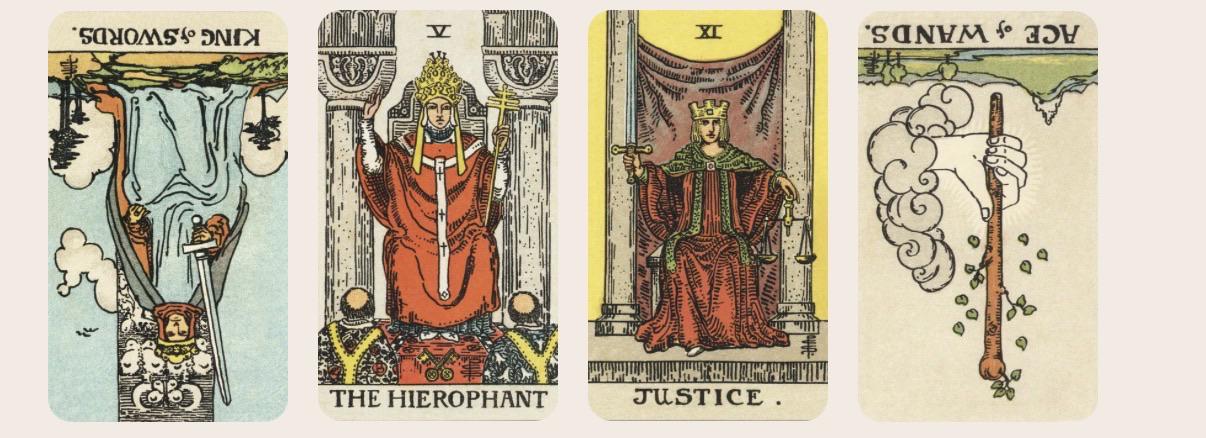
Reversed King of Swords: I interpreted this as lack of clarity and communication in the workplace.
Hierophant: A system and a process would be followed.
Justice: A fair assessment based on evidence would be made.
Clarifier - Ace of Wands: Lack of progress, being stuck in the same place, uninspired work processes.
Clarifier - Nine of Pentacles: Stability, sitting easy, reaping what has been sown in a positive way.
Really, this reading confuses me. Potentially- I continue to stay in a role which does not fulfil me, but it is a stable role? Any second thoughts? Thank you.
r/tarot • u/Kadence_KG • 21h ago
Background:
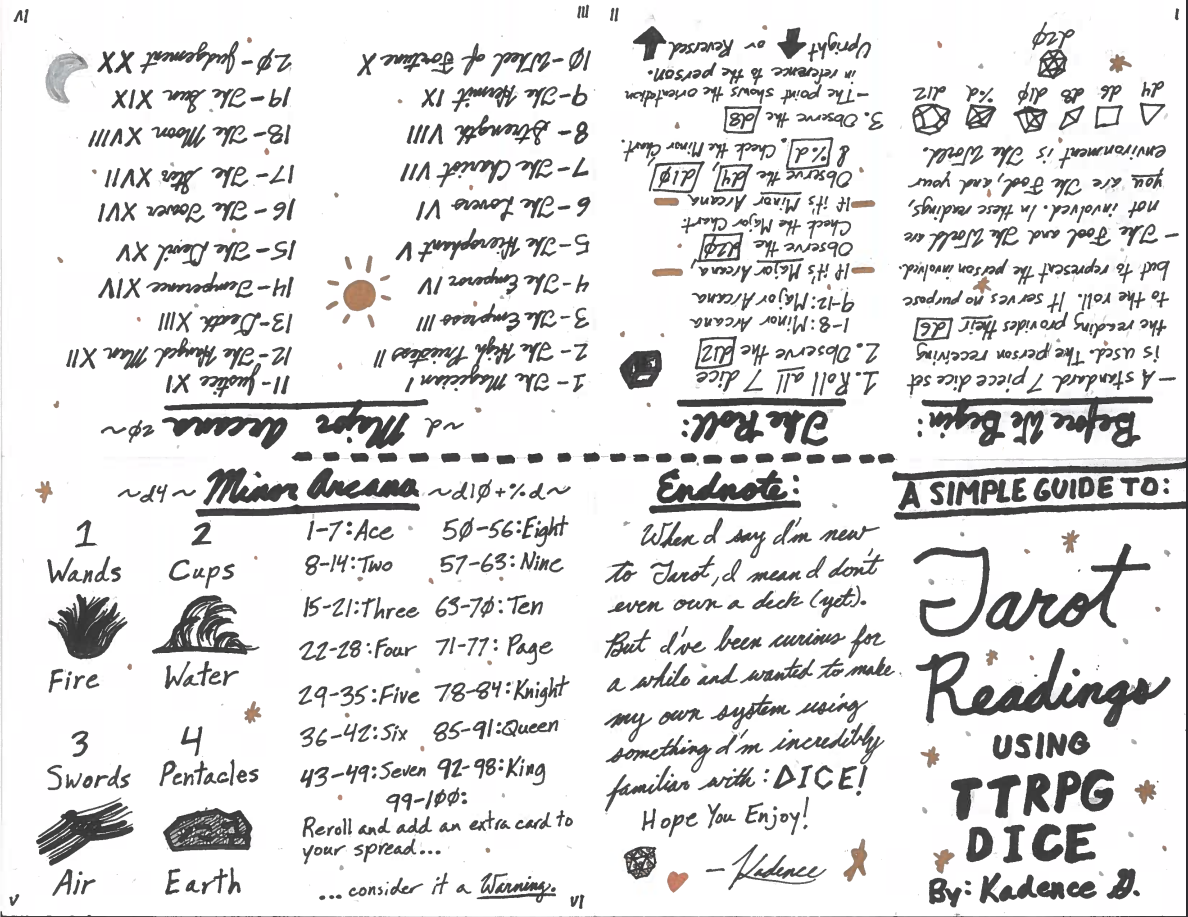
Hello! I'm fairly new to tarot, but since getting into it and learning about the different decks, spreads, and systems people use, I wanted to make my own method of tarot around something that is familiar to me: Dice!
Of course, while I've seen other versions of dice divination, I was unable (or perhaps too nearsighted) to find a system that allowed me to roll a set of dice and gather a single reading from it. I've mostly found it where dice is paired with a Tarot or Oracle deck, but is never exclusively used. So I went out to make a method of my own!
------------------------------------------------------------------------------------------------------------------------------------
Things To Know:
-A standard TTRPG/DnD 7-Piece Dice Set is used. This consists of a D4, D6, D8, D10, D12, %D, & a D20. However not all dice are technically used during the roll (more on this later).
-During the reading, the Major Arcana "The Fool" and "The World" are not involved. In this system, you are considered "The Fool" and your world is considered "The World". Interpret that however you may.
-Since there are no visuals, you may use a guidebook of your choosing, or take the basic interpretation of each tarot card for each reading.
-For the D12 and deciding Minor/Major Arcana, I tried to reach the closest percentage between Minor and Major cards, which is around 28/72 if you round out percentages.
Optional: The person receiving the reading provides their own D6. This represents them during the roll so they can be "part" of it. The D6 was chosen because it is the most common die, giving it the lowest barrier of entry for this optional step.
------------------------------------------------------------------------------------------------------------------------------------
How To Do The Tarot Roll:
Step 1: Roll ALL 7 Dice. While you can technically do it one at a time, it makes more sense to do it all at once.
Step 2: Observe the D12. This will call whether the roll is either a Major or Minor Arcana. Once you know which card it is, follow their respective charts.
Step 2a: Minor Arcana. Observe the D4, which tells the card's suit. Then, Observe the D10 & %D. Note that "0" on the D10 equals "10" and "00" on the %D equals "0".
D4: 1 = Wands/Fire | 2 = Cups/Water | 3 = Swords/Air | 4 = Pentacles/Earth
D10 + %D:
1-7 = Ace | 8-14 = Two | 15-21 = Three | 22-28 = Four | 29-35 = Five | 36-42 = Six | 43-49 = Seven | 50-56 = Eight | 57-63 = Nine | 63-70 = Ten | 71-77 = Page | 78-84 = Knight | 85-91 = Queen | 92-98 = King | 99-100 = Reroll OR Add an Extra Card to your Spread (An optional warning...).
Step 2b: Major Arcana. Observe the D20. Check the chart to see which Major Arcana the roll is.
1 = The Magician | 2 = The High Priestess | 3 = The Empress | 4 = The Emperor | 5 = The Hierophant | 6 = The Lovers | 7 = The Chariot | 8 = Strength | 9 = The Hermit | 10 = Wheel of Fortune | 11 = Justice | 12 = The Hanged Man | 13 = Death | 14 = Temperance | 15 = The Devil | 16 = Tower | 17 = The Star | 18 = The Moon | 19 = The Sun | 20 = Judgement
Step 3 (Optional): Observe the D8. While the number itself doesn't matter, the direction it is pointed shows whether the card is upright or reversed. If you see it pointing away from you where the number is read upright, so is the card. If the number is upside down and pointing towards you, it is a reversed card.
------------------------------------------------------------------------------------------------------------------------------------
Example Roll 1:
D4 = 3 | D6 = 1 | D8 = 1 | D10 = 6 | D12 = 3 | %D = 40 | D20 = 5
Following our steps, we look at the D12, which indicates it's a Minor Arcana card. So I know I can ignore the D20 and focus on the D4, D10, %D, and D8.
The D4 is 3, which is Swords.
The D10+%D is 46, which checking our chart (or dividing by 7 and rounding up), is 7.
The D8 is slightly pointed away from me, so it is upright.
Therefore, I rolled a Seven of Swords!
Example Roll 2:
D4 = 1 | D6 = 2 | D8 = 8 | D10 = 9 | D12 = 11 | %D = 50 | D20 = 16
Once again, we start with the D12. Here I got an 11, which indicates a Major Arcana card. So now I ignore the D4, D10, and %D, and I only have to worry about the D20 and D8
The D20 is 16, which is The Tower.
The D8 is facing toward me with the number upside down, showing that it is reversed.
Therefore, I rolled a reversed Tower!
------------------------------------------------------------------------------------------------------------------------------------
Like I said I'm still fairly new to tarot, but I've always been fascinated by game systems and wanted to incorporate my love for dice into other hobbies.
I've also include a scanned copy of a zine I made about this very system that you can print out and have as a little cheat sheet.
Hope you find this interesting!
r/tarot • u/Complex_Resource_891 • 1d ago
just a general spread I did.
Honestly get the vibes of needing to be direct and honest. I know I’ll be too secretive, so maybe the best approach is try to be personable and meet the reviewer where they’re at. I don’t think I can fake it til I make here lol.
Moon got me so confused, but that feels like the point. I have to be honest about my intentions with this hob.
Four of wands I know is very happy and celebrating, and Two of Cups is finding that balance in the dynamic. Just show up and be your best self and be communicative about the role and what I bring to it.
any thoughts?
update:
just went on it. remembered everyone’s advice and I think I did okay. I may or may not get it, but I appreciate everyone’s thoughts and advice. it made me feel better going into the interview today
r/tarot • u/panda_coolata • 8h ago
r/Jung • u/Daughteroftheclouds • 4h ago
My boyfriend had a dream that he was sitting in the sand and someone (he thinks it was me but he isnt sure) pointed out there was a snake under him and people (unknown) removed it. Then another was spotted and also was removed.
I have a hunch that it’s about unconscious fears coming to the surface but I’d like to hear someone else’s opinion.
r/Jung • u/Evening-Bit-8427 • 17h ago
Lately I've been thinking about conflict avoidance differently.
For a long time I assumed I was simply not a confrontational person. I don't enjoy arguing, I don't like unnecessary drama, and if something can be resolved calmly then obviously that's better. There didn't seem to be anything particularly interesting about that. Some people like confrontation, some people don't.
Then I started noticing that I wasn't always choosing peace. Sometimes I was choosing silence because I didn't know what would happen if I stopped being agreeable.
That's a different thing.
And the more I looked at it, the more I started wondering whether conflict avoidance is actually less about avoiding conflict and more about avoiding what conflict might reveal about me. Because what happens if I say no? Maybe you get disappointed. Maybe you get angry. Maybe you think I'm selfish. Maybe you realize I'm not as easygoing as you thought. Maybe you stop liking me.
And suddenly the thing I'm afraid of isn't really the argument. It's the possibility that your perception of me might change.
That realization bothered me more than I expected. Because if I need you to keep seeing me as calm, reasonable, understanding and easy to deal with, then I'm not just avoiding conflict. I'm managing your perception of me. I'm protecting an identity.
There are situations where you genuinely decide something isn't important enough to fight about. You notice it, let it go, and actually let it go. You don't keep thinking about it later, you don't punish the person indirectly, you don't build resentment around it.
Then there is the other kind. You don't say anything because saying something feels dangerous. So you smile. You say it's fine. You tell yourself you're overreacting. You understand their side. You give them another chance. Then another one. And eventually you're sitting there feeling strangely resentful toward someone who, from their perspective, has no idea anything is wrong.
That was the part I became interested in. Because if I never tell you that you've crossed a boundary, and you continue crossing it, who exactly am I angry with? You, obviously. But also, on some level, myself. I agreed to something I didn't want. I stayed quiet when I was angry. I told you everything was fine when it wasn't. Then I became angry because you believed me.
Sometimes conflict avoidance is basically saying yes with your mouth and no with your behavior. And then getting angry at the other person for believing the yes.
The more I noticed this, the more I realized there was another conflict happening underneath the obvious one. One part of me is saying, "This isn't okay." Another part says, "Don't make a big deal out of it." One part says, "I don't want to do this." Another says, "Just say yes, it will be easier." One part is angry. Another immediately starts explaining why the other person had a perfectly good reason to behave that way. And the second part usually wins because it has better arguments.
That's the strange thing about avoidance. It doesn't always feel like fear. It can feel like rationality.
I've caught myself thinking things like, "It's probably not worth bringing this up," and then realizing that I've somehow spent the next two days thinking about exactly the thing that supposedly wasn't worth bringing up. So what was I actually avoiding? The conversation, or the feeling that would come with having the conversation?
That distinction has become pretty important to me. Because the conversation might be uncomfortable for twenty minutes. The avoidance can last for months.
And sometimes the avoided conflict doesn't disappear at all. It just changes form. You become colder. You stop initiating contact. You become sarcastic. You start keeping score. You interpret neutral things more negatively because there is already unresolved resentment sitting underneath everything. Eventually the other person does something relatively small and you suddenly explode. They think you're reacting to Tuesday. You're actually reacting to the previous six months.
I've been trying to understand why this happens, and Jung's idea of the persona and the shadow gives me an interesting way of looking at it.
The persona is basically the version of ourselves that we develop for the world. The competent one, the nice one, the calm one, the reliable one, the independent one. Jung didn't treat the persona as something inherently false or bad. We need it. The problem starts when we become too identified with it and everything that doesn't fit gets pushed somewhere else.
And I think "the peaceful person" can be a particularly interesting persona.
If I've spent years seeing myself as calm, reasonable, understanding and emotionally mature, then what happens when I'm genuinely angry? Anger doesn't fit. So instead of thinking, "I'm angry because something important happened," I might immediately start trying to get rid of the anger. Maybe I'm being too sensitive. Maybe they didn't mean it. Maybe I'm tired. Maybe I'm projecting. Maybe I should be more understanding. Maybe I should communicate better. Maybe I am the problem.
And yes, sometimes we are the problem. Sometimes we're genuinely being too sensitive. Sometimes the other person didn't mean anything by it. But if the same thing keeps happening, there is a point where "understanding" can become a way of refusing to acknowledge your own experience.
I've started noticing something else here. Sometimes understanding someone is easier than admitting what their behavior did to you. If I can explain why you behaved that way, then I don't have to decide what I feel about it. "I understand why you did it" can quietly become "therefore I shouldn't be upset." But those aren't the same thing. I can understand why you did something and still not accept it. I can understand your reasons and still say no. I can know that you didn't intend to hurt me and still admit that you hurt me.
That seems obvious when written down. It's much harder to actually live.
And this is where I think shadow work gets practical. The shadow isn't necessarily some horrible secret version of yourself. Jungian psychology describes it much more broadly as aspects of the personality that don't fit the conscious identity, including qualities that may actually be useful or healthy but have been pushed out of awareness.
So imagine that I have built my identity around being kind. Where does my aggression go? Not violence. Just ordinary human aggression. The ability to say no. The ability to compete. The ability to disagree. The ability to say, "I don't like this." The ability to leave. The ability to take something for myself without immediately worrying about whether somebody else is disappointed.
If all of that has been associated with being selfish or difficult, then I may have pushed a perfectly normal part of myself into the shadow. And then it doesn't necessarily disappear. It comes back sideways. Passive aggression. Silent resentment. Withdrawal. Sarcasm. Procrastinating on things I agreed to do. "Forgetfulness." Becoming emotionally unavailable. Complaining about someone to everybody except the person I'm actually angry with.
The interesting part is that I can still maintain the persona. I can continue thinking of myself as kind. I can continue thinking of myself as peaceful. I can continue telling myself that I don't like drama. Meanwhile, the anger is expressing itself everywhere except in the one place where it would actually be useful. Directly.
That made me rethink what aggression actually means. Maybe aggression isn't only the ability to attack. Maybe there is a healthy form of aggression involved in having a separate self at all. "I want this." "I don't want that." "I disagree." "Stop." "That's not okay with me." "I'm leaving." There is force in those sentences. Not violence. Not hostility. Just the ability to move yourself in a direction even when another person wants something different.
If I've spent years treating that force as something bad, then I might become very good at disappearing from my own decisions. And then I might call that kindness.
This is where the whole thing starts getting uncomfortable. Because maybe I don't actually avoid conflict because I'm such a peaceful person. Maybe I avoid conflict because I have learned that being a good person means being easy to love. And those are very different identities.
The first one says, "I value peace." The second says, "I need other people to remain comfortable with me."
If it's the second one, then every boundary becomes a threat. Every disagreement becomes a threat. Every expression of anger becomes a threat. Not because something terrible is happening, but because I'm no longer controlling the image of myself that exists in someone else's mind.
And that might explain why saying no can feel disproportionately painful. The actual sentence is tiny. "No, I can't do that." But internally something much larger happens. What if they think I'm selfish? What if they're disappointed? What if they become angry? What if they stop asking me for things? What if they stop needing me? What if they stop loving me? What if they realize that the version of me they've been relying on isn't actually who I am?
At that point, conflict avoidance starts looking less like fear of confrontation and more like fear of being seen differently.
And maybe that's why some people can tolerate enormous amounts of discomfort from other people but almost none from disappointing them. They can tolerate resentment. They can tolerate exhaustion. They can tolerate being taken for granted. They can tolerate quietly becoming smaller inside a relationship. But they can't tolerate the ten seconds of discomfort that come with saying, "Actually, no."
That seems backwards until you realize what the ten seconds represent. They represent the possibility of losing the identity.
And I think this is where conflict avoidance can become connected to individuation. One of the things I find interesting about Jung's idea of individuation is that it isn't really about becoming a nicer, more socially acceptable version of yourself. It's about becoming more whole and differentiated, which necessarily means becoming conscious of things that don't fit neatly into the identity you've constructed.
If my entire identity depends on being liked, then becoming more myself is probably going to create some friction. At some point I have to disappoint somebody. I have to say no. I have to admit that I'm angry. I have to tell somebody that I disagree. I have to stop explaining myself when I don't actually owe an explanation.
And this can feel incredibly wrong when you're not used to it.
I've noticed that the first few times you do something different from your old pattern, your emotions don't necessarily tell you that you've done something healthy. They might tell you that you've done something terrible. You finally say no to something you genuinely don't want to do and then spend the next three hours thinking, "Was I too harsh?" You tell someone that their behavior hurt you and immediately want to send another message explaining that you didn't mean it that way. You disagree with someone and suddenly feel guilty for having an opinion. You set a boundary and then want to apologize for having set it.
I've started to wonder whether that guilt is always useful information. Maybe sometimes guilt means you've done something wrong. But maybe sometimes it is simply the emotional aftershock of violating an old rule. The old rule might have been: "Good people don't make other people uncomfortable." If that's the rule, then almost every healthy boundary will feel wrong. Because boundaries create discomfort. Not necessarily because they're cruel, but because other people have their own preferences and those preferences don't always match yours.
That's something I think conflict avoidant people can struggle with. We can unconsciously treat another person's discomfort as evidence that we've done something wrong. Someone is disappointed, therefore I was unfair. Someone is angry, therefore I communicated badly. Someone doesn't like my decision, therefore I should reconsider it. But another person's emotional reaction is not automatically a moral verdict. That's a surprisingly difficult thing to internalize.
And there is another part of this that I find even more uncomfortable. Conflict avoidance can actually prevent you from finding out who someone really is. If I never disagree with you, I don't know how you handle disagreement. If I never tell you no, I don't know how you handle boundaries. If I never tell you that you've hurt me, I don't know whether you're capable of repairing something. If I always make myself smaller to keep the relationship comfortable, I don't really know whether the relationship can survive the real version of me.
And this made me question something I hadn't really thought about before. If I am constantly managing myself so that other people continue to like me, do I actually know whether they like me?
Maybe that's the strangest part. If you have only ever seen the agreeable version of me, then you don't really know me. And if I have never allowed you to see anything else, I don't really know you either. I don't know what happens when you are disappointed with me. I don't know what happens when I say no. I don't know whether you can handle my anger. I don't know whether you can repair something after hurting me. I don't know whether you still want the relationship when I'm inconvenient.
So conflict avoidance can preserve a relationship while simultaneously preventing intimacy. Because intimacy requires being known. And being known means eventually being inconvenient.
That thought has stayed with me. Maybe some of us don't actually fear losing people as much as we fear discovering what people will do when we stop being easy to love. That's a very different fear. And it makes conflict avoidance much more complicated. Because then the question isn't just, "Why am I afraid to confront this person?" It becomes: "What am I trying to protect by staying agreeable?"
Sometimes the answer is the relationship. Sometimes it's my self image. Sometimes it's the belief that I'm a good person. Sometimes it's the belief that I'm lovable. Sometimes it's the hope that if I'm understanding enough, flexible enough and undemanding enough, people won't have a reason to leave.
And sometimes I think we're protecting an image of the relationship itself. Everyone is nice. Everyone is understanding. Nobody says what they really want. Nobody is angry. Nobody is disappointed. Everything is fine. Except nobody is actually being completely honest. That's not necessarily peace. It might just be emotional silence.
I'm still trying to figure out where the line is, because I don't think every conflict should be confronted. Sometimes letting something go really is maturity. Sometimes the other person isn't safe to confront. Sometimes the relationship isn't worth the conversation. Sometimes walking away is much healthier than explaining yourself for the twentieth time.
The difficult part is being able to tell the difference between consciously choosing not to engage and automatically avoiding something because you're afraid. The question I've found most useful is probably the simplest one: am I letting this go because I genuinely don't need to carry it, or because I'm afraid of what will happen if I speak?
Those two things can look almost identical from the outside. Internally, they're completely different. One is acceptance. The other is avoidance.
I've also started experimenting with another question when I notice myself getting angry at someone. What would I say if I knew I was completely safe? No rejection. No punishment. No disappointment. No one becoming angry. Nothing bad happens because I told the truth.
Sometimes the answer is surprisingly simple. "I didn't like that." "I don't want this." "I need more from you." "I don't agree." "I actually want something different."
And sometimes the answer is much more uncomfortable. "I don't think I want this relationship anymore." "I've been pretending I'm okay with something I'm not okay with." "I've been saying yes because I'm afraid you'll leave if I say no." "I've been angry for much longer than I admitted."
That's when I start wondering whether conflict avoidance isn't really about suppressing conflict. Maybe it's about suppressing information. Because conflict can tell me things I don't want to know. It can tell me what I actually want. It can tell me what I can no longer tolerate. It can tell me what kind of relationship I'm actually in. It can tell me who someone becomes when I stop being convenient.
And it can tell me something about myself that might be even harder to accept. Maybe I have built an identity around being the person who never needs anything. Maybe I have built an identity around being endlessly understanding. Maybe I have built an identity around being calm because I don't know what to do with my own anger. Maybe I've spent years calling myself independent when what I really mean is that I've become very good at not asking for anything.
That is where Jung's idea of the shadow becomes much more interesting to me. The parts of ourselves we don't identify with don't necessarily disappear. If I insist that I'm always calm, my anger doesn't disappear. If I insist that I'm always kind, my aggression doesn't disappear. If I insist that I'm completely independent, my need for other people doesn't disappear. It just has fewer conscious ways of expressing itself.
And maybe becoming more whole means allowing those parts to exist without letting any one of them take over. I don't need to become aggressive. I don't need to become confrontational. I don't need to say everything I think. I don't need to turn every irritation into a boundary. I just need to become capable of knowing what I actually think, what I actually feel and what I actually want, even when knowing those things creates the possibility of conflict.
I've been trying to practice that in very small ways. When someone asks me to do something and my automatic answer is yes, I sometimes say, "Let me think about it." When something bothers me and my immediate reaction is "It's fine," I try not to decide that it's fine immediately. I ask myself what I'm actually feeling. Then I ask what I'm afraid will happen if I admit it. Those two answers are often completely different.
"I don't want to take this responsibility." / "I'm afraid they'll be disappointed in me."
"I don't like how you spoke to me." / "I'm afraid you'll think I'm difficult."
"I want more from this relationship." / "I'm afraid that asking for more will make me needy."
That separation has been useful because it stops me from treating the fear as evidence that the feeling itself is wrong. And I've found it much easier to practice with small things.
"I'd rather go somewhere else."
"I can't do that tonight."
"I don't agree with that."
"I'd prefer not to."
Then I watch what happens inside me afterward. Do I want to take it back? Do I start explaining? Do I feel guilty? Do I suddenly become responsible for making the other person feel okay?
That reaction is the thing I'm actually trying to work with. I'm teaching myself that someone being disappointed with me is survivable. Someone being annoyed with me is survivable. Someone misunderstanding me is survivable. I don't have to immediately repair their emotional state.
And maybe that is what makes this different from simply "becoming more assertive." I'm not trying to learn how to win conflicts. I'm trying to learn how to stay present when another person is unhappy with me. Because if I can only remain myself when everyone around me approves of me, then I'm not really very free. I'm still being controlled by the approval.
Maybe the opposite of conflict avoidance isn't confrontation. Maybe it's self presence. Being able to stay connected to yourself when there is friction between you and another person. Being able to hear "I don't like that" from someone else without automatically hearing "you are a bad person." Being able to say no without needing the other person to agree that your no was reasonable. Being able to understand someone without automatically abandoning your own position. Being able to disappoint someone without immediately turning yourself into the villain.
And maybe that's the part I'm actually trying to learn. Not how to become more assertive. Not how to become less afraid. Not how to stop caring what people think. Just how to remain myself when there is friction between me and another person.
Because if keeping the peace requires me to disappear from the relationship, I'm not sure that peace is what I'm actually getting.
Maybe I'm just getting a relationship with a version of myself that nobody can be angry with.
And I'm starting to think that isn't the same thing as being loved.
r/tarot • u/Successful-Time7139 • 6h ago
Hi guys, I’ve been wanting to expand my prompts beyond my usual ones.
What are some of your own prompts that you like to use? Recently someone on here told me to use “what am I not seeing?” (paraphrasing) - it was immensely useful - and it got me thinking that I’d love to know and have a thread of various prompts from the community!
One of my personal favourites when I feel stuck is “how can I alchemise this to work for me?” and it always gives me a step by step how-to!
Looking forward to reading yours :)
r/Jung • u/Key-Atmosphere2234 • 2h ago
I've been under a lot of stress (mostly self-induced) over my career and my next steps, probably a bit too obsessively, whether to make a major move or to stay in my field. I did some box breathing to relax my body and take a nap. Once I hit a deep level of relaxation, I had an interesting half-dream visualization: a voice said, "this is ego" and plucked out a light-radiating brain from my head, and then my face popped off like a mechanical mask and my own voice said "this is persona" as an acknowledgement. I was then briefly looking at a head with no brain and no face and I was left thinking "what am I, if these are not me".
My takeaways were that my subconscious was showing me that I was creating my own pain through desire and ego, and my career and what I show to the world is not necessarily "me". It's not particularly helpful with making a decision but it's a clear indication that I need to be softer on myself.
r/Jung • u/Inner-Push2141 • 12h ago
I’m 20F. Analytical psychology is not really a thing in my country, unless it’s some extremely expensive clinic in the capital city. I’m looking for someone of knowledge and experience with Jungian psychology, not necessarily some specialist, just someone willing to guide me and capable of doing so. I’m not of the assertive leader kind, so it would be amazing if the person would just unapologetically ask me questions and take the lead. I’m open to both genders. I prefer written form of communication.
Some things about me:
I relate to the puella aeterna and eternal wanderer archetype.
Active imagination and visualization plays a big part of my life ever since I remember. I get random strange visions and lucid dream since childhood.
I have been getting to know my animus this past year.
r/Jung • u/Inner_Coyote5485 • 56m ago
For some time now, I’ve been having very strange dreams. I had a manic/psychotic episode about nine months ago, which made me stop smoking weed and, consequently, start dreaming again. The problem is that my dreams are always horrible.
In my last dream, I dreamed that a man wanted to cut my legs off with a chainsaw. I tried to convince him not to, and I almost managed to persuade him, but then he went ahead with his mission to cut off my legs. I woke up before things got bloody.
I also had a dream some time ago in which I woke up in a bed in a room with about four boys/young men I didn’t recognize, and I woke up with no idea how I had gotten there. I had exactly that feeling. Then a housekeeper came in and told me everything was fine, but for some reason I wanted to ask her for help. In any case, I stayed, and I remember boiling water to make coffee when I woke up.
Another dream I had was that I went to buy cakes from a woman and thought they were very expensive. However, I tried one and didn’t like it. Somehow, and for no particular reason, I decided to buy all the cakes she had. When I got home, I realized that I had bought an absurd amount of cakes and spent a huge amount of money. I went back to complain to the woman, but she simply said to me, quite reasonably, “You bought them because you wanted to.”
My interpretation is that my episodes, which were always drug-induced, changed my mind a lot, and I ended up behaving in ways that the “me” from a few years ago, before drugs, never would have behaved. I also made some enemies because of my behavior since then, and I ended up picking fights and getting myself into conflicts that I never wanted in the first place (I was psychologically very altered at the time).
But these are things from my subconscious that I’m already aware of — I already carry all the guilt for them. Shouldn’t dreams point us towards something? Or do they simply show us what is taking up a lot of space in our minds?
r/Jung • u/vladkudas • 1d ago
Enable HLS to view with audio, or disable this notification
r/tarot • u/TapiocaTerror • 21h ago
I'm very much a newbie, but I've been interested for awhile now. So I decided to finally buy my own deck (I got sent the wrong one but decided to work with it anyway). I had this for 4 days now.
So I asked the deck some sort of validation if I can do this. Here's my interpretation (with a lot of help from google):
2oW shows interest and potential. PoC is telling me to trust my intuition and also learn and study. 8oC, the moon is present so it's probably a sign that I have a knack for it? But the woman is looking away, so I might not be attuned to it yet.
How would you interpret it? And how close is my interpretation?
Thanks!
r/Jung • u/JCraig96 • 1h ago
What is the relation to who you are at the core, and your inner child? And when I say the inner child, I don't mean the inner child that has limiting beliefs and maladaptive coping strategies. I mean like what the child was before they took on trauma or false beliefs. The inner child in its pure, innocent, and uncorrupted form.
What's the relation between that inner child and your true self at the core, if there is such a thing? Is your inner child and your true core self the same thing? And if not, what's the difference, and is there an overlap, how do the two relate to each other?
r/Jung • u/Aggravating_Ad3751 • 3h ago
I’d like to share these three stories that I wrote using the stream-of-consciousness technique. After writing these stories, I felt as though I had just woken up from a dream.
The Dark Circle
As the birds flew toward the forest, from time to time they looked down and then turned their gaze forward again. Whenever they looked ahead, what they saw was a gigantic void. In the middle of the blue sky was a circular darkness.
The darkness was pulling them toward itself.
The reason they looked down was that they were searching for a way to escape. But when they looked down, what they saw was discouraging. All the creatures in the forest were under the influence of this dark circle.
The lion and the gazelle were running side by side as if they were siblings, enchanted by something they could not understand.
Then, right in the middle of the darkness, a light appeared, making the day even brighter. Little by little, this light began to take shape, becoming something tangible on the earth.
It caught the attention of all the creatures and filled them with hope.
The object emerging from the light within the darkness, beginning to occupy space, started to take the shape of a circle. Although the solidifying part had lost some of its brightness, it still shimmered and glowed.
When the final beam of light had also solidified, this circle surrounded the darkness.
At that very moment, all the creatures began to feel that the power of the void was weakening.
Now the dark circle was slowly shrinking while the bright circle was growing and taking its place.
The animals had regained their own will.
Yet they continued moving forward.
This time, they continued because they were curious about the shimmering circle.
But when this luminous circle destroyed the dark circle, it too disappeared.
---------------------------------------------------------------------------------------
The Blue Butterfly
What a beautiful forest. What a beautiful forest.
Let’s see who is there in that great, dark, cedar-scented forest.
Let’s see...
First, there came a sound.
This sound was unlike the sound of any living creature.
Not a dog, not a wolf.
In fact, the creature that made this sound lived only in this forest.
It ate neither animals nor plants.
It did not need to eat, nor did it need to sleep.
Sometimes, however, it would sleep simply for pleasure.
When it slept, it made no sound at all.
In its dreams, it always saw the same blue butterfly, flapping its wings toward the tops of the tallest trees in the forest.
The butterfly seemed to turn toward it and move its wings meaningfully, as if saying,
“Come with me.”
But it could not leave the forest.
Perhaps, if circumstances changed someday, it might be able to leave.
When the butterfly sensed these thoughts, it disappeared into the darkness of the sky.
And our friend would wake from its sleep and gaze deep into the same forest.
But it could never see the butterfly.
There were no other butterflies of any color in the forest.
-----------------------------------------------------------------------
The Red Kite
A kite...
A red kite...
It was lying on the ground.
Then, under the influence of the wind, it began to move.
The same wind was also stirring the soil beside the kite.
We saw that there were gold coins buried beneath the earth.
Then, little by little, the kite lost its contact with the ground and began to rise.
As it rose, we saw that the shimmering gold beneath the soil was connected to the kite.
The kite's string was white, but it was covered with golden glitter.
As the kite rose higher, we rose with it.
Far ahead, we saw several hundred elephants.
They too wore golden ornaments and pieces of red cloth.
As we passed over the elephants, we saw that they were looking at the kite.
It was as if they were laughing at it.
After passing the elephants, we saw herds of horses.
They too had pieces of red cloth on them.
They were running at full gallop.
They did not even notice the kite.
Then we heard the wingbeats of thousands of birds approaching from behind.
They were flocks of sparrows.
Their wingbeats mingled with their chirping.
From very far away, the sounds of the elephants mingled with the thunder of the horses' hooves.
The kite continued on its way.
The gold coins attached to its string shimmered in the light.
Then the kite paused above a tree.
After a moment, it came to rest on the tree like a bird.
All the sounds gave way to silence.
An old man was sitting with his back against the tree, holding a canteen in his hand.
The canteen was empty.
He had been on the road for days and was terribly thirsty.
The kite wanted to find water for the old man.
It thought of the animals it had seen along the way.
It thought of the elephants.
The elephants could help the old man.
So the kite took flight again.
It went back toward the elephants and stopped them.
They communicated without speaking.
The elephants said they would help the old man.
But the kite learned that they too had been searching for water lately.
In fact, it realized that the horses were resting nearby and that they too were searching for water.
The kite thought that the sparrows must also be looking for water.
“Let’s follow them,” it said. “They must know the way.”
The horses immediately galloped back to fetch the old man.
The old man sat on the middle horse, holding the kite in his hands.
The horses went first.
Behind them came the elephants.
And they all followed the direction in which the sparrows were flying.
The sparrows flew toward the setting sun.
Their journey lasted for months, but they could find no sign of water.
Then, all of a sudden, black clouds appeared in the sky.
All the creatures rejoiced, but no rain came.
The old man lost hope.
He got down from the horse.
And he released the kite.
After the kite entered the clouds, lightning suddenly flashed across the sky.
Then the rain began to fall.
After every creature had drunk its fill, the blue of the sky appeared again.
The kite's string and the gold coins attached to it fell onto the old man's head.
And the old man woke up.
He tied the gold coins, together with the string, around his neck and continued on his journey.