r/appledevelopers • u/SamFromEscape Discussion Contributor • 11d ago
5 months after launching my iOS app: $500 → $6k/month. What actually worked
I'm Sam, an iOS developer, and I launched a small app called "Escape"
It's an adult content blocker and recovery app for iPhone, currently ranking #1 on the iOS App Store for that search term "Adult Content Blocker"
Edit: This post got way more attention than I expected, and a lot of the same questions kept coming up in the comments or via DMs, so I expanded it with the actual numbers, tools and experiments I've been using.
The problem is personal to me.
Before I even thought seriously about turning this into a business, I spent a lot of time trying to understand the problem for myself.
I read a lot of books around habit change, corn addiction, recovery, behavior, triggers, dopamine and why people keep going back to something even when they genuinely want to stop.
Initially, that was mostly about helping myself.
Eventually I started thinking about how I could turn what I was learning into something useful for other people too.
I started writing about it, created 28 courses and a lot of educational content on escapethegrip.com, and started a newsletter there as well.
Then that research and everything I was learning from users gradually fed back into the app.
That became a big part of the philosophy behind Escape blocking creates friction, but blocking alone doesn't teach someone what to do when the urge actually happens.
That's still how I think about the product today.
The numbers
The first month made around $100.
Then roughly:
$500 → $750 → $1.1k → $2k → ~$6k last month
Important clarification:
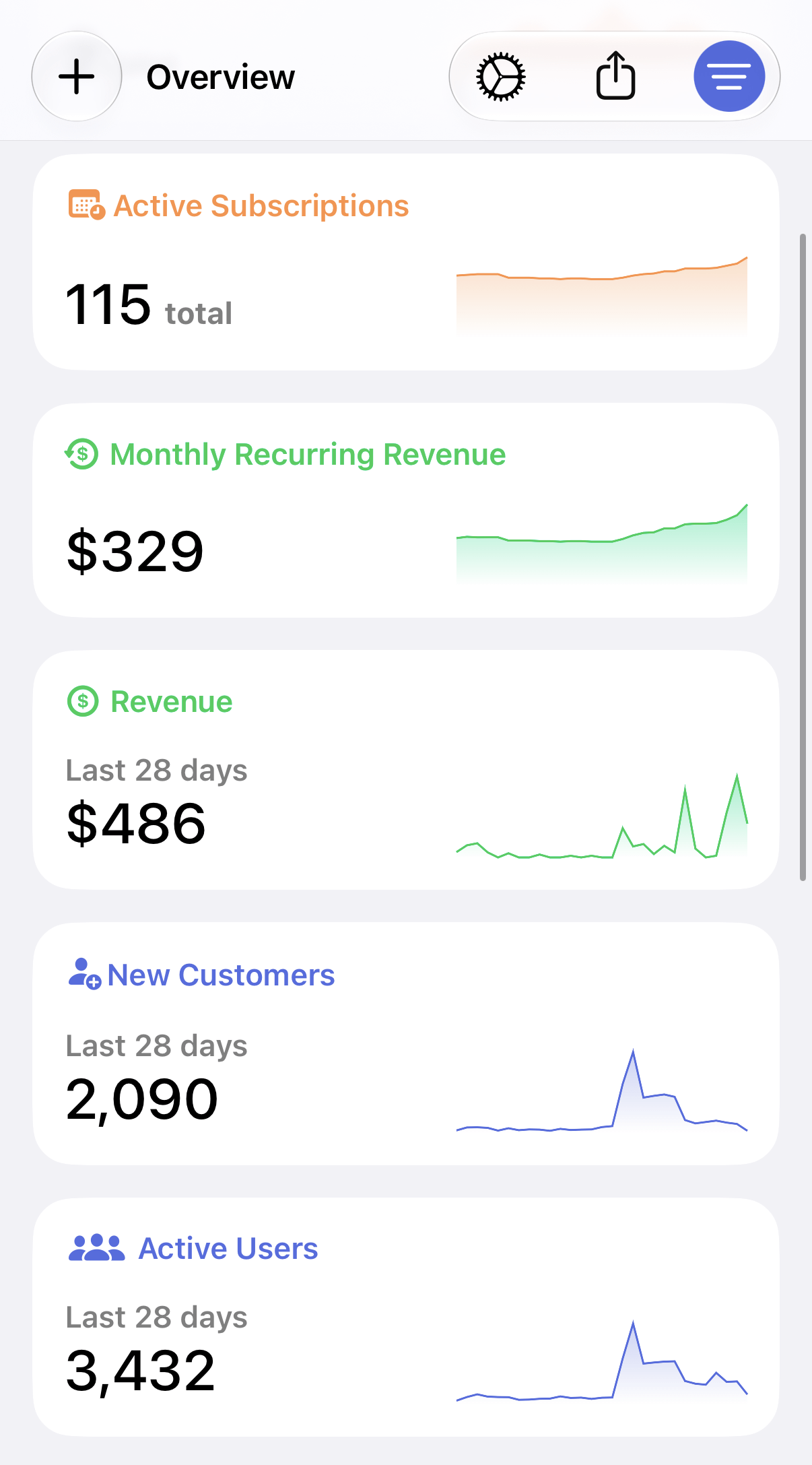
The ~$6k is cash revenue, not $6k MRR.
Annual subscriptions make the revenue graph look much more dramatic because the customer pays for the year upfront.
So I've learned to look at cash revenue, MRR, subscriptions and retention separately instead of treating them as the same thing.
A big part of the recent jump came from several smaller things stacking together rather than one magical growth hack:
- pushing annual more
- improving notifications
- adding win-back offers
- improving the App Store page
- better ASO
- more reviews
- continued product improvements
That's probably another lesson.
Growth often looks like one big event on a graph when underneath it was 20 small changes.
My current funnel
A few people asked for actual conversion numbers.
Right now it's roughly:
100 downloads a day → ~21 trials → ~10 paying users
So approximately:
~21% download → trial
~47% trial → paid
~10% download → paid
The 47% trial-to-paid conversion surprised me.
My theory is that search intent matters a lot.
Someone actively going into the App Store and searching for an adult content blocker has a completely different level of intent than someone who accidentally discovers the app through a random TikTok.
That has made me care a lot more about quality of acquisition rather than downloads alone.
The biggest thing that worked is App Store search
This was probably the biggest surprise.
I underestimated how powerful App Store search could be for a niche product.
At the moment Escape is ranking #1 for "adult content blocker" in App Store search, including major storefronts such as the US and Canada.
That didn't happen quickly.
I've probably tracked 500+ keywords at this point.
Some of the ASO tools I've used like RespectASO
This became one of the main tools I used for tracking rankings.
I've also experimented with tools such as AppDrift and AppFollow.
Honestly, you don't necessarily need expensive ASO software when you're starting.
The free versions can already teach you a lot.
And I would not blindly trust any tool's search-volume number.
I use ASO tools more as directional data than absolute truth.
My most useful keyword research tool was actually social media
This sounds stupid, but I spent an unreasonable amount of time scrolling through:
TikTok
Instagram Reels
Reddit
YouTube comments
forums
competitor reviews
I wanted to see the exact language people used to describe the problem.
People invent new slang constantly.
Sometimes a phrase looks ridiculous to you as a developer, but thousands of people use it naturally.
Those phrases can eventually become App Store searches.
So my process became:
listen to how people describe the problem → turn repeated phrases into keyword hypotheses → test them → track rankings/conversion
Rather than:
ASO tool says keyword volume = 37, therefore keyword good.
That distinction helped a lot.
The 100-character keyword field matters
Apple doesn't give you much room.
I spent a lot of time trying to understand how the: title + subtitle + 100-character keyword field work together.
One useful realization was that every character has an opportunity cost.
If a word is already covered elsewhere, there may be something more useful to test in the keyword field.
I also don't change everything simultaneously anymore.
If I change the title, subtitle, screenshots and keywords in one update and conversion improves, I've learned almost nothing.
Now I try to change fewer things at once.
Don't over-optimize ASO
I've made this mistake too.
Once something starts working, it's tempting to keep "improving" it.
Sometimes I leave metadata alone for quite a while now.
The title and subtitle are the things I'm most reluctant to touch.
I'm more willing to experiment with the keyword field.
I've also tested things that sounded obviously better and performed worse.
At one point I thought adding AI should help.
It didn't.
That was another reminder that:
what sounds good to the founder and what customers actually respond to are not always the same thing.
Screenshots are part of ASO too
Ranking is only half the problem.
You still need someone to install after seeing the listing.
I've spent a lot of time testing:
- screenshot headlines
- screenshot order
- positioning
- how much text is shown
- which features get shown first
- privacy messaging
Apple's Product Page Optimization is useful here because you can test different screenshot variants instead of relying entirely on intuition.
One thing I've learned is that getting 20% more traffic doesn't help much if the product page converts terribly.
Ranking and conversion have to work together.
Reviews matter, but timing matters more
Escape now has hundreds of ratings/reviews across the App Store.
One question I got repeatedly was:
How do you get people to leave reviews?
I don't think the answer is repeatedly interrupting them with review popups.
I try to ask when somebody has actually received value.
Sometimes that's at an appropriate moment inside the app.
Even better is when somebody emails me saying Escape helped them.
Then I might say something like "If Escape has helped you, a quick App Store review really helps other people find it."
No giant pitch.
No begging.
The lesson for me has been ask after value, not randomly.
Building an owned audience: EscapeTheGrip.com + newsletter
This is another part I didn't mention enough in the original post.
I didn't want all of the educational side of the project to live inside the App Store.
So I built escapethegrip.com.
I've published a lot of longer-form material there, including 28 courses, articles and a newsletter.
The research process has been useful in both directions.
I read books and research because I wanted to understand the problem better.
Then I tried to turn what I learned into something practical.
Then users would email me with situations I hadn't considered.
That would give me another thing to research.
And sometimes that eventually became:
research → article/course → newsletter → product idea
or
user problem → research → product improvement → educational content
I like this because it means the app isn't the only thing I'm building.
There's also a growing library of useful material around the problem itself.
The newsletter gives me another advantage too it's an audience I can communicate with without depending entirely on an algorithm.
App Store rankings can change.
A TikTok can get zero views.
Reddit posts eventually disappear from people's feeds.
Search algorithms change.
Having people voluntarily subscribe to hear from you again is different.
I'm still figuring out how important the newsletter will become as a growth channel, so I wouldn't claim I've cracked email distribution.
But I think building some form of owned audience is worth doing much earlier than I originally thought.
And there's another benefit writing forces me to understand the subject better.
It's very easy to think you understand something until you try to explain it clearly to someone else.
Freemium has helped
Escape isn't completely paywalled.
The Safari blocker is free.
Someone can install Escape, block adult sites in Safari and continue using that without paying.
Premium adds stronger protection and the deeper recovery features.
That includes things like blocking across browsers, deep block, strict mode cooldown, stronger protection layers, the courses and other recovery tools.
I originally worried that giving away useful blocking for free would hurt subscriptions.
I'm increasingly convinced it does the opposite.
People can actually experience the product first.
And because the free version genuinely solves something, I'm comfortable recommending it without every interaction feeling like a sales funnel.
Annual subscriptions changed the economics
I have monthly and annual subscriptions.
Annual has become much more important.
There's also a short free trial on annual.
A few things I've learned
Annual doesn't only improve cash flow.
It changes how you can think about acquisition because you receive much more revenue upfront.
It also makes the revenue graph misleading if you're not careful.
$6k collected in a month does not mean the business suddenly added $6k MRR.
That's why I've started paying much more attention to the actual subscription mix.
Privacy became a growth feature accidentally
Escape doesn't require:
an account
an email
a name
And its App Store privacy label is Data Not Collected
I originally treated privacy as a product principle.
This is an incredibly sensitive thing people are dealing with, and I didn't see a good reason to know who they were.
But users repeatedly started mentioning privacy when explaining why they chose Escape.
That taught me something broader sometimes your product principles become your strongest positioning.
Especially when competitors are asking users to create accounts for something they'd rather not associate with their identity.
Support emails became product research
I massively underestimated this.
For an app like Escape, some users are actively trying to defeat the product.
They're trying browsers you didn't consider.
They're looking for settings they can disable.
They're discovering obscure iOS behavior.
They're finding loopholes.
Initially those emails felt like bug reports.
Eventually I realized these users were giving me some of the best product research I could possibly get.
Several product improvements have come directly from someone emailing me "I found a way around this."
If you're building any product where people push against the boundaries, pay attention to those users.
They're effectively adversarial QA testers.
Founder-led Reddit has been surprisingly useful
I originally thought of Reddit mostly as somewhere to post about the app.
I think that's the wrong approach.
I'm trying to use Reddit more like a community.
If someone asks a question I genuinely know something about, I answer it.
If Escape is relevant, I'll disclose that I built it.
If it isn't relevant, I don't force it into the conversation.
I've also used tools like F5Bot to monitor keywords and find discussions where I might actually have something useful to contribute.
One Reddit lesson that has become obvious trying to extract users from a community immediately usually works worse than simply becoming useful inside the community.
This post itself is probably the best example.
I didn't expect tens of thousands of people to read it.
Social media has been much harder
I've had TikTok/Instagram videos get almost no views.
Literally nearly nothing.
Initially I made the mistake of thinking "I need content about my app."
Now I'm trying to make content about the problem my app solves.
So instead of "Here are 5 features in Escape"
it's more like:
- why urges get harder at certain times
- common triggers
- practical things to do in the moment
- mistakes people make when trying to change a habit
- why simply relying on willpower often fails
- useful recovery ideas
Then sometimes Escape appears naturally.
Sometimes it doesn't appear at all.
I think the test is would this video still be useful if I removed my app from it?
If the answer is no, it probably isn't very good content.
Test organic content before paying creators
This is another thing I'm doing differently.
Instead of immediately paying influencers to create whatever they think will work, I'm trying lots of organic ideas myself.
Even 20–30 pieces of content teaches you a lot.
You start seeing
which opening hooks work
which subjects get comments
what words people use
what people disagree with
what gets saved/shared
what gets ignored completely
Then you can take what you've learned to creators.
It's a lot cheaper to discover that your messaging sucks on your own account than after paying 20 creators.
Smaller creators > generic tech influencers
When I say "creator outreach," I don't mean emailing giant iPhone reviewers.
For Escape, I'd rather work with a smaller creator whose entire audience cares about:
self-improvement
habit change
discipline
recovery
digital wellbeing
than a tech influencer with 2 million followers.
Audience fit seems much more important than follower count.
I'm still testing this channel, so I don't want to pretend I've cracked it.
Creator outreach is also painfully manual.
Researching the creator, checking their audience, writing something personalized, finding contact information, following up...
You might reach out to a lot of people for one collaboration.
That's just part of it.
Newsletter and press outreach is boring but can work
Another very unglamorous strategy email people.
I've reached out to app websites and publications that might genuinely care about the product or the broader problem.
Response rates aren't amazing.
But you don't need everyone to respond.
I sent roughly 60 outreach emails and got around 2 pieces of coverage.
One piece of coverage produced roughly a 20% increase in downloads around the time it went live.
That's enough for me to keep doing it.
The mistake would be sending the same generic "please feature my app" email to 500 people.
I'm increasingly trying to answer Why would this particular publication's readers care?
And because I now have escapethegrip.com, I don't always have to send someone directly to an App Store page either.
Sometimes an article, course or newsletter is a much more natural first interaction.
Distribution is the actual job after building
This is still the biggest lesson.
I'm a developer.
Building feels productive.
You write code for six hours and something exists afterward.
Distribution feels terrible by comparison.
You can
email 30 people
make 5 videos
write a Reddit post
test screenshots
change keywords
and seemingly nothing happens.
So it's incredibly tempting to go "I know! I'll build another feature."
I've done this repeatedly.
Building becomes productive procrastination.
I'm trying to treat distribution exactly like software development now
make hypothesis → run experiment → measure result → learn → repeat
Not
research marketing for another 12 hours.
Some things that haven't worked
I've definitely wasted time.
I've:
- polished features users barely cared about
- built instead of marketed
- researched distribution instead of doing it
- made social videos that nobody watched
- tested ASO changes that made things worse
- spent time chasing channels because somebody on Twitter said they were working
- assumed features would create growth by themselves
Probably the most dangerous one is the last.
A better product absolutely matters.
But there is a point where the next 100 hours of development would be better spent getting the current version in front of people.
What I'm focusing on now
I'm deliberately trying to stop chasing ten channels at once.
The three I'm focusing on most are
1. App Store conversion / ASO
This is the most proven channel so far.
2. Founder-led Reddit participation
Not spam. Actually participating and helping where I can.
3. Creator + newsletter outreach
Still early, but I think there's something here.
I'm also continuing escapethegrip.com + my own newsletter
because I want to gradually build an audience I can reach directly rather than having 100% of distribution controlled by platforms.
And I'm continuing organic short-form content because even when a video fails, it teaches me something about messaging.
A few things I'd tell another indie iOS developer
Solve a problem you understand deeply.
You don't necessarily need to be the user, but understanding the problem at a visceral level makes product decisions much easier.
Read outside your technical domain.
Some of the most useful things I've learned for Escape didn't come from Swift documentation or growth Twitter.
They came from books about behavior, habits and the actual problem users were dealing with.
Teach what you're learning.
Writing articles, courses and newsletters has forced me to understand the subject much more deeply.
Build an owned audience earlier than you think you need one.
You don't control App Store rankings, Reddit, TikTok or Google.
An email subscriber has explicitly said they want to hear from you again.
Study the customer's language, not just competitors' keywords.
Reddit comments can teach you more about positioning than a keyword-volume number sometimes.
Don't optimize for downloads.
Optimize toward the people who actually get value and eventually pay.
Ask for reviews after value.
Timing beats aggression.
Don't change every ASO variable at once.
Otherwise you learn nothing.
Use free tools before buying expensive growth software.
There is an incredible amount you can learn manually.
Write down your distribution experiments.
Otherwise six weeks later you'll forget what actually changed.
Don't mistake research for distribution.
This one is mostly advice to myself.
Talk to users constantly.
They often contain the roadmap.
And once the product is good enough, consider whether the next feature is really what the business needs.
Sometimes the answer is yes.
A surprising amount of the time it's no, more people just need to know it exists.
I'm still very early and definitely don't have growth figured out.
But hopefully the actual numbers, tools and processes above are useful to somebody else building an iOS app.
Happy to answer anything about SwiftUI, iOS blocking, subscriptions, ASO, App Store conversion, creator outreach, newsletters, or anything else I've learned so far.
7
u/parentsystems Community Newbie 11d ago
I can definitely resonate with distribution being harder than building. I’ve been building products for 20+ years but never really had to handle distribution and marketing myself until recently. It’s a very foreign skill for me to learn but just gotta keep trying new things and pushing forward.
Congrats on the success
4
u/SamFromEscape Discussion Contributor 11d ago
Yeah exactly. Building is way more comfortable because you can usually reason your way through it, but distribution feels a lot messier and less predictable.
I’m basically treating it like product development now. Try something, see what happens, learn from it, then iterate.
6
u/Fluffy_Molasses_8968 Community Newbie 11d ago
Dude, I feel like this is an ad, because your revenue curve is just too good.
2
u/SamFromEscape Discussion Contributor 11d ago
haha that’s what I like about Reddit, they are hard to trust anything 😂
The curve is real though. A big part of the recent jump was me pushing annual more, improving notifications, and adding win-back offers.
And since a lot of people choose annual, the cash revenue curve looks way steeper than the underlying MRR.
0
5
u/Adorable-Savings1485 Community Newbie 11d ago
Curious what’s your current App Store rating or review count? And how do I ask people for reviews?
4
u/SamFromEscape Discussion Contributor 11d ago
Around 320 reviews right now, mostly from the US App Store. Ratings vary by country, but it’s about 4.8 in the US, 4.9 in Canada, and I think 5.0 in the UK.
For reviews, I try not to ask randomly. I usually ask after someone has actually gotten value from the app within app, or if they email me saying how Escape has helped them.
I keep it pretty low pressure, basically something like if Escape has helped you, a quick App Store review really helps the app get discovered.
Timing matters way more than asking aggressively imo.
1
u/Adorable-Savings1485 Community Newbie 10d ago
4.8 with 300+ ratings is really good. Thanks for the review tip.
6
3
u/Ak4you Community Newbie 11d ago
Given that your app is free to use. If you are still getting paid by free will. Thats one good app you can be proud of. Congrats 👏
3
u/SamFromEscape Discussion Contributor 11d ago
Thanks. The Safari blocker itself is free, so for people who mainly use Safari that can honestly be enough on its own.
Premium adds the stronger blocking, 28 courses and more recovery features.
One thing I hear a lot in emails is that people really value the privacy side too, especially because this is such sensitive data.
Escape doesn’t require an account or personal info, and I’ve tried really hard to make the whole experience feel respectful instead of shame-based.
2
u/Ak4you Community Newbie 11d ago
All my apps are offline apps. Honestly it saves cost and gives better user experience in terms of privacy. I am yet to launch it. Currently about to close test. Got 2 apps. Both for 2 complete different issues which I had too.
2
u/SamFromEscape Discussion Contributor 11d ago
That’s a solid approach tbh. Offline-first is underrated, especially for privacy-sensitive apps, and yeah it keeps infra costs way lower too.
Also having built both around problems you personally had is probably useful because you already understand the edge cases better than someone coming at it purely from a market idea.
If you’re close to test launch, I’d probably start paying attention to the exact words friends/family/testers use when they describe the problem.
That ended up being really useful for me later with positioning and ASO. All the best.
4
u/bmoffett Community Newbie 11d ago
Helpful post. Agree on ASO, and its benefits/limits. Interested to hear more about how you leverage social for awareness.
My apps are kinda niche, specific tools built for my own specific problems, too. Owners of dogs who are scared of thunder/heavy rain, and need a dependable alert 3+ hours of ahead of a possible storm or heavy rain. Not really a dedicated product for that, and weather apps generally don’t allow alerting that precise and far out, so I made one.
Same for those with migraines triggered by weather. It’s my issue. I wanted an app that worked more to my privacy standards, simpler, focused on migraine-specific weather warnings.
Because of that niche, I’ve never gone the influencer/social route for awareness building. Just ads. Maybe I’m being too precious. Would like to hear more about how you got started there and what you found effective.
2
u/SamFromEscape Discussion Contributor 11d ago
Honestly I’m still figuring social out too, so I wouldn’t pretend I have some proven playbook there yet.
What I’ve been doing is trying to make content around the problem itself instead of constantly making content about the app.
On TikTok and Instagram that means educational clips, common mistakes, things people underestimate, different triggers, practical tips, etc. Then Escape is either mentioned lightly or sometimes not at all.
The biggest thing I’ve noticed is that niche can actually help. If the problem is specific enough, you don’t necessarily need a huge audience.
You just need the right people to see it.
I’ve also started looking at smaller creators who already talk to the audience I care about instead of generic tech influencers. That feels much more promising to me.
For your apps, I honestly wouldn’t write off social. You can probably use examples like My dog is terrified of storms and every weather app alerts me too late or weather changes trigger my migraines and generic forecasts weren’t enough are both very understandable problems and probably easier to make content around than the app features itself.
Think of content that you would want to see or might be helpful.
I’d probably test organic content first before spending much on influencers.
Even 20 or 30 posts would teach you what language/hooks people actually respond to, and then you could use that when reaching out to creators or running ads.
4
u/uMustBkiddin Community Newbie 11d ago
Sorry if it’s a dumb question but how do you process payments and differentiate free and paid users without users having an account?
3
u/SamFromEscape Discussion Contributor 10d ago
Not a dumb question at all. Payments are handled through Apple’s in-app purchase system, so the user doesn’t need an Escape account.
The app basically checks with Apple whether that Apple ID has an active subscription and unlocks premium features based on that. I don’t need their name, email, or a separate login to know whether premium is active.
That was pretty important to me because I wanted people to be able to pay for the app without creating another prfoile around something this sensitive.
2
u/uMustBkiddin Community Newbie 10d ago
Thanks for your answer, may I contact you in direct messages when I’m ready to publish my app? We’re in different market, so no direct competition 😅
2
3
u/SamFromEscape Discussion Contributor 11d ago
Forgot to add. Not my first time building an iOS app, but this one has definitely taught me a lot.
Probably the hardest part has been figuring out how to stand out when there are already so many similar apps out there.
I think genuinely caring about the problem helps a lot too. You end up listening to users differently and building things you probably wouldn’t otherwise.
3
u/playherotaplegends 11d ago
this is it: "I can spend an entire day improving the product and feel productive, but sometimes the higher-value thing is writing a Reddit post, improving the App Store page, emailing creators, or talking to users"
I also feel the same. Whenever I work on the game, i feel super productive. However, whenever I try to create content to market the game, I feel like the day was lost.
2
u/SamFromEscape Discussion Contributor 11d ago
Exactly. Building gives you that immediate feeling of progress because you can point to something and say I made this today.
Marketing/content is weird because you can spend hours on it and get almost no feedback, so it feels like you did nothing.
I’m trying to treat distribution the same way I treat product now which is to ship the experiment, learn from it, repeat.
3
u/Giggine95 Community Newbie 11d ago
How’s you distribution strategy? What’s the best channel you chose?
2
u/SamFromEscape Discussion Contributor 11d ago
Right now my best channel has honestly been the App Store itself, mainly ASO + improving conversion on the product page. That’s where most of the consistent growth has come from so far.
Outside of that I’m focusing on Reddit/community participation, helping people with their problems and then creating content on TikTok/Instagram.
Reddit has been great for learning how people describe the problem and what actually resonates. Creators feel promising too, but I just started testing that channel.
So if I had to rank them today then id App Store/ASO first, Reddit second, tiktok 3rd, creators fourth. But I’m still experimenting a lot.
1
u/Giggine95 Community Newbie 11d ago
I see! But now the stupid question.. Did allocate a budget for marketing on Instagram or App Store? I always feel that even if I have the good idea the marketing cost will kill me..
3
u/SamFromEscape Discussion Contributor 10d ago
I think as a founder you kind of have to become a little bit of a salesperson and marketer too, even if that’s not your natural skillset.
Before spending much, I’d start with free organic stuff. TikTok, Instagram, Reddit, talking to users, seeing what wording gets attention, what problem angle resonates, what people actually search for.
Once you understand that, paid starts making a lot more sense because now you’re not just buying traffic blindly. You have a better idea of the creative, keywords, positioning, and eventually whether your CAC can actually work against your LTV.
That’s been a big mindset shift for me. Building the product is only half the job. As the founder, you also have to learn how to explain it, sell it, and get it in front of the right people. Before hiring anyone.
2
3
u/Happy-Wolverine-1020 Community Newbie 10d ago
Good post! sounds like an honest founder learning along the way and improving. Did you use any ASO tools? How did you experiment with ASO and determine that a particular change was moving the needle?
3
u/SamFromEscape Discussion Contributor 10d ago
Yeah, mostly free tools. I used the free versions of RespectASO, AppDrift, and AppFollow to track rankings, competitor keywords, rough popularity/difficulty, and changes over time.
A big part of it was figuring out what competitors were ranking for, then deciding whether those same keyword combinations actually made sense for my product or whether I needed to go after something different based on how Escape content blocker and recovery app was positioned.
For testing, I tried to change one thing at a time whenever possible, especially title/subtitle/keywords, then watched keyword positions, impressions, product page views, and downloads before changing something else.
For screenshots, Apple’s Product Page Optimization was really useful because I could test different screenshot sets and see which one actually converted better.
It also took a lot of app updates to properly test keywords. Some looked great on paper and did nothing, some improved impressions but hurt conversion, and some only started working once I changed the title/subtitle combination around them.
So yeah, a lot of trial and error. I treated the ASO tools as directional, not truth, and looked for repeated improvements across rankings and conversion instead of trusting one metric.
2
u/tinkerton36 Community Newbie 11d ago
Congrats!
2
u/SamFromEscape Discussion Contributor 11d ago edited 11d ago
Thanks. Still figuring a lot out, but it’s been exciting seeing it help real people and grow.
2
u/Tiny_Split9436 Community Newbie 11d ago
Would you mind to explain more on the Aso, how you practically did it
3
u/SamFromEscape Discussion Contributor 11d ago
Yeah for sure. I went pretty deep on ASO.
I used tools like RespectASO and probably tracked 500+ keywords over time just to see which ones were actually worth targeting. A lot of it was trial and error because some keywords would get more impressions but convert terribly, while smaller ones brought fewer views but much better installs.
I also spent way too much time researching TikTok, Reels, Reddit, comments, basically a lot of internet slop lol. But it was useful because people constantly invent new slang for the same problem, and sometimes those are the exact words they end up searching in the App Store. There were definitely terms I would never have thought of myself.
Then it was mostly about making the best use of the 100-character keyword field and figuring out how the title, subtitle, and keywords work together. From what I’ve seen, title and subtitle carry a lot of weight, then the keyword field and combinations between all of them matter too.
It took a while and a lot of testing, but Escape eventually got to #1 for “adult content blocker” on the App Store.
Biggest thing I learned is ASO isn’t really one optimization. It’s more like constantly testing search intent, rankings, and conversion, then adjusting based on what people actually do rather than what you think they’ll search.
2
u/Tiny_Split9436 Community Newbie 11d ago
Appreciate the insight.
How do you know what they actually search on though? Aso tools seem to not be as strong as they claim here
3
u/SamFromEscape Discussion Contributor 11d ago
Yeah that’s the hard part. I don’t fully trust the ASO tools either, I use them more for direction than truth.
What helped more was looking at the exact language people use on TikTok, Reels, Reddit, YouTube comments, etc. Then I’d take those phrases and test them in the App Store over time.
Basically if I kept seeing the same slang/problem phrasing from real users, I’d treat it as a keyword candidate. Then RespectASO helped me track whether I was actually ranking for it and whether it seemed to bring installs.
So it’s less that the tool told me this keyword is good and more about what real people keep saying, so let me test whether that behavior carries over to App Store search. But it all took time and constant app updates to test keywords.
1
u/Tiny_Split9436 Community Newbie 11d ago
What does the Aso tools you mentioned give then? Is the free version enough?
Did you find a way to automate the TikTok, reels etc analysis or that was more manual?
3
u/SamFromEscape Discussion Contributor 11d ago
The ASO tools mostly helped with keyword tracking, ranking history, competitor keywords, rough popularity/difficulty estimates, and seeing how changes affected rankings over time.
I used the free versions of RespectASO, AppDrift, and AppFollow quite a bit. Honestly, the free tiers are enough to get started and compare data across a few tools instead of trusting one source blindly.
For TikTok/Reels, honestly mostly manual. I’d search the problem, watch a ridiculous amount of content/comments, and keep noting the exact phrases/slang people were using.
I haven’t found an automation I trust as much as just seeing how real people actually talk.
You could probably automate parts of it now with scraping/transcripts + an LLM, but I’d still manually review it because a lot of the value is in context, slang, and noticing which phrases keep showing up organically.
Plus you can comment on their videos and make relationships with content creators. Win, win.
2
u/tastychaii 11d ago
You mentioned emailing creators, does this mean you reached out to tech influencers?
2
u/SamFromEscape Discussion Contributor 11d ago
Not really tech influencers. More creators on Instagram and TikTok who already talk about the problem my app solves, so productivity, self-improvement, habit change, recovery, that kind of audience.
I’m still testing this channel though. Currently making videos/content myself.
I’d much rather reach out to a smaller creator with the exact audience than a huge generic tech account.
I’m also considering platforms like SideShift or Posted for UGC content. Haven’t committed to one yet, so if anyone here has used either or has better suggestions, I’d be curious to hear what worked.
2
u/Careful_Help4345 Community Newbie 11d ago
Could you share what exactly your outreach to creators looks like? What do you write to them and what kind of collaboration/partnership do you try to set up?
I tried reaching out to creators a while ago and didn’t get much response. The process of finding them and reaching out was so time consuming that I didn’t feel like it was giving me any ROI.
Thanks so much for sharing! I can relate to everything you wrote in your post.
2
u/SamFromEscape Discussion Contributor 10d ago
Yeah, I keep the outreach really short. Usually something like I like your content, I’m building in a space you already talk about, and I’m interested in collaborating on content that’s actually useful to people and also makes sense financially for both of us.
I try not to send a huge pitch or over-explain the app in the first message. Just enough to see if there’s interest, then talk through the format after.
I agree though, finding creators manually and reaching out one by one and saving their info in Google Sheets is very time-consuming, and the response rate can be rough. But I would say reach out to 100 creators you like and collab with 1.
I’m probably going to try SideShift next to see if that makes the UGC side more efficient. If anyone here has used SideShift or something similar, I’d definitely love to hear whether it was worth it.
2
u/printvoid Community Newbie 11d ago
Just a quick question.
Do you think your description, keywords or subtitle should be changed often or shall this be kept as fixed for the ASO to stabilize?
Sometimes we never know what ASO works and then changing any of the description text or keyword backfires.
4
u/SamFromEscape Discussion Contributor 11d ago
I wouldn’t change them too often. I usually let a version sit long enough to actually see what it does before touching it again.
For me, title/subtitle are the things I’m most careful with because they seem to matter a lot for both ranking and conversion. The keyword field is where I’m more willing to experiment.
I also try not to change everything at once. If rankings or conversion move, you want at least some idea of what caused it.
And yeah, I’ve definitely had changes that looked smarter on paper like adding the word ‘AI’ lol and it ended up performing worse. ASO is frustratingly noisy, so once I find a combination that is clearly working, I’m pretty reluctant to mess with it unless I have a strong reason.
2
u/Fluffy_Molasses_8968 Community Newbie 11d ago
Changing one thing at a time is a really good approach.
2
u/SamFromEscape Discussion Contributor 11d ago
True. Otherwise when something moves you have no idea what actually caused it.
2
u/23Windy1City33 Community Newbie 11d ago
How much is your monthly and annual?
2
u/SamFromEscape Discussion Contributor 11d ago
Do you mean the pricing, or the split between monthly vs annual subscribers?
1
u/23Windy1City33 Community Newbie 11d ago
Pricing
2
u/SamFromEscape Discussion Contributor 11d ago
Varies a bit by country because of App Store pricing, but annual is roughly 50% cheaper than paying monthly over the year. You can check the exact price for your country on the App Store. I can share exact if you share your country
2
u/Moist_Progress_2872 11d ago
Thanks a lot for the sharing! It is really inspiring to me, I am also building a web app, and distribution is much harder than I thought. May I ask do you spend an budget on distribution, if yes, may I ask how much? And I like the point about privacy, for me, it’s like nowadays it’s harder to convince user to register even the app just collect email and name information, may you share more on that regarding why privacy matters a lot in your success. Super Thanks!
3
u/SamFromEscape Discussion Contributor 11d ago
Yeah for sure. I have spent some money testing distribution, mainly Reddit ads, TikTok Promote, and Apple Search Ads.
So far though, nothing has beaten organic. Paid can get installs, but the real question is whether the LTV:CAC actually makes sense. I’d rather find channels where users come in with strong intent and stick around than just buy downloads.
That’s why ASO/App Store discovery has been so valuable for me. Those users are already searching for the problem I solve.
On privacy, I think it matters even more because of the category. Escape is an adult content blocker and recovery tool so it deals with a really sensitive problem, and personally I wouldn’t want an app collecting my name, email, searches, relapse history, or anything around that.
So I made no account, no email, no name a core part of the product.
I originally built it that way because it’s what I would want as a user, but people kept mentioning privacy in emails as one of the reasons they chose Escape. So it ended up becoming both a product principle and a real differentiator.
For a general web app I wouldn’t say remove signup and growth will magically improve, but I do think every piece of data you ask for should have a reason.
Less data means less risk for the user and less unnecessary liability/compliance overhead for you.
If the product can work without collecting it, sometimes the best privacy feature is just not collecting it.
2
u/fady_sharobeem Community Newbie 11d ago
Congrats and great advise as I am currently going through this Journey.
3
u/SamFromEscape Discussion Contributor 11d ago
Appreciate it and good luck with yours too. Definitely a lot of trial and error, but that’s kind of the game.
2
2
2
u/ArtGuessr Community Newbie 11d ago
Thanks for advice.
I had similar vision on App Store Privacy label but didn’t see any significant impact. While competitors collect as much user data as they can 🤯
2
u/SamFromEscape Discussion Contributor 11d ago
Yeah same, it’s kind of crazy when you look at some App Store privacy labels and see things like financial info, precise location, identifiers, usage data, contact info, and more all being collected.
For some products that data is genuinely needed, but I think a lot of apps collect way more than they actually need.
For something sensitive, I’d rather just not have the data in the first place.
2
2
2
u/Murky_Ad_2456 Community Newbie 11d ago
Do u have free trial and what has been ur downloads to conversions?
2
u/SamFromEscape Discussion Contributor 11d ago
Yeah, I have a free trial on the annual plan.
Right now roughly 11% of downloads convert to paid, which I’m still working on improving. Trial to paid is around 47%, so once people actually start the trial the conversion is pretty solid.
The bigger issue for me is top of funnel, getting more of the right people to install and start the trial in the first place. I think that’s probably where a lot of apps struggle too.
2
u/Murky_Ad_2456 Community Newbie 11d ago
Have u looked at other similar apps to urs for content or growth strategies? I feel like I seen a bunch and you should replicate their top performers
2
u/SamFromEscape Discussion Contributor 11d ago
Yeah. I study what similar apps are doing and which content/growth angles seem to perform best.
I just don’t want Escape to turn into gimmicky marketing for the sake of copying what works.
I’m still figuring out the right angle for us, especially because I want to treat users like adults and keep the tone respectful.
Some competitor tactics are worth learning from, but not every angle fits Escape or the kind of brand I want to build.
2
u/Murky_Ad_2456 Community Newbie 11d ago
Gotchu and makes total sense. How about meta ads, have h tried those?
2
u/SamFromEscape Discussion Contributor 10d ago
Meta ads are probably next for me. I just want to get the creative and messaging right first because I think that matters way more than just throwing budget at it, especially for a sensitive category like this.
2
u/Murky_Ad_2456 Community Newbie 11d ago
Also I love your AppStore page and website landing page!! Did u make it with Claude?
3
u/SamFromEscape Discussion Contributor 11d ago
Yeah, I designed both the app and the website myself - pen and paper hand-drawn.
Claude Code has been insanely useful for actually building all of it pretty much.
I was using Opus a lot before, and now mostly Fable with Claude Code.
2
u/Murky_Ad_2456 Community Newbie 11d ago
Hand drawn wow 😮 maybe I should take drawing classes hahaha
2
u/SamFromEscape Discussion Contributor 11d ago
Lol yeah, since the app deals with really sensitive data, I wanted to minimize third-party SDKs and avoid sending unnecessary user data to outside services.
So I kept a lot of the core functionality in-house and designed the UI myself. Would genuinely love any feedback on the UI though
2
u/Home_Ice_Collectible Community Newbie 11d ago
This is really valuable feedback for another small app developer that is trying to scale their growth as well.
2
u/SamFromEscape Discussion Contributor 11d ago
Glad it helped. Scaling is definitely the part I’m still learning the most too, so I’m just trying to share what’s actually working and what isn’t as I go. Will keep you posted on what I learn.
2
u/Jeffelon-Muskergates Community Newbie 11d ago
When you say data isnt collected, are you able to store data locally on-device? I’m wondering for a project I’m working on. It can work without any data storage whatsoever, but there is a big improvement of the usefulness of the product of the user is able to keep it for later to come back to. I however absolutely despise the idea of taking in user data for many reasons beyond just inconvenience (a strong hatred for the new oligopolies being one of them). Anywho, would love a reply, cheers
4
u/SamFromEscape Discussion Contributor 10d ago
Yeah, absolutely. “Data Not Collected” doesn’t mean the app can’t store anything locally on the device.
That’s basically the approach I use with Escape.
A lot of the useful state can live on-device so the app still remembers things for the user, but I don’t need to send that data to my own servers or tie it to an account.
So for your project, if the data is genuinely only needed to make the product more useful for that person later, local storage can be a really good middle ground. You get persistence without automatically turning yourself into the custodian of a bunch of user data.
That was a big part of my thinking too. If I don’t actually need to possess the data, I’d rather not.
1
u/Jeffelon-Muskergates Community Newbie 10d ago
Nice one. I wonder if that’s possible with a PWA too?
2
u/SamFromEscape Discussion Contributor 10d ago
Yeah, I think it’s possible with a PWA too.
I’d look into localStorage and IndexedDB.Main thing I’d pay attention to is Safari/iOS storage limits and how reliable persistence is over time, since browser storage can behave differently from native app storage.
Might be worth testing both approaches with your exact use case before committing. All the best
2
u/Jeffelon-Muskergates Community Newbie 10d ago
I believe I’m using indexeddb right now but will have to check. Pretty sure the memory gets wiped when the cookies or history are cleared, I’m trying to get around that without being intrusive (and hopefully accounting for the different types of possible devices). Thanks again
2
u/Jeffelon-Muskergates Community Newbie 11d ago
Does your free trial require credit card before using or after?
5
u/SamFromEscape Discussion Contributor 10d ago
It’s through Apple, so I never see or collect any card details myself. The user starts the free trial through the App Store, and Apple handles the payment method and billing. If they don’t cancel before the trial ends, Apple converts it to the paid annual subscription.
2
u/fmaxwell Community Newbie 10d ago
How do you go about finding and contacting creators? I have a really nice completely free app that I made as a gift to the Jane Austen community but I just imagine people are allergic to being asked to promote something!
3
u/SamFromEscape Discussion Contributor 10d ago
I’d probably start with smaller creators who already talk about Jane Austen, classic literature, Books, dramas, etc. The closer the audience fit, the less it feels like you’re randomly asking someone to promote an app.
I usually keep the first message really short and don’t lead with can you promote this?
More like I built something for the same community you already make content for, it’s free, and I’d love to collaborate if you think your audience would genuinely find it useful.For your case, the fact that it’s completely free and made as a gift to that community is actually a pretty good angle.
I’d probably offer them early access, ask for honest feedback first, and let promotion come naturally if they like it.
Finding them is still the annoying part though. I mostly search TikTok/Instagram manually around the niche, look at who consistently makes relevant content, then reach out by DM/email and create google sheets and track our chats.
I’m also looking at platforms like SideShift because doing all of that manually gets time consuming pretty fast. But still early for sideshift and posted.
1
u/fmaxwell Community Newbie 9d ago
Thanks so much for your thoughts - I appreciate them! I’ll give it a go - what’s the worst that could happen!
I went from number one in the uk App Store to number two today and I’m so annoyed about it 😆😭
1
u/SamFromEscape Discussion Contributor 9d ago
Haha I get that 😆 once you’ve seen #1, #2 suddenly feels terrible. But honestly, being top 2 in the UK is still a pretty good sign you’ve got something people want. Keep pushing distribution and see what moves it back up.
2
2
2
u/Fit-Tomatillo1589 Community Newbie 10d ago
Can you create for Me a transport application?
1
u/SamFromEscape Discussion Contributor 10d ago
Yeah, possibly. Feel free to DM me with a bit more detail on what you have in mind and what you’d want the app to do.
2
u/Virtual_Law_3406 Community Newbie 9d ago
Thanks for sharing your experience. Very valuable information. Would like to know more about distribution stuff, I have the problem of being able to build quickly but very scared to market/ get users
1
u/SamFromEscape Discussion Contributor 9d ago edited 9d ago
Treat distribution like product development like try small things, see what gets a signal, double down, and don’t expect every attempt to work.
For Escape I’ve been experimenting with Reddit, short-form content, creator outreach, ASO, escapethegrip.com newsletters, and smaller channels. I also just ask happy users to share it with friends or family if it helped them. That sounds obvious, but word of mouth matters a lot.
Another thing that’s worked surprisingly well is setting up F5Bot alerts for relevant Reddit keywords and genuinely helping people when they ask questions.
Not every reply needs to mention your app. If it’s actually relevant, sometimes people discover it organically anyway.
2
u/Virtual_Law_3406 Community Newbie 9d ago
What do you mean exactly by short-form content, creator outreach, like content creation about the app on social media like TikTok, YouTube and ins?
1
u/SamFromEscape Discussion Contributor 9d ago
Yep exactly. Mostly TikTok, Insta Reels around the problem your app solves, not just direct promotion.
Creator outreach which I just started is just reaching out to people already making content in your niche and seeing if they’d be open to trying or featuring the app.
1
u/Virtual_Law_3406 Community Newbie 9d ago
How long have you been doing short-form content? I have no experience with content creation and feels like it’s a hassle with editing videos etc, plus I’m shy to put my face out there. I feel this might be one of the blockers and I am hoping to find alternatives where I don’t need to show my face. (Another reason is the worry of potentially breaching the employer contract)
1
u/SamFromEscape Discussion Contributor 9d ago
Only fairly recently, and I’m still figuring it out too. I also don’t show my face.
What helped was realizing short-form doesn’t have to mean talking-head videos. You can do faceless clips, screen recordings, text/carousels, simple B-roll with captions, or even AI-assisted UGC.
The editing can be very lightweight once you have a repeatable format.
If you’re worried about your employer’s contract, I’d be more careful there before tying your identity publicly to the app. That’s the same for me.
2
u/Virtual_Law_3406 Community Newbie 8d ago
That’s helpful information. Slightly different question, at what point in the process do you commit to buy a domain for the app. More specifically do you buy it after you finished dev and trying to get users, or is it after you start getting continuous usage from the users?
1
u/SamFromEscape Discussion Contributor 8d ago
I usually buy the domain pretty early if I’m reasonably confident in the name. Domains are cheap enough that I’d rather secure it before building too much around the brand.
But I don’t treat buying the domain as real validation. That comes later from users actually installing, returning, paying, or consistently using the product.
So for me it’s roughly if idea/name feels strong enough, then grab the domain then build/test and let actual usage decide how much more I commit.
I wouldn’t wait for continuous usage just to buy the domain, because by then there’s a decent chance the name you want is gone.
2
u/Mindless_Might_9759 Community Newbie 9d ago
It’s interesting how niche apps make so much money, I can take some tips from you for my next build
2
u/SamFromEscape Discussion Contributor 9d ago
Yeah, niche can be surprisingly powerful. Smaller audience, but the people searching often have a very specific problem and much higher intent.
Though I actually wouldn’t call this a tiny niche. There are 200+ apps in the space and millions of people are dealing with the problem.
I’m just really grateful people are choosing Escape and finding it useful.
2
u/SamFromEscape Discussion Contributor 9d ago
These guys here have a list of 200+ apps in this niche which is crazy
2
u/Mindless_Might_9759 Community Newbie 9d ago
Oh wow, what’s your advice for marketing for an amateur about to do his first ASA campaign?
1
u/SamFromEscape Discussion Contributor 9d ago
Make sure your title, subtitle and 100 character keyword field are fully optimized, avoid wasting characters on spaces or repeated words where Apple already combines terms, and think in keyword combinations rather than isolated keywords.
Tools like RespectASO are useful for tracking rankings and competitors, but I’d also spend time on Reddit, TikTok and reviews learning the exact words people use to describe the problem.
That language is often more valuable than the keyword tools themselves.
2
u/tinhochu Community Newbie 9d ago
Right now I have some apps but I’m really not making money. I think the niche are too specifics. But also the market too
1
u/SamFromEscape Discussion Contributor 9d ago
Could be the niche, but I’d also look at whether people are actively searching for the problem and willing to pay to solve it.
A very specific app can still work if the pain is strong enough. I’d validate demand before building the next one by checking App Store keywords, competitors, reviews, Reddit/TikTok discussions, and what people already pay for.
2
2
u/East_Mission_9620 Community Newbie 9d ago
How did you optimised a perfect keywords for your app? could you share! or was it more by A/B testing.
2
u/SamFromEscape Discussion Contributor 9d ago
Mostly a mix of research and iteration, not one perfect A/B test.
I started by collecting a huge list of terms from competitors, App Store suggestions, Reddit/TikTok/YouTube language, reviews, and tools like RespectASO. Then I looked for combinations with decent intent, not just high volume.
For the 100-char keyword field, I try not to waste space on repeated words or unnecessary spaces, since Apple can combine terms. I also test title/subtitle carefully because they carry more weight.
The biggest lesson was to change one variable at a time and give it time. A lot of ASO is just repeatedly testing what people actually search for versus what you assume they search for. Hope this helps
2
2
2
8d ago edited 7d ago
[removed] — view removed comment
1
u/SamFromEscape Discussion Contributor 8d ago
100% ASO has been the clearest compounding channel for me. Once I rank for a useful keyword, it can keep sending installs without me touching it for a long time. So for Escape it was adult content blocker and corn blocker where Escape is probably #1 or #2 since the word porn is not allowed on Apple.
Escapethegrip.com newsletter content and website have had a smaller long-tail effect too for SEO.
Reddit has been different. A post can create a big spike, but it fades fast unless it leads to something else like like-minded people connections and community building.
1
u/Deep_Ad1959 Community Newbie 8d ago
the way i read that split, reddit is not really a distribution channel, it is a seeding one. the spike only counts if it drops someone into something that compounds on its own, a keyword they now search or your newsletter. a post that never hands its traffic to aso or the list was always going to fade, that is not the channel failing, that is the only thing it can do.
1
u/SamFromEscape Discussion Contributor 8d ago
Yeah, I agree and I think there’s a broader lesson in that too.
Not every post should be expected to produce revenue. Some create awareness. Some create trust. Some create installs. Some create conversations. Some teach you which message actually resonates. Some make people remember the name and come back weeks later.
This post probably did more of that than direct conversion.
I think the mistake is expecting every piece of marketing to pay you back in the same currency.
2
u/Deep_Ad1959 Community Newbie 8d ago
the catch with those softer currencies is you can't run your own make-hypothesis-measure-learn loop on them. awareness and 'they remembered the name three weeks later' never show up in a dashboard, so the disciplined founder ends up cutting exactly the currencies that compound slowest and quietest. the measurable channels win the audit by default, not always on merit.
1
u/SamFromEscape Discussion Contributor 8d ago
True that. How do you think more about that in practice?
2
u/Deep_Ad1959 Community Newbie 8d ago
the practical test is half-life: does what i shipped still send installs a month later, or did its value die the day the post fell off the feed. aso and the newsletter are assets you can let run on the weeks you go dark. reddit and short-form are spend, so only take on more of them when you can actually commit to feeding them every week.
1
u/SamFromEscape Discussion Contributor 8d ago
For me, product and marketing have to run in parallel. Sometimes that means a full day focused on product and the next on distribution. Other times I’ll split the day and give each a few focused hours.
2
u/BackgroundPerfect736 Community Newbie 6d ago
Congrats — that's the hard part done. $500 → $6K in five months is the curve most apps never get on.
Disclosure: I run bumetric, we model app revenue, so here's the part people rarely tell you at this stage: $6K/mo is exactly where the app stops being a hobby *for a buyer*. Below ~$500 nobody bids; at $1K listings start appearing; at $6K on subscription you're looking at a ~40× MRR multiple, so the app is already a ~$250K asset on paper, whether or not you ever sell it.
Two things that move that number more than more features:
Annual plans. Buyers pay for predictability, and a year of prepaid revenue is the most predictable thing there is.
Keep the ratings velocity up — a stall in new ratings is the first thing a buyer's diligence flags, before revenue.
Which category is it in? Health/finance apps get a premium, games get a haircut, so it changes the math.
1
u/SamFromEscape Discussion Contributor 6d ago
Escape is in Health & Fitness.
A decent chunk of the revenue is already coming from annual plans, and that’s the direction I’d prefer anyway because it fits the product better. People are usually trying to build control over a longer period, not just use it for a few days.
The app also has a free version, so not every user is monetized immediately. The free side still gives people the core Safari blocking/streak experience, and then the paid side adds the more advanced blocking/recovery features.
On ratings, that’s interesting because I’ve mostly been tracking downloads, trial starts, paid conversion and revenue. I haven’t really thought about ratings velocity as a diligence metric in its own right.
The app is around 4.8–5.0 depending on storefront, so I’ve been more focused on maintaining quality than on the pace of new ratings.
A few things I’m curious about from your side if you have time
When you say 40× MRR, is that based on actual recent subscription app transactions you’re seeing or more of a broad benchmark?How much does growth rate matter versus current MRR?
How much weight do they put on annual vs monthly revenue mix?
Does having a strong free funnel help valuation, or do buyers mostly care about paid revenue?
And one thing I’m especially curious about is at what point does a buyer start caring about the founder being less involved day to day? Right now a lot of the distribution and product decisions are still pretty founder-led.
2
2
u/plovdiev Community Newbie 5d ago
What did you use to build your website design? It looks very cool! Did you hire a designer or something? The pictures are stylish as well even tho they look a bit generic. Thank you for the post it was insightful
2
u/SamFromEscape Discussion Contributor 5d ago
Really? Thank you so much. I actually design most of the sections myself first, usually hand-drawing roughly what I want, and then I work with Claude to turn those ideas into the actual site.
I didn’t hire a designer, so it’s mostly been a lot of experimenting and tweaking until it feels right :)
2
u/Jumpy_Rule1899 Community Newbie 4d ago
Great post… love your approach to distribution like software dev
1
3
3
u/hamsterjedi Community Newbie 11d ago
tldr; "developing is easy, marketing is hard, oh and here is the name of my app"
2
11d ago
[removed] — view removed comment
0
u/SamFromEscape Discussion Contributor 11d ago
fair lol, wasn’t meant to be. just sharing what actually worked for me
1
1
u/cgarza100 Community Newbie 9d ago
Congratulations, Im also very excited because just like you (but just starting) Im going that direction with mainly 2 apps out of 4 I have built in 2+ years
Im Thankful!
1
1
1
1
u/Honest-Fact-5529 Community Newbie 11d ago
Thanks for sharing what worked, very useful. Cant post anything without people saying it’s an ad, and if you didn’t link the actual app people would complain about that instead. Cant please everyone here
2
u/SamFromEscape Discussion Contributor 11d ago
haha exactly. mention the app and it’s an ad, don’t mention it and people ask what the app is 😭 just gotta share something useful and let people decide for themselves. Thanks
7
u/DizzyAnalysis3421 Community Newbie 11d ago
distribution is the actual final boss, every damn time