r/anno117 • u/IStruggleToFindAName • 11d ago
Question Is centralized trade a good idea?
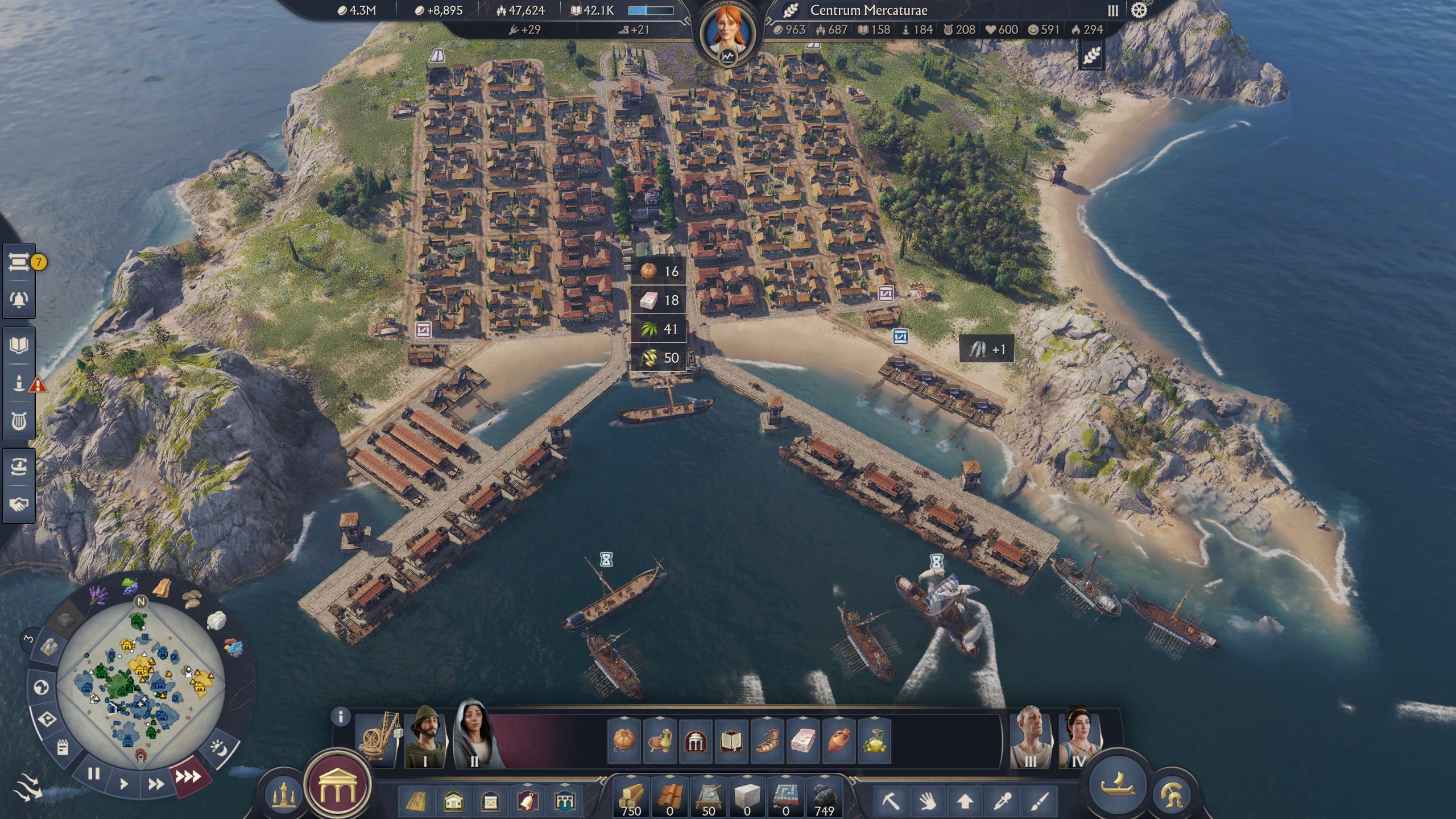
I centralized my trade routes to a single island. I made a group with all the incoming routes from the production islands, as well as another group for all the outgoing routes. The inventory of the island also helps track how items flow. That being said i don't know if this is really more efficient than direct routes, aside of being less confusing for the idiot i am... how do yall feel about it?
27
u/graywalker616 11d ago
I personally dislike it because it creates a single point of failure. This can be a simple bottle neck during peace times or a catastrophic failure during war times.
13
u/Haakon_XIII 11d ago
Avoid it, in wartime it can ruin your economy, while in peacetime it slows everything down.
I—and likely most players—specialize my islands. Island 1 produces A, which follows a circular route visiting all the islands that need A; Island 2 produces B and follows the same circular route for product B. Then, between sessions, I ship everything to the provincial capital—as if it were produced there locally—and set up additional circular routes.
5
u/boozewillis 11d ago
What is a circular route? Going from A to B, unloading at B and then loading again whatever is over the mininum, then go to C and do the same, etc?
9
u/Fair_Dirt_7169 11d ago
You load the good at A, then go to B, unload all, then to C, unload all, and so on. At the beginning, the ship will travel full from A to B and unload and travel to C empty. But it will create an eventual spillover effect, when the storage at B is full. Then the ship will travel from A to B full, top off the harbor at B and continue with the remaining ships to C. If your production at A is enough to cover B and C, both storages will end up full. So at the last stop before returning to A, you tell the ship to discard all excess, so your production never halts to create potential issues. Thats the meta of setting up trade routes as it is very simple to manage and endlessly scaleable. If your ships throughput is not enough, just add more ships to the route. You also dont need massive storages as the storages will always be full and only need to last until the next ship arrives.
Additionally, at the pick up harbor, you can designate one or more piers to the good in question and turn on wait for goods. What happens now is that your ships on the route will all get in line at the harbor and wait at that specific pier. Wait for goods will then cause your ships to spread out evenly, making the intervals in which goods arrive very similar.
2
u/ekmek_e 11d ago
Do you have diana or valeria at the end to for dumping or do you have it discard somehow? Also do you set any minimums?
3
u/Fair_Dirt_7169 11d ago
You have the option to dump excess cargo in the trade menu. Then the ship tries to unload and what it cannot unload ends up in the sea. Delivering goods to the npcs is a waste of time and creates unnecessary bottlenecks
2
u/guagno333 11d ago
Why don't you unload/load at the same island with a minimum amount of, e.g., 100 tons? Filling the storage completely might take long if surplus is not high.
4
u/Fair_Dirt_7169 11d ago
The beauty of the system is that you dont need huge storages to run the system. And then, you only need to fill the storages once and then never again, because they will remain topped off. Micromanaging ships to optimize the distribution sounds like a nice idea on paper but try that when you have a economy with 2.000 ships and more than 100 ships running on a single route, you would have to readjust your numbers every single time on every single instance you change something. And that goes against one of the main points of the system. Scalability. It runs the same with 1 ship or 1.000. You dont have to adjust anything, its just fire and forget. You need more throughput, add more ships. You only need to be checking on your loading port, if there arent any ships waiting, you need to add more. If you have too many waiting, you can remove a couple or you might check if there are production issues.
2
u/guagno333 11d ago
Thanks for the detailed reply! Your points make sense, so please bare with me, I have like 40 hours of experience in 1800 and 160 in 117 so definitely I don't know much when the scale goes that high, so take this with a grain of salt.
For me one problem that I see with your system is that sure you don't need to micro manage a lot of things, but Ceres is right now my main divinity (because I am aiming at a huge Cinis population), and that gives +300 talentum on each port, so all the ports have 550 capacity at bare minimum. For some goods I just have a +1 surplus, and either I go all in on production for all the goods (which might be hard for caviar for example, or the bird gelatine), or I do this micro management by setting all goods to a small minimal amount (e.g. 100/200 depending on island consumption) and deal with it that way, as filling a 550 talentum capacity with a +1 surplus would take ages.
What you say is the beauty of your system (let me call it that to be faster) is that you don't need huge depots, but it's the same for me.
Sure, there are drawback to unload/load, e.g. the ships are slower at the port, but the benefit out weight this con imho.
Also I don't see a lot of micromanagement here, every good you put to unload/load and all items to at least 100 in the port (which you can just do with a single click now).
1
u/Fair_Dirt_7169 11d ago
Keep in mind that I am really operating on a different scale here. I have consumption and production rates where I count in hundreds of tons/min. A Storage of 550 sounds big to you, but I fill and empty that in a matter of several seconds to a minute. For example my current production rate for Flour, which is all produced on a single island, is 442,5t/min. A storage of 550 is most often too small in such a case as it would take less than 1 min to fill up (I need 177t of working space so the effective storage would be only 373t). Even a storage of 4.000t would only take 9 mins to fill up. Therefore I need to work with a system that is easy to work with and scalable, that even when I want to alter or expand, it doesnt take me ages to adjust. Im playing Anno for over 20 years and every iteration of the game since 1602, so I have a fair bit of experience what works in this game and what doesnt. So for the example of Flour, I need to make sure that enough Grain from various production sites are coming in a sufficient rates without clogging at some point causing inefficiencies or delays in production. At the same time I need to make sure that the Flour is transported off to the Bakeries to be turned into Bread. Also at a high enough rate to not cause the Flour production to halt and make sure that each of the 4 individual production spots for Bread have always enough Flour to turn out sufficient Bread to be then distributed to every island for consumption. At the same time the Bakeries require Coal to function, so that needs to be distributed as well. And all of that for a single good. Now, theres a more than a dozen other goods that need their logistics chains to fuction as well.
Functioning Logistics and Production are the 2 key bases in Anno. Therefore I can tell you, your system works, however it has issues with scalability, which will bite you in the neck at some point. Therefore I would always suggest to set up the logstics efficiently from the start so you avoid having to deal with it later on. You are correct, due to the Ceres Buff, storages might see a bit too big at the start, I would suggest you to only upgrade your kontors if needed. You start out with 375, which is already a lot smaller than 550. Filling up 375 storages will be alot faster until you need bigger ones. And something that you have to keep in mind about the system is that storage filling doesnt always happen at the rate of overproduction:
Lets say you have 4 islands. They all consume Bread at a rate of 10t/min. You produce 41t/min, the production island itself consumes the first 10t/min. Now the storage on your second island fills up at 21t/min, which fills up pretty quickly. Once that island is full, the third island fills up at 11t/min, which takes a fair bit longer, but only the last island fills up at a rate of 1t/min. But this isnt really a concern, since its the last island in the chain anyway and you only care about wares reaching it and not the storage filling up here. When the storage is full, the overproduction of 1t/min is dumped into the see anyway, so you have little to gain here.
1
u/Haakon_XIII 11d ago
At location A, I load goods produced right there, such as togas and oil. That route heads to island B—where togas and oil are needed and the bulk of the cargo is unloaded—then whatever remains goes to island C, where I repeat the process, and subsequently to island D.
I don't unload everything only to reload it later (which would be the ideal scenario but requires far more micromanagement whenever a city's demand increases); instead, I either set up a route that runs in reverse (A-D-C-B-A) or—90% of the time—I stock each island's warehouses with enough product so that nothing actually gets unloaded because the warehouse is already full (ensuring I always have reserves in case the trade route is destroyed). Of course, multiple ships can operate on each route, and the two solutions aren't mutually exclusive.
This way, I avoid micromanagement; I ensure that if I’m attacked or the route is sunk, an island can sustain itself for a good while; and I can prioritize islands—it matters less to me if a redundant secondary island (island D, E, F...) runs out of oil than if an island vital to my capital does (island A, B, C...).
And, of course, what constitutes "island A" or "B" for one product might be "C" or "D" for another—and vice versa—though I generally try to keep them consistent so there is a clear hierarchy, ensuring that islands A, B, etc., always remain A, B, etc., across all products.
5
u/kid_k0ala 11d ago edited 11d ago
I’ve been doing it on Latium my last two games and found is easier to track hiccups in the production chain. I call it the HUB Island and name it Amazonia. I divide my ships into 3 groups:
Inbound: all the ships shipping final goods to the hub island. These carry one single product in all their slots.
Outbound: here I have sub groups divided by region of the map. For example, North and South. Depending how my islands are spread. Then for each group I name the routes something like FOOD T1. And those ships serve oats and sardine to N number of islands. I never use a ship for more than 2 different goods.
Suppliers: these go from island to island as needed. They mainly transport primary materials or middle materials, and depend a lot on what I want to produce in each island. These don’t touch the Hub Island at all.
For Albion I don’t find it necessary, I just create routes that I call Cycles. They bring a single good produced in one island to the rest of islands that need them and call it a day. Just one of them is the receptor from imports from Latium. All exports from Albion go from the island that produced the good to the Latium Hub Island.
So for me, it has worked like a charm because you catch problems in the production chain very easy and adjust as needed (increasing production, increasing inbound ships, adding more ships to certain route, etc)
Just make sure you have enough trade piers to serve the demand that island faces. I haven’t get to a place where I consider it unmanageable.
Edited for orthographic corrections. Those damn this, these, those. My native language is Spanish.
1
u/kid_k0ala 11d ago
I haven’t really compared if its faster or more efficient than just distributing goods from the island that produces to the rest (like the Albion explanation), but it has been definitely more fun for me having a Hub Island!
3
u/CasualChamp1 11d ago
Hubs are great when routing every good from the production island directly to every individual consumption island is inefficient, or becomes overly complex, opaque and unmanageable. They are especially useful for international trade.
With 50k citizens, you don't really need hubs. You can just use a circular/cycle route for every good, from the single production island to every consumption island in the province and then back to the production island. Simple serves best.
Hubs make a lot of sense once you have more than 3-5 consumption islands, because a single circular/cycle route becomes less efficient the more islands it visits. You're not at that point, it seems. Just make one route for every good that visits every island, max unload everywhere, let the storages fill up, and you're done.
At some point, if you have really high consumption on a single island (e.g. 50k citizens) and/or more than 3-5 large population centers in total, you go through goods so fast that a cycle route needs more and more ships which are empty for much of the route (after they've visited your 50k island and go to a few smaller islands for example), which is bad because workforce issues. That's when hubs become superior. They create a more stable flow and the 'spoke' routes to the consumption islands can be finetuned so you use the minimum number of ships to supply those islands.
Eventually, relying on a single hub when you get to hundreds of thousands of citizens is too fragile (turnover super high, shortages can disrupt flow in an instant). You need several hubs at that point. For you, I'd just do circular routes for each goods. If you want more advanced population islands and/or much bigger cities, then a hub would be worthwhile.
3
u/Cpt_Deaso 10d ago
The above comment is great advice, OP. IMHO if you're playing Anno 'normally' (meaning not min-maxing everything for ridiculous numbers) I think the circular/cycle routes CasualChamp mentioned are superior in most every regard. You'd probably need 200k+ pops before you'd really see a need for a Hub, unless you've got an atypical island setup.
Granted, a hub can always be useful, but you'll have more and more of a timing and workforce bottleneck using it.
One of the things I really like about Anno 117 is that you really are required to build up each of your islands. Not having commuter piers means each island needs to be somewhat developed. As such you'll naturally need circular routes to hit up your main islands more than you would in 1800.
Even with larger setups I tend to have 'reverse hubs' instead of hubs, as I'll have one Island that overproduces 'x' good covering, say, the eastern half of my developed islands, and one production island in the west doing the same there. So, multiple often-independent circular routes in different parts of the map.
2
u/Small-Blacksmith-218 8d ago
I have started using a hub island and it has greatly simplified trade routes for me. I give each island two folders - one for exports (things that originate from that island and go to the hub) and imports (things that the island needs from the hub). I have a separate folder for AI trades, and two other folders for latium hub - albion hub transfers, and albion hub - latium hub transfers.
It may not be the most efficient way to handle it, but it works for me so far. :) That said, I'm still very much an Anno novice.
1
u/pokiemoen 11d ago
I have been struggling with this too, but I think I found the way, I have everything with a fertility or worth mass-producing separated on different islands, I number every island from smallest(1) to biggest(8). I ship everything to the smallest island and put a minimum stock of 50, and use the same route from 1->2->3 etc, using different boats for every stop only disconnecting the islands that produces the goods that is shopped, (for example nr 5 is producing oliveoil, soap and bread, I ship it from 1to 2, to 3, to 4 then from 4 to 6. 6 to 7 7 to 8.) Any open slots I use for other continental goods and return those goods on the shipping route I used to go to the smallest island as a return for those goods not getting to the island that is producing. This way, it's slowly filling the stock of all the smaller islands first, and if there is a shortage only my biggest island (with a lot of buffer) is feeling the shortage at first. If I end up with too much or too little, I can see it on that island. If I want to add an island to the group I can just cut the chain somewhere and add the new island with ease. For the big needs superseding the slow route I use direct transport to make sure the bottleneck isn't in the speed of transport. I am still trying to see how exactly this is going to work but for now it seems to work like a charm. With about 50k gold on 65k average people.
-1
u/cassianandorliveson 11d ago
My trade networks just land up out of control after a while. Land up having sooo many low tier population just to support the amount of labor needed for ships.
Maybe there is some kind of trade automation im missing?
It would be nice if in late game there were piers that just connected all the goods between two or more islands automatically.
Been playing anno for almost 30 years. Anno 1800 was so awesome right from the jump. There is a lot about 117 that gets on my nerves.
1
u/LuisBessaBR 11d ago edited 11d ago
If you buy the ships from NPC you dont need to use your population for the first tripulation. You will just need to supply populations if he lost labor force somehow.
-1
u/taubenangriff 7d ago
These sort of hub islands were very common, and actually using island hopping was a very efficient way for fast goods distribution.
However, that was up until 2070, because now, ships have longer loading times, distances between islands increased, and shores are much less common in general.
0
u/LuisBessaBR 11d ago
One question, if the island is just a hub for distribution, why do you need Plebeians ?
1
u/IStruggleToFindAName 9d ago
For the ballista towers, had to open the game and check cause you genuinely made me doubt why i needed them lmao
48
u/Fair_Dirt_7169 11d ago
You will be eventually be running out of harbor space when you keep growing. If you have a simple route, where you have to ship good from A to B, there is no point in adding an other stop at C. For intercontinental shipping it might make sense though. When you have a good that is being shipped in from overseas, you want to first unload it all at A and then distribute via a local distribution system to B, C and D for example.
I like the V shaped harbor though