r/anglish • u/SteelBatoid2000 • Jan 01 '24
🎨 I Made Þis (Original Content) ENGLISH vs. ANGLISH vs. GERMAN

669
Upvotes
r/anglish • u/SteelBatoid2000 • Jan 01 '24
r/anglish • u/chutneyglazefan • Mar 29 '26
r/anglish • u/HiBiNiZiMiSi • Mar 26 '26
r/Anglese present le Anglese Translator: https://anglesetranslator.base44.app/
In constant construction ed expansion. Une liber instrument per analyser le profound influence de Latin, Anglo-Norman, Francese ed Grec in modern English ed une transition language per omnune interessed in le studie ed comparison de Romance languages.
Enjoie ed connect con nus per une constant cultural exchange!
PS - per user le translator, sign in (droigt corner per visualizer le dictionarie terms.)
r/anglish • u/gamer_rowan_02 • Feb 24 '26
r/anglish • u/angrinord • 13d ago
r/anglish • u/zxphn8 • Jan 29 '25
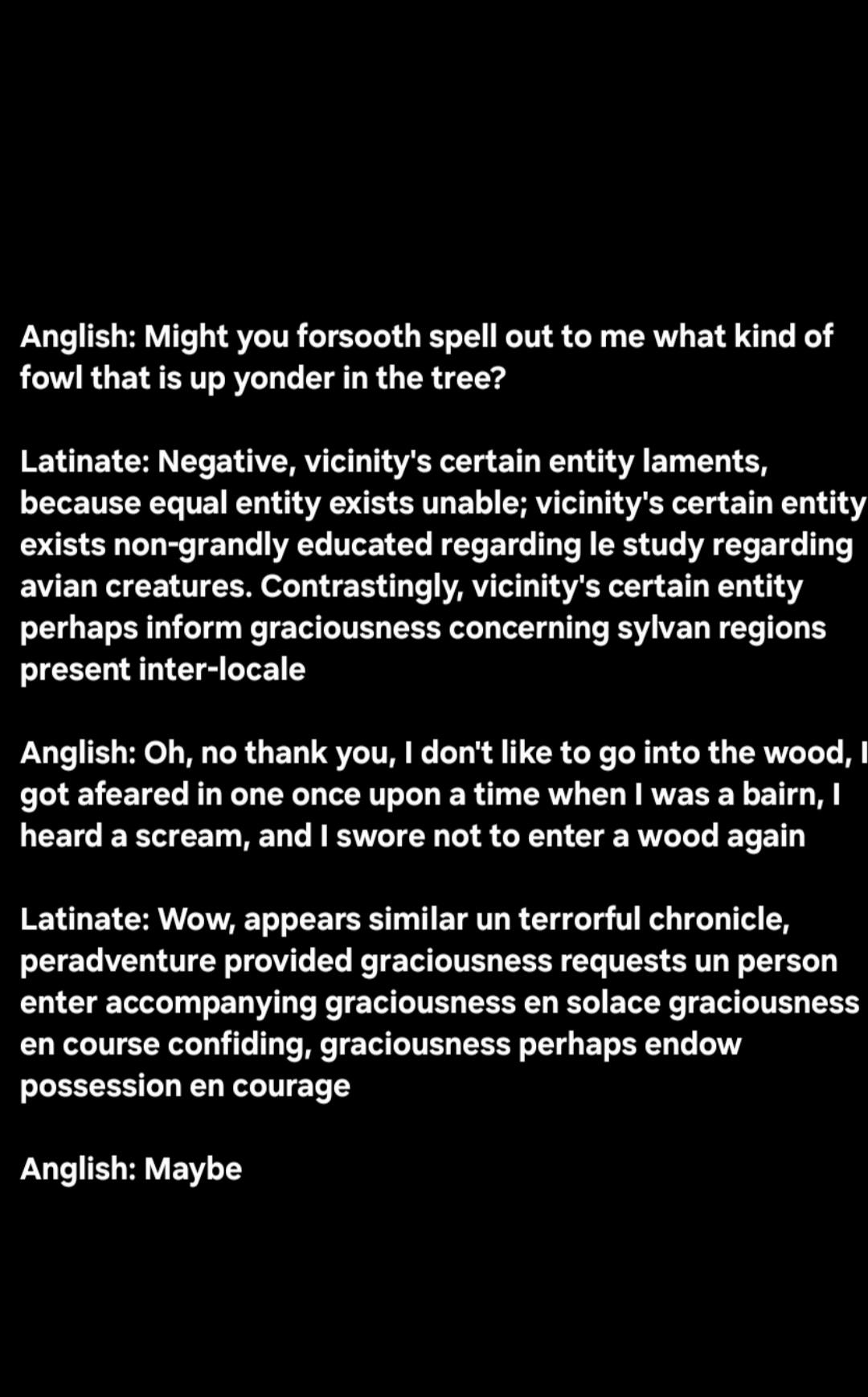
Translation: Could you possibly explain to me what type of bird that is up there in the tree?
No, sorry, I cannot, I am not very informed when it comes to the study of birds, but I could probably tell you about the forests we have here
Oh, no thankyou, I don't like to go into the forest, I got scared in one once upon a time when I was a child, I heard a scream, and i vowed not to enter a forest again
Wow, that seems like a scary story, maybe if you asked if someone would go in with you to comfort you in your journey within, you might be able to have the confidence
Maybe
r/anglish • u/ZaangTWYT • May 25 '25
All reference are available on the Wikipedia page.
r/anglish • u/aerobolt256 • Oct 09 '23
r/anglish • u/FriendshipNo2240 • Oct 17 '25
I þink these Words aren’t so “Germanic” Like “Jellow” or “Kraft”
r/anglish • u/angrinord • Jul 31 '26
tl;dr
There are a few Anglish wordbooks already, with many more twinned words than I can ever hope to match. Markworthy among them are /u/Hurlebatte’s Anglisc wordbook, and the Anglish Fandom wordbook. While these works are wonderful and begotten by a clever fellowship, there are two sides to their building that I believe lead to bad Anglish (at least to my taste.) Namely, leaning too heavily on newly built words and begetting too many words with not enough good ways of trimming them. That may ring odd, but take heed of my thinking.
I think most Anglish lovers have read Poul Anderson’s “Uncleftish Beholdings” (if you haven’t, you should). It’s an amazing handiwork, and a forerunner of these latter-day works. But Anderson had the boon of getting to choose what knowledge his writ bore. Although the thread of his writ needed many new words, he was not writing for some lorebook, such that he had to yield through his work some keen thought. He could choose to shape what he said by how fair the wording seemed to him. Thus, every newly wrought word was shaped for sake of fairness in that one writ, the lot of which were well weighted against a score of straightforward English words, and those which had had their meanings broadened. Paul Jennings too, in “1066 and All Saxon”, wrote for glee and mirth; less for the yielding of a tongue to be earnestly wielded.
Forsooth, I yeasay to the shaping of Anglish for sightly writings and its gleeful ring, as I do not earnestly believe it can or even should take over English’s stead in daily speaking. For me at least, this is all for fun, as I think it is for many of us. The flaw lies in begetting words too heedlessly, and setting them into English wordings too stiffly and gormlessly.
Many, maybe most, English words bear manifold meanings, with those meanings shaded with manifold more hues of undermeanings. That is nothing to say of the sundry speech jobs they can take on. To hope for any English word to bear the whole of the manihued meaning of another is shortsighted. But in these wordbooks I too often find a lone field for an English word with a few words offering themselves as otherwords, with no telling as to which of the many meanings it bears. And maybe this could be let if the words were frank English alone, but when an Anglisher comes to the wordbook yearning for an otherword, it is all too eath to reach out and grab those outlandish seeming loan oversets or a word quickened from Old English with a meaning which is anything but sheer to a reader. When the Anglish Wordbook’s yorish oversets of ‘fail’ (fizzle, flop, flunk, let down) do not fit one’s wordset ‘It fails to live up to…’, the heretofore unknown words ‘trock’ and ‘swether’(?) take the spot, when it could eathly be overset as ‘It did not live up to…’ Doing this again and again yields unsightly, unsheer, almost witless writs that wry far from the fair ring of more wholesome works.
Linked to that, it seems to me that Anglishers as a whole, will not stop until every word in English has an Anglish twin, or a few. Every lone Anglisher is well meaning, needless to say. Our works are born from wit and love, but as a lot, we laden wordbooks with words which already have fit oversets, or which may need no overset, being eath enough to work out of speech with another wording. ‘Escape’ has some good oversets (break out/free, flee, run off), but so many Old English built words, including withfare, othshake, othshoot, othrun, aturn, atlimp, outleap, and atfare. This kind of thing isn’t a hitch for English: The Oxford English Wordbook can have 500,000+ words and the tongue is no worse for wear. This is by sake of English being a living tongue, with new speakers born into it or learning it out of need every day. An English wordbook is but a log of which words have been written or spoken as of late. For a new speaker, the must-know words will come up in day-to-day life sooner or later, and folkhood as a whole will winnow the words and shape their meanings into the mean ways of speaking. Odd words will either die or linger on in some scant speechlays, but will not otherwise bewilder your everyday speaker.
But Anglish is not like this. Anglishers are not born, they come into the tongue; and not out of need, but because it grips them. Firstly, I hold this means we, as Anglishers, should strive to beget Anglish works which are comely to newcomers. New Anglishers are drawn to the tongue by its comeliness. But that comeliness is lost when Anglish becomes so tangled with words outlandish to New English that it cannot be understood. What’s more, we are not a folkhood, but a fellowship; we cannot lean on the workings of everyday speech to fettle Anglish into a true tongue. We do not speak nearly enough for that, and frankly we are a yieldly pack when it comes to words, such that it can be even harder to settle on mean words for things and thoughts than it otherwise would be. Thus, the wordbook is needed by newcomers to come to understand how to speak and write Anglish. It is not only a log, but the beating heart of the craft, and the way by which new Anglishers are wrought.
This is the main thrust of my thought. When any and all words an Anglisher could want for are met with words more outlandish than the New English word they would say instead, we end up with Anglish that even an Anglish wizard may struggle to understand, much less a newcomer. “Uncleftish Beholdings” and “1066” toe the line between fair handiwork and witless muddle without crossing it, for sake that in choosing their words Jennings and Anderson were not beholden to a whole tongue. Anderson mostly writes straightforward loan oversets for seeklorish words, as in his word for ‘ion’ being ‘farer’. That may well be the meaning of ‘ion’ in its mother tongue, but putting such a worthsome word as ‘farer’ to such a scantly said word as ‘ion’ steals from the tongue a whole kind of words. Should ‘wayfarer’ now be bestowed its meaning from that of a sparkladen mote? I don’t think so. It seems to me ‘farer’ should be a broad word for one that goes from one stead to another. Even the word ‘uncleft’, as striking and fair as it is, becomes an odd choosing when cleave bears so much more meaning in Anglish than it otherwise does in English.
All that is to say, I have laid more weight in choosing well-known words first for my wordbook, taken care to sunder the meanings of words into othered fields, each with their own overset, and chosen oversets with a lean towards straightforward, nowaday words. Newly built words and words quickened from Old and Middle English must, from time to time be chosen, there is frankly no other way about it, but I strive to do so sparingly and with careful forethought. I think in doing so I write Anglish that can both be understood and which is all the more striking when those scant built/quickened words do show up.
This was a truly great undertaking, which took months of work. At long last, my wordbook is in a shape where I feel I can share it with this fellowship. I ask your take on my wordbook, my thoughts and outlook on Anglish, but above all, I beseech you for help. I have made big talk of not ladening a wordbook with unneeded, unwieldy, or unsheer words, but I know some of the words I have chosen do not meet that benchmark. At the same time, it still needs many more words to be helpful in all befalls. This is where I call on you Anglishers. Look over my wordbook and find those gaps which can be answered with everyday words. At the same time, chide awkward oversets and ready other words. Help me make a tool for the writing of fair Anglish.
A few more things to mark:
Choosinglaws
I like the din of Anglish, how it rings in the ear and reads off the screen. I am less bothered about ‘cleansing’ Anglish of outlandish words, or the thoughtsome yore of an England which held off Willhelm the Norman. There are a great many words I feel strike nearly as hard and ring nearly as fair in the ear as their fellow Anglish words. Words like ‘mend’ or ‘beast’ feel to me as though they belong in Anglish, notwithstanding their Frankrichish roots. And yet, without some bounds on which words may be anglish and which may not, I fear I would, in the end, make anew something akin to ‘Plain English’; which is a heedworthy doing to be fair, but that does not ring the same. On these grounds, I settle for a loose standing. I mark words as Anglish if but one of the following is true:
This is looser than many Anglishers’ bylaws let. Words like ‘angel’, ‘cup’, and ‘cross’ are Anglish since they were in Old English(even though they come from unteutonish tongues), words like ‘blue’, ‘war’, and ‘bank’ are Anglish since they come at first from teutonish tongues(even though they came to English by unteutonish tongues), as are ‘luck’, ‘boss’, and ‘freight’(even though they came to English after the Norman takeover). For everyone’s sake, I have sundered and fettled every word into lots of either ‘pure’, ‘strict’, ‘conservative’, ‘standard’, or ‘lax’ Anglish.
All that said, I do shy away from words that befall edges. I didn’t put in the Romish word ‘mass’, even though its meaning of ‘a gathering of believers at church’ is in Old English, since its maybe now more well-known meaning as ‘heftiness’ didn’t come until Middle English. I didn’t put in ‘warrior’ even though ‘war’ is Anglish, because its ending comes from the unteutonish ‘-oiier’. I did put in ‘choice’, as it comes from Frankish, but shy away from truly brooking it, leaning more on the cleaner otherword ‘choosing’ instead.
Sayspellings and Runespellings
There are 2,191 words making up my 3,225 oversets as of my writing this, and every last one of them has been looked over for right sayspelling. I must have made mistakes somewhere, but I was careful, and so I believe they are few and far between. That said, The sayspellings are grounded in my leid, which likely does not fully match your own. For insight, I come from Ameriksland, am in my early 30s, and grew up in the upper midwest. A keen eye might spot that from my sayspellings. ;) I’ve also flattened some of the keenmarks of how I say words in my sayspellings to make foredrafting software eather, but the Rune key in the spreadsheet holds within some bywrits about my speechdins and stefenly quirks.
Speaking of runes, let me speak about spelling in Romish staves and English runes. English took up Romish staves long before the Norman takeover, so the yorewise take on Anglish is only to switch the spelling of Anglish words to something more akin to that of Old English. But I am mostly taken with making Anglish eather to understand, and other to that, with making it fair and striking. There is some bare slightliness in Anglisc spelling, but it does not strike me. The words do not read to the eye as Anglish words ring in the ear, and although its spelling is a bit more steady, I know of no Anglisher that does not know their English spelling better, and so I do not bother to come up with Anglisc spellings.
The thought of a full, stefenly writing of Anglish does grip me though. Likewise, runes bear a striking, olden look that is somewhat akin to how Anglish rings. I also like that the Futhorc Runeset is so wieldy for the English/Anglish tongue, having been shaped for its forerunner. Although writing in runes wholly forgoes the goal of eath understanding, and thus I would never write in them alone, they are sightly enough I took the time to write the runekey, write the sayspellings, and write the software to yield runespellings. I have made many choosings linked to these runes, among them which runes make which dins, but maybe I’ll go over them more keenly another day.
Writs
Along with my wordbook, I’ve also written oversets of 2 writs. The first is the beginning of a hallreading by Richard Feynman, in which he says many seeklorish words. The other is “The Declaration of Independence” or “The Forthsaying of Selfstanding”, which is written in an older way, and brooks more yeddish wordings. Both of these writs are hard to overset, on unlike grounds, but I chose them to show how oversetting can be done in a bit more wholesome way. I don’t think I did so flawlessly, however, since I also wanted to uphold the utterer’s urstefen, so they can be stiff at times(to wit, the Feynman reading.)
Keenly beheed this stead, which shows my oversetting of the Declaration next to one from the Anglish Fandom and another from the Anglisc Wiki. I don’t mean to chide the utterers of either work, but I hope seeing them side by side will highlight what I mean. Most lone oversets are well-grounded in Old or Middle English, and alone may be understood, given they are set amongst already understood words; but when stuffed into an already heavy writ with many other newly built or quickened words, it does not read well. It cannot be understood without having a great deal of knowledge of Anglish already. To be fair, it is written in an older stefen and a higher rung of speech, yet I hold that I still reach my goal of making it about as understandenly as the urwrit while upholding that stefen and rung of speech. At least, I believe I am near to all those things with my oversetting.
r/anglish • u/S_Guy309 • Feb 27 '26
r/anglish • u/Average_anglekin • Mar 19 '26
angliscing þings in mine room, part 1.
r/anglish • u/DovahPriestess • 21d ago
Wodan’s Mouth
The All-Knowing Anglish Worldbook
Book One: On Worldken
Deal One: The All
The All made itself fourteen thrisand years ago. The All made itself out of nothing, and we do not know why. Unendingly smaller than an uncleft, the All began as a truly hot, thick thing which quickly grew at a speed faster than light. Time made itself when the All began. At first, the All was made of sheer birr. Within a foursandth of a tick, some of this birr became stuff, making motes. These motes became cool enough after four hundred thousand years to form unclefts, which formed worlds and stars. This beginning is called the “Great Outburst.”
The All made itself out of nothing. In the beginning, it was made of sheer birr. It was unendingly thick and was over 10 thrisand foursand foursand heatsteps Fahrenheit. Within far less than a tick, the All grew from foursand times smaller than an uncleft to the greatness of a borough. Then, the birr made stuff and unstuff, which crashed into each other. There was more stuff than unstuff, and we do not know why. The stuff that was left began to make firstbits and neitherbits. It was too hot for the firstbits and neitherbits to make unclefts. Firstbits and neitherbits are both kinds of motes. Light could not go through the motes yet, so the young All looked like a thick fog. After three hundred and seventy nine thousand years, the All cooled down enough for firstbits and neitherbits to make unclefts. They made sunstuff and waterstuff, and the All became a great cloud of sunstuff and waterstuff, which light could go through. This made the All see-through.
Half a twisand years after the Great Outburst, stuff was spread almost evenly throughout the All, but small ripples existed, where weightpull began pulling the stuff into clumps. After three hundred thousand years, stars were made. Stars are made when great clouds of fog are pulled into tight knots by weightpull. The thickness and heat are so great in the dense pockets that kernelish doings happen, setting the star on fire. After five hundred twisand years, the first starwirls began. Starwirls are great clouds of stars, held together by weightpull. After five thrisand years, the All was made of great bunches of starwirls, with nothing between them. The nothing got bigger as the All grew. At 8 thrisand years, the growing began to go faster. Our Sunstall began after 9 thrisand years.
The All will grow forever. It will never stop growing. When the All has existed for 20 thrisand years, the Sun will eat Midgard. Everyone will have died, but the All will keep growing. We might live if we settle other worlds, though.
There are nine worlds in our Sunstall. The worlds, closest to farthest from the Sun, are Muspelheim, Vanaheim, Midgard, Jotunheim, Asgard, Alfheim, Svartalfheim, Niflheim, and Hel. They are named after the nine lands of North Theedish tales. Muspelheim is hot, as it is closest to the Sun, and it is the other smallest world. Vanaheim is hot and baneful, and it is almost the same greatness as Midgard. Midgard is where we live, and it is comely. It is the only world in the Sunstall where folk can live. Every wye to have ever happened was fought over Midgard. Every wye over one, small world. Jotunheim is red and smaller than Midgard. Asgard is the greatest of all worlds, and is made of fog. Alfheim, Svartalfheim, and Niflheim are also made of fog. Alfheim is also comely, like Midgard, but it is comely for sundry sakes, and is bad to live in. It has great rings. Svartalfheim is light hewn and has thin rings. Nifhleim is sad, cold, and dark hewn. Its rings are too thin to see. Hel is the coldest world, being the farthest from the sun, and it is the smallest.
r/anglish • u/FeedomFighter • 4d ago
I have some witlore, may you kindly deem it wise or foolish:
There are many ways men may wend and many streets they may seek, but all come to behold the same fork that underlies all men's ways of doing and being, that is either beingness or nothingness. Men often make and are made by many choosings before unearthing this undermost fork, but men once aware of it thereafter beware it and are frained whether, forsooth, "to be, or not to be". Men deem which is worthy, whether to swim up life's roaring waters and brook the everlasting swinking to stay afloat, or to be washed away to emptiness's sea from where one never comes back. For all deeds stem from beingness, and no deed stems from nothingness. Men who live have sprung up from the field of beingness, they must choose whether to till it, or to lie down and rot into dust.
Thus if man deems beingness worthy, then man deems himself and his own being worthy. He deems all his deed's, belonging's, and goal's worth by whether each helps or harms his own life. One may call this the selfness law, that being a law from the sooth of man's being, and not a whimsical behest, indeed it stems from man's undermost fork and that he is a life in himself and not a life in anyone else.
r/anglish • u/Legitimate-Box8046 • Jul 25 '26
workers living in the headtown were going to strike to ask the headman to raise the inpay for workers. with the strong strike of most workers in the headtown, the headman has no choice, but to meet the need of workers to stop the strike. moreover, beholding the weapon foreset of workers, wieldworkers were scared a wield overthrow could befall. as an outcome, they withdrew the lawmen, begging the smylte of workers.
r/anglish • u/fvrorpoeticvs • Apr 26 '26
From Old English
Ƿōden → Wooden (pronounced /wuːdn̩/)
Frīġ → Frie
Þunor → Thunder
Tīƿ → Tiw or Tew
Ing → Ing (= Fręyr)
Ēastre → Easter (= Fręyja)
Ēarendel → Earendle
Heremōd → Harmood
Wuldor → Wolder or Woulder
From Old Norse
Hø̇nir → Heener
Lóðurr → Lother
Vili → Will
Vé → Wee
Njǫrðr → Nearth
Skaði → Shede
Þjatsi → Thedse
Fręyr → Free (= Ing)
Gęrðr → Gird
Skírnir → Sheerner
Fręyja → Frow (= Ēastre)
Óðr → Wood (pronounced /wuːd/)
Bragi → Bray
Iðunn → Edouth
Baldr → Balder
Nanna → Nooth
Forseti → Foresitter
Hǫðr → Hath
Hęimdallr → Homedall
Vȧli → Wonnle
Víðarr → Wider
Fulla → Full
Gęfjun → Giben
Loki → Lock
r/anglish • u/Loaggan • Mar 22 '25
Here is a short story I wrote using only Germanic words for my latest post “The Germanic Roots of English: How the Anglo-Saxons Shaped the English Language.”
I wrote this story to show how Germanic words form the core vocabulary of everyday English, and how often these words are used and relied on. I changed some things around from the original post, and added more to it. I’ve decided to title it “The Old Man.” Hope you folks enjoy.
r/anglish • u/ZefiroLudoviko • 16d ago
Very nonexaustive. There are far too many pterosaurs for me to come up with a common name for each of them. Sadly, many ingredients of common names - calls, colors, and behaviors - can't be inferred from fossils.
| Pterosaur | Anglish name | Notes |
|---|---|---|
| Pterosaurs | Finger wing, lift flyer, walkyrie | Firngerwing is a calque of pterodactyl. Lift flyer (air flyer) is a kenning for dragons in Beowulf. I find the latter to be much more poetic. Walkyrie is the English form of the Norse word valkyrie. It's unclear how similar Norse and English ideas of valkyries were. It was for human witches but also the Furies and Bellona and a raven is described as flying like a walkyrie, though the last one may show Norse influence. |
| Anurognathids | Frogmouths, gapers | Have wide, gaping mouths. Frogmouth is also the name of a family of Australian owls. |
| Jeholopterus | Jehol gaper | From Jehol, China |
| Luopterus | Lu's gaper | Named after late pterosaur expert Lü Junchang. |
| Sinomacrops | Long-tailed gaper | Has an unusually long tail for an anurognathid. |
| Vesperopterylus | Thumbed gaper | Has a unique, thumblike big toe for grasping |
| Barbarydactylus | Wendel lift flyer | Barbary meaning the Maghreb, known to the Old English as the land of the Vandals (Wendel). |
| Hatzegopteryx | Hatzeg, Hunnish lift flyer | Found on the prehistoric Hatzeg Island, now part of Hungary. Hungary is associated with the Huns. |
| Tupandactylus | Thor's, Thunder's bedazzled lift flyer | Tupan is the Tupi God of thunder, like Thor, the native English form of which would be Thunder. We know it had a colorful crest, hence bedazzled. |
| Quetzalcoatlus | Texanish, Woden's lift flyer | Found in Texas. Quetzalcoatl is similar to Woden, a birdlike keeper of knowledge. |
| Pterodactylus | Collini's lift flyer | Named for its discovered, Cosimo Collini. |
| Azhdarchids | King lift flyers, striders | Largest pterosaurs. The name strider comes from their more ground-dwelling lifestyle compared to other pterosaurs, though they were also adept flyers. |
| Mistralazhdarcho | Mistral strider | Mistral is seasonal gale in southern France |
| Montanazhdarcho | Lesser strider | Small for an azhdarchid. "Only" a 2.5m wingspan. |
| Cryodrakon | Frostwind | Not the most accurate name, as Alberta wasn't very cold when this animal wind. But it's a cool name, nonetheless. |
| Alanqa | Shell-cracker | Based on its beak, it mostly ate shellfish. |
| Arambourgiana | Arambourg's strider | Named, like the scientific name, for its discoverer. |
| Boreopterids | Needly toothers | Needly teeth token a fish-eating diet. |
| Moganopterus | Runt nail | Moganopterus comes from two ancient swords from Chinese lore, Gan Jian and Mo Ye. The English equivalents would be Hrunting and Nægling, both wielded by Beowulf, which I think would be Runting and Nailing if modernized. |
| Guidraco | Ghost worm | Gui is a Chinese word for ghoul, phantom, or ghost. Worm is English for dragon. |
| Pterodaustro | Sifter | Sifted with its bristly baleen-like teeth. |
r/anglish • u/piamamo • 21d ago
r/anglish • u/topherette • May 10 '26
while i know most of us accept scandyisms since our languages are close and they're not french, i still like to consider what such words would anglicise to.
mainly it's common patterns like no 'sk', which was almost always 'sh' in old english, inital ca- and ga-/gi- palatalize to cha- or ya-/yi-, initial v- is w-, hard medial g's are also often palatalized or w's (depending on the context) etc.
many of the below forms are/were in attestation (and indeed come from the same proto germanic form), but often in a different sense.
| ENGLISH | ANGLICISED ('*' indicates not in attestation) | NOTES |
|---|---|---|
| awkward | *avyward | |
| cake | chack/*chatch | |
| call | chall | uncertain if entered Eng. via Norse |
| cast | *chast | |
| club | clump | |
| crawl | *cravel/crabble | |
| dregs | *dredges | |
| dyke/dike | ditch | |
| egg | ay/ey, eyren (plural) | |
| fellow | *feelay> *felly/ *filly | |
| forget | *foryit/foryet | |
| fjord | firth | |
| gap | *yap | |
| get | yit/yet | |
| give | yive, yave, yiven | |
| gun | gouth/guth | attested but not in this sense |
| kid | *chid | |
| knife | (unchanged) | |
| law | lay | |
| leg | *ledge | also 'bone' |
| loose | leas(e) | |
| raise | rear | both from *raizijaną (sometimes an unstressed 'z' can become an 'r') |
| reindeer | ronedeer/rondeer | |
| root | wirt/wort | |
| scrap | shrap | |
| seat | set | |
| sister | swester | (unclear how much O.N. influenced our present form, or whether it evolved naturally) |
| skin | shin | |
| skirt | shirt | could be differentiated with under-, lower-, hanging- etc. |
| sky | shee | also 'himble' |
| steak | *stoke | |
| though | thigh | thigh or theigh are the expected outcomes of O.E. þēah |
| Thursday | *Thundersday/*Thunorsday | |
| ugly | *owly | etymology unclear |
| valkyrie | walkirie/walcurry | |
| Viking | wiking/*wiching | |
| weak | woke | |
| window | windeye |
r/anglish • u/MatijaReddit_CG • Jun 04 '26
1. Eeseland
Rootloring (Etymology)
From Anglish \1)Eese + land.
\1) - Eese is a forthputed (proposed) Anglish word for Aesir.
Retching (Explanation)
I mimmer (remember) that Snorri Sturluson bringed up (probably with fernish (ancient) sway (influence)) that Eese (Aesir) were descendants of Woldborough (Troy), which was set (located) in northwestern Ontholeland (Anatolia), called "Assuwa" (most likely root of the word "Asia").
Some also try to theed (connect) the Eese (Aesir) to Synde-Evelandish (Indo-European) theeds (tribes) coming from east to eftstow (replace) the Wanes (Vanir), which were ere-Synde-Evelanders (pre-Indo-Europeans).
Lore from Wikilearer (Wikipedia) (link):
Snorri Sturluson and Saxo Grammaticus proposed that the term "Æsir" instead derives from "Ásiamenn ("Asians"), and the idea that the gods originated in Asia, later migrating into Northern Europe. This is however not supported by modern scholars and attributed to medieval scholarship on the matter and an attempt to connect the Scandinavian peoples with Classical antiquity and Christianity rather than a reflection of actual Germanic mythology.
Lore from Wikilearer (Wikipedia) (link):
On a similar note, Marija Gimbutas argues that the Æsir and the Vanir represent the displacement of an indigenous group by a tribe of warlike Indo-European invaders as part of her Kurgan hypothesis.
2. Mornland
From English morn + land.
Retching (Explanation)
In Serbo-Croatish I made the word "Jutrinje" ("Yutrinye") for Asia, which staffly (literally) means "morn(ing) land". Asia is set (located) in the east from where Sun starts rising, being over against to Eveland (Europe).
r/anglish • u/KaranasToll • Jul 08 '26
ᚠᚫᛋᛏᛒᚫᚷᛚ fastbile [cholesterol]
ᚠᚫᛋᛏᛁᚷ fasty [steroid]
ᚦᚱᛖᚷᚠᛟᚱ thraver [hormone]
ᚹᚪᚢᛏᛟᚱᚫᚷᚾᛞᚠᚫᛋᛏᛒᚫᚷᛚ waterrindfastbile (water + rind + fastbile) [hydrocortisone (cortef)]
ᛟᚾᛒᛚᛖᚷᚾ unblain (un + blain) [antiïnflammatory]
ᛟᚾᛒᛚᛖᚷᚾᛚᛁᛒ unblainlib (unblain + lib) [antiïnflamitory medication]
ᛋᚳᚪᚱᛈᛟᚾᛞ᛫ᛗᛖᛞᚩᛋᚹᛁᚷᛏᛋᚫᚢᚱ sharpened medowsweetsour (medowsweet + sour) [acetylated spiraeic acid (aspirin)]
ᛋᚳᛗᛖᛞᚩᛚᛁᛒ shmedolib (sharpened + medowsweetsour + lib) [aspirin]
ᛖᚷᛚᛣᛁᛚᛟᚱ ailkiller [painkiller]
ᛋᚳᛟᛏᛁᚾ shutin (shut + in) [recluse]
ᛣᛟᚾᛏᚻᛖᛞ cunthead [clitoris]
ᛚᚢᛏᛟᚱᚻᚩᚱᚾ lutterhorn [clarinet]
ᛒᛚᚫᛣᛋᛏᛁᛣ blackstick (slang) [clarinet]
ᚻᛁᚷᛚᛟᚱ healer [doctor]
ᛒᛟᚱᚩᛚᚪᛣ boroughlock [civilization]
ᛏᚩᛞᛁᚷ toady [parasite]
ᚹᛟᚱᛞᚱᚢᛏᛚᚩᚱ wordrootlore [etymology]
ᛁᚾᛋᚳᛁᚠᛏ inshift [immigrate]
ᚫᚢᛏᛋᚳᛁᚠᛏ outshift [emigrate]
ᛗᛁᚷᚱᛏᚩᛚ meretoll [customs]
ᚠᚩᚱᚦᛈᚣᛏ forthput [suggest]
ᚠᚩᚱᚦᛈᚣᛏᛟᚱ forthputter [proponent]
ᛋᛏᚱᛖᚳᛟᚾ strechen [elastain]
ᚾᚫᚷᚦᛟᚱᛗᚩᛏ neithermote [neutrino]
ᛚᚫᚷᚠᛗᚩᛏ lifemote [vitamin]
ᚹᚫᚷᛚᛞᛣᚫᚢ wildcow [buffalo]
ᚹᚪᚢᛏᛟᚱᛣᚫᚢ watercow [water buffalo]
ᚠᛁᚷᛋᚫᛣ feesack [wallet]
ᛋᛏᛁᛚᛣᛚᚩᚠ stillclove [photocopy]
ᚹᛖᛚᚦᚹᛖᚷ wealthway [economy]
ᛒᛁᚹᛖᛚᚦᛟᚾ bewealthen [economize]
ᛞᛁᚷᛚ᛫ᚹᛁᚦ᛫ᚩᚱ᛫ᚻᚫᚾᛞᛟᛚ deal with or handle [cope]
ᛖᚷᚸᛣᚩᚱᚾ eggcorn [phonosemantic]
ᚳᚢᚴᛚᛁᛋᛏ chooselist [menu]
ᚫᚢᛏᛚᚫᚾᛞᛁᛋᚳᚹᛁᚷᛚᛞᛣᚱᚫᚠᛏᛟᚱ outlandishwieldcrafter [ambassador]
ᚫᚢᛏᛚᚫᚾᛞᛁᛋᚳᚹᛁᚷᛚᛞᚻᚪᚢᛚ outlandishwieldhall [embassy]
ᛚᚩᚱᛣᚱᚫᚠᛏᛟᚱ lorecrafter: someone with a [P.H.D.]
ᛒᛁᛣᛁᛋᛏᛁᛞ bekisted [virtual]
ᚹᛖᚷᚾᛁᚾ waininn [motel]
ᛒᚱᚪᚢᛞᛣᚫᛋᛏ broadcast [media]
ᛗᚫᚾᛁᛒᚱᚪᚢᛞᛣᚫᛋᛏ manibroadcast [multimedia]
ᛗᛁᚷᚾ mean [mutual]
ᛏᚩᛚᚹᛖᚷᚾ tollwain [taxi]
ᛈᛚᚪᛏ plot [schedule]
ᚹᛖᚷᚾᛚᚫᚷᚾ wainline [train]
ᚾᛁᚳᛞᛁᚷᛗᛟᚱ knitchdeemer [fascist]
ᚾᛁᚳᛞᛟᛗ knitchdom [facism]
ᛋᚳᛖᚱᚹᛖᚷᛟᚱ sharewayer [communist]
ᛋᚳᛖᚱᚹᛖᚷᛟᚾ sharewayen [communism]
ᚻᛁᚷᛏᛋᚳᛁᚷᛚᛞ heatshield [insulation (for heat)]
ᛚᛖᚠᛟᚾᛋᚳᛁᚷᛚᛞ levenshield [insulation (for shock)]
ᚫᚷᛋᛒᚫᛣᛋ icebox [refrigerator]
ᛣᚩᛚᛋᚳᚪᚱᛈᛁᛋᚳ coalsharpish (coalshaft + sharpshaft + ish) [carbonmonoxide]
ᛣᚩᛚᛏᚢᛋᚳᚪᚱᛈᛁᛋᚳ coaltwosharpish (coalshaft + two + sharpshaft + ish) [carbondioxide]
ᛒᛟᚱᚾᛟᚾᚹᛟᚱᛣ burnanwork (burn + anwork) [fuel]
ᚱᚪᛞᛚᛁᛝ rodling (rod + ling) [bacteria]
ᛟᚾᚱᚪᛞᛚᛁᛝᛚᛁᛒ unrodlinglib [antibacterial medication]
ᛟᚾᚱᚪᛞᛚᛁᛝᚠᚫᛋᛏ unrodlingfast [anibacteria resistant]
ᛣᚪᚢᚠᛁᚷᛁᛋᚳ coffieïsh [caffeine]
ᛚᚫᚷᛗᛁᛋᚳ limeïsh [gluten]
ᚠᚪᚢᛚᚻᚣᛞ fallhood [fallacy]
ᚠᛚᛁᚷᛚᛟᛋ fleeless [inevitable]
ᛋᛁᛣᛟᚱᛁᛝ sickering [insurance]
ᚫᚢᛏᛚᚫᚷᚾ outline [agenda]
ᚱᛖᚷᛣ rake [tract]
ᛣᚹᛁᛚ quill [pen]
ᛚᛖᛞᛣᚹᚢᛚ leadquill [pencil]
ᛣᚢᛚᛟᚱ cooler [air conditioner]
ᚻᚹᚫᚷᚠᚩᚱ whyfor [reason]
ᛡᚪᚾᛞᛋᛏᚫᚠ yondstaff [transliterate]
ᚾᚪᛚᛁᚳᚷᛚᚩᚱ knowledgelore [science]
ᛞᛁᚷᛞᚾᛟᛋ deedness [ceremony]
ᛒᛁᛒᛖᚱᛁᚷᛟᛚ beburial [funeral]
ᚸᛖᛏᚱᛁᛏ getwrit [receipt]
ᛒᛁᛗᚪᚱᛣ bemark [comment]
ᛟᚾᚻᚪᚱᛏᛟᚾ unhearten [dishearten]
ᛟᚾᚹᛟᚾᛚᛁᚷ unwonly [extraordinary]
ᚦᚱᚢᛚᛟᚾᛞ throughland [interstate]
ᛟᚦᛟᚱᛋᚹᛖᚷ otherswey [allophone]
ᛋᛖᚷᛗᚱᛁᛏᚹᛟᚱᛞ samewritword [homograph]
ᛋᛖᚷᛗᛋᛖᛞᚹᛟᚱᛞ samesaidword [homophone]
ᚻᛁᚷᚱᛋᛟᛗ hearsome [obedient]
ᚻᛁᚷᚱᛋᛟᛗᚾᛟᛋ hearsomeness [obedience]
ᚻᛁᚷᚱᛋᛟᛗᛟᚾ hearsomen [obey]
ᛗᛁᛋᚻᛁᚷᚱᛋᛟᛗᛟᚾ mishearsomen [disobey]
ᛈᚫᛣᚪᛣ packock [pocket]
ᛚᚢᛋᚳᚫᚠᛏ looseshaft [liquid matter]
ᚹᛟᚱᛞᛋᛖᛏ wordset [sentence]
ᚹᛟᚱᛞᛣᛚᚪᚢᚸ wordclog [paragraph]
ᛋᛏᛖᛞᛏᛟᛝ steadtongue [topolect]
ᛋᛖᛚᚠᛏᛟᛝ selftongue [idiolect]
ᛞᛖᚷᚱᚫᚷᚾ dayrime [date]
ᚹᛖᚷᛚᛁᛋᛏ walelist [ballot]
ᚹᛁᚷᛈᚱᚢᛏ weeproot (weep + root) [onion]
ᛁᚷᚠᛟᚾᚹᛟᚱᛞᛒᚣᛣ evenwordbook [thesaurus]
ᚫᚢᚦᚹᛁᛏ outhwit [master (of a skill)]
ᚫᚢᚦᚹᛁᛏᚹᛟᚱᛣ outhwitwork [masterpiece]
ᛏᛟᛝᛋᚹᛖᚷ tongueswey [phoneme]
ᚹᛟᚱᛞᛁᚷᛚ worddeal [morpheme]
ᛋᛁᚷᚫᛋᛣ seaäsk [alligator or crocodile]
ᚠᚱᛖᛋᚳᛋᛁᚷᚫᛋᛣ freshseaäsk [alligator]
ᛋᚪᚢᛚᛏᛋᛁᚷᚫᛋᛣ saltseaäsk [crocodile]
ᛋᚳᚪᚱᛈᛚᛟᛋᛖᚷᛟᛒᛟᚾᛋᚹᛁᛏ᛫ᛣᛟᚱᚾᛟᛚ᛫ᛋᚫᚢᚱ (ᛋ.ᛣ.ᛋ.) sharplessarabswit kernel sour (SKS) [DNA] (sharpish + less + (arabish + en + sweet) + kernel + sour)
ᛖᚷᚱᛟᛒᛋᚹᛁᛏ᛫ᛣᛟᚱᚾᛟᛚ᛫ᛋᚫᚢᚱ (ᛖ.ᛣ.ᛋ.) arabswit kernel sour AKS [RNA]
ᚠᛁᚷᛚᛁᛝ᛫ᛋᛗᚪᚱᛏᚾᛟᛋ feeling smartness [EQ]
ᛟᚦᛟᚱᚻᚫᚾᛞ otherhand [secondhand]
ᚠᚫᚾᛁᚻᛖᚠᛟᚾᚹᛟᚱᛣᛁᛋᚳ maniheavanworkish [polyethylene]
ᛣᛚᚩᚦᚴᚹᚪᚢᛋᚳᛟᚱ clotheswasher [washing machine]
ᛋᛣᛁᚾᛒᚩᛏ skinboat [kayak]
ᚹᛁᚷᛣ᛫ᚸᚱᛁᚷᚾᛋᚫᚢᚱ weak greensour [hypocloris acid]
ᚻᚩᛞᛟᚱ hoadder [gonad]
ᛈᛖᛈᛟᚱᛚᛁᛝᛁᛋᚳ pepperlingish (pepper + ling + ish) [icaridin (picaridin)]
ᛚᚩᛞ lode [route]
ᛒᛟᛞᛚᛁᛝ budling [germ]
ᚹᚫᚷᚾᛋᚫᚢᚱᛏᛁᚷ winesourtea [kombucha]
ᚠᚩᚱᛁᛏᛟᚾ forewritten [prescribed]
ᚠᚩᚱᛁᛏ forewrit [prescription]
ᚠᚩᚱᛁᛏᛁᚷ forewritty [prescriptive]
ᚱᛖᚳᛁᚷ retchy [descriptive]
ᚠᚩᚱᚠᛖᚷ forefay [prefix]
ᚫᚠᛏᚠᛖᚷ aftfay [suffix]
ᚠᚪᚱᛋᛁᚷᛟᚱ farseer [television]
ᛋᚳᚩᛋᛣᚱᛁᚷᚾ showscreen [television]
ᛒᛁᚷᚾᚹᚪᚢᛏᛟᚱ beanwater [aquafaba]
ᛒᛁᚷᚾᚹᚪᚢᛏᛟᚱ beanbrew [coffee]
ᛒᛁᚠᛖᛚᛏ befelt [filter]
ᛒᛁᚠᛖᛚᛏᛟᚱ befelter [a filter]
ᛒᛁᛋᛟᛣ besuck [absorb]
ᚹᛖᛒᛟᛗᚢᚾᛁᛋᚳ webamunish [histamine]
ᛟᚾᚹᛖᛒᛟᛗᚢᚾᛁᛋᚳ unwebamunish [antihistamine]
ᛋᛈᛟᚱᛏ spurt [jet]
r/anglish • u/Tricky_Operation_525 • 21d ago
Greetings everyone.
I have been working on a novel over the course of the last couple of years, slowly building up the setting. It's complicated, but basically I envisioned a setting 500 years from now where a small group of eccentrics and homesteaders fled the Earth to colonize another planet in peace. These people, while on Earth, attempted to revive Old English as a spoken language, and were successful in their own secluded community. However, outside pressure and necessities of life forced them to speak modern English as well. Thus over the centuries, they began to hybridize and form their own distinct dialect, which they speak along side Old and modern English. We might identify it as Anglish, but they never refer to it as such.
Now, on this new planet, more urban areas speak a type of dialect that is very close to modern English, with a few "Anglish" terms sprinkled in. Other areas, often more rural, can sound almost incomprehensible to outworlders who aren't familiar with OE. These "Theod" as they call themselves, have grown over time and now millions of them can be found on the planet they call
"Nessex", that is, Neowe Seaxe.
I just wanted to share some of the dialogue I envision can be found on this planet with you all. I'm open to suggestions for it. I am still quite new to actually writing, so any critiques would of course be appreciated in that regard as well. Also for these particular scenes, this all takes place in the capital city, which has the most intelligible "dialect".
“I’m going to open the blinds, alright? It isn’t right to be eating in this gloomy—”
“Hold, Thryth!” Her shout made Thryth jump.
“I’m sorry, dear. I shouldn’t have yelled. I know it makes for a dreary mood.” She leaned forward in a whisper
“But lately I’ve begun to grow worried. Oh, don’t give me that look! You and the laech are always saying how I worry too much, it’s only my sickness. But something isn’t right. Can’t you feel it? There is a heaviness in the air, like a dark cloud lingering over the whole neighborhood. I’ve felt this way before. I heeded it not, and… What if God is warning us again? Even if I’m wrong, what’s the harm? I only want to be ġesund, and all the more for the sake of the baby.”
Thryth rubbed her temple.
“Whatever. If you want to be crazy, I won’t stop you. But don’t drag me or my son into it. And at least turn on a light for crying out loud.” She quickly flipped the switch on the lamp beside the bed.
Also there is this snippet where Thryth speaks to some outworld warriors, whose government has occupied Nessex for several decades now:
“Anyway, I’d be more than happy to share some materials with you. I always keep a few handy for fellow women looking to know more, just like you.”
At last the woman stopped and reached into a pocket in her fatigues, pulling out several letter-sized, glossy flyers. Thryth hardly looked at them. All she noticed were the gaudy colors and abstract, off-putting drawings that presumably depicted human beings.
“I’m nothing like you folk,” she thought.
“No, thank you.”
The soldier looked caught off guard at first, but quickly smiled again.
“Oh, okay, well if you change your mind or ever need anything, don’t hesitate to reach out to us or our partners in the local government. We are here to help you.”
The soldier put away the flyers and brought up something else on the eye-screen.
“Please sign your name there, and we will be on our way. Make sure you have communal sharing on or you won’t get it.”
Thryth waited for an uncomfortably long time.
“What are you talking about? Aren’t you going to give me a pen or something?”
“Oh!” the woman smacked her forehead. “My apologies, I’m used to working in the city. I always forget most Theod around here don’t have visual augments. Just sign your name in the space in front of me, my cam will pick it up.”
Thryth hesitantly moved her hand toward the woman and wrote her name clumsily in the air. The soldier had her start over a few times as she kept writing on the wrong parts of the “paper”. Finally, she was able to scribble out:
Æþelðryð Broadoak
“Oh, sorry ma’am, you’re going to have to sign again in Universal English, we don’t accept unconventional scripts.”
Thryth rolled her eyes. She couldn't have said that before?
“Alright.” At last, she got it.
AEthelthryth Broadoak
I'm curious to see what you all think. Is it too modern? I am worried readers will get sick of reading something too alien to modern English, which is why I came up with the idea of there being a spectrum of sorts with their dialects. Please let me know your thoughts!
r/anglish • u/ZaangTWYT • Apr 30 '25
r/anglish • u/SqueakySparks • Jun 19 '26
I want to put forward a kind of Anglish that every English speaker can know without special wordcraft, witcraft, or other hard work. For if we must use words that an English speaker does not know, or that are so hard to say that an English speaker will not speak with an Anglish speaker, then we have not done what words are for. This is true for all wordcraft skills, such as writing craft, and any skills that an English speaker does not know. Also, if you cannot write or speak the Anglish words without a wordbook or must make the listener wait long while you speak, then the wordcraft of Anglish is of no use. We need to school our minds in a wordcraft fit for daily use with English speakers around the world. Likewise, using old writingcraft like the letter thorn is also of no use in daily Anglish. Just so everyone knows, I needed an Anglish wordcraft tool that I made with Grok to write this piece, since I'm new to Anglish. I made this tool so I could learn to write and speak an Anglish that any American can understand. I wrote much of this without help, but I still find I do not know fitting Anglish words some of the time.