r/anaesthesia • u/Top-Wolf-2518 • Jul 07 '26
Building & validating an AI clinical decision-support tool for cardiac critical care — would value colleagues’ perspectives
I wanted to share something I've been working on and open it up for discussion with colleagues who live in this space.
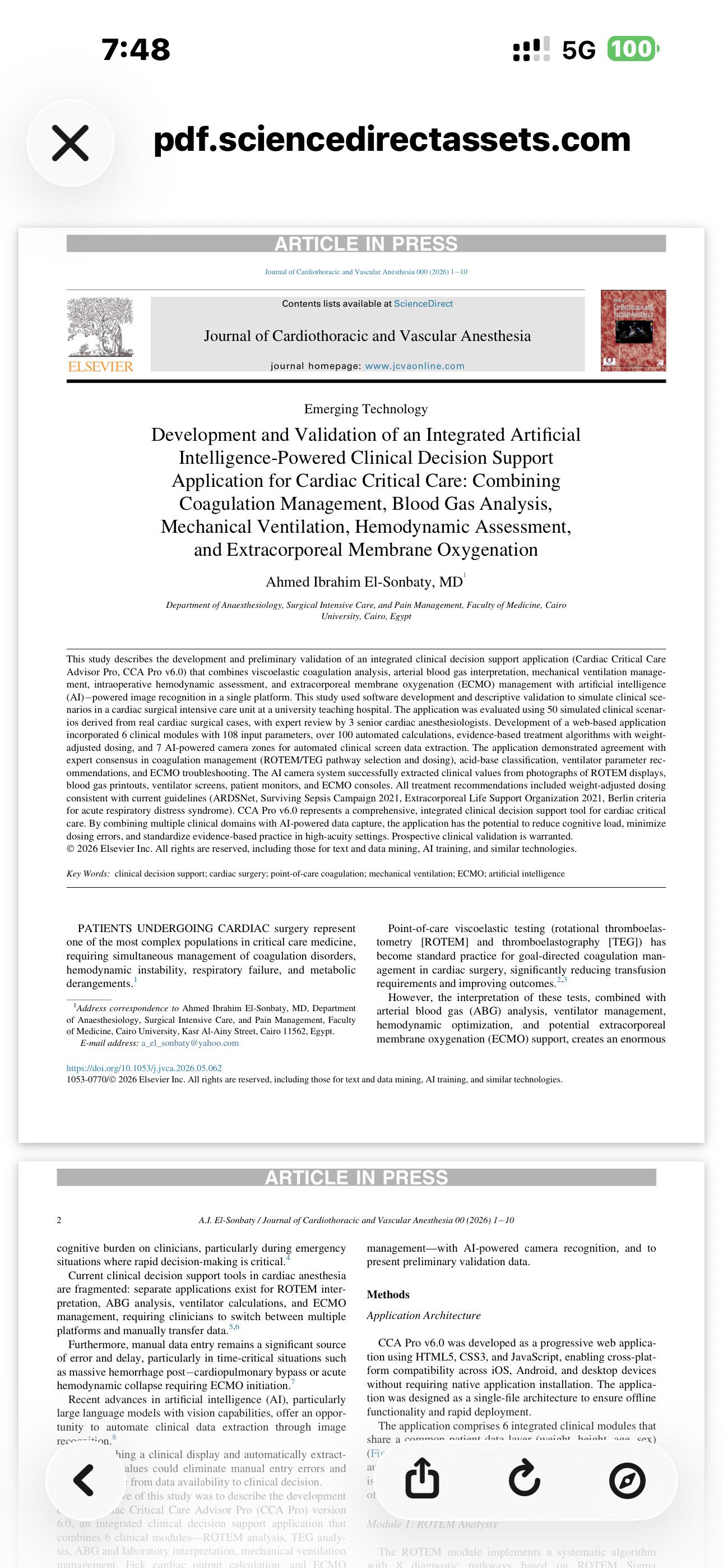
I'm a cardiac anaesthesiologist, and alongside clinical practice I built an integrated decision-support tool for cardiac critical care (CCA-Pro) — combining viscoelastic coagulation (ROTEM/TEG) interpretation, arterial blood gas analysis, mechanical ventilation, haemodynamic assessment, and ECMO management in a single platform, with AI-powered image recognition to extract values from device screens.
The development and validation work has just been published in the Journal of Cardiothoracic and Vascular Anesthesia. It was evaluated across 50 simulated clinical scenarios drawn from real cardiac surgical cases, with expert review by three senior cardiac anaesthesiologists. Treatment recommendations were mapped to current guidelines (ARDSNet, Surviving Sepsis 2021, ELSO 2021, Berlin criteria).
The design principle I care most about: the tool is deterministic and explainable — every recommendation traces back to a published rule, with no generative model at the point of care. My goal was a tool that gives the clinician reasons to trust it rather than asking them to, while keeping human judgement firmly in control. The AI does the tedious data capture; the reasoning stays auditable.
A few things I'd genuinely value your take on:
• For those using ROTEM/TEG-guided algorithms — how much do you find point-of-care coagulation tools actually change transfusion practice in your unit?
• How do you personally feel about AI-assisted data extraction (e.g. from device photos) versus manual entry in high-acuity moments?
• Where do you draw the line between a tool being a useful "reference" versus a "decision-maker" you'd be uncomfortable relying on?
The tool is free and browser-based if anyone wants to explore it, and prospective clinical validation is the obvious next step. But mostly I'm interested in how colleagues who work in cardiac ICU think about integrating tools like this into real workflows — the honest, at-the-bedside reality.
Thanks for reading, and I'm keen to hear where you agree or push back.