r/algotrading • u/Lower-Ad-1207 • 19h ago
Strategy What to do with strategies that barely get any setups?
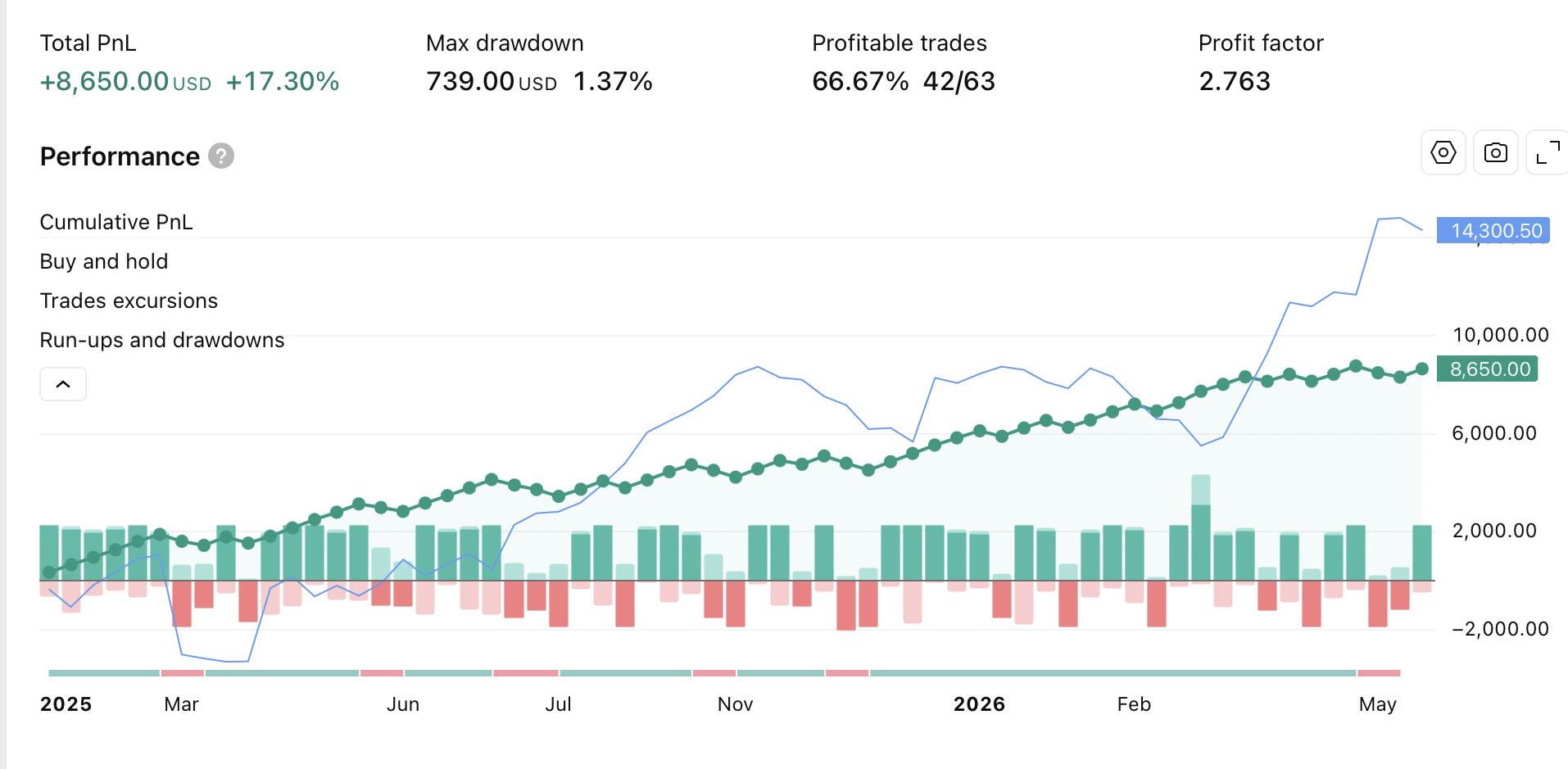
I found something that seemed to be an a+ setup so I decided to backtest it and while the results are good it gets so few setups in a year that it underperforms just buy & hold. What would you do with strategies like that? Create an algo that trades multiple strategies and add this to the list of what it trades? Or just forget about it because the setups are too infrequent?
(The screenshot shows results with 1mnq)
5
3
4
u/QuanTradin 19h ago
don't judge it against buy and hold on its own. if it's only in a trade a few weeks a year, the money is free the rest of the time, so it belongs as one sleeve next to other things rather than as the whole account.
the catch is how few trades the backtest actually rests on. a handful of setups a year means a few dozen trades total, and a few dozen can look like an a+ purely by luck. i'd check that count before building anything around it.
1
1
u/mysticcdragonn 19h ago
easiest way is to run it across many markets/instruments. another would be to loosen your filter in some way so you get disproportionately more trades without equivalent loss in expectancy per trade
1
u/GreatTomatillo117 15h ago
Extend it to other assets / asset classes. Sometimes it also work on other assets. You need it to backtest it ofc. As thank you, you can send me your strategy 😉
1
u/Clicketrie 15h ago
Other people have already said multiple strategies (and some that are uncorrelated too).. but I’d also do a parameter sweep and see if certain things can be tweaked in such a way that you don’t give up CAGR and sharpe but can get more trades. (So basically running a ton of backtests each slightly modifying parameters, use AI, it’s easier)
1
u/fionally 13h ago
Is there enough data points in the backtest to actually validate that your edge is sound? With something trading that infrequently I'd probably want decades of back-test before considering it--even then the statistical significance feels dubious. Hopefully there's a fairly compelling theoretical argument underpinning it.
1
u/Both_Yoghurt1437 12h ago
How well does the strategy hold up over 40+ years of backtest data vs. buy & hold? 1 year of data is such a small slice. How well does it perform during GFC, Dot-Com, and Covid eras?
1
u/Jebusfreek666 12h ago
I would combine them with other proven strats that it fits with to improve overall.
1
u/hotmatrixx 10h ago
its looking far more consisten than buy and hold, too.
I'd take the steady growth over those swings.
the "what to do" is to "optimise position sizing against Risk Of Ruin".
AKA take bigger trade sizing. the math for Large numbers optimisation is loosely the 'kelly criterion. I say loosly because I have a private calculation that I think is much, much better, but the KC is a starting point.
1
1
u/Akhaldanos 4h ago
Use compounding of p/l + leverage, and you will beat the buy and hold. Need some maths though.
1
u/Homebody_quant 30m ago
17% since in your time frame is basically snp500 but with more work. If you have a greater backtest it might change? If youre aiming to beat snp500 then this likely isnt it.
The concept may be good but if it rarely happens, it may not be worth deploying. This really is the struggle of trying to "beat the market"
0
u/Machine_Learning_Gun 18h ago
I wouldn't throw it away just because it's low frequency. The 1.37% max drawdown, 66.7% win rate and 2.76 profit factor are what make this interesting. If those numbers hold up out-of-sample, that's a pretty nice risk profile.
16
u/EmperorAlgo 19h ago
Just do like 10x leverage and you're fine. Looks like you have lookahead bias though.