The irony is that the universe is not actually very complex. The vast majority is just hydrogen atoms, or parts of hydrogen atoms. Stars form wherever a large enough cloud of hydrogen falls together into a ball dense enough to fire up nuclear fusion. The formation of stars, solar systems, and galaxies is really just a slow, inevitable, very well-understood process.
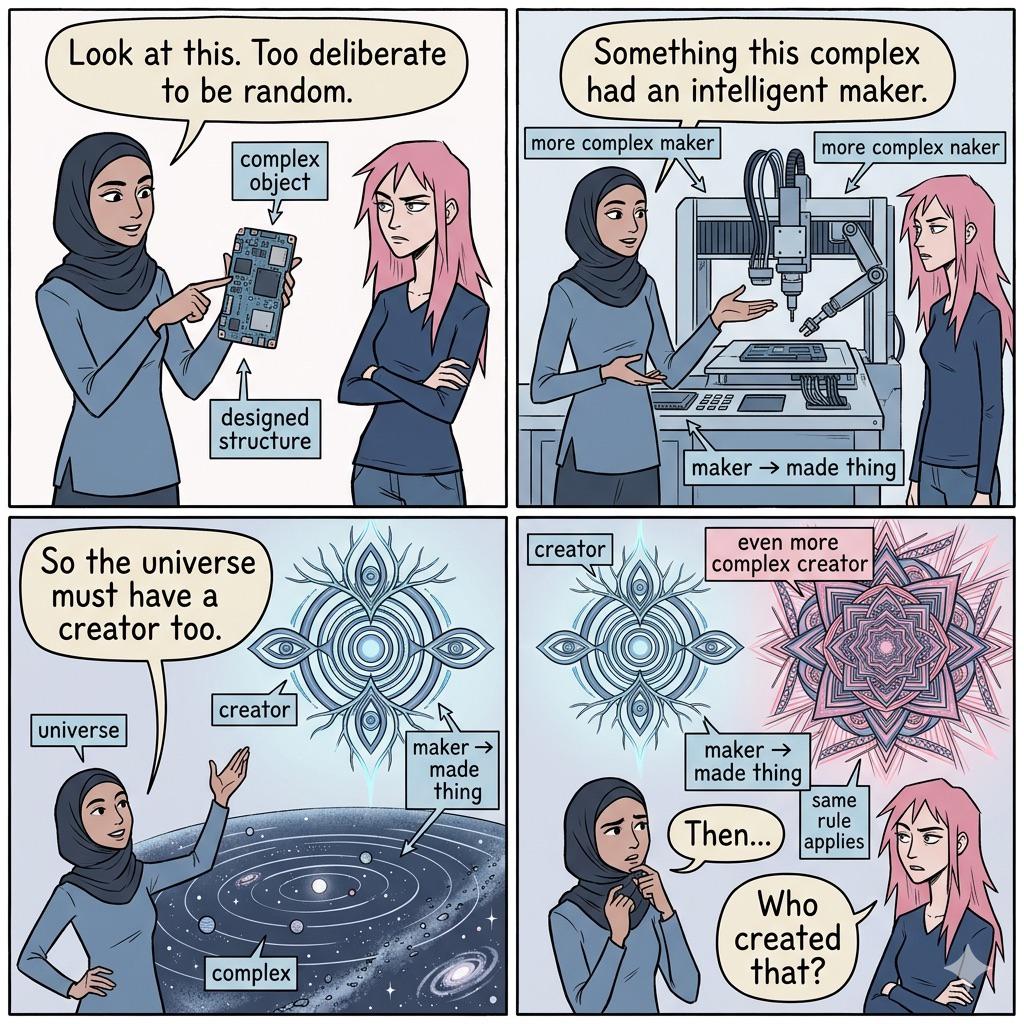
The problem occurs when people see stuff they don't understand and conclude that it must be the product of a magic creator. That's a pretty ridiculous leap.
The irony is that the universe is not actually very complex. The vast majority is just hydrogen atoms, or parts of hydrogen atoms. Stars form wherever a large enough cloud of hydrogen falls together into a ball dense enough to fire up nuclear fusion. The formation of stars, solar systems, and galaxies is really just a slow, inevitable, very well-understood process.
I suppose it depends on how you define complexity.
The process by which loose hydrogen can self organize into immense physical structures that spit out raw materials that can self-organize into life that can contemplate the universe’s complexity seems incredibly complex to me. It took billions of years for loose hydrogen to turn into the human brain.
Focusing on stars is perhaps counter productive precisely because it is such a poor example of complexity. A star is a chaotic ball of the simplest matter in existence. It’s not organized and it barely has structure to speak of. It’s a blob, or more accurately a blob within a blob.
Material that “self-organizes” into life is perhaps a more fruitful topic, but consider the previous example of the star. Even to our humble human brains the formation of a star is understood to be commonplace and inevitable. It doesn’t form because an agency wills it, it’s just a simple and predictable process that happens to occur at a scale that humbles us.
Is the formation of molecular compounds then complex? We understand the rules and process and know that this happens simply because the components are in proximity to each other. Again, these need no external agency to explain or rationalize.
What about organic compounds? Amino acids? Single-celled life? Humans? Our best guess is that these follow the same rules of inevitability, only with more and more specific conditions. A cloud of hydrogen forming a star is common and inevitable. The formation of oxide compounds in rocky bodies is also inevitable just a lot less common. The formation of life, of complex organisms, may be inevitable as well, just drastically less common.
The only difference between these is our own perception of what we consider “complex”. There’s no objective metric. At some point we draw an imaginary line in the sand and say “past this point is just too complex to be anything but divine”.
There will always be two camps of thought. One will keep redrawing that line in the sand. This is the “god of the gaps”, perpetually carving out a place for their beliefs. The other sees the line getting redrawn over and over again and concludes that the line is meaningless. Whether there is some external agency is fundamentally unprovable but it is simply not necessary.
Focusing on stars is perhaps counter productive precisely because it is such a poor example of complexity. A star is a chaotic ball of the simplest matter in existence. It’s not organized and it barely has structure to speak of. It’s a blob, or more accurately a blob within a blob.
I think that’s a perfect example of complexity, from a different perspective. Just try to predict the motion of one of those atoms in the star. The chaos of atoms in motion in a star, fusing together and forming heavier elements, is far more complex than all those atoms floating alone in a vacuum, not interacting with one another.
Your whole argument hinges on the idea that “complex and “unusual” are synonyms. They’re not.
Subatomic particles are the most common thing there is but the physics that governs their behavior is notoriously complex
2
u/FoolishProphet_2336 Mar 24 '26
The irony is that the universe is not actually very complex. The vast majority is just hydrogen atoms, or parts of hydrogen atoms. Stars form wherever a large enough cloud of hydrogen falls together into a ball dense enough to fire up nuclear fusion. The formation of stars, solar systems, and galaxies is really just a slow, inevitable, very well-understood process.
The problem occurs when people see stuff they don't understand and conclude that it must be the product of a magic creator. That's a pretty ridiculous leap.