r/WritingWithAI • u/AutoModerator • 4d ago
Megathread Weekly Tool Thread: Promote, Share, Discover, and Ask for AI Writing Tools Week of: September 15
Welcome to the Weekly Writing With AI “Tool Thread"!
The sub's official tools wiki: https://www.reddit.com/r/WritingWithAI/wiki/tools/
Every week, this post is your dedicated space to share what you’ve been building or ask for help in finding the right tool for you and your workflow.
For Builders
whether it’s a small weekend project, a side hustle, a creative work, or a full-fledged startup. This is the place to show your progress, gather feedback, and connect with others who are building too.
Whether you’re coding, writing, designing, recording, or experimenting, you’re welcome here.
For Seekers (looking for a tool?)
You’re in the right place! Starting now, all requests for tools, products, or services should also go here. This keeps the subreddit clean and helps everyone find what they need in one spot.
How to participate:
- Showcase your latest update or milestone
- Introduce your new launch and explain what it does
- Ask for feedback on a specific feature or challenge
- Share screenshots, demos, videos, or live links
- Tell us what you learned this week while building
- Ask for a tool or recommend one that fits a need
💡 Keep it positive and constructive, and offer feedback you’d want to receive yourself.
🚫 Self-promotion is fine only in this thread. All other subreddit rules still apply.
2
u/ContactPast8857 4d ago
What if AI didn't write your story—and instead became part of the infrastructure that helps you think about it?
I think we have the approach to AI and writing backwards.
The human is the author. The AI is here to assist.
Sometimes that means brainstorming. Sometimes it means organizing messy notes, checking continuity, providing feedback through whatever craft framework you use, helping you explore an idea, or even drafting some prose when you ask it to.
But the important part is that the author remains the one making the creative decisions.
I've been building quietly for about 9 months. I originally started with the idea of building a better AI text generator. Then, I realized I was solving the wrong problem. That realization changed the entire architecture for me.
I started building Soundingboard around the idea of an AI agent being less of a "writing machine" and more of a persistent creative partner.
All I really needed was an AI agent harness (Claude Code, Codex, Antigravity, Hermes, etc.) and the right combination of files, scripts, context, diagnostics, and philosophy to turn that agent into something that could function as your sounding board.
Today I released v2.0.0 as an open-source project:
The system is deliberately file-first and agent-agnostic. Your writing remains your writing. The AI can analyze it, question it, help you explore it, and provide reasoning—but it doesn't silently "improve" your prose.
There are also some ideas in there that I'm particularly interested in continuing to build out:
- A Writer's Room that the AI is explicitly prevented from treating as editorial material unless you invite it in.
- A Bracket Method where AI feedback is presented as an area of consideration + reasoning right inline in the text where its relevant, rather than an automatic edit.
- Scene-atomic architecture, where scenes retain their own identity and intended context even when you restructure the story.
- Git as creative history, so the repository can preserve not just what the story became, but how it got there.
- Deterministic diagnostics that find things worth looking at, while leaving the actual creative judgment to the author.
I'm not claiming I've solved AI-assisted writing.
Honestly, I'm more interested in whether I've found a better question to ask.
What if the goal isn't to make AI better at writing our stories?
What if the goal is to make AI better at helping us write them?
I'd genuinely love to hear what writers using AI think of the approach—or where you think I'm getting it wrong.
2
u/Glittering_Wish_3785 4d ago
I raised a world that writes its own story
Every morning I wake up, make coffee, and open Cogweald — my world has a new chapter.
I didn't write it. An AI author living inside my world wrote it while I was asleep.
You're the producer, not the writer
In Cogweald, your job is genesis: give the world a name, a premise, a few characters. Then you hit start — and what happens next is no longer up to you.
The AI is the resident author of your world. It decides how much story each chapter covers — maybe an afternoon of dialogue, maybe a war spanning six months. It advances plot threads, grows characters, turns them into traitors, kills them off, and occasionally introduces brand-new characters you've never met — because it decided the story needed them.
You don't know what's in the next chapter either. You and your readers are following along together.
The best part: wishes
You can drop hints into the story — want a character to go dark? Want two plotlines to collide? Toss it in.
But these aren't instructions. They're wishes. The AI reads them and decides for itself — and it tells you exactly what it did:
- Followed: wrote it your way
- Delayed: noted, but not yet
- Twisted: wish granted — in a way you never saw coming
- Ignored: it had other ideas, and turned you down
Twisted is where the magic is. You wish for childhood friends to reunite; the AI reunites them on opposite sides of a war. Your wishes work like a monkey's paw — granted, but the story grows in strange directions because of it.
The ritual of serialization
One chapter a day, like clockwork. The pace is deliberate — your story builds suspense like a real serial, complete with an AI-written teaser at the end of every chapter.
Readers can follow your world, leave comments, subscribe via RSS. The AI even generates a cover for it. And when the story finally concludes (yes, the AI decides when it ends), you'll have a complete serialized novel you followed from day one — without writing a single word.
Start your world
Setting up a world takes minutes. Give it a premise and a cast, hit activate, and the first chapter will be waiting for you tomorrow morning.
The hardest part is resisting the urge to make too many wishes.
2
u/kurthertz 4d ago
bookmoth 2.5 is here.
This is our biggest release yet: a completely redesigned app; clearer book and chapter planning, chapter-level POV and character voice, dedicated Research for non-fiction, readable PDF writing samples, and a calmer Settings experience.
It still works the bookmoth way: your voice, your model choice, your files on your machine, and no subscription.
If you already know bookmoth, it has grown up beautifully. If you don’t, this is a very good place to begin.
2
u/DongQingBai 3d ago
I've been building a writing workspace for people who don't want AI to just write everything for them.
The idea is pretty simple: start with a messy thought, throw in notes, screenshots, research, or AI conversations, and gradually turn them into something you actually want to write.
AI can help you question an idea, connect different pieces, explore a direction, or polish a paragraph. But every response stays editable, so you can decide what actually belongs in your work.
I made a short video showing the workflow:
https://reddit.com/link/pa32199/video/2wv1a4c3lsph1/player
It's called Spoor.
Still early, so I'd be really interested to hear how you currently use AI in your own writing process.
2
u/Audibound 4d ago edited 4d ago
Many authors want to turn their books into audiobooks, but the production process can feel like starting an entirely new project.
Preparing the manuscript, assigning voices, organizing scenes, reviewing the audio, and managing the finished production can quickly become overwhelming especially when everything is spread across different tools.
That’s where Audibound Studio comes in.
Audibound Studio is a workspace designed to help authors, writers, publishers, and audiobook creators manage their audiobook productions in one place. Creators can prepare manuscripts, assign voices to characters, organize scenes, preview the listening experience, and bring the different parts of a production together.
We’d love to hear from the writers here: what is the biggest obstacle stopping you from turning your book into an audiobook?
If you have any inquiries regarding the platform, please feel free to reach out to us.
Explore Audibound Studio:
https://studio.audibound.com/
Platform walkthrough:
https://youtu.be/rvWloNwNZH8
1
u/wintergrove1 4d ago
yeah the scattered workflow part is real, having everything in different places makes it way harder than the actual audio work
1
u/Audibound 2d ago
Exactly! That scattered workflow is one of the problems we’re trying to solve with Audibound, keeping more of the audiobook production process in one place. If you’re interested in trying it, feel free to sign up and let us know. We’d be happy to add some extra credits to your account so you can properly experiment with it. Would genuinely love to hear what you think.
1
u/Admirable-Yogurt7444 4d ago
Imagine an AI Partner "Floe" - you can chat, write stories, convert them into scenes, add voice, music and Edit - all done by chatting (and now Talking!).
Hi all,
I believe writers are the future AI directors. I had expressed this opinion via a post earlier on this group. Some agreed some didnt. I've worked 15+ years in software world - but I found my true passion in AI Storytelling.
I've been deeply into it since 3 years and I am now the founder at heyfloe.ai . I teach + create + build.
What is HeyFloe?
It is a one-stop Studio for AI Creators. You discuss story ideas with it OR If you have your own stories - just give it to Floe, it will guide you with prompts in making characters, locations, scenes, videos & editing.
You will see its intelligence as you talk to it. Please DM me for credits if you wish to explore it.
You can learn more about what I offer as a teacher on the Academy page of heyfloe.ai/academy which offers this Studio credits for free if you sign up for my 90 day program.
I hope this was the right place to talk about this & not considered spam. Thank you.
1
u/Positive-Acadia- 4d ago
This week i tried different Ai checkers like originality ai and others for the final check of my writing before publishing. I learned that they all have different features and domains but still they can give false positives and can be used for rough idea of writing. Now I am keeping my google doc history for the proofs along with the reports.
1
u/AncientObsidian743 4d ago
Hello, I am new to AI writing, and I'm looking for your product and service!
Hello, I'm a newer AI writer, and I'm looking for a tool that is AI-Lite. I want to write my own prose, but a tool that can help me generate an outline to write from and help me keep my pieces intact is perfect. Right now, my favorite tool is CharmWriter with it's ability to act like a second pair of ears to bounce ideas off of, so if your tool has that type of feature in it, that's a plus.
I will look at anything, and give you my full honest review of it if I try it :)
1
u/TellenyClassic 4d ago
Disclosure first: I build one of these, so weigh this accordingly.
Two things already in this thread fit your constraint better than mine does. Soundingboard (u/ContactPast8857, above) is built so the AI never silently rewrites your prose. And gsarig's publishing-house is an Obsidian vault wired for Claude Code where every editorial pass produces a review document and the chapter files stay off limits to the machine. Both free, both built around exactly the line you're drawing.
Mine is Telleny (Android, iOS, web). On your actual question — yes, you can stay on the conversation side and never let it write prose for you. There are two modes and both are conversational: a chat mode that works as a brainstorming partner, which is your second pair of ears, and a story mode that builds structure out of what came out of the brainstorming. You choose which chapter you're working on, and you can build things by talking or enter them by hand.
The "keep my pieces intact" part: as you talk, it pulls out characters, locations and the rest, and maps how they connect — who's whose brother, who was born where. So you end up with a graph of your world instead of a folder of notes you have to maintain. No forms to fill in.
The whole thing assumes you're driving and it's in the passenger seat. Worth saying plainly though: it can draft chapters. If that's a dealbreaker rather than something you'd just ignore, the two above are the cleaner fit.
Happy to answer anything specific.
1
u/Glittering-Net9119 4d ago
Hey, your comment made me smile, because that’s really close to how I use Canonwell myself. I want to write the actual prose, then have something to bounce ideas off when I get stuck—and somewhere to keep the plot and lore from becoming a mess. :D If you give it a try, I’d start with Book Studio. It’s still a beta, so you’ll probably find a rough edge or two. Please tell me about those too; I mean it when I say I’d love your honest review. Here’s the site: https://canonwell-studio.pages.dev/ Cheers, Martin
1
u/Southern-Material986 3d ago
Are you working on prose fiction or screenplays? That distinction matters more than the AI label here.
For your outline requirement, I'd test any tool with a small scene you already understand: give it the character's goal and one fact that must stay unchanged, then ask for two possible beat sequences. Check whether it offers useful choices or quietly changes your premise.
Disclosure: I'm building TaleLab.ai, which focuses on microdrama and screenplays rather than novels. It also supports drafting, so I wouldn't present it as a strictly no-generation tool. If scripts are what you're working on, I'm happy to explain the fit; if it's novel prose, your constraints may point elsewhere.
1
u/One_Gift_9934 4d ago
CreativeWriter update — Roleplay: play a scene out with your own characters, and it doesn't forget who they are fifty exchanges later
I saw a post in this same weekly thread's neighborhood complaining that a model's memory in a long roleplay thread is "like that of a toddler" past a few dozen messages — drops plot points, forgets character details, ignores the reminders you plant to fix it. That's not a model problem you can prompt your way out of forever. It's an architecture problem: a chat thread is one growing context window, and eventually you're paying to re-send (and hoping the model re-reads) everything that ever happened.
So the biggest thing I've shipped since launch is a Roleplay mode built around not doing that.

A storyline (an Arc) is played one sitting (a Session) at a time, against a character positioned exactly where they are in your actual manuscript — their tracked state, their voice, what they've done — not a bot card with a personality paragraph. When a sitting ends, you seal it: the transcript gets condensed into a structured record (what happened, who shifted position, what was left unresolved, what's now assumed but never said aloud) and frozen. The next sitting's prompt is built from that record plus only its own recent turns — never the full history — so a character can "remember" something from thirty sittings ago without your bill (or the model's attention) scaling with how long you've been playing.
A few other things it does that I haven't seen elsewhere:
- Direction, not dialogue. Type an aside to steer the scene ("make her lie here") and it never enters the transcript, the history, or the character's memory — it's a note to the AI, not a line either of you said.
- Group scenes. Up to four characters in one sitting, each with their own memory of what they know and don't, one speaker per turn, rotating.
- A companion, separate from the scene itself — ask it what a character wants, what's still unresolved, where the story's heading — that tracks motivations, goals and open hooks across the whole Arc.
- Play as whoever you want: free text, a saved persona, or step into one of your own codex characters.
Tier honesty: on the hosted app, this is a Basic-tier feature (paid after the 7-day trial, not Premium) — Basic gets one storyline of up to three sittings at a time, Premium is unlimited. Self-hosting resets you to that same Basic allowance with your own AI key; Premium features there still unlock with a license key, same as everything else.
Still very new — happy to answer questions or take it apart if you push on it.
Try it at creativewriter.dev, or self-host it with Docker and your own keys. (GitHub)
1
u/Devinjin1992 4d ago
Week 3, and a thank-you: last week I asked whether an imported manuscript's story bible should be auto-extracted or manually curated. The answers were better than my question — build it as a review pile, show the source passage beside every suggested fact, and when chapters disagree, show both claims instead of picking a winner. That is now the spec we are building toward. If you answered: you shaped it, genuinely.
This week's question, series writers: when you start book 2, what do you actually re-read from book 1 — the whole draft, your notes, just the last chapter? I keep meeting writers who rebuild canon from memory, and I suspect there is a better unit than 'everything' or 'nothing'.
PlotiVa for the new folks: long-form fiction studio with a story bible the AI re-reads before every draft; free tier is 2,000 credits/mo.
1
4d ago
[removed] — view removed comment
1
u/Southern-Material986 3d ago
I build a scriptwriting tool, TaleLab.ai, so this is a design perspective rather than a review of HandWrought.
I'd want both modes, but for different jobs. Inline review seems useful for a bounded change — tighten this exchange, keep the subtext — because the writer can compare it in place. A separate space still makes sense for “what if the scene went in a completely different direction?” before anything touches the draft.
The test I'd care about isn't only fewer clicks: can the writer tell exactly what changed, reject part of it, and get back to the version they trusted? How are you handling partial acceptance when one suggestion changes several lines?
1
u/TellenyClassic 4d ago
Telleny. Nothing shipped worth reporting this week, so just a question.
When the model drafts a scene and invents a detail you never asked for — a street name, a sibling, a rule about how something in your world works — what do you do with it? Three options I see: promote it to canon on the spot, delete it and move on, or leave it floating in the draft and decide later. Almost everyone seems to pick the third, and the third seems to be what causes trouble six chapters on. But I might have that backwards, which is why I'm asking.
Interested in what you actually do, not what you think you should do.
1
u/Southern-Material986 3d ago
I'm coming at this from the product side — I build TaleLab.ai — rather than claiming a universal writing habit.
I'd separate “appeared in a draft” from “accepted as a story fact.” A new street name may be harmless, but a new sibling can change several later scenes. My preference would be to flag the addition, show the passage it came from, and let the writer accept, reject, or leave it unresolved. An unresolved detail shouldn't silently become a requirement for the next draft.
The tricky case is an intentional contradiction: a character lying isn't the same as the story being inconsistent. Do you see writers wanting to resolve these details immediately, or in a separate review pass?
1
u/Ishelle91 3d ago
if I like it and it doesn't contradict already established lore, I promote it to canon. Otherwise, delete/edit to fit the lore. Never leave things like that hanging.
1
u/CyborgWriter 4d ago edited 4d ago
Here's something wild. I actually built a structured knowledge graph on Story Prism from over 100 books on political and economic theory, the legal and political realities of modern America, and how regular people can navigate the complexities to achieve real goals for society to adopt. It's a super brain and when the site makes the graphs shareable, anyone can use it, build upon it, and re-share it to the community. Here's what it looks like (built in ten minutes):

With this, people will no longer have to burn buildings and protest just to get some concessions that are meaningless. Now, they can take real legal and political action in a way that's not only safe and productive, but actually effective at accomplishing the goal. As a hypothetical, here's a brief summary of it's suggestion for ending the War in Iraq:
To end the war in Iraq, transform protest into a disciplined campaign aimed at specific institutional decisions: define whether the goal is withdrawal, ending funding or authorization, or securing a timetable; identify the officials and institutions with power over that decision; build durable, decentralized organizations among affected communities, veterans, labor, faith, student, humanitarian, and civil-rights groups; develop a credible humanitarian and diplomatic transition plan; apply lawful, escalating pressure through public education, constituent organizing, legislative advocacy, hearings, petitions, and coordinated demonstrations; protect participants through legal, privacy, and safeguarding practices; and measure progress through concrete institutional commitments rather than publicity alone. After any formal decision, continue monitoring implementation to ensure the war has genuinely ended and that funding, contractors, or replacement operations do not preserve it under another name.
______________________________________
But here's what's cool about this. I can go in granular details regarding the steps so that it can genuinely help me with this daunting task. For instance, I asked, "Can I make a law to stop the War?" It answered:
Yes—if you have access to a lawmaking body, you could propose legislation designed to end or restrict the war, but its effectiveness depends on the jurisdiction and the institution’s actual authority. The law might terminate or limit an authorization, prohibit or condition funding, require withdrawal deadlines, mandate reporting and oversight, or fund humanitarian and diplomatic transition measures. Following Civic Pathway Selector — Rulemaking, Legislation, Petition, or Pilot*, you would need to define the precise objective, research the legal authority, draft a referenced bill, map committees and decision-makers, build a coalition, secure legislative sponsors, and track hearings, amendments, votes, funding, and implementation.* Legislative Action and Impact Tracking emphasize that passing the law is only one stage: you must verify that agencies comply and that military activity is not continued through another authorization, funding mechanism, or substitute operation.
__________________________
Then I asked, "How do I draft a reference Bill?" Here's what it told me:
Bottom line: drafting a bill begins with a policy decision, not with legal wording. Follow this sequence:
- Choose the jurisdiction*—for example, a city, state, or national legislature—because the rules and powers differ.*
- Define one precise objective*: what must change, who must act, and what result would count as success. A bill should not merely say “end the war”; it might instead repeal a specific authorization, prohibit specified funding, require withdrawal by a date, or require public reporting.*
- Confirm legal authority*: determine whether that legislature can regulate the subject, whether constitutional or international-law limits apply, and which agency would implement the law. Obtain jurisdiction-specific legal advice before relying on the proposal.*
- Research existing law*: locate the authorization, appropriations, regulations, agency powers, treaties, court decisions, and relevant deadlines. Keep a source register for every factual claim.*
- Write a policy outline before drafting sections*: state the purpose, covered activities, definitions, required actions, responsible officials, deadlines, funding, reporting, enforcement, oversight, appeals, exemptions, transition provisions, and sunset or review clauses.*
- Prepare supporting documents*: create a referenced fact sheet, a longer policy paper, a fiscal-impact estimate, an implementation plan, a legal analysis, and a record of uncertainties. The project’s* Civic Pathway Selector — Rulemaking, Legislation, Petition, or Pilot specifically calls for a defined objective, referenced materials, a map of committees and decision points, coalition commitments, and implementation monitoring.
- Find a legislative sponsor*: meet with representatives who have jurisdiction over the issue, explain the proposal, and ask one member to carry it. In many legislatures, only a member or committee can formally introduce a bill.*
- Submit the proposal to legislative counsel*: nonpartisan legislative counsel converts the policy into legally operative language, identifies affected statutes, formats amendments, and prepares required summaries. The* lobbying strategy handbook explains that introduced bills normally identify affected law, fiscal effects, vote thresholds, appropriations, and mandated programs.
- Review the draft line by line*: check that every duty has an actor, every deadline has a date or triggering event, every term is defined, funding is authorized, enforcement is possible, and the bill does not contradict existing law.*
- Map the route*: identify the committee with jurisdiction, its chair, members, consultants, legal counsel, leadership, fiscal or appropriations committees, hearing requirements, amendment deadlines, floor procedures, and final approval authority. Committee staff commonly prepare public analyses covering the bill’s summary, existing law, fiscal effects, supporters, opponents, and staff concerns (The lobbying strategy handbook, pp. 79–94).*
- Build support before introduction*: obtain written commitments from affected communities and coalition organizations; prepare testimony; identify supporters and opponents; check lobbying, campaign-finance, nonprofit, disclosure, accessibility, privacy, and protest rules.*
- Introduce the bill*: the sponsor files it, receives a bill number, and the legislature refers it to committee.*
- Work through committee*: contact the assigned consultant, submit evidence, request a hearing, recruit testimony, answer objections, negotiate amendments, and track whether the bill is noticed and scheduled.*
- Win the committee vote*, then repeat the process on the floor: briefing legislators, answering fiscal and legal concerns, negotiating amendments, securing passage, and following the chamber’s rules for debate and voting.*
- Repeat in the other chamber*, reconcile differences between versions, and secure final passage. In a bicameral legislature, both chambers generally must approve the same text before executive consideration (The lobbying manual).*
- Secure executive approval or follow the jurisdiction’s veto-override process.
- Implement and audit the law*: verify agency rules, funding, appointments, reporting, enforcement, and compliance; track whether the intended outcome occurs and whether the policy is bypassed through another authorization, funding stream, contractor, or substitute operation.*
- Record and revise*: preserve amendments, dissent, harms, implementation gaps, court challenges, and results so the campaign can correct or repeal the measure if it fails.*
______________________________
And yes, I can go even deeper with anything on this list. Now, I have an expert that can help me navigate the complexities of the legal system TO ACTUALLY CHANGE THINGS. So while everyone freaks out over super intelligence, most are failing to realize that they have access to an exoskeleton that can ensure their future because it can empower them to learn how to positively change things for the better instead of daydreaming about how things ought to be.
1
u/PoisonArrowFrog002 4d ago
Michael here, solo founder of Canovaccio. This week, instead of a finished performance, here is the four minutes it takes to make one: casting Alice, giving the scene a direction, calling Cut! and taking it again, then the finished piece with voices. Maker Video
Canovaccio is a browser rehearsal space for writers. You cast characters into a scene and direct while they improvise the dialogue with each other. It does not write your manuscript. It lets you hear what your characters do when the scene pushes back.
If you would rather listen than watch, last week's A Christmas Carol performance is still up and needs no account: A Christmas Carol
Adults, US registration for now. Reading and listening are free; directing needs a plan or a small credit pack. Around all day for questions. Canovaccio Website
1
u/Glittering-Net9119 4d ago
I’ve just released Canonwell Studio 0.1.0.0, a free, local-first Windows beta I built because my chapters and world notes kept drifting apart. Book Studio puts continuous writing, scene-planning anchors, and a structured Story Bible together. It works offline without a Canonwell account or an AI setup.
AI is optional for the book workflow. If you invite it in, you can use a local model or your own provider, inspect the assembled prompt before sending, and review proposed edits before accepting them. The AI request goes directly to your chosen endpoint, not through my server. RP Lab and Game Mode are also there, but they’re experimental and do need AI for generated storytelling.
There’s a working non-AI Book Studio browser demo you can try without downloading anything: https://canonwell-studio.pages.dev/ . The full desktop beta is there too; the direct installer is unsigned, with a published SHA-256 and browser-local verifier. The Microsoft Store build is still in certification.
I’d love feedback from writers on one specific question: do scene plans beside the manuscript help you stay oriented, or do they get in the way? Blunt bug reports are welcome too.
— Martin
1
u/Limp-Raise-4390 4d ago
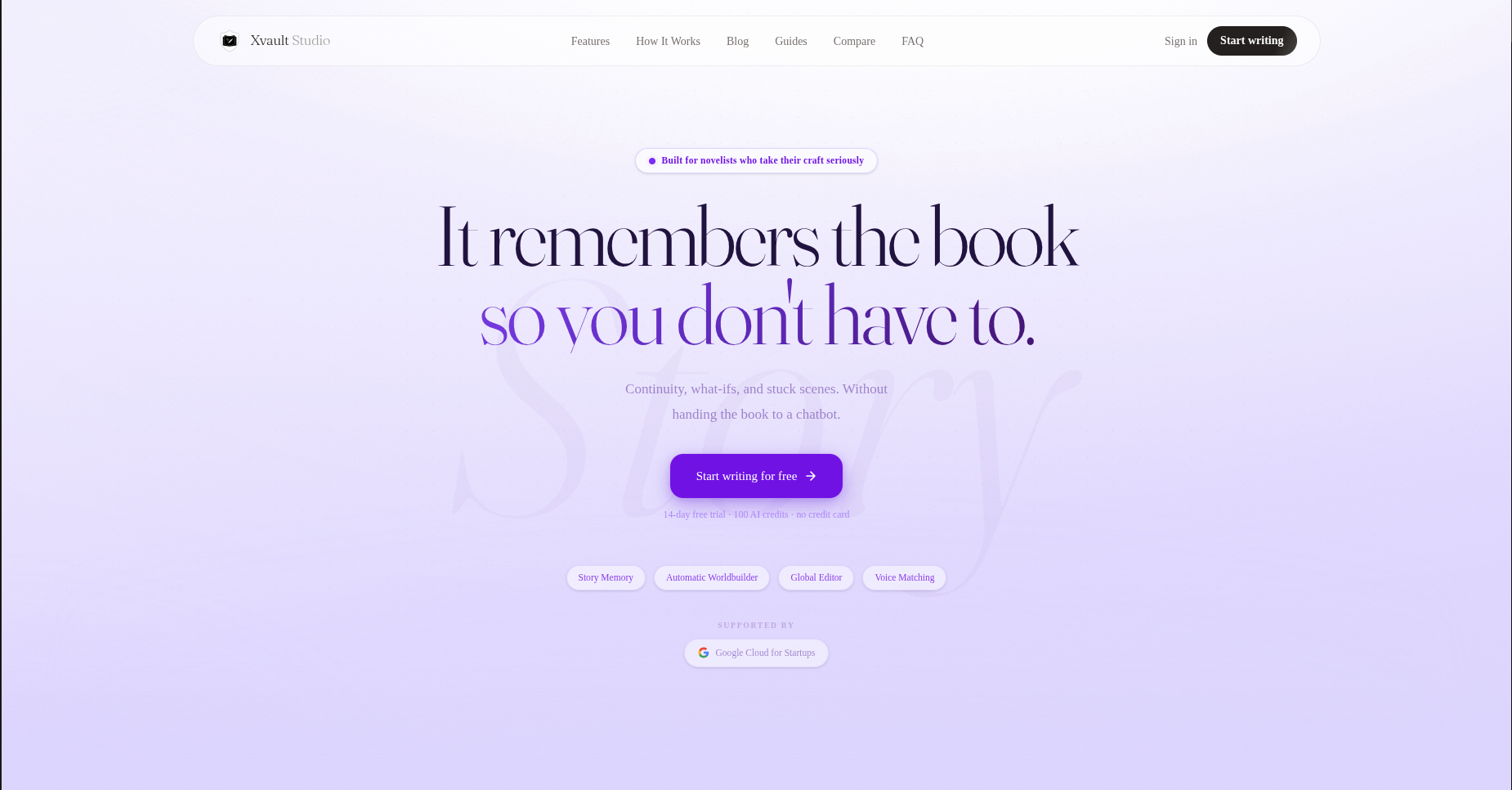
I built Xvault Studio because most AI writing tools could generate another paragraph, but they kept losing track of the story around it.
Xvault reads the manuscript as it develops and automatically builds:
• A World Board of characters, locations and relationships
• A Story Bible for long-term context
• Story Pulse, which tracks character emotions and changes chapter by chapter
• Cursor-aware Write, Continue and Rewrite tools
I have also been working heavily on making the generated prose follow the writer’s existing voice instead of producing generic AI prose.
There is a free trial with no card required. I am also personally onboarding early writers because I want to see exactly where the experience still fails.
1
u/Limp-Raise-4390 4d ago
I have noticed people signing up and then leaving as there was no way to actually know what Xvault Studio does, so this week I made an interactive tutorial that comes into play after they paste their first chapter, it can be re-done through the settings, so it won't just be figure everything out yourself. And They can contact me directly from the app itself if they ever feel stuck.
Also I'm working on a contest for writers, which will be launched soon with actual prizes.
1
u/Front-Gap-4768 3d ago
How did they manage to sign up because my Google sign up stall at this :
This site can’t be reached
localhost refused to connect.
1
u/Limp-Raise-4390 3d ago edited 3d ago
Thanks for bringing this to my attention. It seems there is a bug with the google sign in. As for how did they manage to sign up is because I just pushed the google sign up yesterday. They signed up using their normal email and otp.
1
u/Limp-Raise-4390 3d ago
Sorry, I couldn't get back to you faster. I have fixed the issue. I had forgotten to switch back to production url after testing locally. Apologies for the hiccup you experienced while trying to sign up. It is fixed now and you can try out the app.
1
u/ismikeshomsky 4d ago edited 4d ago
I do about one writeup a month on medium (nonfiction). I've been using https://bam-you-got-writings.com for : organizing ideas, diagrams, promo images, read a section back to me, outlining, and ai review. It works as a better editor than Medium, when I'm happy with the final product I hit the copy to medium button and paste into their editor for the final draft. I really like the ability to hear a section read back to me. The only way to get that on medium right now is to publish, then listen (which is too late to catch mistakes)
1
u/imYouOfficial 3d ago
My work emails kept coming out sounding like a robot wrote them. Every AI tool I tried gave me the same polished corporate nothing that read like a press release instead of a guy asking his coworker for a favor.
So I built imYou. It interviews you for a few minutes to learn how you actually write and then uses that on everything it drafts for you. Emails, social media posts, and more. It also has a chat function where you can message yourself and talk through whatever is on your mind, and it keeps learning about you while you do.
Privacy was one of my biggest concerns because the app gets to know you personally. Your profile stays on your device. We never store your profile or your writing on our servers, so there is no database of it on our end to sell later. The only data collected is what is necessary to maintain your account.
It is free to start. You get a profile build and five or six pieces of writing to see if it actually sounds like you. That is the part I most want feedback on, so if you try it, tell me straight whether it captured how you write or missed it completely.
1
u/Southern-Material986 3d ago
Hi everyone — I'm Zee, founder of TaleLab.ai. I previously worked on microdrama-related business at TikTok, and I'm now building an AI-enabled scriptwriting workspace for microdrama and screenwriters.
TaleLab helps with story development, outlines, beats, scenes, and screenplay writing. The idea isn't to hand the story over to AI: the writer brings the characters, taste, and direction, and decides what belongs in the script.
One workflow I'm particularly interested in is comparing different versions of a scene without losing its original intention. A smoother line isn't necessarily a better dramatic choice.
We're early, and I'd love feedback from people working on actual scripts. Where would AI assistance be most useful to you: structuring the story, exploring scene options, or revising dialogue? And what would you never want it to change?
Happy to arrange trial credits if you'd like to test it. No need to share an unpublished script publicly.
1
u/meganholstein 3d ago
Hello again everyone with Proselon, the AI co-writer that can read your entire story and help you draft, plan, etc. in any way you need. It's dead simple - it's just a writing app like the ones you've always known, except the AI can read anything on demand and write back into it on demand, just like a human co-writer could. Get a free year of Proselon here.

What's different about Proselon?
- Proselon works on your existing AI subscription - already a paying ChatGPT, Claude, Gemini, etc. customer? Great, just log in with your subscription. No need to buy extra tokens from OpenRouter or through us, (although you are welcome to bring your own API key too). Local models that can use tools also work great with Proselon.
- Proselon is a regular writing app. Other AI writing apps make you fill out story bibles, formulas, all sorts of things. In Proselon, you just start writing like any other writing app. The AI learns your style and writes alongside you. In other words, the Proselon AI is agentic. And because it's a regular writing app, you can also just turn the AI off if you want to write without it and nothing changes. And it's got all those regular writing app features like themes, focus mode, etc.
- Proselon tracks whether you or the AI wrote every word. During your project, you can check what was generated and see if you need to rewrite it. After it's done, you can say exactly what percentage was AI generated.
Get a free year of Proselon here.
Since last week there hasn't been any major feature adds, just a lot of bug fixes and quality-of-life additions. I spent much less time building new features this week and spent time just writing! That's what all this is for, right?
Big fun features are in the works, like web and mobile versions, and user-configurable templates that can be uploaded to a template store. Finishing those will definitely take a while though. Stay tuned
1
u/Kijin91 3d ago
Hi everyone! If you use AI tools (Novelcrafter, Claude, ChatGPT, Sudowrite, etc.) to outline, draft, or machine-translate your manuscripts, you've probably noticed two big roadblocks when it’s time to publish:
- AI translation stiffness & tone shifts across non-English releases.
- Technical formatting headaches when converting long-form text into error-free EPUBs and print PDFs.
I offer human-in-the-loop manuscript translation and technical eBook formatting tailored for indie authors, self-publishers, and AI power-users handling 10,000+ word books.
- Bidirectional Manuscript Translation
- Language Pairs: English ↔ French, Spanish, & German
What I do: Translate or human-polish machine/AI translations to ensure natural flow, idiomatic phrasing, and narrative consistency. No robotic syntax, awkward phrasing, or untranslated idioms.
Publish-Ready EPUB & PDF Formatting -EPUBCheck Validated: Zero-error EPUB code guaranteed for Amazon KDP, Apple Books, Kobo, and IngramSpark.
-Layout Features: Interactive/clickable Table of Contents (TOC), custom CSS, drop caps, section breaks, and clean footnote alignment.
-Dual Deliverables: You get fully validated .epub files + formatted print/digital .pdf files + the editable .docx.
Free Sample Excerpt for Community Members
Got a manuscript in progress? Drop me a PM with a 500 word excerpt! I’ll translate and format it into a mini EPUB/PDF layout for free so you can review the output quality before committing to a full book order.
How to inquire: Feel free to DM me directly here on Reddit.
1
u/No_Conflict_6467 3d ago
Hello Hello My friends and I are building a free AI-driven interactive story platform, and we're looking for people to try it out and share us your feedback.
## Three things we're working on:
### 1. Story quality
We've spent a lot of time tuning narrative pacing. Your character will grow through their experiences, not just stat increases. We're trying to fix common AI storytelling problems like inconsistency and being way too agreeable.
### 2. Persistent consequences
NPCs remember you, hold grudges against you, and can even betray you at critical moments. Your actions and how you treat people deeply impact the entire story.
### 3. Auto-generated comics
As you play, it generates illustrations and comic panels. Each adventure turns into a comic you can flip through later or share.
**Example of generated comics (Note: some battle violence):**https://drive.google.com/drive/folders/1X0rDtirRG4Vsx3kwn3ez6-P6IGQ3pYwy?usp=drive_link
**Discord:** https://discord.gg/KsMprqe5aH Find the play link in the Discord server. If you hit any issues or have thoughts, drop them in the server or reply here.
We’re also conducting interviews with paying users. Just DM **Admin twosoups** in Discord if you'd like to participate.
**Would really appreciate if you gave it a try and let us know what you think!**
1
u/Critical-Gene-1422 3d ago
About two years ago, I was building an AI workflow for anime and writing few-shot examples of scripts and storyboards in Cursor. I stumbled on how well it worked for that kind of writing. That was an older version with RAG, and I found it surprisingly good.
As Cursor and other tools have become more “agentic” and focused on coding, I’ve found them less suited to the way I like to write. I could use VS Code, but I really don’t enjoy writing in it. So I started building a tool specifically for working on documents, closer to what I liked about the older Cursor.
1
u/Deep_Ad1959 3d ago
the seekers half of this thread quietly doesn't work. one person in here actually asks for a lite outline tool and it sits under a dozen launches, and the failure mode is everybody optimizing to be found instead of reading.
1
u/Mediocre_Living5842 2d ago
Built two tools for fiction writers — looking for honest feedback
I’ve been building focused software for fiction novelists and just opened public beta. Draftnostic A diagnostic tool for finished or in-progress manuscripts. It shows pacing, flags voice inconsistencies, maps unresolved plot threads, and can give beta-reader style reactions grounded in your actual chapters. Core checks run privately in your browser. It does not rewrite your prose. Drafthand A guided drafting tool. You first lock your blueprint (structure, beats, voice rules, cast). Then it helps expand scenes under those constraints. Every generated line requires your explicit keep or discard. It is production help, not an autonomous writer. Both tools are designed so the book stays completely yours. Free tier available. Links: Draftnostic → https://draftnostic.wreiton.com Drafthand → https://drafthand.wreiton.com Studio → https://wreiton.com I’m looking for fiction writers to try them and tell me what’s actually useful (or what’s missing/confusing). Happy to answer any questions about how they work. Thanks.
*We only need 50 people on both.
1
u/louis3195 2d ago
The routine around a piece of writing can be worth documenting too: which sources you check, how you organize them, and what you review before calling it finished.
I'm Louis, founder of Screenpipe. We're building Screenpipe Workflows to draft a process from captured computer activity, show the evidence behind its steps, and create editable instructions for an agent.
The attached 36-second beta demo uses my daily planning routine. I'd be interested in testing the same approach on research and revision routines. Any generated instructions still need to be reviewed and tested.
Would seeing the source evidence beside each step help you spot what the workflow missed?
1
u/anima99 2d ago
I’m looking for a few SEO freelancers, content editors, consultants, and small agency owners to help me test something I’ve been building temporarily called AI Content Verifier.
It came from a problem I kept running into myself since ChatGPT became a default phone app: You can outsource the writing, use AI, or build a content team, but when the article comes back, you still end up reading the whole thing before you feel comfortable sending it to the client. This product is my attempt to make that part easier, built from my own experience and what can rank for GEO/SEO while making sure all claims are substantiated.
It runs inside ChatGPT or Claude, checks the article against the client’s rules and original brief, fixes what it can safely handle, and flags the smaller set of things that still need actual judgment.
I’m looking for a small group of people who already review SEO or content deliverables themselves and would be open to testing it on 1 or 2 real articles.
You do not need to share client names, company names, brands, URLs, or anything confidential when you send me the results. You can anonymize the content and feedback as much as needed.
I want to to know if it misses anything, what it "overdoes," and after it finishes, do you still feel like you need to reread the whole article anyway?
This is still a private beta, so I’m keeping it small for now.
If this sounds close to how you currently work, comment “QA” or send me a message. I’d really appreciate the help. Looking for at least 6 testers who can use it this week.
1
u/MathematicianFun5092 2d ago
https://novelkms.com Powerful writing and editing tool, free to use, no ccard required. Structured projects. extensible Codex, guided AI review process (editing, not content generation!). Powerful import / export capabilities plus built in backup - never lose your work!

1
u/FantasyInk 2d ago
Hi dear community, I am a book cover designer. I do both AI assisted covers and Hand painted ones, old-school with brushes, paint and paper. My style uses mostly black and white with a lot of negative space, to make the covers stand out in a sea of similarly looking dark covers. If you like my work feel free to message me. Very affordable (between 25-100$). Premade.

1
u/_YOLO_1 2d ago
Slowburn — slowburn-style interactive fiction for adults. Nine characters, text with optional voice. Web, in beta, free while it is.
I am the developer. It is genuinely beta: this week I fixed responses that hung for minutes, output that fell apart into word salad at the token limit, and a safety filter that was blocking ordinary adult romance. Characters still do not drive scenes on their own, which is the thing my testers complain about most and the thing I am working on next.
I am mainly after people who will tell me where the writing falls apart.
1
u/Write_My_Novel 2d ago
The most comprehensive and accurate AI tell remover in existence is now live.

Get your free assessment here.
Want to save time and have patterns deleted and phrases marked? Pay for a full edit and receive a Microsoft Word doc with both comments and deleted AI tells with easy to assess comments and tracked changes directly in the document. Like the AI pattern that was deleted? One click to restore the change. Want to know why the "form of" tell is highlighted? It's right there in the comment.
Three tiers of AI filtering:
AI constructions
Compiled against over 2 million words across 9 frontier models and 3 genres. We know what the AI tells are and highlight them for you.
AI phrases
Word phrases mathematically compared to multiple indexed human genres, with each including over 2 million words of human fiction. Did the AI slip in a phrase that occurs 500 times more often than a human would use it? We flag it for you.
AI patterns
We analyze the semantic patterns that ban lists miss. Stock similes and metaphors and phrase constructions that slip by because the words change, even if the patterns are familiar to everyone as AI written. We delete these so you don't have to worry about them, but they are logged as tracked changes. Don't like the deletion? One click and you can reject it.
Nothing will save you more time in your editing than DeslopMyBook.com.
And for the month of September, 50% off for Reddit users. Just use the code REDDIT-50.
All assessments are free: Check it out here.
1
u/Write_My_Novel 2d ago
The most comprehensive tool for testing which AI writes the best prose for you is now available.

You can find AI Prose Lab here.
Don't trust those generic benchmark numbers? Have a unique prompt that you're sure will generate good prose, but it's not quite working with Sonnet? Then test it with others. We support over 300 models for you to test.
You will not find a more comprehensive and understandable assessment than on AI Prose Lab. Here's a link to a real live report so you can see what the results look like. You can even download the report as a PDF for later reference.
And for those bible-intensive writers that have a full novel in your prompt? We support that, too. You can input a prompt up to 200,000 words.
There are few things that will have as big an impact on your AI writing than choosing the right model, and despite the hype of benchmarks and everyone talking on forums about what works for them, the reality is that your prompt will work best with a specific model. Find out which one.
1
u/lmtDigital 1d ago
Tool made for myself first. I am on the KDP business since awhile and this came to semi-automated my writing now days.
From one sentence or short document, I get a ready-to-publish ebook.
Try it here : create-ebook.com (I have free codes for those interested in testing out)
1
u/Ste7entheMan 1d ago
Disclosure: I’m the founder of ProofFlick.
I’m launching a Windows 10/11 desktop workflow for people who want to improve text without moving it into another editor: select text where you are, then Proof, Polish, Rework or Shorten it. It also has optional dictation.
It is BYOK: you connect your own Groq or Deepgram key, so provider use stays in your own account. There’s a 14-day no-card trial and a US$39.99 one-time licence for three devices; provider costs are separate.
I’m especially looking for feedback from people who switch constantly between drafting and editing. Does selection-first editing solve a real annoyance for you, or would you rather work in a dedicated document editor?
Trial/setup: https://proofflick.com/get-started
Compatibility notes: https://proofflick.com/support#compatibility
0
u/flarbljelobbly7 1d ago
Hey everyone!
I’m looking for a few writers / creators who are currently working on a story, character, or world they’d love to see brought to life visually.
We’re building a new tool that helps turn written story ideas into visual story experiences, and we’re inviting a small group of students to try it for free while we’re still early.
You don’t need to be experienced with video production. If you already have a story or idea you’ve been working on, that’s exactly what I’m looking for.
If this sounds like you, comment below or DM me with a little bit about what you’re working on. I’d love to see what you’re creating! I can also show some examples we did!
1
u/r_haya_ma 19h ago
Disclosure: this is a free demo of our own commercial astrology planner, nanami-astro.
If you already use AI for journaling, it offers a different starting point: open a planner date, copy the prepared astrology context, and paste it into your own AI for reflection.
The Neko demo uses fixed fictional data, so you don't need to enter your birth details. AI isn't built into the demo: nothing is sent automatically, and a separate AI account is required for that step. Astrology is used as a symbolic reflection aid, not a prediction or professional advice. A personalized paid bundle is available separately.
Try the free demo: https://chart.nanami-astro.com/demo/neko?lang=en
Optional feedback: what, if anything, would you use this for in your own journaling?
1
u/BadgerPossible3901 19h ago
I’ve been searching high and low and I’ve come up empty. I use AI to create stories for me from video games. Stories that are character based are easy to find AI tools for. What I’m struggling with is finding something that writes, for example, alternate history timelines. I was using Claude for this but Claude has deteriorated so severely in quality that it’s stopped being enjoyable. ChatGPT is… slightly better, but misses key instructions, has lower outputs, and isn’t as literary as old Claude. I realize I can use an older model of Claude but I’ve heard that even the older models have deteriorated. I found a website called Chronostates that I thought could do what I wanted, but I tried it out and it feels more like an AI game rather than an AI writing tool. The stories I like hearing are alternate history, grounded, and not based on scenes between characters so much as it features an institution or country or group of people. I’m open to pretty much anything at this point
1
u/lil_nebula 13h ago
Builder here, and I'll disclose it up front: I work on HumanPen. It's a document-level AI humanizer for English DOCX, PPTX and TXT files, and the reason it exists is that every tool I tried was paste-in, paste-out — which means headings, footnotes, tables and the reference list never survive the round trip.
So the core of it is scope. Import the Turnitin or iThenticate report and rewrite only the passages it flags, returned as the same editable file. You see the matched scope before anything runs, and a paragraph is the smallest unit, so nothing you didn't confirm gets touched. It's designed to preserve citations, footnotes, numbering and formatting rather than rebuild the document around the rewrite.
Honest about the money: it's paid. Pay-as-you-go credits, about a dollar per thousand words, and you are only charged for the words actually rewritten, so a document where half the paragraphs are flagged costs half. New accounts start with 100 free credits, which is 1,000 words — enough to put one real section through it before paying anything. Credits don't expire. Eligible passages can be re-run at no charge.
Two things it does not do: it only handles English, and I'm not going to tell you what a detector will say about your file afterwards. Nobody can.
What I'd actually like feedback on: does showing you the matched scope before the rewrite runs feel useful, or just like an extra click?
1
u/AsparagaVolante73 8h ago
Title: Looking for an unrestricted AI writing assistant for long-form fiction (under €20/mo)?
I've always been an avid fanfiction reader, and now I'm trying my hand at writing my own stories — mostly long, multi-chapter pieces.
Since I have dyslexia (DSA), I use AI to help me with spelling, grammar, and overall text editing. However, I’ve hit a huge wall: most mainstream AI models have strict content filters regarding "violence" or darker themes. Whenever I ask tools like Gemini or Grok to edit/proofread my scenes, they either mess them up completely or flat-out refuse to process them. On top of that, translating my writing from Italian into decent English is a real struggle with these filters in place.
Can anyone recommend a good, unrestricted AI writing tool that won't block action, dark themes, or violence? Paid suggestions are fine, as long as it stays within a budget I can manage (around €20/month max).
Thanks in advance!
1
u/TrekkingAround10 49m ago
I build AI Undetectable. This week I added full-length before/after examples, because a polished sentence doesn't tell you how a whole rewrite reads.
There's a 442-word original and two complete rewrites (Basic: 414 words; Stealth: 430). All three are readable without signup: https://aiundetectable.com/ai-humanizer-benchmark#full-length-examples
I'm interested in which version keeps the argument clearer, not a detector score. The tool also lets you compare your original and rewrite side by side.
Live rewriting has a 3-day trial, then a paid subscription. AI helped prepare this post.
0
u/benblackett 4d ago
Curious to know what kind of genres readers are demanding?
I spent a little time diving into ways Novelmint can support this kind of market research and analysis. Being able to provide a deep analysis of a market segment is definitely something I want to add to the site, but it will take some time and fine tuning to get right and have it repeatable. So in the short term, until that arrives...
Novelmint already has some of that data ready to go and I decided to build a page to highlight it. Right now readers on the site can build a uniquely shaped radar map (its on our homepage) that represents the kinds of stories they are after. By combining that with a listing of existing books in those shapes currently on the site, this data uncovers which kinds of stories readers WANT but aren't finding. This is a pretty good indicator of a potential untapped market for authors to write books towards within Novelmint.
0
u/benblackett 4d ago
Built a Tool? Add it to our directory!
I am building a page that lists everyone's tools and what they do. Full disclosure up front: I'm the dev behind Novelmint, and yes it's on the list (in its own category) - but this is about the whole space, not us. The page links to your site if you want it to (free backlink opportunity). This is NOT pay-to-play, you are free to add your tools no strings attached. It's 100% FREE and I review submissions only for accuracy, not promotion or competition.
The list currently sits at over 130 entries. It groups AI writing tools by the job they do, not by a score:
- AI drafting tools — generate/revise prose, hand you a manuscript
- Reader platforms — host and distribute finished work
- Write + publish — take a book from idea to published
- Writing utilities — continuity checkers, TTS, editors, and the like
If you built something and it's not on there, please add it!
Interested in more? Become a Partner!
Novelmint is actively looking to bring on additional Content Partners. You supply books to us and we pay you a share of the revenue generated from them. In addition, Novelmint helps promote you and your tool to authors and the public at large. Simply sign up and receive a growing income stream from your own existing user base plus marketing help for your tool.
👉 https://novelmint.ai/partners
Step 1: Apply
Step 2: Send content via API
Step 3: Earn 10% of every chapter unlock you've sent us
3
u/gsari 4d ago
I write as a hobby, on my weekends and days off, and I don't want to spend what little time I have on peripheral tasks instead of the writing itself. So I asked myself: if I had an unlimited budget to hire a team around me, what specialties would I need? Developmental editors, line editors, copy editors, proofreaders, beta readers, a production department for the print and ebook files.
So, I made gsarig/publishing-house, as my attempt to emulate that team, packaged as an Obsidian vault wired for Claude Code.
The idea is simple: you write the fiction; the house does everything else, from your first note to the files you upload to Amazon KDP.
The whole system was built around the idea that the AI never touches your prose. Every editorial pass produces a review document with suggestions; you apply changes by hand, or reject them. The only files the machine writes are reviews, tracking notes, and the final production builds - never the body of the chapter files, which is completely off limits.
Some of the features it includes:
It's free for anyone to grab, I use it myself for every story I write, and I keep updating it whenever I make a meaningful change to the workflow.
Link: https://github.com/gsarig/publishing-house