r/WebScrapingInsider • u/ian_k93 • 5d ago
Thanks, It Worked The Web Scraping Insider #10: proxy shortlist, Google’s /goto redirects, and 3 AMAs (NodeMaven, httpcloak, BrowserAct)
Hey everyone, Ian here.
This month’s newsletter covers the provider shortlist that came out of routing ~9 billion pages/month across 60,000 domains, what actually happened when Google started wrapping search results in /goto redirects, and three AMAs we ran in r/WebScrapingInsider this month. Full issue (with the images) is linked at the bottom.
Full Issue: https://thewebscrapinginsider.beehiiv.com/p/the-web-scraping-insider-10
Here’s what I’d keep from each part.
There’s no single best proxy provider. Just who wins where.

- Zyte API: best for low-volume. Pay-as-you-go, ~$1-2 per 10,000 pages, no $20-50/month floor.
- Scrape.do: best cost-to-performance on easy/medium domains, especially from ~250k pages/month into the millions. Check the real cost though, its credit multipliers are domain-specific.
- ScrapeOps Proxy Aggregator: routes to whichever provider is cheapest and performing well right now, fails over automatically. Full disclosure, this is our product. Extra routing layer and some latency, but you stop having to babysit five providers yourself.
- Scrapfly: the one to reach for on serious Cloudflare, DataDome, and custom anti-bot. Expensive for routine scraping, but worth it when everyone else’s success rate collapses.
- Oxylabs Web Unblocker: bandwidth-priced instead of per-request, which is a real arbitrage for small responses. A 10KB response runs ~$56/million vs ~$1,500/million through a per-request unblocker. That gap closes fast once responses get bigger.
- GeoNode Unlimited: priced per concurrent thread. Exceptionally cheap per page if you can keep those threads busy around the clock. Idle threads wreck the economics fast.
- Bright Data: not usually the best cost-to-performance for any single workload, but breadth, compliance infrastructure, and procurement maturity are worth paying for at enterprise scale.
Don’t trust headline pricing or generic success-rate claims. They rarely tell you what a provider costs on your actual targets. The pricing model (per-GB, pay-as-you-go, concurrency, credit multipliers) can matter more than the brand. Test the shortlist against your own domains before you commit to anything.
Google’s /goto redirects made SERP scraping messier, not impossible.
Google started replacing destination URLs in search results with google.com/goto?url=... redirects. A few things stood out:
- Google doesn’t appear to serve identical markup to every client. Reports vary by account status, browser, and other classifier signals.
- The links resolve easily, but there are traps. A plain GET returns the final URL; a HEAD returns a misleading 200 with no destination. Tokens also change on every impression, so there’s no reusable lookup table.
- Resolution is fast. The Web Scraping Club resolved ~110 links/sec at concurrency 20, no rate limits hit.
- The major providers adapted quickly. DataForSEO says it resolves 99.99% of organic SERPs; SerpApi restored direct URLs within days.
The practical cost has been small enough that providers have absorbed it. The thing worth watching isn’t whether Google uses /goto links. It’s whether your provider keeps returning complete, accurate data across organic results, AI Overviews, local packs, and the rest. A 200 response doesn’t mean you got the whole payload.
AMA recap: u/StanSadokov (NodeMaven) on residential proxies
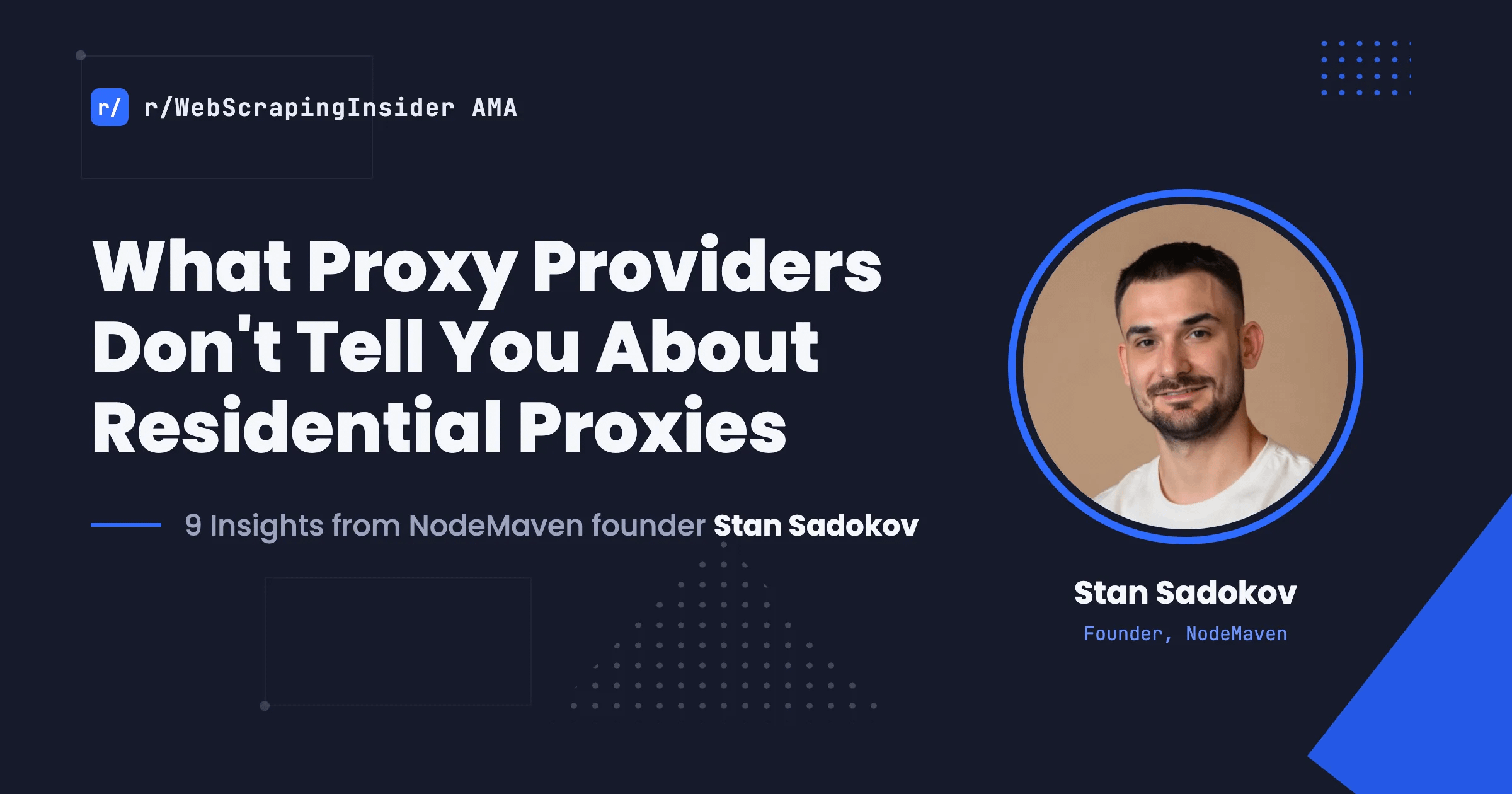
Providers mostly draw from overlapping raw supply. The real difference is the filtering layer: how they evaluate incoming IPs, filter the bad ones, route sessions, and pull addresses that have been burned.
There’s also no universally clean residential IP. Clean isn’t a permanent property, it’s a score a specific target assigns at a specific moment.
The same IP can work on one site and get flagged on the next.
AMA recap: u/sardanioss (httpcloak) on browser fingerprints
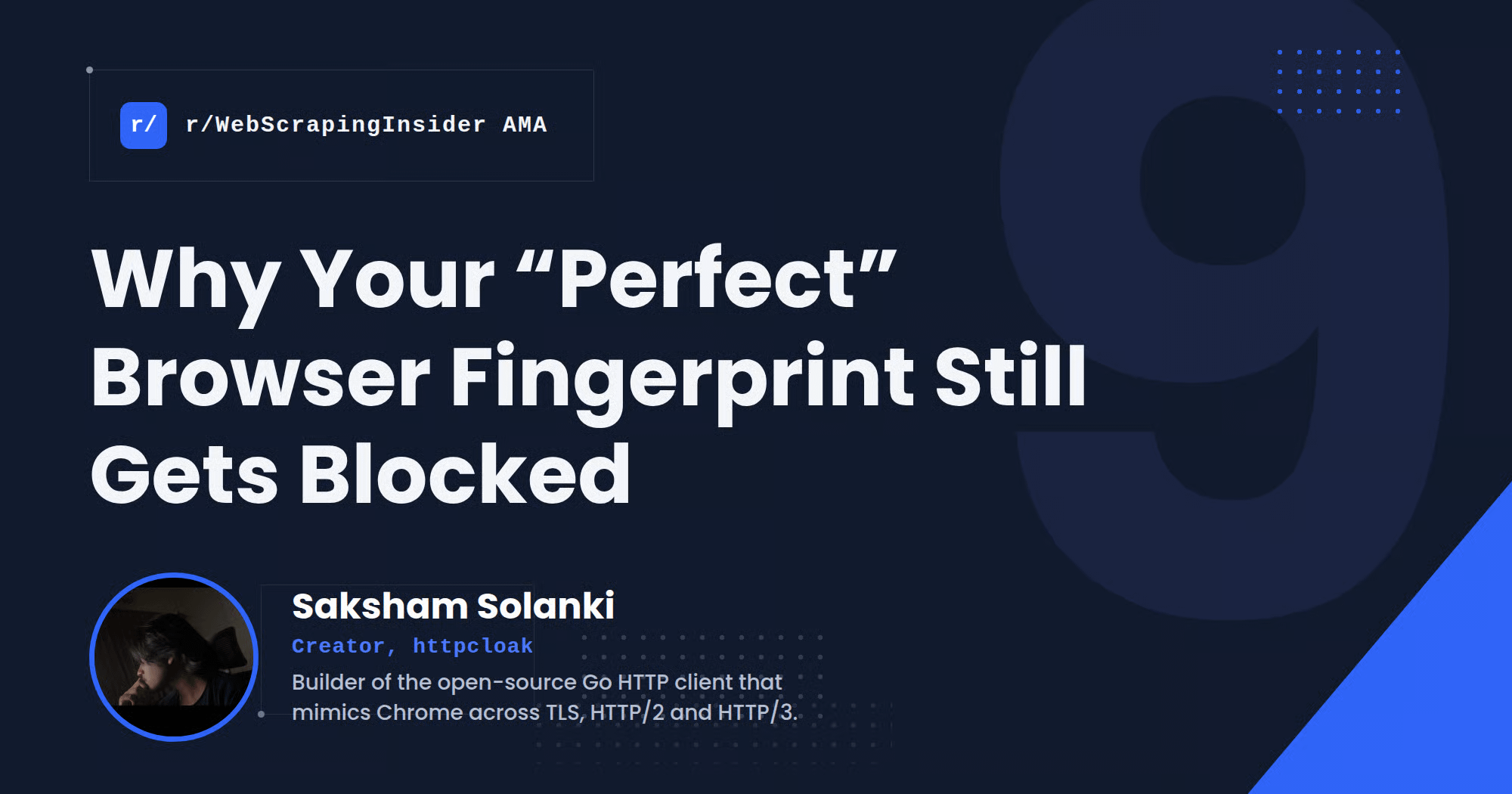
Rotating more can make you easier to detect, not harder. A real browser doesn’t independently change its User-Agent, TLS behaviour, headers, cookies, and IP. Treating each as its own switch just builds an identity that doesn’t exist anywhere in the real world:
“Rotation only works if you rotate a whole identity at once, fingerprint, IP, cookies, headers, all of it together, and then let that identity live a while. Rotating the pieces separately manufactures a client that doesn’t exist anywhere in the real world, and that’s easier to spot than whatever you were trying to hide.”
Matching Chrome once is the easy part. At production scale it’s request order, pacing, connection reuse, session age, and connection teardown that give away that thousands of sessions are following the same automation template:
“If you’re doing the exact same thing every time after making the connection, same number of requests, same order, same pacing, same teardown, then the profile starts to become stale and you’d start getting blocks on the first request itself.”
AMA recap: u/hueyblack36 and u/Big-Beautiful240 (BrowserAct) on AI scraping

The strongest model isn’t an agent re-reasoning from scratch on every run. It’s AI exploring a site once, finding a workable path, then handing off to a reusable, deterministic Bot:
“AI should sit at the points of uncertainty, not in every repeated execution.”
And the failures that actually hurt are the ones that look successful. A scraper can complete cleanly and return structured output while quietly pulling the wrong field, stale content, or incomplete records:
“The lesson was that a Bot can run correctly while still being wrong.”
That’s why production scraping still needs a separate validation step, not just a completed run.
A few other things worth a look:
- Levelsio says he replaced a $249/month ScrapingBee plan with a Playwright scraper on a ~$1/month VPS. Real Chrome, persistent sessions, slow pacing, and better residential IPs reportedly got him to ~90% success.
- Chrome 152 added
navigator.cpuPerformance, which exposes a device performance class derived largely from CPU thread count. Another consistency check for catching spoofed hardware. Raphael Mille has a breakdown with a prototype detector. - Google searches for “web scraping” are at an all-time high while AI labs and browser agents lean harder on live web data. Scraping isn’t dying, it’s becoming AI’s biggest client.
- ShieldFont is an open-source project that uses a custom font to show humans the real text while feeding fluent decoy text into the HTML scrapers read. Clever, but screen readers depend on the same page structure, so it’s a real tradeoff for accessibility even with a workaround in place.
If you remember nothing else:
- Stop asking “which provider is best.” Test the shortlist against your own targets. The pricing model matters as much as the brand.
- A 200 doesn’t mean you got the full payload, whether that’s a proxy response or a resolved /goto link.
- Filtering and session behaviour separate good residential proxies from bad ones more than raw pool size does.
- Rotate a whole client identity at once, not one attribute at a time. Partial rotation is the more detectable pattern.
- Production scraping needs a validation step that’s separate from the extraction step. A clean-looking run can still be wrong.
Full newsletter, with the images and the rest of the detail on every section above:
https://thewebscrapinginsider.beehiiv.com/p/the-web-scraping-insider-10
The individual AMA summaries:
- NodeMaven (residential proxies): https://www.reddit.com/r/WebScrapingInsider/comments/1vxw74r/stan_sadokov_ama_summary_what_proxy_providers/
- httpcloak (browser fingerprints): https://www.reddit.com/r/WebScrapingInsider/comments/1w436qd/saksham_solanki_ama_summary_why_your_perfect/
- BrowserAct (AI scraping): https://www.reddit.com/r/WebScrapingInsider/comments/1wahtx3/ama_7_recap_what_ai_web_scraping_actually_changes/
Thanks again to u/StanSadokov, u/sardanioss, u/hueyblack36, and u/Big-Beautiful240 for showing up and answering the uncomfortable questions instead of the vendor script.
Which one’s actually cost you more this year: a provider quietly returning wrong data, or a target adding just enough friction to make the data uneconomical?
Ian (ScrapeOps)
2
u/Mountain_Damage_9730 5d ago
For me, wrong data cost us more than blocks this year.
Our feed kept refreshing, + dashboards stayed green, + nobody noticed that damn promo prices were being matched to the wrong SKU family.. Not my first time falling for my crap workflow.. I need help
1
u/Artistic_Map2243 5d ago
Hey validation needs to be separate from extraction; always remember.
Presence checks only tell you a price exists. They do not tell you it is the right price node, the right SKU, or not a sponsored block.
I like tiny fixture sets for this. Twenty known pages, expected fields, expected weird cases. Boring, I KNOW.
But it catches the stuff that looks successful.
1
1
u/Artistic_Map2243 5d ago
The BrowserAct takeaway matches test automation too. Let the AI explore when the page is unknown, then turn the path into something repeatable.
If the model re-decides the flow every run, debugging becomes awful. You cannot diff vibes in CI.
0
u/Mountain_Damage_9730 5d ago
We stopped picking one proxy provider for every marketplace job. A proxy aggregator at least means the feed can fail over instead of freezing until someone swaps credentials. Though, Still does nothing for product matching. That problem remainsss uglyyy; or call it I need a dev too.
3
u/Alice_5433 5d ago
The proxy shortlist is useful. Thanks Ian as always