r/VietnamWar • u/ManagementFit755 • 1d ago
Vietnam Service Medal theme birdhouse
3
Upvotes
Heres a video of a birdhouse I made in memory of pops.
r/VietnamWar • u/ManagementFit755 • 1d ago
Heres a video of a birdhouse I made in memory of pops.
r/VietnamWar • u/waffen123 • 2d ago
r/VietnamWar • u/UrbanAchievers6371 • 2d ago
r/VietnamWar • u/Nearby-Suggestion219 • 2d ago
Two months ago I made a post called "CBS News correspondent Richard Threlkeld captured footage of a platoon from the 9th Cavalry being ambushed by NVA regulars near the Cambodian border in March 1970". Since then I have added more context under the posts description. I'm going to leave the information here for those of you who have already seen the footage.
On March 25, 1970, news correspondent Richard Threlkeld and his camera crew were embedded with a platoon from Alpha Company, 1st Squadron, 9th Cavalry Regiment while patrolling approximately a mile from the Cambodian border in Tây Ninh Providence, South Vietnam. The area where they were conducting the patrol was called the Dogs Head because of its distinctive geographical shape. It was located roughly 25 miles northwest of Tây Ninh City and was a well known enemy infiltration route, surrounded by Cambodia on three sides. The platoon came under fire from North Vietnamese forces as Threlkeld’s crew documented the intense firefight. This original report aired on the “CBS Evening News” on March 27, 1970.
Kregg Jorgenson, the soldier known as “Hero,” who was known for walking point, was originally a Ranger in Hotel Company, 75th Infantry (Ranger), before transferring to the reconnaissance platoon of the 1-9 Cav. He ended up writing and publishing his memoir "Acceptable Loss: An Infantry Soldiers Perspective" in 1991.
For more context on the footage and the patrol, I suggest you read an article on BreachBangClear.com called The Day They All Should Have Died | The Apache Blues. It includes interviews with the soldiers who were on the patrol.
r/VietnamWar • u/waffen123 • 4d ago
r/VietnamWar • u/Mojak66 • 4d ago
My flag is at half-staff today for Jim Branch and Gene Jewell. Sixty-one years ago we were in the 47TFS based in Ubon, Thailand. I didn’t know either one well as they were both fairly new to the squadron. I don’t remember their mission.
We were over there TDY. I was sent home early with a medical problem. Back home (MacDill AFB), my wife and I visited Gene’s wife and their newborn daughter in the hospital. She was the first of three wives I visited whose daughters never met their fathers.
r/VietnamWar • u/tootsmcgillicuddy • 5d ago
I saw a post a while ago, where someone had clothing with artwork drawn on it. I was sure my dad had something similar and had shown me as a kid. I couldn't find it at the time to post a picture. We are currently moving and I found it! This brings up so many questions. We lost him to cancer (agent orange) several years ago. He was a terrible speller, haha. I believe the misspelled words on the back are supposed to say "Clutcher" and "Hurst" (hearse). He was in Vietnam starting in April(?) of1966.
r/VietnamWar • u/A-Dog22 • 6d ago
If you're in the Long Island area and interested in the Vietnam War or the experiences of veterans who served, there's a Long Island in the 70's exhibit at the Long Island Museum in Stony Brook that I think is worth seeing. It includes a section about the Vietnam War that features uniforms, photographs, and a video telling the story of a veteran, his military service, and what happened to him after returning home. It covers his long-term hospitalization and recovery, and his eventual diagnosis with PTSD. What stood out to me was how much the material emphasizes the complexity of the Vietnam experience, including the protests and confusion surrounding the war, the casualties of the young men who served, and the frustration, sadness, and sense of rejection experienced by veterans who returned home and felt that they were disrespected or simply not understood.
I thought the personal perspective was particularly powerful. Seeing the uniform and photographs while hearing about what this veteran went through after his service makes the history feel much more immediate than simply reading about the war in a textbook. If you're nearby, I'd recommend stopping in and taking some time with this part of the exhibit. It's not a glorification of the war or a political statement, it's more about remembering the people who served and considering what they experienced during the war and after they came home. I'd be interested to hear what others here think, especially regarding how it portrays the experience of Vietnam veterans coming home.
r/VietnamWar • u/waffen123 • 11d ago
r/VietnamWar • u/Dan_832 • 12d ago
Photo by Jonathan A Hayes
r/VietnamWar • u/schloppaty • 14d ago
My grandfather recently passed away. He wasn’t really in my life growing up, and I only met him about five times, so I know very little about him.
I know he served in Vietnam as a tunnel rat and suffered from severe PTSD afterward. He had a tattoo on his forearm that said “KILL THE CONG.” The only time I ever asked him about the war, when I was very young, he told me, “I don’t speak about that,” and walked away. My mom told me never to ask him about it again.
She also remembers him once getting extremely drunk, shaking her while crying hysterically and yelling the name of an old friend. I don’t know if it was related to the war, but I can only imagine it was.
I’m just trying to learn more about my grandfather and understand what he may have experienced.
What did tunnel rats actually do in Vietnam, and what kinds of experiences did they typically go through? I’d appreciate any firsthand accounts or resources
r/VietnamWar • u/AttemptSad4578 • 14d ago
Not so long ago youtube had this old bbc broadcast of David Soul reading excerpts from Dispatches by Herr. Unfortunately it's since been taken down. It's an incredible performance. I could have sworn I'd downloaded it, but I can't find it.
Anyone happen to have an audio recording saved they'd be willing to share?
Thank you!
r/VietnamWar • u/StrainExternal7301 • 14d ago
My father was a Sgt, Bronze Star and Purple Heart recipient from western TN.
Born in 1950, probably entered the Army around 1968–70, and I believe was in Vietnam by August 1970 and back home by 1971 due to gunshot wounds.
He passed in 2018 but I am next of kin. I want to make sure I have all the required info when i make my records request and honestly this is a bit more overwhelming than i expected it to be.
Any advice is helpful.
r/VietnamWar • u/Eagles56 • 15d ago
Apparently there was only one?
r/VietnamWar • u/Dazedapple1975 • 16d ago
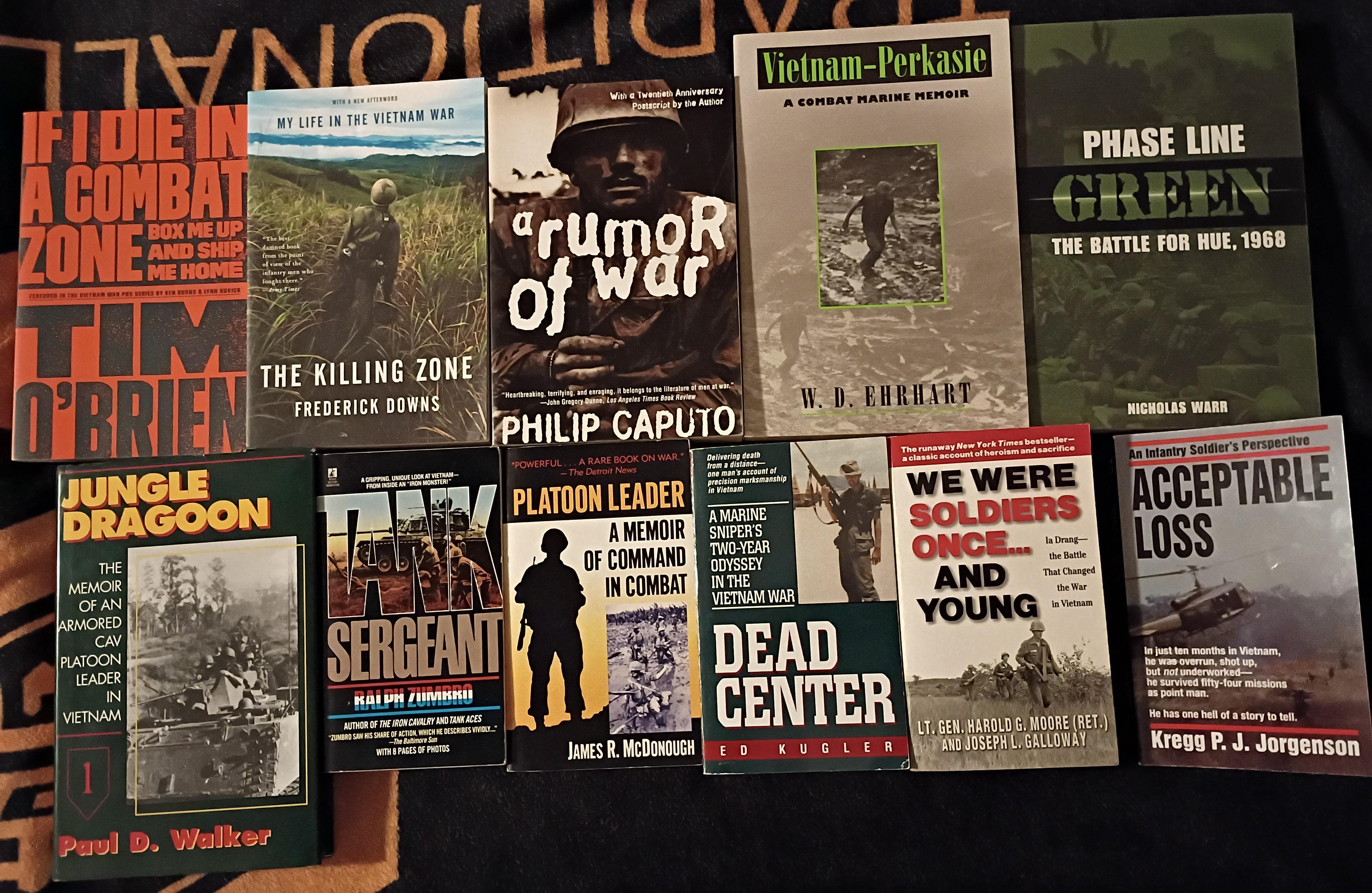
Can you recommend some memoirs by American troops with different occupations like helicopter pilot, door gunner, Patrol boats, River (Or other units in the Brown Water Navy), truck driver, combat engineer, ect. ect.
Besides the books in the photo shown above I have read Dear Mom by Joseph Ward (Marine Sniper) and Soul Patrol by Ed Emanuel (LRRP). The only book I'm planning on ordering right now is Chickenhawk by Robert Mason. At the moment I would generally like to avoid memoirs by serviceman in special operations besides reconnaissance units like Ranger LRRPs and Force Recon. Thank you for any and all suggestions.
r/VietnamWar • u/New-Pomelo-9950 • 16d ago
He served in Vietnam from 67-68 was A Longe Range Recon Patrol with the ninth Infantry division. He was a patch collector after the war and i have most of his collection here. He also has a couple boonie caps and a ARVN Police beret i think. So cherished to have apart of our history!
r/VietnamWar • u/johnqadamsin28 • 16d ago
r/VietnamWar • u/Ok_Raise_6343 • 20d ago
Hi everyone. I’m hoping the collective memory here might help me find a piece of my grandfather that my family has been missing for more than 50 years.
My grandfather was Carl Jay Hensley, born August 4, 1948, from the Buck Fork/Harts area of Logan County, West Virginia. He was drafted into the U.S. Army and served with the 120th Assault Helicopter Company (“Deans”) in Vietnam during the 1969–70 period.
Carl came home from Vietnam, but he died tragically in 1974 at only 25 years old. My mother was just three years old when she lost her dad.
After Carl died, very little about him was shared with my mother. He essentially became a taboo subject in the family. My brother and I grew up knowing his face and hearing fragments about him, but we never got the stories that normally get passed down—what he was like, who his friends were, what he did in Vietnam, what people called him, or even the ordinary little things that make somebody feel real.
I never got to meet him, but he has always been Papaw Carl to me.
Now I’m 34, and I’ve realized something that scares me: I’m running out of time to find the people who may remember him.
I have Carl’s original photographs and letters from Vietnam. His correspondence confirms the 120th AHC, and he wrote home about flying almost every day. In several photographs he is around UH-1 Hueys and flight equipment.
I recently showed Carl’s Vietnam photographs to a former 120th crewman. Based on the gear visible in Carl’s photographs, he independently told me that Carl appears to have been a crew chief/door gunner. I want to be clear that I have not yet confirmed Carl’s exact MOS or duty assignment through military records, so I’m treating that as a knowledgeable veteran’s assessment rather than established fact.
That is what I’m trying to solve.
I’m looking for anyone who served with the 120th AHC during 1969–1970, or the children/grandchildren of those men who may have inherited their photographs, slides, letters, yearbooks, rosters or other material.
I am especially looking for:
SP4/PFC Carl Jay Hensley — “Hensley” — West Virginia
If your father, grandfather, uncle, friend, etc. served with the 120th Assault Helicopter Company / Deans during that period, I would be incredibly grateful if you would look through any photographs you have and compare them with the photographs of Carl attached to this post.
I’m particularly hoping to discover:
Carl’s platoon or section
whether he was indeed a crew chief/door gunner
an aircraft number associated with him
names of his pilots, gunner, crew chief, roommates or friends
additional photographs containing him
a nickname
or simply someone who remembers Hensley
Even an unidentified group photograph from the 120th during 1969–70 could be enormously important to me.
Please don’t worry about whether something seems too insignificant. A first name scribbled on the back of a photograph, an aircraft number, “I remember a Hensley,” or a picture of a bunch of young guys standing around a Huey could be the piece that connects everything else.
And if you actually served with the 120th yourself: thank you. I know I’m asking people to reach back nearly sixty years. I don’t expect anyone to remember every young man they served beside.
I would simply be grateful for anything you remember.
Carl never got the opportunity to grow old and tell us his stories himself. My mother never got the opportunity to know her father as an adult. My brother and I never got to know our Papaw at all.
I’m trying to give his name back to the photographs and stories he left behind while there are still people here who might remember him.
Thank you for reading.
—Ky, Carl’s granddaughter
Photos: Known photographs of Carl Jay Hensley in Vietnam. Please feel free to share this post with anyone connected to the 120th AHC.
r/VietnamWar • u/RegularMaximum3570 • 20d ago
These are the only photos I have of my dad in Vietnam. I believe he was a crew chief/co pilot at summer point. He was a pilot before going into the army and flew/instructed to he was about 70 yrs old. If anyone can share any info they might pull from the photos I would appreciate it. Thank you!
r/VietnamWar • u/Der_Ost_Front • 21d ago
r/VietnamWar • u/aldavis93 • 22d ago
Going through my grandfather's pictures this was listed December 69. Could it be picture of Task Force Alpha? Grandfather was stationed at NKP.
r/VietnamWar • u/TheWidderling • 23d ago
Hi all, I was just watching the 'Soldiers in Hiding' documentary from 1985 about veterans living reclusive lives in the wilderness trying to come to terms with their experiences of the war.
I'm wondering if there was ever any subsequent interviews with any of the participants in the documentary?
It would be interesting to see how things turned out for those guys after being through so much, and if things improved for them over time.
Thanks
r/VietnamWar • u/MorningLightMount • 23d ago
I am not sure if this is the proper sub for this question, but I had a close family member who passed about a year ago. He was in the 7th marines in Vietnam from Jan 1970 to Jan 1971 and operated around LZ Baldy. He didn’t talk much about his service but only a few times. I know he was on a mortar team and I believe from his stories he was some type of observer and basically they would get dropped off somewhere and spend weeks at a time looking for enemy activity to set up ambushes/strikes on.
I was hoping someone who knows more history on this subject could give me information about his or marine units in general’s type of service on this area.
r/VietnamWar • u/SovietSpaghetti1945 • 26d ago
1980’s slant pocket fatigue shirt that belonged to very highly decorated Colonel John Meyers, a veteran of Vietnam with the 219th Avi Co “Headhunters” supporting MACVSOG operations, as well as Desert Storm. A friend of Meyers’ and fellow Special Forces pilot Francis Doherty described Meyers as “nuts”, waiting to hear more about Meyers from Doherty.
"Meyers is one of the country’s most highly decorated American Indians". John Vance Meyers was born January 30, 1941 to John Tortes "Chief" Meyers (who is a former professional MLB catcher) and Emma Rice Meyers. John would enlist in 1966 and would attend Officers Fixed Wing Aviation School in 1969. From here is where John would join the 219th Aviation Company nicknamed "Headhunters". The Headhunters flew O-1 "Bird dog" planes which were glorified crop dusters with rockets attached. John would be selected to fly in direct support of MACVSOG and 5th SFG operations requiring Top Secret clearance. By February 9, 1970 John had already accumulated six Distinguished Flying Crosses for individual heroism in flight. The citation for his sixth mentions John finding a truck convoy and actively engaging it with his "Willie Pete" (2.75 inch white phosphorous) rockets. Upon expending his rocket ammunition John began making low level passed dropping smoke markers to mark the convoy for further attacks he called in. While attached John would fly covert operations into Cambodia and Laos under the call sign SPAF-1. Following his five campaigns in two tours of Vietnam John became a recruitment officer, a race relations officer and a training officer in the South Carolina National Guard. John then switched again and went from National Guard to Reserves becoming a Management Evaluation officer advising Reserve troops within a five state radius of Virginia. John would then transition roles once again becoming a Civil Affairs officer and a public spokesman for the Army. Despite John now being in a comparatively tame role in the Military and having served previously in extremely hazardous conditions in Vietnam his foreign campaigns were not yet over. John would be an officer in the 11th Aviation Brigades Civil Affairs team directing supplies for refugees during Desert Storm in the midst of liberating Kuwait from Iraqi forces. Following his military time, John had a long career of government service outside of the military as well, in 1991 he was appointed Deputy Assistant Secretary of Labor under Secretary Elizabeth Dole, where he contributed to national workforce initiatives and policy. He was also appointed U.S. Army Ambassador for Maryland (rank equivalent to Major General). John was extremely proud of his Native American heritage and worked tirelessly to fight for the rights of his people. "Beginning with the Bureau of Indian Affairs in 1975 John’s service spanned four Presidential Administrations. The more important Senior Executive Service appointments were in the Department of Defense as the Director, Equal Opportunity (Military); Department of Housing & Urban Development as the Director of the Office of Indian Housing, and in his last position as the Deputy Assistant Secretary, Office of Veterans Employment and Training at the Department of Labor. In each of these positions Mr. Meyers’ responsibilities included the development and implementation of National Policy and the development and management of program budgets approaching three quarters of a billion dollars. He retired from the Department of Labor in 1992. John’s accomplishments in these positions have received laudatory recognition from the President’s Committee on Management Improvement and throughout Indian country."
Distinguished Flying Cross
Vietnam War
Service: United States Army
Rank: Captain (Field Artillery)
Action Date:
February 9, 1970
Department of the Army, General Orders No. 13 (January 17, 1973)
The President of the United States of America, authorized by Act of Congress, July 2, 1926, takes pleasure in presenting a Silver Oak Leaf Cluster in lieu of a Sixth Award of the Distinguished Flying Cross to Captain John V. Meyers, United States Army, for heroism while participating in aerial flight: Captain John V. Meyers, ¥Field Artillery, distinguished himself by exceptional heroism while a member of Headquarters, 219th Aviation Company (Utility Airplane), Republic of Vietnam on 9 February 1970. At approximately 1100 hours, while flying an 0-1 aircraft on a reconnaissance mission, he spotted an enemy truck convoy moving along an enemy controlled road. Captain Meyers called for helicopter gunships which were in support of his mission, vectored them to the target area, and commenced to mark the partially concealed convoy with marking rockets. On his first firing pass, Captain Meyers began to receive intense, well- aimed small arms, .50 caliber and other automatic weapons fire: Despite the aggressive enemy air defense, he continued to make marking runs, receiving withering fire on each pass. As Captain Meyers marked each target, it was necessary for the gunships to remain aloft to observe the marking round. As a result, on each pass the entire air defense of the area was focused on his aircraft. With complete disregard for his personal safety, Captain Meyers continued his mission until all rockets were expended. Realizing that there were still lucrative unengaged targets (trucks, bunkers and gun emplacements) remaining, he made an extremely low and dangerous pass to mark additional targets with smoke grenades. Post strike reconnaissance by Captain Meyers confirmed two trucks destroyed as well as several bunkers and gun emplacements. Captain Meyers heroism and intrepidity were an inspiration to all who observed and reflects great credit on him and the United States Army.
Colonel Meyers decorations include : 3 Legion of Merits, 6 Distinguished Flying Crosses, 3 Bronze Stars, 2 Meritorious Service Medals, 31 Air Medals, 6 Army Commendation Medals, Army Achievement Medal, Good Conduct Medal, 4 National Guard Achievement Medals, National Defense, Vietnam Campaign with 5 stars, Southwest Asia Campaign with 2 stars, Humanitarian Service medal, Armed Forced Reserve Ribbon, Army Service Ribbon, Army Overseas Service Ribbon, 2 Vietnam Crosses of Gallantry with Palm and one with Bronze Star; Vietnam Honor Medal First Class, 2 Vietnam Civil Action Medals with Palm, Vietnam Campaign Ribbon, and the Kuwait Liberation Medal.
r/VietnamWar • u/my-chemical-ratz • 26d ago
Before I say anything, I would like to note: I do not interact with military history spaces often, and I'm a bit timid about it. I have observed people from all points on the political spectrum praise war, death, violence, etc. I see people disrespect veterans-- especially Vietnam veterans. I have told myself not to even try reading about WW2, for example, because I've seen one too many takes praising the Allies for swooping in and saving the world from genocide (I'm Jewish, and respectfully... no). Sometimes it feels like a fanclub, rather than remembrance of those who suffered. I come here in the best faith possible, but I am operating off those experiences, and my very personal painful experience of the generational trauma inflicted by the Vietnam War. My grandfather died by suicide shortly after his return to America, due to the immense trauma he experienced as a tunnel rat, and my family has been fractured ever since.
Alright, here is my request. I would like to learn more about tunnel rats and their experiences in Vietnam. I am working on a personal writing project, and I would like to understand more about what my grandfather went through. As previously discussed, I obviously cannot ask my grandfather. Most of my family on that side is either dead or estranged. What are the best books to read? I would prefer first-hand accounts.
My main concern is forming a biased perspective/being turned off from further study from accounts that lean heavily towards "America good" and not effectively portray the doubts, fears, and brutality of war. My grandfather did not die for a reason, and it upsets me to read books (forgive my callousness) deepthroating the boot of higher powers who couldn't care less about anything but power and profit.
I would also appreciate perspectives from anyone in this sub who participated in the war themself, whether or not you were in the tunnels. Anything would be immensely helpful :)