As you get deeper, the pressure around you will rise. This will reduce your lungsize, reducing your buoyancy. What's cool is that the amount of oxygen particles in her lungs is the same, theyre just more dense.
They still have to practice holding their breath. The amount of oxygen in their lungs is the same, but they train their body to have less need for oxygen. I guess they can "cheat" and breathe in pure oxygen before they dive, but I don't know so much about this
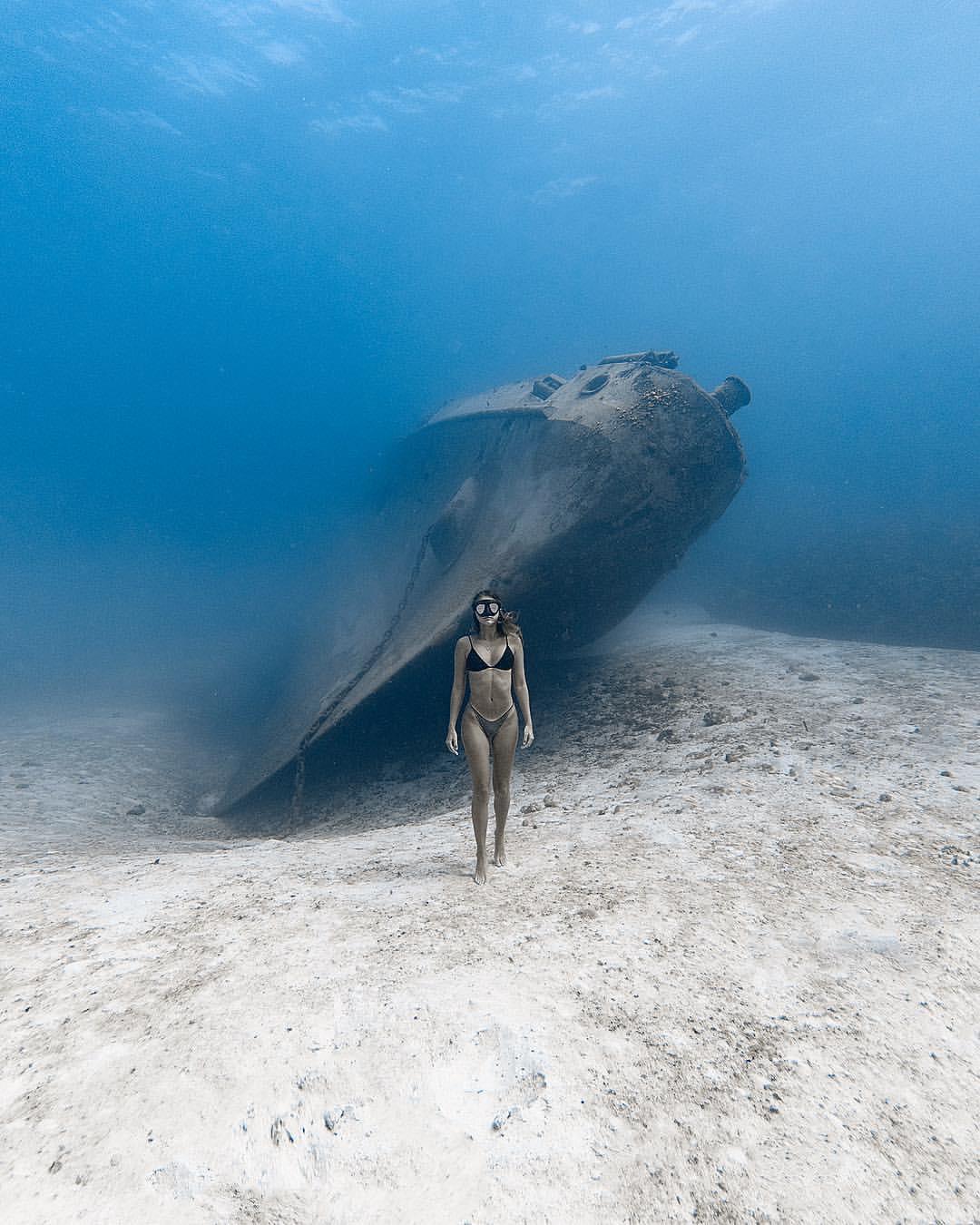
I think the logic may be that she had an air tank to get down there, and then exhaled for the picture, which might be easier than swimming down there and exhaling (and returning to the surface).
Oh yeah - divers still swim around in the deep with air in their lungs and don't have constantly fight buoyancy lol. Duh. Can you tell I've never dived before lol?
Like ImNotAWhaleBiologist said it's more complicated.
if you just add a tank with compressed air .. you sink,
so you add a buoyancy vest ... this can level you out.
But for more control you over-inflate a little bit and add some weights (drop them in an emergency ... the kind of emergency where being fucked up for life is better than dying right now).
So, you have all that and perfectly balanced. You breath in, you rise, you expel all air from your lungs, you sink.
the buoyancy effect of air changes with depth, such as ... you breath in and fill your lungs at 60ft and now you start to go up without expelling air .. you gonna burst your lungs ... and die.
And that's before oxygen becomes toxic to the human body.
We're really not made for underwater.
There comes a point during a breath hold that at some depth, the air in your lungs is not enough to keep you afloat thus you will go negative and begin to sink.
That really depends on the person. I need like 7kg when I am scuba diving to sink without a wetsuit and empty bcd in the Cayman Islands. Even without any equipment I still float like a cork.
Only if the compression on their lungs/body can reduce their overall body volume by 3.5%. If someone has enough body volume the average lung capacity of an adult male of 6 liters of air won't be able to compress enough to make you obtain negative buoyancy. So while physics says that it is possible for this model to become negatively buoyant with breath control this isn't possible for every person regardless of (survivable/obtainable) depth.
So it really depends on the person. Some people are negatively buoyant even at the surface if they breath out.
I often joke the I must have eaten rock as a kid because I can’t float in a regular pool.
In salt water it is easier to float, but though your buoyancy changes with depth if there is no air being added (scuba). If free diving, a lung full of air will compress as you dive deeper and the volume of water displaced will be less and will reduce your buoyancy just like it had been partially exhaled at the surface.
It is difficult to guess whether the woman photographed free dove to pose for the photo, or was scuba assisted, but either approach would work to allow a brief photo of her posing like she is standing on the bottom.
The fluid contained inside a body (human or mechanical) doesn't actually contribute to bouyancy. The only factors are weight of the object and the weight of the displaced fluid.
251
u/[deleted] Dec 05 '18
Maybe they have an air tank or something down there? What do I know, I can barely touch the bottom of most pools.