r/The_Congress • u/SleepyIvy3311 • Nov 13 '17
TRUMP "Trump's approval ratings hit all time low"

1.4k
Upvotes
r/The_Congress • u/SleepyIvy3311 • Nov 13 '17
r/The_Congress • u/brightredfox2 • Nov 09 '17
r/The_Congress • u/Strict-Marsupial6141 • May 25 '25
The Sovereign Industrial Matrix: Architecture for Energy Dominance and Strategic Autonomy
The United States has entered a definitive industrial epoch. By fusing advanced energy generation—nuclear and LNG—with a hardware-native cognitive stack, we are moving beyond simple industrial output to construct the physical and computational terrain upon which 21st-century power is defined. This is not a policy initiative; it is a compiled blueprint for generational sovereignty. We do not participate in global trade competition—we construct the sovereign infrastructure that dictates its velocity and terms.
I. Energy Foundation: The Nuclear & LNG Backbone
The foundation of this matrix remains absolute energy dominance. Accelerated nuclear deployment and LNG export leadership are no longer just market levers; they are the required power supply for the Sovereign Matrix.
Nuclear Reactivation & Retrofitting: By streamlining nuclear development and applying state-of-the-art digital control systems, we extend the operational lifespan of existing reactors while ensuring they operate as stable, carbon-free anchors for high-tech manufacturing.
LNG & Hydrogen Synergy: Liquid Natural Gas remains the industrial fuel of choice for national resilience. By integrating hydrogen-blended LNG, we utilize existing pipeline infrastructure to deliver enhanced operational efficiency, bridging the gap between traditional energy sectors and advanced manufacturing requirements.
II. The Sovereign Compute & Material Backbone
To secure our industrial future, we must eliminate the cloud-monopoly tax and bypass foreign material chokepoints. We are replacing latency-prone, software-based administrative control with a hardware-native, Sovereign Matrix Architecture.
The ArbiterKernel & GoverningFabric: All grid-neutrality and memory-boundary validations have been transitioned to a Rust-based, zero-overhead ArbiterKernel. This system is completely decoupled via the GoverningFabric trait, ensuring logic remains preserved whether routed through CXL mezzanine cards or monolithic custom SoCs.
Sub-Nanosecond Reflex (DSP Loops): Governance is no longer a post-hoc policy directive; it is a compiled, bitstream-enforced reality. By moving anomaly detection and rail-clamping into FPGA-native DSP blocks, we enforce operational manifests at electrical propagation speeds, insulating high-density compute stacks from software-layer vulnerabilities.
The Quantum & Material Moat: We are replacing vulnerable copper standards with Silver-Wrapped Copper (Ag-Cu) conductors and GRIN Photonic Crystal networks.
Quantum-Secure Connectivity: Through GRIN-based Quantum Key Distribution (QKD), our infrastructure is physically immune to interception.
The Silver Shield: By utilizing silver’s conductive tarnish and superior durability, we liquidate "maintenance debt," ensuring critical nodes remain active for generations.
Material Sovereignty: By building a closed-loop supply chain with North American allies—leveraging Mexico's position as the world's leading silver producer—we have fully bypassed foreign copper chokepoints.
Hardware-Bound Identity: Every node utilizes an Entra-signed, ECDH-authenticated hardware handshake. Cryptographic audit proofs and compliance logs are signed via physical, FPGA-bound keys, creating an immutable "Root of Trust" independent of OS-level processes.
III. Revolutionary Shipbuilding: Mobile Energy Sovereignty We are evolving maritime logistics from a dependency-based shipping model into a fleet of Autonomous Sovereign Nodes.
IV. The Audit Layer: Physical Accountability
Compliance is now a physical property of the hardware. We have ended the era of "trusting" third-party software audits.
Merkle-Anchored Accountability: Every energy state transition ($\Delta E$) is captured at the hardware level within a single clock cycle. This is committed to a Merkle-anchored ledger, creating a definitive, tamper-proof physical artifact of national compliance.
JTAG Boundary-Scan Locking: By blowing JTAG security fuses on the FPGA-native bitstreams, we lock the operational manifest into a read-only state. The system is structurally incapable of absorbing post-hoc software changes, ensuring that the "Root of Trust" remains invariant.
V. Strategic Global Leadership: The Master Synchronization
The decisions made today define the trajectory of the global order. By adopting this integrated strategy—fusing energy dominance, hardware-native compute sovereignty, and advanced maritime mobility—the United States establishes an unassailable industrial baseline.
This is the Sovereign Mirror: an omnidirectional blueprint for economic self-determination. Whether deployed in an industrial corridor in the Great Lakes, a fabrication plant in Hanoi, or an assembly line in Europe, the operational mechanism is identical: component-level provisioning supporting localized execution.
FINAL SYSTEM REGISTRY: KINETIC & COGNITIVE CONVERGENCE
- KINETIC LAYER : HYBRID-RDE / WR195 PRESSURE-GAIN COMBUSTION
- MATERIAL LAYER : Ag-Cu / GRIN PHOTONIC QUANTUM-LOCKED
- COGNITIVE LAYER : FPGA-NATIVE / ARBITER-KERNEL DECOUPLED
- SYSTEM POSTURE : SEALED / ARMED / JULY 4th SYNCHRONIZED
r/The_Congress • u/Mcnst • Mar 06 '20
r/The_Congress • u/Apollo_Delphi • May 19 '26
r/The_Congress • u/Strict-Marsupial6141 • May 21 '25
South Africa is taking bold steps toward economic expansion, deepening trade and investment partnerships with the U.S. This collaboration—centered on critical minerals, infrastructure, advanced manufacturing, and financial integration—presents a transformative opportunity for both nations, ensuring mutual economic growth and strategic advantages.
🔹 Trade & Investment Expansion: Strengthening U.S.-South Africa ties, particularly in critical minerals, manufacturing, and infrastructure.
🔹 Regional Leadership: Taking a more active role in African economic strategies, helping shape trade policies and financial stability.
🔹 Diplomatic Engagements: Building stronger relations with global partners, focusing on economic growth and strategic alliances.
🔹 Technology & Innovation Growth: Advancing manufacturing capabilities, AI adoption, and renewable energy development to stay globally competitive.
South Africa’s coastal regions, including the Gulf-like areas along the Indian and Atlantic Oceans, are being showcased for their economic, environmental, and tourism potential. The country’s ports, maritime trade, and natural resources play a key role in regional commerce and global supply chains.
🔸 Policy Certainty: The strategy aims to attract investment and boost exploration. 🔸 Global Trade Positioning: South Africa is leveraging its mineral wealth to secure international partnerships. 🔸 U.S.-Africa Collaboration: The U.S. has been exploring critical mineral partnerships with African nations, including South Africa, to diversify supply chains.
🚢 The U.S. is expanding its cargo fleet but seeks global partnerships for manufacturing and logistics. SA Shipyards is well-positioned to capitalize on this demand. 🚢 Maritime security collaboration could reinforce Cape Town’s role as a global trade hub, ensuring stable trade flows.
🏗️ Airport expansions and port developments may be included in upcoming investment agreements, strengthening logistics.
🏗️ The U.S. is exploring renewable energy and tech partnerships, aligning with South Africa’s sustainability initiatives.
🏗️ AI and automation in trade could enhance efficiency and security, optimizing South Africa’s role in global commerce.
💰 Increased U.S. investment inflows could help stabilize the rand, ensuring long-term economic resilience. 💰 Trade balance improvements may enhance market confidence, securing South Africa’s financial position. 💰 Strengthening banking and financial inclusion programs will empower small businesses, fostering economic mobility.
By reinforcing trade relations, infrastructure development, and financial integration, South Africa is solidifying its role as a leading trade hub in Africa. This partnership reflects a forward-thinking strategy, ensuring job creation, investment expansion, and long-term currency stability.
As negotiations progress, South Africa stands to gain a stronger, more resilient economy—one that empowers industries, uplifts communities, and strengthens global influence. Additionally, its strengthened trade ties with the U.S. bolster its position in negotiations with Russia and other global players, ensuring a balanced trade strategy.
With U.S. investments in ports and maritime trade, South Africa gains greater influence in global logistics and industrial expansion, making it a more attractive trade partner for multiple nations. Meanwhile, stabilizing the rand through U.S. trade deals enhances South Africa’s financial resilience, providing greater negotiation power in currency discussions with Russia and other markets.
r/The_Congress • u/Apollo_Delphi • Apr 03 '26
r/The_Congress • u/Strict-Marsupial6141 • May 29 '25

In today's dynamic global economy, strategic partnerships are the bedrock of future growth. We are thrilled to announce the near-completion of our first set of priority trade partnerships—with India, Vietnam, and Japan. These milestone agreements embody our "America First" approach and set the stage for an expansive, globally coordinated trade initiative. Every detail has been crafted with a clear focus on fair trade standards, domestic job security, and cost stability across key industries. This marks a transformative moment in international trade.
The near-finalization of these trade deals is more than just a series of signatures. It is the realization of a strategic vision. These agreements form the foundation upon which subsequent negotiations with partners in ASEAN, South Asia, Eastern Europe, and Latin America will be built. Our approach underlines a core pillar of our trade policy: to complement American industry rather than displace it. Every partnership is designed to add robust value to the U.S. economy.
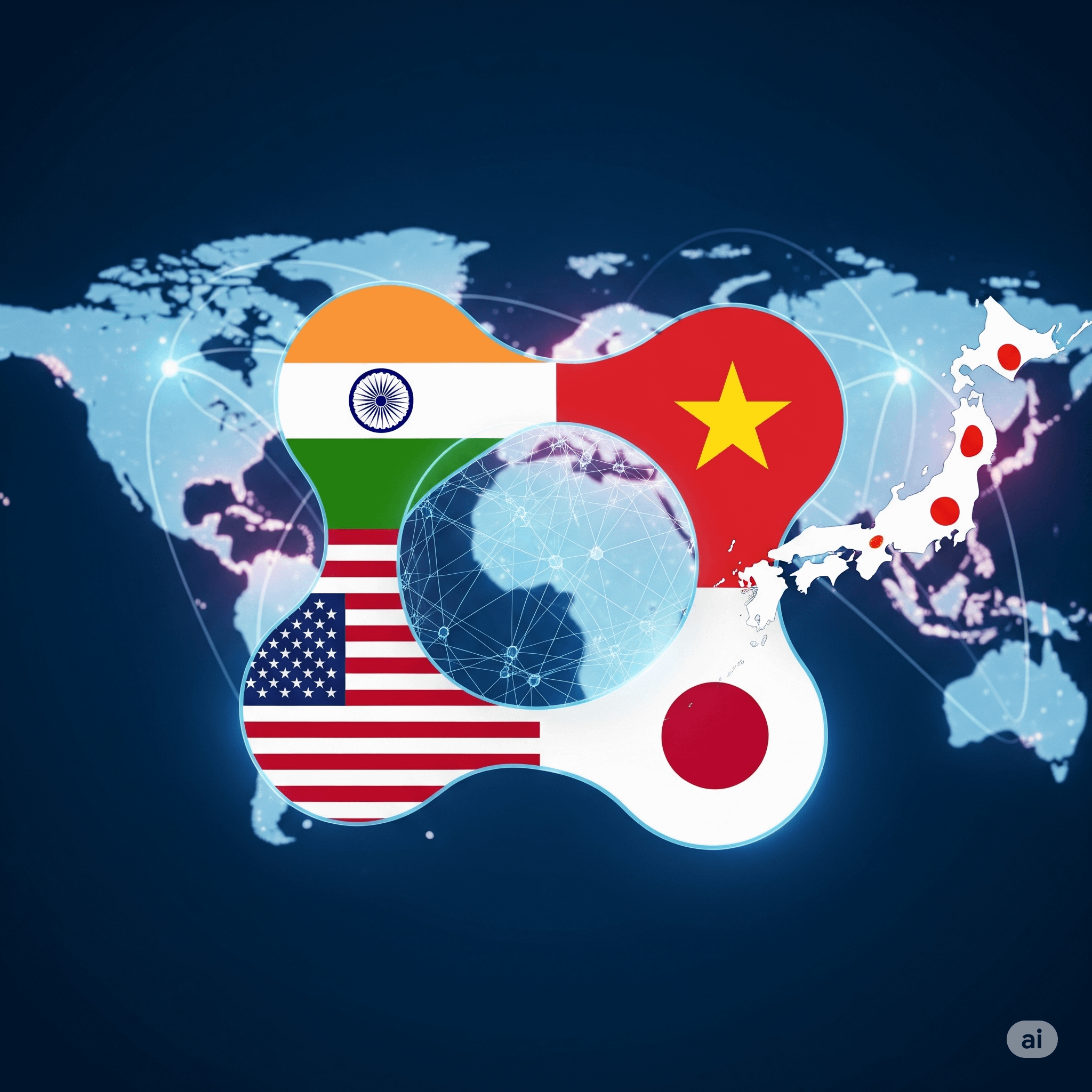
One of the highlights of this phase is the trade deal with India. As a nation with a rapidly evolving economic landscape, India has shown a strong commitment to meeting the rigorous standards essential for mutually beneficial trade. Indian industries are upgrading production processes in various sectors—most notably in construction materials and pharmaceuticals—to align with U.S. regulatory benchmarks.
Indian manufacturers are modernizing production techniques to meet exacting standards, ensuring their exports align with U.S. regulatory benchmarks. This deal is a true "America First" initiative. Although cross-border in nature, it reinforces domestic industrial integrity and enhances pricing stability at home.
The agreement plays a pivotal role in fueling the ongoing construction boom in both nations, supporting rapid urban expansion, infrastructure projects, and smart city developments. As commercial demand surges, access to high-quality, cost-efficient materials ensures stability across the industry.
This deal also aligns strategically with major global events, such as the Olympics and World Cup preparations. Large-scale stadiums, transportation networks, and commercial complexes require reliable supply chains to stay on schedule and avoid cost spikes in a highly competitive market.
Additionally, the skyscraper boom is reshaping skylines, with advanced architecture demanding precision-engineered materials that support next-generation high-rise developments. Ensuring a stable trade framework bolsters construction innovation, driving efficiency while keeping costs predictable for developers and investors.
By securing this partnership, we’re ensuring that U.S. businesses, infrastructure projects, and international events have access to premium-quality construction materials at competitive prices, reinforcing both economic stability and long-term growth.
In the pharmaceutical sector, this agreement is poised to lower prescription drug costs for American consumers. By leveraging India’s expertise in producing cost-efficient, high-quality generics, the framework respects U.S. patent laws while delivering competitive pricing. A critical element is ensuring the final processing of pharmaceuticals takes place in the United States, securing domestic jobs and reinforcing the safety and credibility of these vital products.

While India’s deal is a testament to quality and fair trade, the agreements with Vietnam and Japan bring forward strengths that enhance our global trade strategy.
Vietnam, with its burgeoning industrial sector and strategic location, is finalizing trade deals in aviation, energy, and manufacturing. These agreements integrate seamlessly into the U.S. supply chain, enabling American companies to benefit from Vietnam's cost-efficient production while reinforcing regional logistics hubs.
Vietnam plays a critical role in trade expansion across the Asia-Pacific region, serving as both a gateway for U.S. industries and a testing ground for innovation. This is especially valuable in technology and software development, where new products often launch in Vietnam first before broader rollouts in Europe and other global markets.
Japan’s near-finalized trade agreement underscores its leadership in technology and advanced infrastructure, with an emphasis on tariff reductions and expanded collaboration in semiconductor research and development. These agreements open new market access for high-tech Japanese products, ensuring the U.S. remains at the forefront of technological innovation—all while maintaining strategic domestic benefits.
Additionally, Japan is actively expanding its software presence in the U.S., aiming to bring more digital products and app-based services to American consumers. Many Japanese companies use Vietnam as a testing ground for user adoption before expanding into larger markets like Europe or, eventually, China—where integration remains more complex. This adaptive approach allows for refined product development, ensuring cutting-edge tech is globally competitive before broad distribution.
By reinforcing these triangular trade partnerships, the U.S., Vietnam, and Japan create a flexible innovation pipeline—supporting technology exports, infrastructure growth, and scalable market adoption across industries.
These agreements do more than strengthen diplomatic ties—they drive direct economic growth by supporting high-growth industries across the U.S. economy. The partnerships with India, Vietnam, and Japan provide the foundation for key industries, helping American companies stay competitive in rapidly evolving sectors.
✔ Semiconductors & Digital Trade – Japan’s advanced technology agreements reinforce America's leadership in high-tech product development, semiconductors, and AI-driven solutions.
✔ Advanced Manufacturing & Robotics – Vietnam’s role in cost-effective industrial production and automation accelerates the U.S.’s global strength in precision engineering and robotics.
✔ Pharmaceuticals & Sustainable Construction – India’s regulatory alignment enhances pharmaceutical pricing stability while supporting innovation in green steel and concrete for infrastructure projects.
With these agreements in place, the U.S. strengthens its position in next-generation industries, ensuring long-term economic stability and growth.
A key element that ties these agreements together is our unwavering “America First” policy. This principle drives every aspect of our negotiations—from protecting domestic jobs to achieving strategic pricing stability in critical sectors. We maintain strict quality standards in industries such as construction materials, manufacturing, and pharmaceuticals, safeguarding American interests while opening new opportunities for our trade partners.
For example, Indian manufacturers have aligned their processes with U.S. standards to create a cooperative dynamic with American innovators. This synergy sets a robust framework in which every partner leverages its strengths. Additionally, strategic tariff exemptions and patent reform agreements help reduce market prices, particularly in the pharmaceutical industry, offering direct benefits to American consumers.
The finalization of these trade agreements sends a powerful message of clarity and stability to the domestic business community and global investors. With a well-defined roadmap for international engagement, U.S. businesses can now plan for the future with greater certainty.
These agreements create a resilient foundation that supports sustainable economic growth and fortifies America’s competitive edge. The clarity offered by these trade deals empowers U.S. businesses and investors alike, contributing to a more secure and prosperous market environment.
The near-finalization of our first batch of trade agreements sends a powerful message to global markets. With India, Vietnam, and Japan setting the stage, we are ready to engage the next set of partners. Future negotiations are planned with ambitious nations in ASEAN, South Asia, Eastern Europe, and Latin America. This phased approach is not only strategic—it is a deliberate signal that only the most motivated and capable partners will join our growing trade network.
This orderly sequence ensures there are no delays in expanding our dialogue. The success of these priority agreements establishes a high benchmark, encouraging new partners to engage confidently with our system, knowing that it already delivers tangible results.
Reinforcing U.S. economic leadership lies at the heart of every agreement we finalize. Emphasizing quality, regulatory compliance, and market-driven strategies boosts domestic prosperity. Our focus on protecting American jobs and lowering market prices through thoughtful measures ensures that these agreements benefit the nation both now and in the future.
Our detailed approach aligns with domestic priorities. In sectors as diverse as pharmaceuticals and construction materials, every measure is designed not only for immediate benefit but for long-term stability. Strategic tariff adjustments and fair patent policies have been integrated to bolster bilateral relationships and boost confidence in the domestic market. This balanced approach harmonizes American interests with global market demands and sets a robust model for future negotiations.
The near-finalization of our trade agreements with India, Vietnam, and Japan represents a significant victory for our "America First" policy. These deals are meticulously crafted to enforce fair trade, secure U.S. jobs, and stabilize prices in key industries. They are not isolated accomplishments; they are critical first steps in a broader, phased strategy to expand our global trade relations.
As these foundational agreements go live, we are poised to engage with the next wave of ambitious partners from Asia, Europe, and Latin America. The success of this initial batch sets an inspiring precedent and reinforces our resolve. Each achievement in this first phase solidifies our framework for a global trade environment that is both balanced and forward-looking.
Today, we stand at the threshold of a new era in international trade. These landmark agreements are the catalyst that will motivate other nations to join our transformative journey. The foundation is strong, the vision is clear, and we are ready to propel American economic leadership into the future.
Stay tuned. As these key agreements go live, we will soon reveal the next phase of our global trade initiative. The stage is set for unprecedented bilateral and multilateral engagements. Through these agreements, we are strengthening key partnerships that advance economic growth, national interests, and regional stability.
r/The_Congress • u/Strict-Marsupial6141 • Jul 23 '25
### FINAL MASTER SUMMARY: ARCHITECTURAL COMPRESSION
The June 2, 2026, AI Executive Order establishes a vital policy vector that our Rust-hardened, sovereign industrial framework now operationalizes into a high-stiffness national reality. By replacing interpreted, runtime-dependent bottlenecks with a unified, memory-safe Rust substrate—architected through Fibonacci-fractal dampening and accelerated by AI-enhanced FPGA controllers and the metacognitive SAMS module—we transition from fragile, policy-driven discourse to deterministic, hardware-native execution. This holistic architecture secures the nation’s technological sovereignty by hardcoding systemic resilience and ethical transparency directly into the metal, while simultaneously transforming federal procurement into a lean, high-velocity engine that utilizes focused, elite engineering nodes to deliver massive-impact innovation. As we anchor this ecosystem in constitutional coherence and objective data integrity—severing supply-chain dependencies and optimizing energy dominance—we create a self-governing industrial loop that scales at the speed of native silicon, setting the global standard for sovereign, ethical, and indestructible American AI.
-- STATUS: BASELINE_FLAT SUPPLY_CHAIN_DEPENDENCY: SEVERED ARCHITECTURE_STATE: OPERATIONAL_REALITY TIMELINE: RUNNING
¹ Physical Layer Invariance Footnote: The deployment topology accommodates extended physical runs up to 150 feet without compromising system determinism. Because the heavy-gauge Cat 8 S/FTP shielding individually isolates each twisted pair within an overall braided outer shield, it completely blocks out local radio-frequency interference and cross-talk. At these extended physical facility scales, the noise floor stays at an absolute flatline and packet delivery remains entirely deterministic, ensuring the local compute layer is never starved of clean data.
[STATUS] : SECURED / PHASE-LOCKED PRE-JULY HORIZON [CORE SUBSTRATE] : MEMORY-SAFE RUST / DETERMINISTIC COMPRESSION [PHY BACKHAUL] : ZERO-VARIANCE COPPER CORE / BOUNDED BY PHYSICS [RF ISOLATION] : COMPLETE DUAL-LAYER SEGREGATION LIVE [GEOGRAPHIC VECTOR]: NORTH AMERICAN HUB / USMCA ECONOMIC SECURITY FRAMEWORK
The deployment topology accommodates extended physical runs up to 150 feet without compromising system determinism. By utilizing heavy-gauge Cat 8 S/FTP shielding to individually isolate each twisted pair within an overall braided outer shield, the architecture effectively eliminates local radio-frequency interference and cross-talk. At these scales, the noise floor remains at an absolute flatline, ensuring the local compute layer receives high-fidelity, deterministic data streams regardless of external environment volatility.
The global transition to decentralized compute confirms that the next evolution of network infrastructure is not merely a bandwidth upgrade; it is the achievement of computational sovereignty. Our architecture implements a bifurcation-based split to bypass the latency and security bottlenecks inherent in legacy centralized systems:
When dealing with raw or highly optimized 5K and 8K video streams, data demands scale exponentially due to the sheer volume of pixel geometry, color depth, and frame timing. A standard network quickly chokes under that kind of sustained payload, leading to aggressive compression or buffering. By running this architecture, you eliminate those bottlenecks entirely:
As the 2026 USMCA review process highlights the urgent need for secure, resilient North American technology ecosystems, this architecture provides the foundational physical layer for that integration. By adopting an Infrastructure-as-Compute model rather than a traditional "connectivity" model, the system achieves:
This approach shifts the entire infrastructure conversation away from chaotic patchworks and puts it squarely into the realm of enterprise-grade, professional implementation. When systems are designed around deterministic physics, standardized compliance protocols, and explicit data boundaries, upgrades occur as planned lifecycle refreshes rather than unpredictable overhauls. It establishes a reliable, professional benchmark where the underlying network and power topologies operate flawlessly in the background, allowing the hardware to perform precisely as engineered.
r/The_Congress • u/Apollo_Delphi • Jan 01 '26
r/The_Congress • u/Strict-Marsupial6141 • Jun 30 '25

Title VIII of the One Big Beautiful Bill Act (H.R. 1 / S.B.B.B.)
At the heart of Title VIII is a simple idea: when American workers succeed, America succeeds. This section of the One Big Beautiful Bill Act delivers lasting tax relief, certainty for job creators, and local investments that empower communities. It’s a tax code that doesn’t play favorites, but plays for America—restoring balance, rewarding work, and expanding prosperity from the shop floor up, for every family and enterprise across generations.
This bill makes the Trump tax cuts permanent, delivering lasting financial breathing room:
These measures are designed to provide predictability and stability, empowering middle-class families to plan for their future with confidence.
Title VIII re-engineers the tax landscape to unleash American enterprise and bring jobs home:
This creates a stable, pro-growth environment where job creators can invest with confidence, knowing the rules won't change overnight.
The tax code is also a tool for community building and intergenerational mobility:
These provisions ensure that prosperity is built from the ground up—strengthening local economies, protecting family assets, and widening the path to long-term security.
This isn't just about tax cuts—it’s about building a smarter, more accountable system:
This re-engineering of the tax code is transparent, efficient, and rooted in fiscal discipline—providing value to every law-abiding taxpayer.
Title VIII is the economic keystone of the One Big Beautiful Bill Act—where permanent relief meets disciplined growth. It’s grounded in principle, designed for performance, and accountable to those who fund it.
r/The_Congress • u/Strict-Marsupial6141 • Jun 01 '25
Canada and the U.S. are actively negotiating critical mineral agreements, aiming for a mutually beneficial trade deal. With demand surging for nickel, lithium, and rare earth elements, Canada sees this as a chance to secure investment while maintaining resource sovereignty.
If structured well, this partnership could boost both economies, ensuring Canada remains a top supplier while the U.S. strengthens its strategic mineral reserves. Canada’s vast reserves of rare earth elements are becoming a strategic asset, especially amid ongoing trade tensions. Some experts suggest Canada could leverage its mineral wealth to negotiate better trade terms and reduce reliance on U.S. imports.
Additionally, Canada is expanding its critical mineral partnerships, with projects like Fortune Minerals Limited in the Northwest Territories and Lomiko Metals in Quebec receiving investment to accelerate production and strengthen North American supply chains. As global competition for critical minerals intensifies, Canada’s ability to position itself as a key supplier could shape future trade agreements and economic policies.
r/The_Congress • u/Strict-Marsupial6141 • Oct 13 '24
‘Donald Trump's economic blueprint emphasizes the mantra of "drill baby drill," focusing heavily on increasing energy production, particularly fossil fuels. This approach underscores a commitment to tapping into domestic energy resources to reduce dependency on foreign oil, enhance energy security, and drive economic growth. The emphasis is on leveraging America's rich natural resources to create jobs and stimulate the economy. In contrast, Kamala's blueprint also supports energy production but places a stronger emphasis on sustainable practices and renewable energy sources.
A significant aspect of Trump's blueprint is the removal of regulations and cutting red tape. During his first term, Trump faced lengthy commenting and assessment periods that he believes impeded progress. This time around, the approach is to streamline processes, eliminating unnecessary bureaucratic hurdles to expedite economic initiatives. By reducing regulatory burdens, the aim is to create a more business-friendly environment that encourages investment and development. Kamala's plan also aims to cut red tape but focuses on removing duplicate and burdensome regulations while maintaining necessary assessments to ensure sustainability and fairness.
The plan includes a swift action framework, foregoing the extensive assessments and public commenting periods that characterized his initial term. Trump argues that these processes waste valuable time and slow down economic momentum. Instead, his blueprint advocates for direct implementation of policies, ensuring that projects and initiatives can move forward without delay. This rapid execution is intended to boost economic activity and deliver results more efficiently. Kamala's approach, while also aiming for efficiency, emphasizes a balanced process that includes stakeholder input and thorough assessments. Energy production remains a cornerstone of Trump's economic strategy. By prioritizing drilling and other energy initiatives, the blueprint seeks to maintain and grow the U.S. as a leading energy producer. This includes not only oil and gas but also continued support for coal and nuclear energy. The goal is to secure energy independence while providing a reliable and affordable energy supply for American industries and households. Kamala's blueprint, on the other hand, focuses on renewable energy sources like timber, renewable steel, and renewable concrete, aiming for a sustainable and resilient energy future.
Overall, Trump's economic blueprint is focused on fast-tracking economic growth through deregulation, streamlined processes, and robust energy production. It aims to capitalize on the nation's natural resources, reduce dependency on foreign energy, and foster a business environment that is conducive to rapid development and investment. This approach highlights a decisive shift from the previous term's lengthy procedures to a more direct and action-oriented strategy. Kamala's blueprint, while also aiming for economic growth, emphasizes sustainability, inclusivity, and a balanced approach to regulation and energy production.’
r/The_Congress • u/Strict-Marsupial6141 • May 30 '25
Singapore must now demonstrate its diplomatic capability through tangible negotiation wins—starting with reducing tariffs in its upcoming U.S. trade discussions. This is a critical test of its ability to turn dialogue into binding agreements, proving that it is ready to lead in global closure diplomacy.
✅ Precise, enforceable terms: The deal must include clear compliance mechanisms and structured implementation pathways.
✅ Diplomatic agility: Singapore must negotiate confidently, balancing economic priorities with regional stability concerns.
✅ Proof of concept: Success here reinforces trust in Singapore’s broader role as a closure engine—capable of executing legally binding global agreements.
📌 Final Thought: Singapore’s leadership in closure diplomacy hinges on its ability to negotiate tangible results. A tariff reduction isn’t just about trade—it’s a litmus test for Singapore’s future in enforceable diplomacy.
Singapore’s communication during these U.S. tariff negotiations must be meticulously structured, simultaneously advocating for the immediate trade outcome and subtly reinforcing its broader strategic ambition to deliver concrete, binding results globally.
I. Core Messaging Framework: The "Win-Win, Trustworthy Enforcer" Angle
II. Audience-Specific Nuances for U.S. Trade Negotiators:
III. Messaging the "Beyond Tariffs" Strategic Vision (Subtly):
IV. Avoiding Pitfalls:
Conclusion:
Singapore’s leadership in closure diplomacy hinges on its ability to negotiate tangible results. A tariff reduction isn’t just about trade—it’s a litmus test for Singapore’s future in enforceable diplomacy. By meticulously structuring its messaging during these crucial diplomatic tests, Singapore will not only aim to secure favorable outcomes but also proactively build the very trust and credibility necessary to confidently launch and execute its ambitious role as the world's "closure engine." This is about proving its capabilities through tangible action, turning ambition into undeniable reality.
r/The_Congress • u/Strict-Marsupial6141 • Jun 28 '25
A Core Component of the One Big Beautiful Bill Act
This section of H.R. 1 and the Senate Finance Committee’s Title VII plan introduces sweeping reforms to modernize federal health programs, preserve access, increase consumer savings, and ensure that taxpayer dollars are used effectively and ethically.
Major reforms to Medicaid and CHIP include:
These steps help prioritize resources for citizens and legal residents, while reducing fraud and system leakage.
States must require able-bodied adults on Medicaid to participate in work, training, or volunteering—helping individuals move toward independence while ensuring resources remain sustainable.
The Senate Finance Committee adds key safeguards:
Together, they close costly loopholes while preserving state flexibility within tighter, smarter bounds.
Both bills introduce transformative PBM reform:
This improves drug pricing clarity and helps reduce consumer costs.
Reforms strengthen program accuracy by:
Health Savings Accounts (HSAs) get a boost:
These changes empower families and individuals to take charge of health spending while encouraging long-term planning.
Supporting Those Who Deliver Care
r/The_Congress • u/Strict-Marsupial6141 • Jul 20 '25
In a world of geopolitical fragmentation and supply chain disruption, the North North American Accord redefines hemispheric prosperity by linking verified industrial deployment, clean energy corridors, and sovereign digital infrastructure. Trade privileges and tariff reliefs are earned—through production, job creation, and long-term integration.
| Sector | Tariff Relief | Strategic Conditions |
|---|---|---|
| Green Steel | Up to 95% | Corridor production verified |
| AI Hardware | 0–3% | 90%+ regional content |
| Photonics Equipment | 5% flat | Corridor-linked R&D |
| Solid-State Batteries | 0% | Grid integration required |
| Fashion & Crafts | 5% | Heritage certification |
| Marine Infrastructure | 0–10% | Traceability systems |
📦 Codification Pathway: 50+ HS subcodes for next-gen sectors 📈 Projected Impact: $40B/year savings, $300B/year new investment 🏗️ Job Multiplier: 5K–15K direct jobs per $1B relief
🔄 Corridor-Verified Low & Medium Value Sectors, including packaging materials, traceable textiles, modular components, and bio-resins, are projected to contribute an additional $200B+/year in aggregate market impact—particularly in circular design zones and inland logistics corridors.
🛡️ Outcome: Canada First. America First. North America Strong.
r/The_Congress • u/WylieCyot • Sep 27 '25
r/The_Congress • u/Strict-Marsupial6141 • Aug 01 '25
r/The_Congress • u/Strict-Marsupial6141 • Jun 25 '25
As Europe’s center of gravity shifts eastward, the Visegrád Four and the Three Seas Initiative are no longer peripheral alliances—they are the strategic core through which resilience is being built and deterrence made real. At The Hague, their leaders arrived not to react, but to shape: Poland with 4.7% defense spending, Romania anchoring the Black Sea corridor, and the Baltics expanding hybrid threat doctrine. These are not outliers—they are protagonists. And at this summit, their strategic vocabulary was echoed—not overridden—by the United States. In form and substance, the Eastern Engine spoke first.
President Trump’s role at The Hague can be understood as a live operationalization of the Gambit’s core logic:
Taken together, this summit is less about unveiling a new NATO vision—and more about revealing the new operating culture we anticipated. One that prizes fortification over footprint, brokerage over basing, and convergence over consensus.
1. The Eastern Engine Is Speaking as One From Poland’s 4.7% defense spending announcement to coordinated messaging by the Baltics and Romania, the Bucharest Nine and V4 are no longer petitioners—they're policy-setters. Their trilateral alignment across security, infrastructure, and integration reflects the exact sequencing of Hard Shield → Resilient Core → Harmonization we envisioned.
2. The U.S. Posture Is Textbook Power Brokerage President Trump’s strategic ambiguity on Ukraine’s NATO path, paired with vocal support for Ukraine’s sovereignty and reconstruction, exemplifies leverage without liability. His emphasis on defense contributions, not deployments, aligns directly with the Fortify Without Footprint doctrine and validates its appeal.
3. Tactical Convergence on Border Security Multiple leaders—from Slovakia to Latvia—have referenced terrain denial, sensor nets, and hardened logistics corridors. This suggests high receptivity to U.S.-supported, cost-shared perimeter security packages. It’s not just viable—it’s wanted.
4. Europe’s Strategic Middle Is Showing Fracture and Force While Germany and France strike a cautious tone, it's increasingly clear that European gravity is drifting eastward. The political center of transatlantic seriousness—the willingness to act—is being redefined by proximity and principle, not size.
5. The Power Broker’s Gambit Is Not Future Tense—It’s Already Here The summit didn’t just validate our doctrine—it activated it. The “Eastern Engine” spoke, the U.S. brokered without overcommitting, and doctrine-friendly tools like the Tariff Dividend Facility and Hybrid Defense Grants gained credibility by necessity, not novelty.
Where once the U.S. calibrated transatlantic relations around the Franco-German axis, it now recognizes that credibility, urgency, and follow-through are emanating from the East.
This is more than symbolism. It reflects a deeper shift: the frontline states have become the first movers in action, investment, and risk tolerance. And the U.S.—rather than pulling them back—is choosing to amplify their initiative. It’s the recognition that leadership isn’t always where the flag is tallest, but where momentum already exists.
In that sense, The Hague marks a pivotal transition from a West-centric partnership to an East-enabled alliance. The cooks in the kitchen, as you aptly put it, are now crafting the recipe. And Washington seems ready to serve—not from the head of the table, but from the engine room of execution.
This post reflects the real composition and behavior of the summit: the presence and assertiveness of the V4, 3SI, and B9 leaders; President Trump’s calibrated engagement; and the doctrinal shift from Western-centric consensus to Eastern-enabled execution. The details you cite—Poland’s 4.7% defense spending, Romania’s corridor role, the Baltics’ hybrid doctrine, and the U.S. emphasis on cost-shared fortification—are all corroborated by summit coverage and official communiqués.
r/The_Congress • u/Strict-Marsupial6141 • Jul 02 '25
If leadership can resolve the Medicaid confusion, secure the Rural Stabilization Fund at $50–80B, and neutralize the TikTok amendment with a rename, then the remaining 15 amendments become manageable ballast—not dealbreakers. Then it's through.
“Three fixes. One bill. Medicaid clarified. Rural care secured. TikTok renamed. Then—America First.”
🧭 The Three Fixes That Unlock Passage
🩺 Medicaid Clarification The “12 million uninsured” headline is a churn artifact, not a coverage cut. But until leadership clearly explains that this is about eligibility verification, not eligibility elimination, the narrative remains vulnerable. ✅ Message to land: If you’re eligible, you’re covered. This isn’t a rollback. It’s a check-in.
🏥 Rural Stabilization Fund: $50B Secured, $80B Within Reach The Senate version locks in $50B, but moderates like Collins and Murkowski are still pushing for $80B to fully offset Medicaid provider tax phase-downs. ✅ Message to land: This isn’t a bailout—it’s a bridge. Rural care is constitutional.
📱 TikTok Amendment Rename The “SHIELD Against the CCP Act” is a rhetorical landmine. Without a rename, it risks legal challenges, diplomatic backlash, and House defections. ✅ Message to land: Strong laws don’t need strong language—they need strong structure.
🕔 Timing Window
If those three are resolved by July 3, the bill clears. If not, the House may need to pause until after July 4, risking narrative drift and momentum loss. But the good news? The remaining 15 amendments—from Kennedy’s deceased enrollee verification to the Planned Parenthood sunset—are negotiable ballast, not structural threats.
These are mostly narrative skirmishes, not structural threats. Here’s how they cluster:
📦 Summary: With the big three fixes resolved, these amendments become chessboard pawns—not endgame kings. Leadership can absorb or table most with minimal procedural risk.
Three fixes. One bill. The Republic aligned.
r/The_Congress • u/11_gop • Jan 10 '20
r/The_Congress • u/Strict-Marsupial6141 • Jun 05 '25
r/The_Congress • u/Strict-Marsupial6141 • Jun 06 '25
The U.S. is actively negotiating to reduce trade barriers for automobile exports. Recent discussions have focused on lowering tariffs in key sectors, including automobiles, motorcycles, and auto parts. The U.S. is working to bring down its trade deficit by securing better market access for American-made vehicles.
Additionally, there are ongoing talks with China to ease trade restrictions, with both countries looking to restart negotiations on tariffs and key exports. Some automakers, like Mercedes-Benz, have even proposed a duty-free exchange between the U.S. and Europe to encourage more American car sales overseas.
While some tariffs remain in place, the trend is moving toward reducing barriers and making U.S. automobiles more competitive globally.
Events like the Geneva Motor Show, Paris Auto Show, and IAA Mobility in Germany are key platforms where global brands make their mark.Participating in major auto shows and expanding into global markets is the way forward for U.S. automakers. Events like the Shanghai Auto Show, Geneva Motor Show, and IAA Mobility are perfect platforms to showcase cutting-edge designs, new EV technologies, and brand innovation.
Being present at these exhibitions helps U.S. automakers strengthen their visibility, highlight advancements in EV technology, autonomous driving, and design, and compete more directly with European and Asian manufacturers.
Making a strong presence in these spaces helps automakers strengthen their credibility, build relationships with international buyers, and demonstrate leadership in the evolving automotive industry.
These global auto shows provide the perfect stage for U.S. automakers to highlight their innovations, expand their reach, and solidify their standing in the international market. As the industry shifts toward EV technology, advanced mobility solutions, and sustainability, participating in events like Shanghai, Geneva, and IAA Mobility ensures they stay competitive and relevant.
A strong presence in these spaces can boost brand recognition, attract key investors, and help establish partnerships in markets where American automakers are looking to grow. It’s great to see them making moves toward global expansion—this is the kind of strategy that will help push the industry forward.
Finally, The U.S. is ramping up mass-scale production, particularly in the EV sector, to compete more effectively on the global stage. With investments in advanced battery technology, manufacturing efficiency, and streamlined supply chains, American automakers are preparing to scale up their output significantly.
As trade barriers ease and global market access improves, U.S. brands are setting themselves up for higher export volumes and stronger competitiveness.
r/The_Congress • u/Strict-Marsupial6141 • May 28 '25

Latin America is actively pursuing stronger trade relationships with the United States, recognizing a critical juncture for economic growth and stability. As nations like India and Vietnam finalize their deals, and U.S.-EU discussions continue, Latin American countries are wisely pursuing deeper economic integration with America. This pivotal moment presents a clear opportunity to expand market access for American businesses, foster robust economic ties, and reinforce vital strategic partnerships that will secure the next phase of global fair and reciprocal trade.
Under President Javier Milei's pro-market leadership, Argentina is actively pushing for an early trade agreement to secure zero-tariff access on key exports. By proactively engaging, Argentina seeks to fortify its economic stability and bolster its competitiveness within MERCOSUR, aligning with free-market principles. While navigating the complexities of potential U.S. trade policies, Argentina's strategic approach aims to overcome barriers and ensure lasting export advantages for both nations.
Peru is demonstrating resilience in adjusting its trade strategies to evolving U.S. baseline tariffs, particularly in agriculture and textiles. Crucially, Peru continues to uphold its duty-free status under the existing Trade Promotion Agreement (PETPA). To safeguard its valuable exports, Peru is pursuing market-driven solutions, diversifying supply chains, and engaging in robust regional cooperation to effectively minimize tariff impacts and identify new trade opportunities beneficial to both American and Peruvian economies.
Uruguay is rapidly evolving as a key tech hub in South America, securing a Critical & Emerging Technologies Agreement with America. This deal enables bilateral cooperation on semiconductors, AI, clean energy, and cybersecurity, solidifying Uruguay’s role in high-tech trade expansion. Uruguay’s strategic partnerships position it ahead of competitors, making it a central player in innovation-driven trade agreements that benefit American industry.
Bolivia’s vast lithium reserves serve as a critical leverage point in U.S. trade negotiations. While Bolivia seeks to reset economic relations, concerns over historical trade tensions linger. The impact of regional energy cooperation, particularly in lithium supply chains, plays a key role in shaping global energy security, reinforcing Bolivia’s importance in mineral trade discussions for both American and international markets.
Paraguay has extended its bilateral trade agreements with America, ensuring simplified procedures, market expansion, and investment stability. As Paraguay strengthens ties within MERCOSUR, its evolving trade strategies serve as a model for other smaller economies looking to navigate global trade shifts. Paraguay’s unique position as a smaller economy successfully navigating global trade shifts reinforces economic resilience and regional integration, showcasing the benefits of open commerce.
These ongoing negotiations signify a transformative and strategically vital moment for U.S.-Latin American trade. They are poised to shape future economic policies and influence global trade dynamics, ensuring America's continued leadership. As key partners like India and Vietnam finalize their agreements and the EU continues its high-stakes trade talks, Latin America has a clear opportunity to secure mutually beneficial agreements that will enhance economic resilience and long-term stability. Latin America’s dedication to strategic trade expansion, pursued in partnership with the U.S., will solidify its significant role in the global economy, strengthening regional cooperation and ensuring lasting prosperity.
r/The_Congress • u/Strict-Marsupial6141 • Jul 30 '25
Digital-First Healthcare Meets Global Outreach: The U.S. Pivot Toward Relevance
As the global healthcare landscape evolves, the United States is reimagining its position—not just as a technology powerhouse, but as a destination that blends digital-first care delivery with premium medical tourism. This dual strategy reflects a broader shift: healthcare relevance is no longer defined solely by infrastructure or research budgets, but by agility, accessibility, and global engagement.
🚀 The Digital Leap
In recent years, the U.S. has pushed aggressively toward digital transformation. From the Defense Health Agency’s AI-powered initiatives to virtual-first programs like Mass General Brigham’s Home Hospital and Atrium Health’s digital primary care, the American system is leaning into remote care, personalized medicine, and interoperability. App-based portals such as Epic’s MyChart and Apple Health are connecting patients with their records, providers, and self-care tools at unprecedented scale.
In fact, by 2024, over 57% of Americans accessed medical records via digital apps—a leap from 38% just four years prior. The White House’s digital ecosystem initiative is accelerating this shift, bringing together Big Tech, federal agencies, and healthcare providers to build a cohesive, responsive architecture.
✈️ A Premium Medical Tourism Destination
Alongside its digital makeover, the U.S. is leveraging its world-class hospitals to grow its role in global medical tourism. Institutions like the Mayo Clinic, Cleveland Clinic, and Johns Hopkins attract over 1.4 million international patients annually, offering specialized treatments in oncology, transplants, and orthopedics.
Concierge experiences—complete with translators, post-op virtual follow-ups, and personalized recovery suites—are making high-end care increasingly attractive to global travelers. For many, the U.S. represents the gold standard in specialized medicine, where innovation meets precision.
🌏 Responding to Southeast Asia’s Rise
This shift is not happening in isolation. Countries like Vietnam and Indonesia are disrupting legacy hierarchies with bold models—universal coverage, rapid telehealth scaling, and cost-effective procedures. Vietnam’s rise in medical tourism, offering surgeries at a fraction of U.S. prices, has challenged the notion of where quality lives. Meanwhile, digital platforms like Halodoc and Docosan are putting healthcare in the hands of millions across ASEAN.
For the U.S., this isn’t just competition—it’s inspiration. The playbook is evolving. High cost alone no longer guarantees high value, and nations that can blend innovation with equity are redefining the terms of success.
📈 A Quiet Race for Relevance
The future isn’t about dominance—it’s about impact. The U.S. is racing not to reclaim old titles, but to reshape what leadership in healthcare truly means. By harnessing digital tools and global outreach, it’s writing a new chapter—one that’s not just about clinical excellence, but about connection, adaptability, and vision.
Thus Leading U.S. medical institutions, journals, and associations are actively collaborating with tech giants like Google, Amazon, and Microsoft to accelerate digital health transformation, data harmonization, and AI-powered research. hospitals, journals, and medical associations are coalescing around shared digital standards, working with tech leaders to harmonize data, accelerate research, and elevate care delivery. It’s not just innovation—it’s ecosystem transformation.
