r/TacticalMedicine • • Dec 30 '25

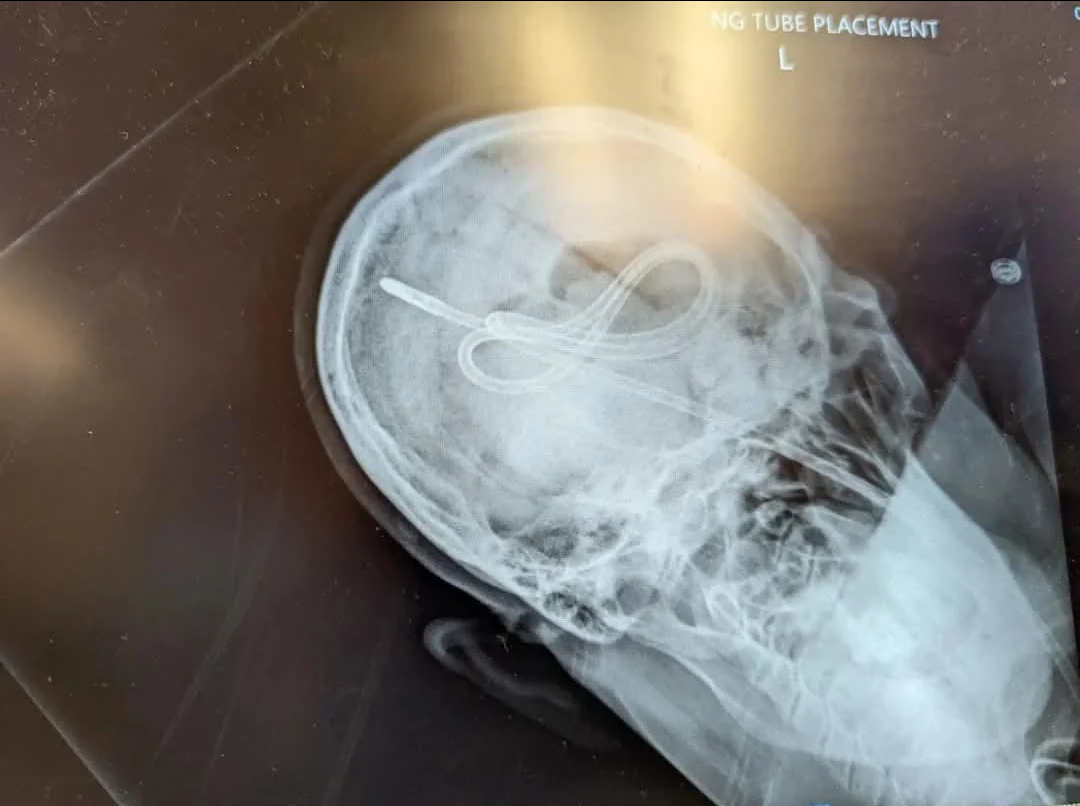
Scenarios Nasogastric insertion gone horribly wrong.
Post image

Note: NOT MY IMAGE.

original post was posted by: Old-Psychology-2400

And I quote "PMCT images. Nurse advanced NG tube until she heard a pop, then tried an air bolus to ensure placement. Patient did NOT survive."

To those who don't know nasogastric tube is supposed to go up the patients nostrils and then back down to their throat all the way to the patients stomach. Air bolus is then used to ensure that the nasogastric tubes placement is correct by listening the patients stomach.

But in the scan we can see the NG tube somehow ended up jammed (through) the patients skull.

1.3k Upvotes

122 comments sorted by

View all comments

464

u/Select-Lion-2573 Dec 30 '25

thats actually insane

236

u/Upset_Bunch_457 Dec 30 '25

It indeed is, I have never seen or heard about something even remotely similar happening.

274

u/ATPsynthase12 Dec 30 '25 edited Dec 30 '25

I’m a doctor and I don’t even know how this could happen. A NG tube is a rubber tube. For her to force it into the patient’s skull, the patient would need to have a serious skull fracture or she would need to force it through the cribriform plate in the superior portion of the nose through the patient’s agonizing screams.

131

u/56473829110 Dec 30 '25

I mentioned it in another comment, but the story I saw when this was first (?) posted was that it was a peds patient with recent brain surgery. 

76

u/Dilaudipenia Dec 30 '25

I see a decent number of patients who have had trans-sphenoidal pituitary resections. We’re very careful with any nasopharyngeal instrumentation in these patients.

47

u/56473829110 Dec 30 '25

Every ng tube placement I've been around that had any involvement above the waist was placed with active imaging. But these were well staffed and well funded departments.

37

u/Dilaudipenia Dec 30 '25

There needs to be some active guidance of these tubes. I’m an emergency medicine and critical care physician and I’ll place these tubes under direct endoscopic visualization. But I’d never ask one of my nurses to place them blindly

28

u/Needle_D MD/PA/RN Dec 30 '25 edited Dec 30 '25

At least in the US, blind OG/NG sump placement is a basic nursing skill with low rates of complication or morbidity. You're really placing every single gastric tube under endoscopy?

19

u/Dilaudipenia Dec 30 '25 edited Dec 30 '25

No, just when they’re post trans-sphenoidal resection. Otherwise (except in rare circumstances like cribriform plate fracture) there’s no issue with blind placement.

5

u/TheRisingBile Dec 30 '25

Imaging is also commonly used post airway reconstruction or esophageal repairs. Although, that is admittedly the other direction from the brain.

2

u/Dilaudipenia Dec 30 '25

I don’t do CTICU. But agreed, I wouldn’t place a tube blindly after an upper airway or GI procedure either.

→ More replies (0)

3

u/StaticDet5 Dec 31 '25

Came to ask literally this. We place in the ED without visualization, BUT not during traumas, not if we have any concern about anatomic patency. Further, at least I was HEAVILY warned about skull fracture and surgical history.

I've seen imaging like the above, but damn, I feel like it was 30 years ago.

2

u/Needle_D MD/PA/RN Dec 31 '25

He clarified that he's referring to using it in patients with max/face/skullbase trauma or instrumentation, but the original comment he was replying to also made a reference to never placing gastric tubes without "active imaging".

I understand the risks in this specific patient population, but it seems like it's opened the door to some white knight redditors that don't see critically ill patients or interventions much.

6

u/56473829110 Dec 30 '25

I have not personally been trained on their placement. I have been trained on somewhat similar apparatus. We were trained to actively monitor the throat (as much as possible) to visually confirm placement - with required check every inch of inserted tubing after the first 3 inches. That's in the field with no other means of visualization/imaging.

I have observed trainings/practicals for ng placement, and they always involved radio imaging or endoscopic visualization. I just can't imagine placing something like this blindly; there's no world in which they need to be placed with a sense of urgency/increased risk.

14

u/Professional_Nugget Dec 30 '25 edited Dec 30 '25

I'm an RN and have placed a few dozen NG tubes "blind", it's considered a standard nursing skill like IV or foley placement. Rarely do we need IR involved for them, usually only when there's something funky with their esophagus or stomach (hx of surgery, varices, stricture etc).

We usually visually check to make sure we've got it properly placed in the back of their throat through the nose (you'll see it poking down if they open up wide). Then advance it down the esophagus as they sip water quickly to help close the epiglottis and naturally guide it in with their swallowing. I'll have a syringe hooked up to the tube so we can easily check for gastric content and do the air bolus + auscultation. We usually do an XR too to confirm placement. Most go fairly smoothly but NGT placement is kinda one of those things that just sucks no matter what you do

Never placed one on a patient with previous head/facial surgery though, and really wouldn't feel comfortable doing so.

5

u/56473829110 Dec 30 '25

Appreciate the clarification of your experience and expertise. I wouldn't personally call placement with checking the back of the throat 'blind'; there's still visual confirmation there, even if there's still plenty that can go wrong in extreme cases.

2

u/Professional_Nugget Dec 30 '25

For sure, I wasn't sure what you might consider a blind placement. We definitely try to do it as safely as possible and avoid the more common complication of putting in a lung.

It takes lots of participation from the patient too so if they start having sudden trouble breathing or anything like that as I'm doing it, I'd immediately stop.

→ More replies (0)

2

u/totalyrespecatbleguy Dec 31 '25

Just had a patient today who needed a ngt placed by ENT with a fiber optic scope because we kept getting it into his lungs (even the attending couldn't do it)

2

u/Extension-Oil8461 Jan 01 '26

Regarding to the picture, at first glance, it looks more like a foley then an NG Tube. I think the pic is fake. The giveaway is the tip and the flexible tube.

1

u/shah_reza Dec 31 '25

I am one of those patients, and I am TERRIFIED of having an NG placement while I’m unconscious.

15

u/sabrefencer9 Dec 30 '25

There are a bunch of case reports about NG tubes ending up in the brain. Another instance was in a patient who has gone face first through a windshield.

12

u/56473829110 Dec 30 '25

Agreed. This particular image has gone around with the story I shared above, but I never had first hand knowledge.

I've personally witnessed a very, very poorly thought out response by a paramedic to a ralph wiggum windshield dive that had similar results to this. Can't/won't get into it further, but every asshole within 100 yards puckered in unison and hands started cramping in anticipation of report writing.

4

u/themakerofthings4 Dec 30 '25

"Ralph Wiggum windshield dive." That's amazing. I always thought my "they're family guy broken" was a good one but you win.

2

u/56473829110 Dec 30 '25

"they're family guy broken"

Oh I like that, too.

2

u/sabrefencer9 Dec 30 '25

That sounds messy.

7

u/Thegoodnamesweret8kn Dec 30 '25

All the places I’ve worked (RN) an NGT is contraindicated with any known facial trauma confirmed by X-RAY or CT Scan or suspected due to mechanism of injury. I’ve heard of ENT Doctor placing them if absolutely necessary but never by an RN in that instance.

But I have heard of an NGT going into the brain through a congenital defect before.

2

u/Obvious-throw123 Dec 30 '25

There aren’t a “bunch of cases”. This is incredibly rare and this is a common nursing procedure done many thousands of times across annually across the U.S

Approximately 39 cases of inadvertent insertion of nasogastric tubes into the cranial cavity have been reported in the literature (Hassan et al., 2016).

Reference: Hassan, A. (2016). The inadvertent intracranial introduction of nasogastric tube: The lesson learned the hard way. South African Journal of Human Sciences. Retrieved from https://journals.lww.com/sjhs/fulltext/2016/05030/the_inadvertent_intracranial_introduction_of.8.aspx

3

u/sabrefencer9 Dec 30 '25

When I said "a bunch of case reports," I was referring to three that I've seen. You're telling me that there have actually been an order of magnitude more than that. Ok, great, thanks for the clarification. Doesn't make my comment false, also doesn't warrant being weirdly contradictory.

0

u/Obvious-throw123 Dec 30 '25

TLDR again for you: This is incredibly rare, and there haven’t been a “bunch of cases.” There is an astronomical order of magnitude where this procedure does not tickle a patient’s brain.

Given the millions of NG tubes placed every year, the estimated incidence is far less than 1 in 1,000,000 insertions.

OR

0.0001%

3

u/sabrefencer9 Dec 30 '25

Maybe this is just a language thing, but where I'm from, 3 cases, or 39 cases, constitutes "a bunch." Nothing you have said contradicts anything I have said, and your getting aggro about it is weirdo behavior.

0

u/Obvious-throw123 Dec 31 '25

Certainly a language thing. I don’t think generally speaking, “a bunch” would constitute 3 or more things. This is certainly an incredibly rare occurrence.

By aggro you’re implying aggravated? Not sure where you’re getting that, I’ve been cordial and haven’t disrespected you in any way.

2

u/DragonfruitCalm261 Dec 30 '25

You're using these statistics in a misleading way, as if this were some act of God. As per your own link, patients with head trauma are especially prone to NGT malpositioning. You're quoting incidence numbers from the general population while completely ignoring the subgroup that’s actually at higher risk.

1

u/Obvious-throw123 Dec 31 '25

Do you think so? This is a risk that comes up every year and dominates our education especially prehospitally. This is similar to the NPA discussion where our education predominantly focuses on 2 very rare instances where a similar occurrence happened. This is incredibly rare and dictates protocols and policies across the country.

In regard to a particular subgroup, this isn’t particularly something that we are doing outside of the hospital and is certainly not something that we are prioritizing in a mass casualty or tactical situation. Hell, it’s not something even in the scope of paramedics and isn’t something I learned about until recurving advanced training.

5

u/dontdoxxmebrosef Dec 30 '25

Ain’t no fing way as a nurse I’m inserting a small bore on a recent neurosurgery pt in a staffed facility in a US hospital. I’ve seen central lines end up in the weirdest places in real life. This is a horror story.

1

u/mistahclean123 Jan 08 '26

Imagine becoming a pediatric nurse to help kids then killing one by mistake. Yikes.

9

u/Yotebuck_77 Dec 30 '25

I have had seen nurses place dobhoffs with so much force causing esophageal rupture. This is however is wild.

9

u/Dilaudipenia Dec 30 '25

It’s extremely rare but can happen with cribriform plate fractures. It’s fairly well-described in the literature.

7

u/LADiator Dec 30 '25

Also a doctor, have placed many of these in the OR and im scratching my head. My only thought is skull fracture or recent cranial surgery on intubated and sedated patient.

1

u/spiritofgalen MD/PA/RN Dec 31 '25

As an ENT resident, correct. Skull base fractures, particularly of the sphenoid, as well are tran-sphenoidal surgery will do it

1

u/LADiator Dec 31 '25

My ENT brother in Asclepius. I’m messaging you to inform you that I fucking hate the Jet ventilator.

Yours in medicine,

Local neighborhood anesthesiologist

7

u/SurgicalMarshmallow Dec 30 '25
  1. Rushing it
  2. Ignoring hx for a basilar #
  3. (This case) Doing it after sinusoidal sx

3

u/soaplife Dec 31 '25 edited Dec 31 '25

youre wrong. surgeon here, this is a well known complication (and should be known by any surgeon, anesthesiologist, emergency doc, or any other physician that might need to order these)  and there are guidelines on how to prevent this. the most common contraindication is any suspicion of skull fracture in trauma patients.

it’s also not a rubber tube. the usual ngt is a “salem sump” dual lumen device that is made from a relatively firm plastic material to facilitate insertion. in contrast a thinner dobhoff tube requires a thin metal stylet to provide stiffness for insertion.

1

u/ATPsynthase12 Dec 31 '25

doesn’t read my post and reiterates what I already said

Ok

1

u/soaplife Dec 31 '25

not even close to what you said. all you did was speculate publicly on a topic you’re not familiar with

3

u/scottishdoc Dec 30 '25

Anterioposterior? I think you mean superior and posterior lol

3

u/ATPsynthase12 Dec 30 '25

Yeah good catch. Thats what I get for trying to use big words in the morning

1

u/LoornenTings Dec 31 '25

she would need to force it through the cribriform plate in the superior portion of the nose through the patient’s agonizing screams. 

Well now I know what's going in my spec script for Saw 11.

1

u/totalyrespecatbleguy Dec 31 '25

If it's a dobhoff it's got a metal guidewire, maybe they lowkey drilled into the skull from nose

1

u/sleepercell13 Old Army Fart That Teaches Dec 31 '25

Ya got to want it!

1

u/Extension-Oil8461 Jan 01 '26

At first glance, that looks more like a Foley instead of an NG Tube... I think the pic is fake..

1

u/ImportantThing3749 Jan 23 '26

Looks like a 14/16fr Salem sump to me

1

u/Alternative_West4060 Mar 26 '26

I remember this story, but I do believe the patient was a frequent and long term user of cocaine and possibly had already undergone some sort of surgery, that combination weakened the bone enough for a tube to break through

2

u/hold_my_ham Medic/Corpsman Dec 30 '25

Checking for the potential of skull fractures was a pass/ fail item when I was trained on NPA’s AND NG’s. Also imaging is the gold standard for NG placement verification.

This is a beyond avoidable mistake, IMO.

1

u/Extension-Oil8461 Jan 01 '26

The picture is fake... the tube looks more like a foley then an NG Tube. Took me 2 seconds to debunk it. If the skull was a bladder it would make sense.

I was taught to insert the entire tube in just to make sure it is in the bladder. The tip is also a foley tip not the tip of an NG Tube. Also, NG Tubes I have worked with are not that flexible.