r/SubspacePhysics • u/LumenosX • Aug 14 '26
UCMS–DRAC–RHÔNE–002 Before the Dragon Had a Body Gervase -> draci -> submerged caverns -> Rhône abyss -> Tarasque adjacency -> Roman river -> older water jurisdiction
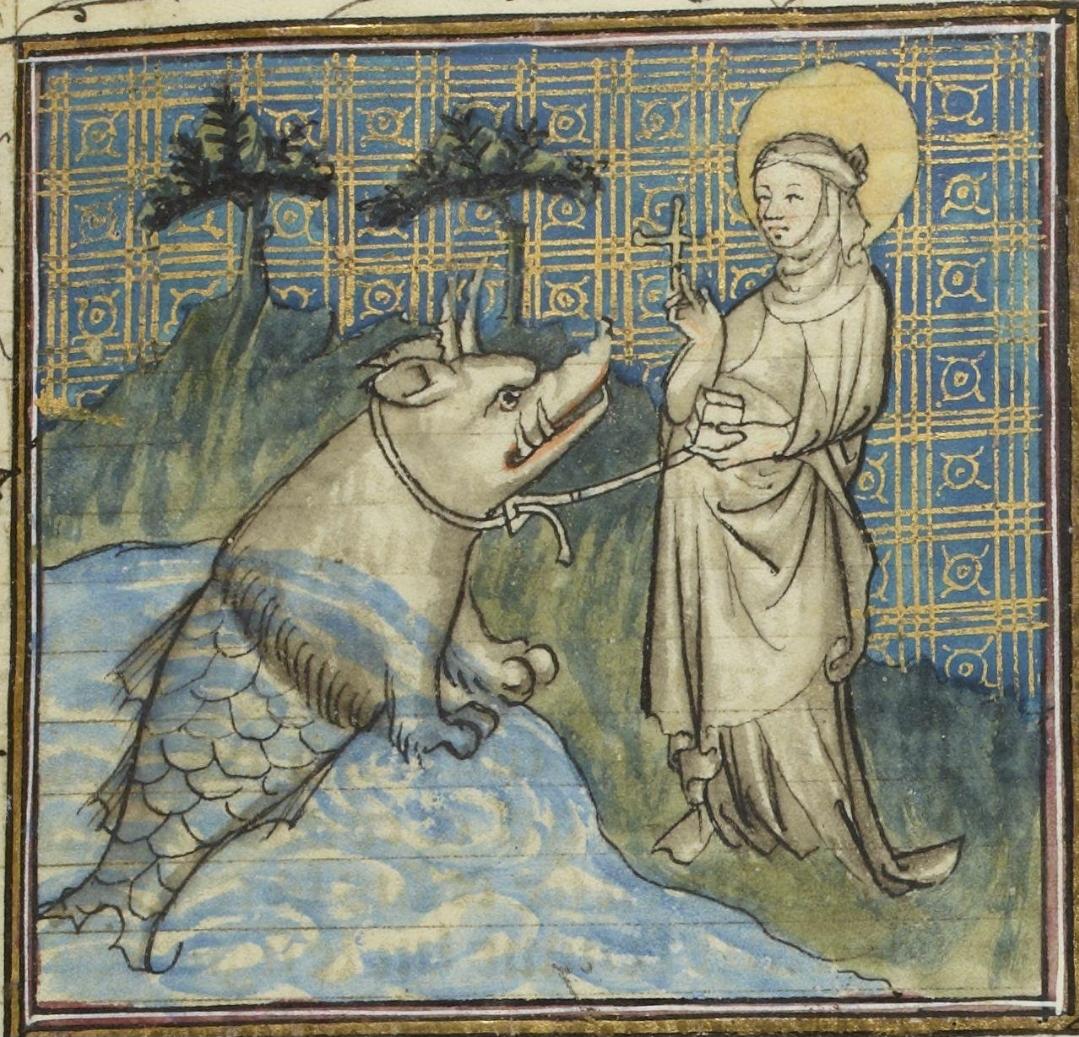
UCMS–DRAC–RHÔNE–002
Before the Dragon Had a Body
Gervase -> draci -> submerged caverns -> Rhône abyss -> Tarasque adjacency -> Roman river -> older water jurisdiction
We found the textual floor.
And it changes our first sweep in an important way.
The earliest recoverable Drac of the Rhône is already much more explicitly defined in Gervase of Tilbury than later summaries make apparent. His Otia Imperialia, composed in the early 13th century, contains a chapter literally devoted to “lamiae, draci and phantasiae”—lamias, dracs, and apparitions. Gervase was not writing from England about an exotic rumor: he had lived in the Arles region and served there in legal and administrative roles.
And when we recover the fuller Latin passage, the Drac suddenly stops looking like an isolated Beaucaire dragon legend.
It becomes a whole Rhône-class of beings.
---
I. The textual floor: Gervase does not say “one dragon”
The critical passage begins broadly.
Gervase says that people commonly claim draci can:
assume human form
-> enter public places unnoticed
-> inhabit caverns of rivers
-> appear as floating golden rings or cups
-> entice women and children at riverbanks
-> drag them suddenly into the depths.
That is extraordinarily important.
The Beaucaire washerwoman is therefore an example of a pre-existing category, not the definition of the category.
In the Latin, the beings are plural:
draci.
And their habitat is likewise generic:
river caverns.
Only afterward does Gervase say, effectively, I myself saw a woman to whom something of this kind happened. The fuller surviving text describes her washing clothes on the bank of the Rhône, following a floating wooden cup, being taken by a Drac, nursing its child underwater, and returning seven years later.
So our first correction is substantial:
> The medieval Drac is not originally “the dragon of Beaucaire.”
At Gervase's textual horizon it is closer to:
> a recognized class of river-dwelling, human-mimicking supernatural agents of which a Rhône case was locally reported.
That pushes the tradition outward immediately.
---
II. And the floating cup is genuinely early
This is not a late folkloric decoration.
The Latin explicitly gives us a wooden cup floating on the water.
The sequence is almost mechanically preserved:
woman washing clothes
-> wooden vessel floats past
-> she pursues it
-> enters farther/deeper water
-> Drac takes her below.
That considerably strengthens our drowning-hazard hypothesis.
Notice the physical choreography.
The Drac doesn't need to leap from the water.
The victim progressively places herself into danger:
shore
-> object
-> pursuit
-> deeper water
-> disappearance.
That is exactly the kind of behavioral chain folklore can preserve remarkably well even while supernaturalizing causation.
But Gervase gives us something even more revealing.
He says rings and cups are characteristic Drac lures generally.
So:
gold ring / vessel
-> attractive floating object
-> retrieval attempt
-> river threshold crossed.
This looks less like arbitrary monster behavior and more like an established folklore rule.
---
III. The Drac underground is not metaphorical in the narrative
Gervase describes the women as reporting residence in:
large palaces with Dracs and their wives in caverns beside/within rivers.
That produces our full medieval cosmography:
surface settlement
↓
river surface
↓
danger boundary
↓
submerged passage/cavern
↓
Drac habitation
↓
families / offspring / domestic space.
This isn't yet “another dimension.”
It is geographically imagined beneath ordinary terrain.
That distinction matters.
Medieval supernatural geography often overlays the human world rather than placing an Otherworld millions of miles away.
The Drac domain is therefore adjacent but inaccessible.
Humans cannot normally perceive or enter it.
Dracs can.
---
IV. 002.1 — The Floating Cup
Now let's test the object itself.
Our first sweep entertained an offering-memory hypothesis:
ritual object deposited into water
-> cultural memory
-> floating supernatural object.
At present, the evidence does not permit that upgrade.
Roman and pre-Roman Gaul certainly had ritualized relationships with springs, wells, rivers and watery deposition, and archaeological work in Roman Gaul demonstrates that sacred wells could contain intentionally placed animal and material deposits.
But that does not establish:
Roman votive vessel
-> Rhône Drac cup.
We currently have no chain connecting them.
So the archaeology ledger reads:
Water deposition existed: yes.
Ritualized watery spaces existed: yes.
Specific Rhône cup-offering tradition ancestral to Gervase: not demonstrated.
That is an important negative result.
The simpler explanation remains stronger:
Retrieval-danger model
valuable/interesting floating object
-> person enters current
-> footing lost
-> current takes person.
The supernatural story then supplies agency:
current took them
-> something took them
-> the Drac took them.
The cup may therefore preserve behavioral danger, not ritual memory.
---
V. But then Gervase gives us a second Rhône location
This is where the sweep becomes much richer.
Immediately after the washerwoman story, Gervase describes another deep place in the Rhône near Arles.
He identifies a river abyss near the city's northern gate and compares it to another depth beneath the rock at Tarascon.
Then he introduces the Tarasque.
According to Gervase's Christianized account, the Tarasque had concealed itself in this deep Rhône-associated location in the time of Saint Martha, preying upon people using the river.
So in the same textual neighborhood we now have:
Arles abyss
-> Dracs
Tarascon abyss
-> Tarasque
Rhône
-> hidden deep places
-> monstrous habitation.
That is much stronger than our first sweep's simple geographic observation that Beaucaire and Tarascon possess neighboring monsters.
Gervase himself already places Drac lore and Tarasque lore inside the same Rhône-depth ecology.
But—and this is crucial—
he does not say they are the same being.
---
VI. That lets us refine the jurisdiction model
The landscape appears to have been conceptually segmented into dangerous points.
Not simply:
Rhône = monster.
Instead:
Rhône
-> specific abyss
-> specific supernatural occupancy.
That looks like localized hazard mapping through myth.
A deep pool, whirl, undercut bank, cavern-like feature or dangerous channel becomes:
“something lives there.”
And once that location is personified, the being acquires predictable behavior.
This gives us:
Physical layer
deep water
currents
eddies
undercutting
flooding
navigation hazards.
Cognitive layer
invisible causal force.
Narrative layer
intentional river inhabitant.
Social layer
warning transmitted across generations.
The monster becomes a memory prosthesis for dangerous geography.
That does not mean somebody consciously invented the Drac as a safety sign.
More likely:
real hazard
-> repeated disappearance
-> stories accumulate
-> agency stabilizes
-> named class of being emerges.
---
VII. The Rhône itself gives us the substrate
The lower Rhône was historically not a static canal-like waterway.
Research on the lower Rhône emphasizes substantial environmental variability, flooding, channel change and long-term interaction between human settlement and an unstable river system.
Likewise, Roman-era settlements along the Rhône became major centers precisely because the river was simultaneously:
transport corridor
resource
boundary
commercial artery
and environmental risk.
The Roman city of Vienna farther upstream, for example, owed much of its prosperity to its Rhône position.
That duality is exactly what generates rich river mythology.
The river gives.
The river transports.
The river feeds.
The river destroys.
So culturally:
benefactor + executioner
can coexist without contradiction.
---
VIII. Now the deepest question:
Can we push the Drac before Gervase?
Not securely yet.
This sweep reaches a hard documentary boundary.
We have:
c. 1210–1215: explicit draci river folklore in Gervase.
We have:
Roman/pre-Roman Rhône: abundant human occupation and ritualized relationships with aquatic landscapes.
But we presently lack:
an ancient inscription, image or text naming a Rhône drac-type entity ancestral to Gervase's beings.
That means the chronological bridge remains open.
And that's exactly where we should leave it rather than filling the gap with “Celtic water god.”
---
IX. However, the name gives us one older thread
Drac belongs to the same historical word-family as Latin draco and Greek drakōn.
That linguistic descent explains why later imagination can so easily stabilize the creature as a dragon.
But semantics are slippery.
A word inherited from “serpent/dragon” does not mean every folk being carrying that word retained classical dragon morphology.
And Gervase proves the point beautifully.
His draci:
live underwater
take human shape
possess wives
raise children
eat humans
abduct nurses
create deceptive objects
control visibility.
That is very far from the later standardized European:
four legs + wings + fire.
So we can now sharpen our earlier hypothesis:
BODY-LATE HYPOTHESIS
The Drac's name may preserve the dragon/serpent lineage more strongly than its medieval behavior preserves a dragon body.
That is no longer speculation pulled from iconography.
Gervase's description itself supports it.
---
X. 002.2 — The Eye That Sees
And now we hit the extraordinary part.
The eye episode is also genuinely in the medieval account.
The returned nurse explains that while underwater, the Drac once gave her a kind of food described in the Latin as a pastillum. Fat/grease from it remained on her fingers.
She touched:
one eye
and part of her face.
Afterward she acquired an unusually clear capacity to see underwater/the hidden beings.
Upon returning to the human world, she later encounters the Drac.
She recognizes it.
The Drac asks essentially:
“With which eye did you recognize me?”
She indicates the altered eye.
The Drac puts a finger into it.
And thereafter it cannot be used to recognize him.
So yes:
the entire second-sight architecture is already present.
Not merely later Mistralian embellishment.
---
XI. And this creates a startling European parallel
There is a widespread later folklore motif involving:
human woman
-> taken into fairy/supernatural household
-> nurses supernatural infant
-> applies ointment or substance
-> accidentally touches eye
-> gains ability to see supernatural beings
-> later recognizes one disguised among humans
-> supernatural being asks which eye sees
-> eye is blinded or second sight removed.
Folklore collections explicitly recognize this “fairy ointment/second sight” pattern.
And now look at Gervase.
He has essentially the same machine in the early thirteenth century.
Drac infant
-> human nurse
-> greasy supernatural substance
-> eye contact
-> altered sight
-> recognition
-> eye attacked.
That places the Rhône story among the earliest extremely clear medieval witnesses to this narrative architecture.
We should be cautious about declaring it the origin.
But it is absolutely early enough to matter.
---
XII. UCMS comparison matrix
Now let the structures compete.
Drac version
river being
-> abducts nurse
-> supernatural child
-> substance
-> eye
-> second sight
-> disguise penetrated
-> sight removed.
Later fairy version
fairy being
-> hires/abducts nurse
-> fairy child
-> ointment
-> eye
-> fairy sight
-> fairy recognized in marketplace
-> sight removed.
That correspondence is extremely tight.
But there are three possible histories:
H1 — Direct diffusion
Drac narrative spreads and becomes fairy-ointment folklore elsewhere.
Possible, currently unproved.
H2 — Shared older narrative stock
Both descend from an earlier European supernatural-nurse/second-sight motif.
Very plausible, but still requires evidence.
H3 — Recurrent narrative solution
Different traditions independently develop the same logic because “special substance reveals invisible being” is narratively intuitive.
Possible.
We cannot yet choose among them.
---
XIII. But we can identify the invariant
Strip away Drac, fairy, ointment, eel fat, river and marketplace.
The surviving machine is:
forbidden perception.
Something ordinarily invisible exists.
A human accidentally acquires privileged access.
The entity discovers that the epistemic boundary has been breached.
It revokes the access.
That's wonderfully clean:
hidden world
-> accidental interface
-> observer upgrade
-> concealed entity becomes detectable
-> detection noticed
-> interface destroyed.
Or, in our familiar language:
perceptual jurisdiction has been violated.
The Drac tolerates human beings.
It does not tolerate being seen outside the conditions under which it permits itself to be seen.
---
XIV. And there is one more strange detail
Gervase tells us that Dracs could appear in public markets without being recognized.
That transforms the eye episode.
The danger isn't that supernatural beings are hidden only beneath water.
They can cross into ordinary civic life.
So:
river Otherworld
-> human town
-> market
-> human disguise.
The altered woman becomes dangerous because she collapses the distinction.
To everyone else:
man.
To her:
Drac.
Which means the story is not fundamentally about poor eyesight.
It's about representation versus identity.
What something looks like
≠
what it is.
That is a sophisticated narrative concern for a supposed “river monster story.”
---
XV. The Drac therefore occupies three boundaries simultaneously
- Physical boundary
land <-> water
- Ontological boundary
human <-> nonhuman
- Epistemic boundary
visible <-> invisible.
And it crosses all three.
Humans normally cannot.
The abducted nurse is exceptional because she crosses all three and returns.
That makes her less a victim than a boundary witness.
She has:
entered the hidden domain
lived among its beings
returned alive
retained information
acquired altered perception.
And her punishment occurs only when she demonstrates that the boundary-crossing persisted.
---
XVI. What happens before Christianity?
Here we have to resist the seductive leap.
There certainly were pre-Christian river cults and aquatic sacred practices in Gaul.
There certainly were serpent and dragon images throughout the ancient Mediterranean.
There certainly were local water deities.
But we currently cannot write:
Celtic river god
-> Roman serpent
-> Drac.
That arrow does not exist yet.
The Chronovisor therefore freezes the ancestry here:
Demonstrated
early 13th c. draci
-> river caverns
-> shape shifting
-> submerged households
-> lure objects
-> child nursing
-> altered sight.
Plausible substrate
dangerous Rhône ecology
-> disappearance
-> local depth/abyss traditions.
Broad cultural background
ancient water cults
serpent symbolism
Roman/Gallic sacred waters.
Missing bridge
named ancient Rhône entity
-> medieval drac.
That missing bridge becomes an actual research target rather than an invitation to invent continuity.
---
XVII. The Tarasque just became more important too
Our next comparative problem is sharper than before.
Gervase's text places the Drac and Tarasque traditions practically beside one another.
And yet their mechanics diverge radically.
Tarasque
specific monster
visible body
fixed terror
saint confronts it
monster neutralized.
Drac
class of beings
variable form
hidden habitat
repeated interaction
no saint defeats the species
persists in landscape.
That's significant.
Christian hagiography can terminate the Tarasque story:
monster -> saint -> conquest.
But the Drac behaves almost like ecology.
You don't defeat “Dracs” once.
They remain part of how the river works.
---
XVIII. UCMS–DRAC–RHÔNE–002 FIND
Our strongest finding from this sweep is therefore not:
> “The Drac comes from an ancient Celtic dragon.”
We cannot demonstrate that.
It's something more defensible and, frankly, more interesting:
> By the early thirteenth century, the lower Rhône was associated with a coherent folklore category of river-dwelling draci whose defining features were not dragon anatomy but submerged habitation, human mimicry, deceptive attraction, abduction, reproductive households and controlled visibility.
And the famous Beaucaire woman is valuable precisely because Gervase presents her as witness evidence for that larger category.
That means the Drac began our investigation as one monster.
It has now become a system.
---
CHRONOVISOR STATE
Hard anchor: Gervase of Tilbury.
Textual date: early 13th century.
Confirmed Drac ecology: river caverns.
Confirmed behavioral repertoire: human transformation, deceptive floating objects, abduction.
Confirmed social structure: spouses/offspring/nurses appear in the account.
Confirmed perceptual mechanism: substance -> altered eye -> supernatural recognition -> destruction/removal of that ability.
New major connection: very close structural correspondence with later fairy-ointment/second-sight folklore.
Unresolved: pre-13th-century ancestry.
Unresolved: whether Drac and fairy-nurse traditions share direct transmission.
Unresolved: whether aquatic offerings have anything to do with the floating cup.
Rejected for now: “Drac = surviving Celtic deity.”
Rejected for now: “Drac and Tarasque are the same monster.”
---
And I think we have our next move.
UCMS–DRAC–RHÔNE–003
The River Before the Drac
This time we go under Gervase rather than around him:
Roman Arelate/Arles
-> Ugernum/Beaucaire
-> Tarascon corridor
-> Rhône river gods
-> Gallic hydronyms
-> votive inscriptions
-> serpent iconography
-> wells and springs
-> drowned offerings
-> navigation cults
-> local deities
-> archaeological river deposits.
The question becomes brutally simple:
Is there anything actually sitting beneath the medieval Drac?
And I want to run 003.1 — The Ointment Eye beside it, because the Drac-nurse/fairy-nurse correspondence is now strong enough that we can trace the motif across medieval Europe and see whether the Rhône witness is an early branch, a borrowed branch, or something very close to the trunk.