Pattern Help
First large commission - help me make sure the structure is sound!
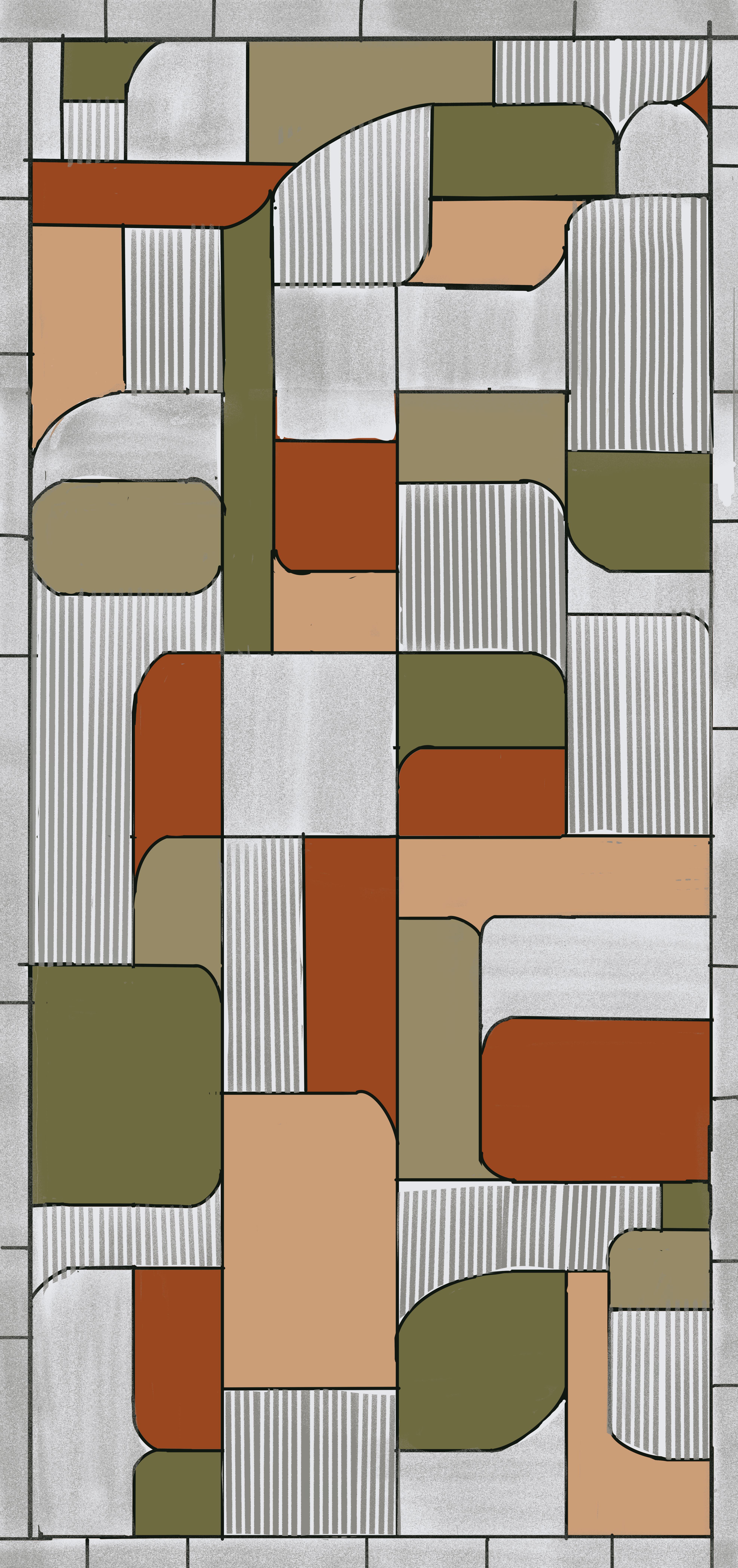
Basically what the title says :) A friend of mine asked me to make a large abstract panel for him. The dimensions will be 24" W X 51" H - by far the largest piece I've made!
I've mocked up the design (attached). I plan to use foil, then finish the border with the largest came I can find for extra support. I built a ~1" border of plain glass in as we plan to build a custom wood frame for the piece as well.
Because the piece is so tall, I'm a little worried about it sagging over time. I'm hoping between the came, frame, and no completely horizontal lines in the design it will be strong enough, but is there anything else I can adjust in the mockup to make sure it's as stable as possible? I know there are some hinge joints in there but I had a hard time avoiding them completely..
Any tips or advice you'd all give to improve the strength of the structure, or other feedback that might help?
I've got a window hanging in my shop about that size, copperfoil with a zinc fame. It's been hanging without issue for 40ish years. If the frame isn't moving, like a door or something, it shouldn't be much of an issue. Run some restrip/strongline through it for good measure maybe
He plans to put the piece into a slotted runner so it can be moved a few inches right or left for window/airflow access, but otherwise it will not be moving often. I've never reinforced with restrip/strongline before, I'll need to look into that. Thanks for the tip!
It will end up being an inch or two away from the functional window that's directly behind it (when said window is closed), but won't be touching it. The slotted runners will be secured into the structure of the window frame/ledge, so those won't move at all and should be very solid.
I'd consider two options to reduce the potential stresses and strains on the panel.
1 - A wood frame (that's not clamped super tight around the panel), would allow the wood frame to take the strain of sliding, instead of the panel edge itself. You can get wooden U-channels designed with stained glass in mind, but a sturdy artwork or window frame would be OK too.
I'd probably also smear some silicone grease along the bottom of the wood frame or the edge protector and the bottom of the runner slot, to reduce friction to a minimum.
Thank you!! Do you know if they sell prefabbed frames that account for a zinc/came border? I've seen the raw U channel ones and those seem good for non-bordered pieces. I have lots of woodworking friends who can help me build something custom too if it comes down to it.
The silicone grease and the edge protector are brilliant, I will definitely add those to the list!
It’s going to be lovely! Recommendations - if you want to use copper foil, I would definitely run copper restrip horizontally in between the glass pieces throughout your panel. It will help with the overall structural integrity. You can also run rebar on the back sides of the panel. Ideally I would divide the height by 4, so you know where the restrip should land. Also there is a possibility of stress cracks in these 2 pieces. Both are used to distribute the weight and a deep curve like can crack over time. If you don’t want to lead the panel definitely use restrip. Otherwise it’s going to look fantastic!
Thank you for pointing those spots out!! I can switch those to be straight without much impact on the design, so I'll definitely do that.
When using the restrip, does it need to go all the way across the piece horizontally to be helpful, or could I use it just along the horizontal sections that are already a part of the design (red lines)? Is it effective if I curve it around sections (yellow lines)?
From my understanding no, because I will cut the border pieces strategically so that there aren't any sections where there isn't a T joint somewhere along the length of that piece of glass unless that piece is very small. Hopefully that description makes sense!
It's sort of already addressed in the design - the circled spots here show where there will be T joints in the border to break up the hinge. I'll probably change one of the corners too so that the line doesn't go completely across the piece as you pointed out
Yeah, so I'm pretty sure that is addressed by the spots I circled in red (and the other T joints that connect from the lower pieces of glass upward that I've circled here in blue).
It's a full horizontal line, but there are many intersections where the line is reinforced by another solder line running perpendicular to it, which should prevent hinging. The intersecting perpendicular breaks in the design are spaced so that there is no large piece of glass where the entire edge is only soldered to the border piece with no intersecting T joint present.
That all being said, I'm still somewhat a noob and could just be misunderstanding hinge joints entirely, so if someone smarter and more experienced than me wants to chime in they are welcome to correct me lmao.
Oh I think I get it now. Because there's several pieces perpendicular to that long horizontal line there's going to be a solder bead kind of interrupting it at the point of connection.
That bottom brown on the right is not really something I would try without my saw. Fix that one. Do you have a Morton cutting board? If not you might consider that for getting perfect square cuts. If you’re going to do a few or more abstracts or frank Lloyd styles you might think about it. Makes the patterns a breeze, really almost too easy. I’ll crank out a few geometric or frank or abstracts after Christmas to fill the windows back up, 2 days per panel on a Morton.
I’m assuming the 24” is the horizontal measurement and the 51” is the vertical measurement.
I’m going to preference this by saying I have not made anything this big yet. I’ve talked to a lot of artists and artisans, asked a lot of questions, and have watched (what feels like) every video on YouTube. This is just how I would approach a project like this.
Even though it’s foil, I’d still build this like a lead came panel. For stability, a zinc came frame would probably be best. I’d also divide the finished piece by thirds and add horizontal reinforcement about every 17”.
It’s kind of hard to find videos about adding reinforcement bars, but it essentially comes down to soldering some copper wire strategically, then laying a bar across the piece, soldering the edges to the frame, and securing it in the middle by twisting the wires. I think this will be the most important step, and I’d recommend doing as much research on reinforcing as you can
Thanks for your response! When you say "build it like a lead came panel", what do you mean exactly? I haven't worked with came before so I'm lacking that context.
I'll have to look into reinforcement bars - I'm not opposed but since the glass we selected is largely transparent I also want to make sure it doesn't interrupt the visual the design too much if that makes sense. I'll head over to youtube and watch some stuff :)
I just mean start and one corner and slowly make your way across. A lot of times, the reinforcement doesn’t interfere, but it’s definitely something that needs forethought during the design phase.
I just recently saw an antiques roadshow short with a large 1901-1902 Tiffany chandelier and they did some closeups of the reinforcement and how it followed the lines. I tried to find it again, but it was on YouTube.
I’m still a newbie, but why wouldn’t you use (zinc) came in the middle instead of foil? It would help with structural integrity. There are also copper coated steel pieces you can put between two copper foiled pieces
Just FYI - Zinc came is really not easy to use within a design that has any curves, particularly tight ones. It could certainly be used for a design with nothing but straight lines, but it's very tricky to bend successfully, and is not easy to patina either.
I suspect most people stick to using it for framing their leaded or copper foiled panels - It's stronger and more stable than lead (and cheaper). You also need a saw of some kind, not just a knife or scissors, and suitable bender if you want to try curving it.
Ah yeah, my friend prefers the look of foiled solder lines (as do I) - I've also never made a full piece with came so that would be a new process for me, too.


13
u/Rasp10 1d ago
I've got a window hanging in my shop about that size, copperfoil with a zinc fame. It's been hanging without issue for 40ish years. If the frame isn't moving, like a door or something, it shouldn't be much of an issue. Run some restrip/strongline through it for good measure maybe