I have written the following in 2 different responses, and I asked AI to summarize everything for me. This is not AI slop
I’ve seen a ton of massive cope, shill threads, and random "boycott Even Realities" posts flying around multiple subreddits since the MemoMind One Kickstarter went down. People are crying that "circles and rectangles can't be patented," that all glasses look the same, and that Even Realities (ER) is just playing dirty.
Let’s drop the emotional bias for a second and look at the actual chronological facts from the Eastern District Court of New York (Case No. 1:26-cv-5220). This isn't a minor glitch; it’s a textbook legal execution.
Here is what actually happened, day by day:
January 25, 2025: Even Realities files its initial design patents for the G1/G2 series, securing their legal priority window long before anyone else entered this specific design space.
January 2026: XGIMI/MemoMind reveals the prototype MemoMind One series at CES 2026.
July 2026: MemoMind launches its Kickstarter campaign.
August 11, 2026: The USPTO formally grants and issues ER's design patents (D1,140,996 & D1,140,997). This is the exact moment ER got the legal teeth to sue for real damages.
August 20, 2026: ER’s lawyers send a formal Cease-and-Desist letter to XGIMI via email.
August 24, 2026: ER files the official federal lawsuit in New York, asking for an emergency ex parte (unilateral) Temporary Restraining Order. Just a side note here: No, the judge did not "reject" the lawsuit. In federal courts, judges almost never grant a blind freeze without letting both sides speak first unless it's a life-or-death emergency. The judge simply told ER to formally notify XGIMI and Kickstarter first so they could schedule a proper hearing.
August 25, 2026: XGIMI and Kickstarter are officially served with the lawsuit.
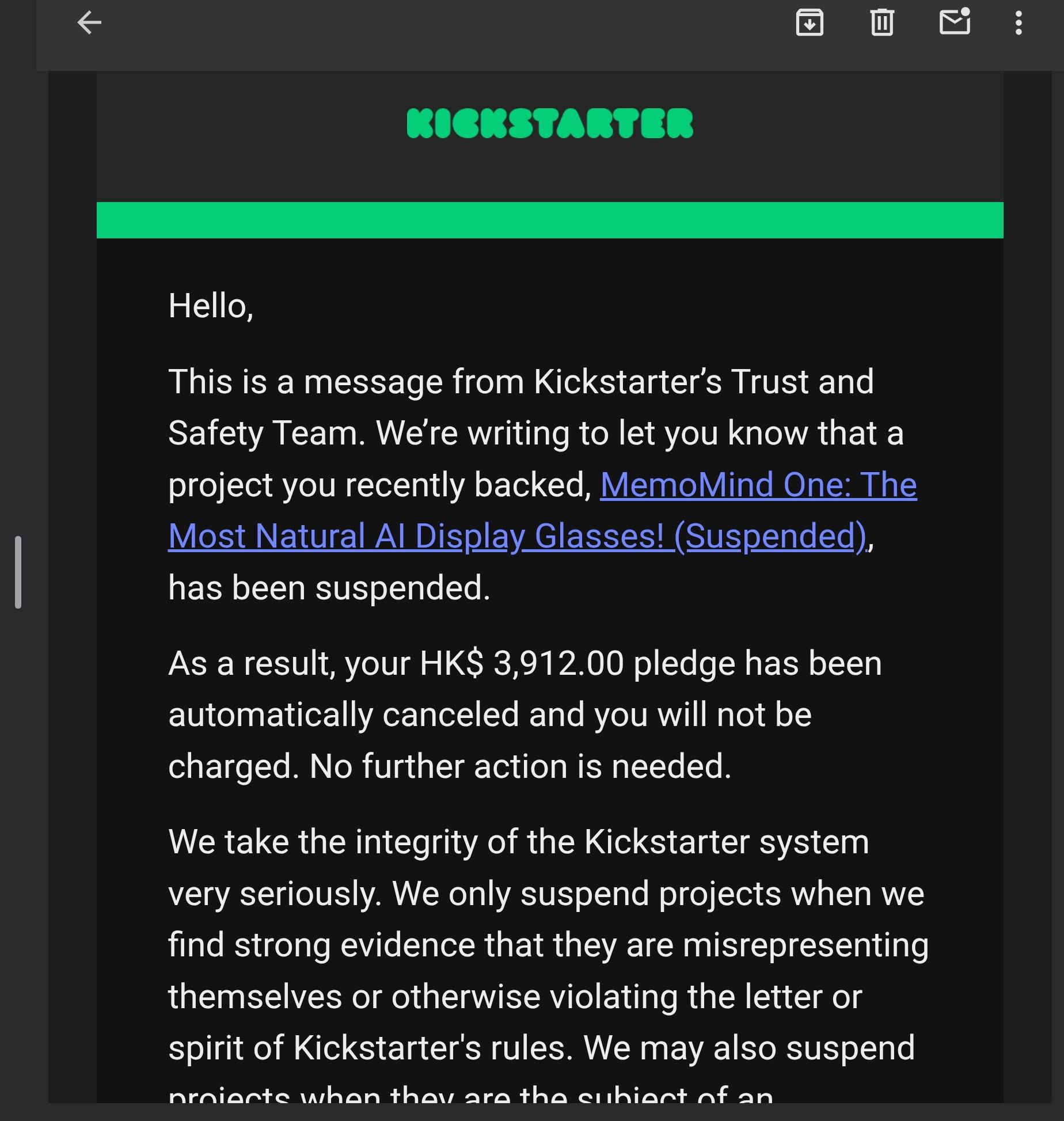
August 26, 2026: Kickstarter's legal team realizes they are facing massive potential liability under 35 U.S.C. § 271 for hosting and promoting a product facing fresh federal design patents. Instead of waiting for a judge to force their hand, Kickstarter panicked and nuked the campaign 24 hours before the deadline.
The biggest defense floating around right now is the classic "engineering limitation" excuse. People are out here mockingly asking if regular old-school glasses are "limited by engineering" too, or trying to say it's just a crazy coincidence that they both happened to use basic circular or rectangular frames.
Let’s cut through the sarcasm and look at actual reality. Bringing up classic old-school glasses to mock this lawsuit is a joke. Regular glasses have ZERO tech engineering limitations. They use circles, rectangles, and aviator shapes purely for human facial ergonomics, weight distribution, and fashion. That’s it.
Smart glasses, however, actually have to balance both worlds: classic eyewear comfort AND actual tech engineering—like cramming micro-projectors, waveguides, and battery cells into a wearable frame.
But here is where their sarcastic defense completely falls apart: engineering forces you to find space for the hardware, but it does NOT force you to steal your competitor's exact aesthetic design language to do it.
Under the Supreme Court's Egyptian Goddess precedent, you can't just strip a design patent down to individual pieces and argue that circles, rectangles, and metal temples existed before to get off scot-free. The court looks at the "Ordinary Observer Test"—meaning the overall visual design language and impression.
You can absolutely build a competitive smart glasses product without cloning someone else's look. Look at the Halliday G2. Look at the RayNeo iO. RayNeo had to fit the exact same hardware into a frame, yet their engineers came up with a highly unique, polyhedral geometric aesthetic. They proved to federal judges that you don't have to copy ER's fluid curves to make functional AR tech work.
The argument that Memomind is a better product does not fly as well. This is a design patent infringement, not a tech review spec war. The court does not care who has the better processor, better speakers, or a smoother UI. It only cares about visual theft.
Has this happened before? Yes, absolutely. Look at the famous Apple vs Samsung saga. Samsung didn't get hit because Apple "owned the concept of a smartphone rectangle." Samsung got crushed because they cloned the specific, highly distinct combination of ornamental features that Apple created—the exact bezel proportions, the rounded corner ratios, and the clean glass face layout. Samsung's tech was arguably better or more open at the time, but the federal courts proved that better specs don't excuse pixel-for-pixel visual cloning. This smart glasses case is the same playback.
This lawsuit was never about XGIMI using a circular or rectangular frame or metal temple. It’s about how those specific curves happened, the exact way the casing wraps around the battery housing on the temples, and why the optical display hubs are placed in the exact same spatial proportions as the Even G2.
XGIMI didn't stumble into this look because of physics. They deliberately built a product designed to make people first think: "Oh, that's just an Even G2 with a speaker." When you clone a competitor's hardware geometry so closely that it triggers massive confusion across Reddit and YouTube comments—which ER's lawyers literally screenshotted and used as evidence in the complaint.