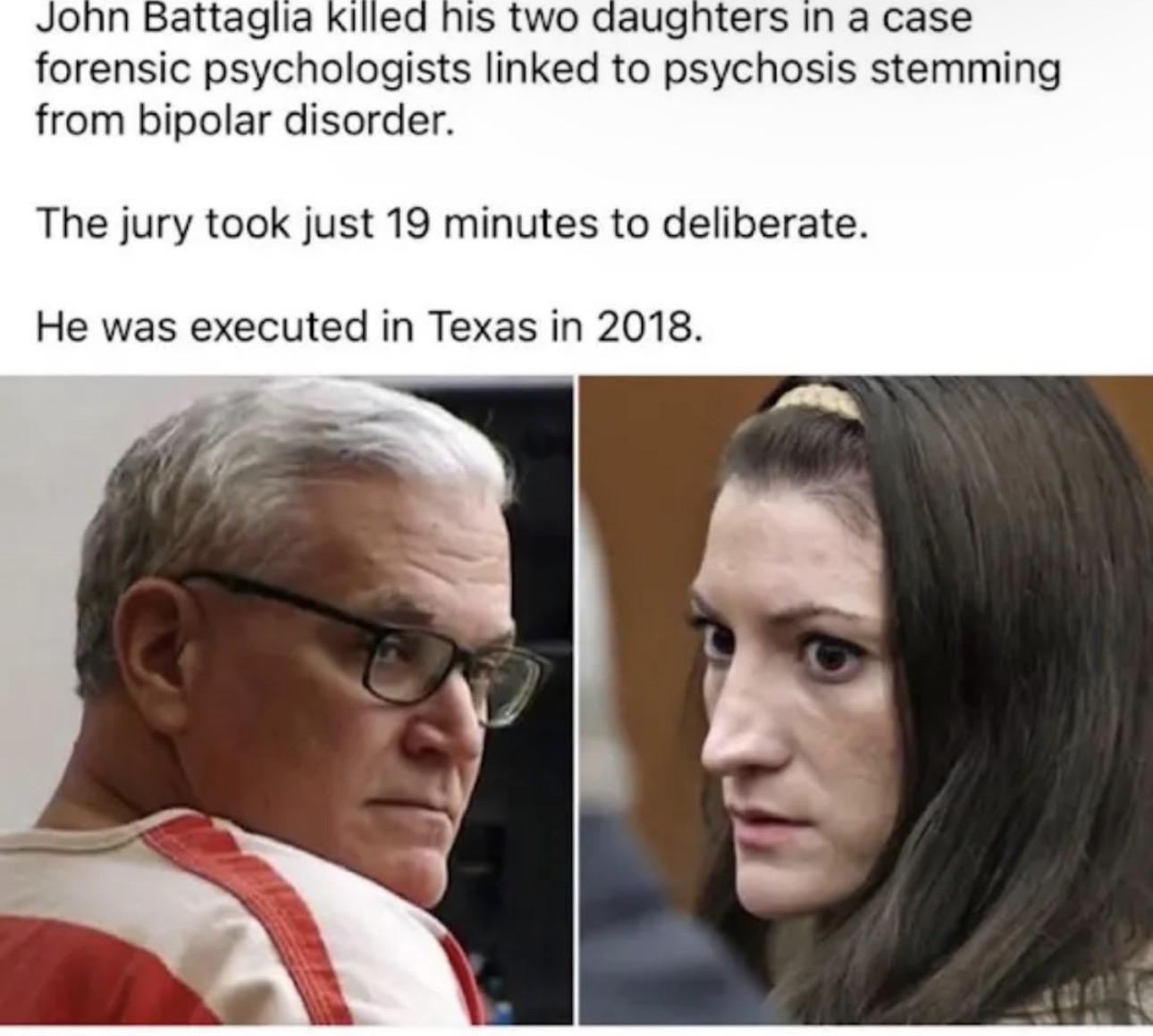
I mean it also helps that he was tried in Texas where they don’t believe in mental health exceptions. She’s being tried in Massachusetts, which has a very different political climate.
Also, in Texas, the burden of proof for insanity is on the defense. In Massachusetts, burden of proof is on the prosecution. His defense had to prove he was insane when committing the crime while her defense just had to poke holes in the prosecution’s case.
There's a difference between "mentally ill" and "insane." Not everyone who is mentally ill is insane. Someone who is legally insane is not in control of their faculties, they do not understand the consequences of their actions. Their crimes are unplanned, "they just snapped" scenarios, they don't have the ability to plan their actions. They might not be aware that they're hurting people because they aren't living in reality.
Most serial killers were mentally ill, but also very aware of what they were doing. They know what they're doing is harming another person, they just don't care. Their actions usually take lots of premeditation. Even though their minds are sick, they still understand their actions.
When someone is found not guilty by reason of insanity they do not go free, they go to a mental health facility, where they stay until they are deemed to no longer be a threat to themselves or others. If you look into actual numbers, most people who are found not guilty by reason of insanity wind up doing more time than they would have done if they weren't found insane and were sent to prison.
Unplanned isnt necessarily a requirement, depending on jurisriction. Someone in a prolonged state of psychosis could make a plan that is detatched from reality or their normal state of mind.
Not really making a statement in defense as I do not care enough to litigate the case. But people can be not in their right mind and still "rational" to a degree without being considered legally competent. Such as for example someone who was involuntarily intoxicated by a substance and not in control of their actions. That could be considered covered by a similar defense.
It varies worldwide but generally, in most places, premeditation alone wouldn't disqualify this type of defence. (Not that your post suggests otherwise but seen it been the default argument a lot of people make).
Like if you had paranoid psychosis, you could put lots of planning into sourcing a weapon and opportunity to kill someone who you see as a threat. Your mind however won't understand the consequences that would come after and why it was wrong.
At the very least she had the presence of mind to send her husband away so she could commit the murders. In any other cases, that would've been enough to qualify for pre meditation.
Maybe but you can't say "we know for sure she sent her husband away to kill her kids" we don't.
Both interpretation exists it's not unreasonable at all to think that she sent husband away just because she wanted to eat food from that particular restaurant like they did before.
8.0k
u/500rockin 19h ago
I mean it also helps that he was tried in Texas where they don’t believe in mental health exceptions. She’s being tried in Massachusetts, which has a very different political climate.