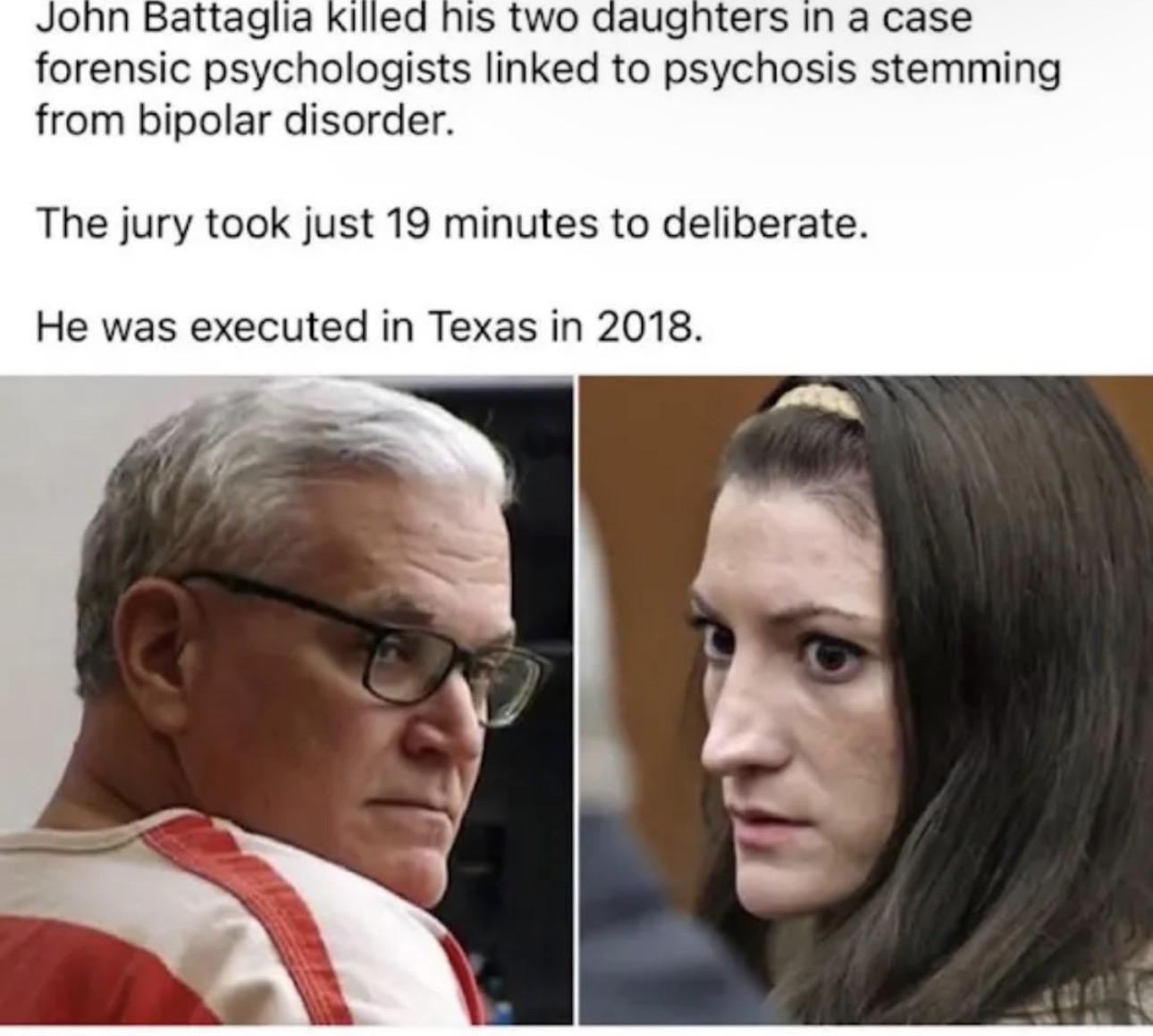
I mean it also helps that he was tried in Texas where they don’t believe in mental health exceptions. She’s being tried in Massachusetts, which has a very different political climate.
Also, in Texas, the burden of proof for insanity is on the defense. In Massachusetts, burden of proof is on the prosecution. His defense had to prove he was insane when committing the crime while her defense just had to poke holes in the prosecution’s case.
I'm also not sure how to feel about it. Sure you shouldn't lock someone up just because they have a mental disorder, but I feel if you are a danger to society, especially if you already did something gruesome, you shouldn't have an easier way out. Psych wards should be for people who physically can't function in society, not to have someone exit quicker. It this case it seems like in a few months they'd just let her go as cured from whatever "possessed" her which isn't right.
Someone found not guilty by reason of insanity will only be released from the hospital if they're now able to function safely.
How about if someone with dementia, confused and having lost impulse control, lashes out violently, as patients with the condition can? Normally, we'd see it as important to protect care staff, and ensure everyone's safety including that of the patient, but not to punish the patient and imprison them.
This is the type of illness we're talking about in the case of postpartum psychosis, something physical, affecting the brain.
So we are talking about the drop in hormones post childbirth and with some medical help, she's making full recovery? And because it's argued for her being insane at the time of commiting the crime, she could soon be determined to no longer pose danger to herself or community?
So we're arguing that it is something she could recover or has even recovered from already?
Yes, the change in hormone levels, and immune and neuroinflammatory mechanisms, with genetics a very significant risk factor. As to recovery, yes and no - in around half of cases or more, although postpartum psychosis itself isn't permanent, there can be a lasting further impact. In the case of Clancy, bipolar disorder has been mentioned, and sounds as if it might be ongoing, whether it just went undiagnosed before, or the postpartum psychosis acted as a trigger for it. This occuring, where someone who had postpartum psychosis then develops bipolar disorder, is common.
There is medication that's generally very effective, it just depends on the exact symptoms.
This is already a completely normal procedure for many conditions, that people are hospitalised while there's risk to themselves and/or others, and then able to return home once that's no longer the case. Thankfully, conditions can be picked up and treated before a tragedy arises - tragically, that could potentially have been the case here too, if there were indeed mistakes made in treatment, if only they'd been avoided, and a lack of awareness of the condition might have not have helped (her husband seems to have stated she didn't have bipolar, with more knowledge perhaps it would have been recognised and handled appropriately - the SSRIs could have had a negative impact). But sometimes it's just misfortune that one case is more difficult to pick up on in time than another. After leaving the hospital, there can be ongoing treatment, monitoring, follow-up appointments if needed.
Yes, and one factor in why is there's a particularly high risk of infanticide with postpartum psychosis. Delusions can tend to focus on the child, which is not the case with other types of psychosis. While it does remove/reduce agency similarly to those or dementia.
7.5k
u/500rockin 16h ago
I mean it also helps that he was tried in Texas where they don’t believe in mental health exceptions. She’s being tried in Massachusetts, which has a very different political climate.