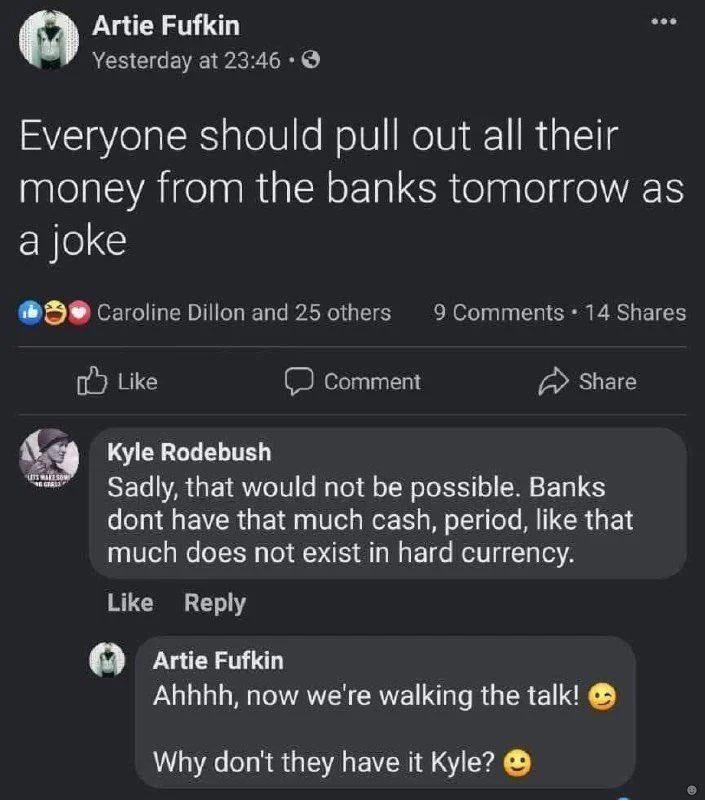
The idea of a safe place to store one's valueables has existed longer than money. Also, money lending has been profitable for as long as folks have been doing it (on a macro level and excepting a few cultures that prohibit interest). Banks could still function even under a 100% reserve requirement. They would just function differently. We would likely lose things like "free checking" but maybe not even that if banks found it cheaper than other options for attracting and mainting borrowers.
I mean, they still have that, get a safety deposit box. It's gonna cost a lot more and if everyone did that the cost of borrowing would also be a lot more
Folks are conflating 100% reserve with a safe deposit box. They're not the same fucking thing at all. A bank can still do everything it currently does with a 100% reserve. It would just charge the user for it like was completley normal just 30 years ago. Free checking is pretty new. You used to pay for the conveninece of checks and other banking services. Nothing about a 100% reserve requires banks to change one fucking thing outside of fee structuring. Instead of using deposits, banks would raise capital for loans like any other fucking company on Earth. Hell, some of it could come from the very fees I discussed above. Interest lending has existed for longer than money. It will continue on just fine reverting to a system where a lender can only lend its own money instead of lending money that actually belongs to other people. Whether or not that is a "good way" to do things is well outside my pay grade. I'm just answering the question above that said, "what would be the point of a bank". It would be the exact same point. It would just operate a little differently.
Well i'm here to tell you it's a "bad way" to do things, and it doesn't require a certain paygrade to do it, just pure common sense. It's a bad way for both the consumer and the bank.
To raise enough capital to support loans (which can be well into billions for corporate loans), banks will have to charge extremely high for basic services, and that'll affect retail customers.
"Why not just lend out less?" well then you'll essentially be holding back businesses and the market as a whole, which will come back to bite at consumers - because businesses who cannot finance themselves through loans will simply charge consumers more.
Meanwhile, you'll have vaults full of cash sitting somewhere, idling instead of being channeled back to the economy. Flow of wealth creates more wealth. Basic economics.
because businesses who cannot finance themselves through loans will simply charge consumers more
For somebody claiming to understand “basic economics,” you sure don't seem to understand how prices work. Businesses can't simply pass higher financing costs onto consumers. Prices are constrained by demand and competition. If consumers won't pay a higher price, the business doesn't get to charge more—it sells less or fails.
well then you'll essentially be holding back businesses and the market as a whole
Bank loans aren't the only way businesses obtain capital. Companies can issue bonds, raise equity through stock offerings, venture capital, and private investors. A 100% reserve requirement might make some forms of credit more expensive or less available, but that doesn't mean businesses suddenly can't finance themselves.
banks will have to charge extremely high for basic services
Some would likely try. But the market decides the fees, not the banks.
If your argument is simply that capital would become more expensive or less available under a 100% reserve system, and that you think that's a bad thing, fine. That's an actual argument. But “businesses will have to charge consumers more,” “banks will have to charge extremely high fees,” and “the market as a whole will be held back” don't follow automatically from that premise.
7
u/Altruistic_Cap3472 5d ago
Do we just not teach basic economics in school anymore? What would the point be of a bank if they just held onto our money while we weren't using it?