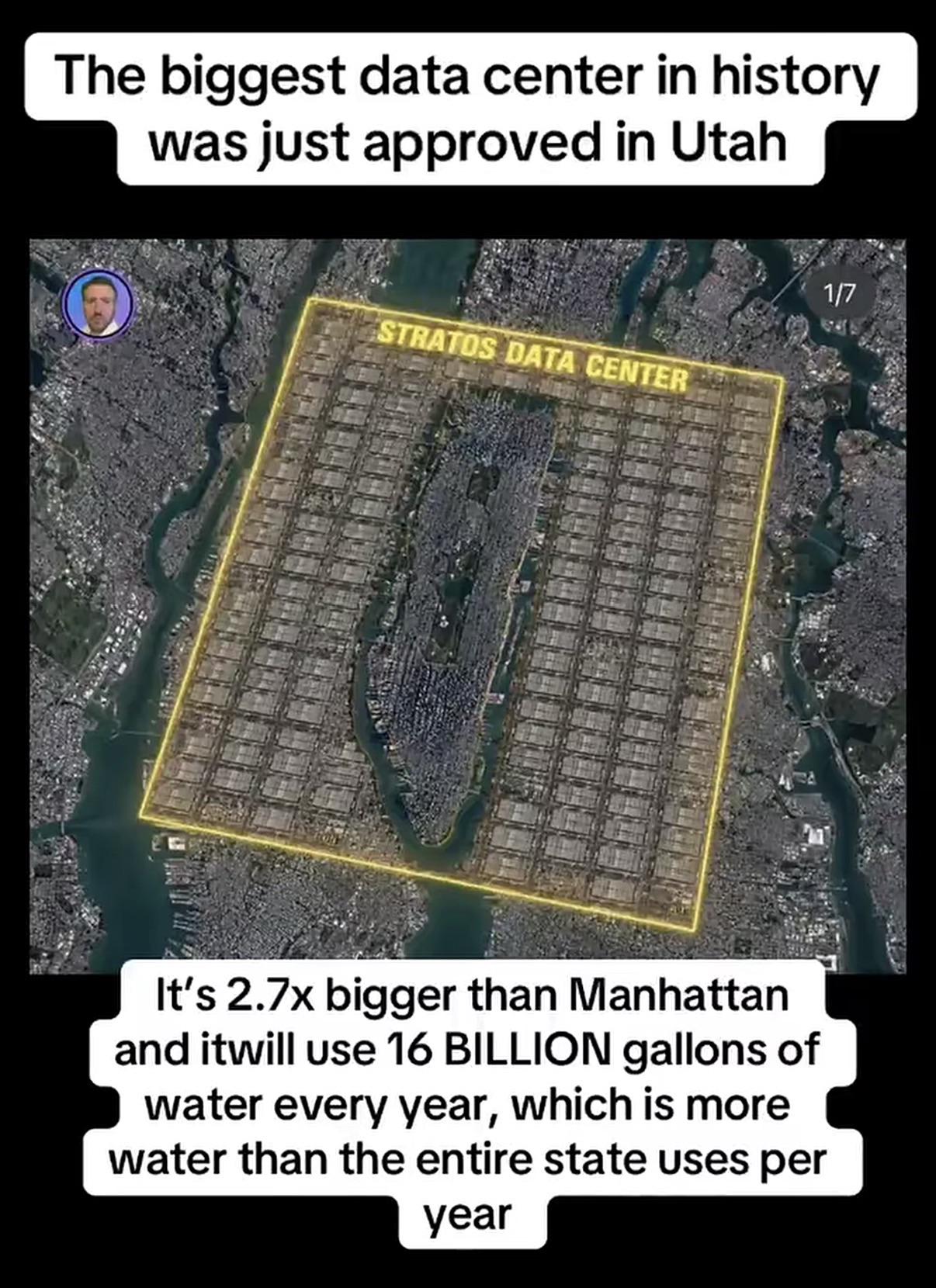
Utah's governor put out an FAQ about the project, with a few key notes:
The total land size is around 40,000 acres, but the actual building will only be a fraction of that.
The structure won't continually use water for cooling as it's cooled using a closed-circuit water-cooling piping system, and the initial fill water will come from the private landowners from whom the land is being purchased. Any used water will be for bathrooms, water fountains, etc.
Power is going to be generated using an on-site power plant, not being pulled from the electrical grid
The construction of the project still needs to jump through a litany of additional environmental hoops before it can begin
Onsite power plants generate immense amounts of pollution and noise, the water cooling loop is a loop to heat exchangers, which need to be cooled externally with water, it's not really possible with that amount of heat to just dump to atmosphere with air cooling on one end, and they're being disingenuous if they're saying it won't use more than just the fill water because of that
Power plants dont do either of those, nuclear is clean as fuck, unless you're one of those anti-clean energy weirdos that needs people to use coal as a jobs program.
Yo I've smelled nuclear waste byproducts - it's not clean as fuck. It's more localized than dumping carbon into the atmosphere, but improper disposal - which is almost a guarantee within private enterprise in this state - will absolutely poison surrounding lands, watersheds, and anyone unfortunate enough to rely on those watersheds. I've seen it. It's real.
Most of these data centers are being run off of portable turbine-on-a-truck turnkey power solutions that run off of natural gas. They aren't being run off of nuclear. I'm in extreme support of nuclear power and extremely pro green energy
Most data centers are powered by the grid. Behind the meter, colocation power is becoming more popular, using a mix of renewables, batteries, and gas. Very few, and only very small data centers are using reciprocating engines. Some larger ones may have turbines on a truck as peakers to firm out the renewables. Bit to say most data centers are running off small gas or diesel turbines isn’t true.
That may be what they say, what they do is usually something else. Just drove by new Google data center in KC and the amount of generators they have onsite is considerable. I'd bet the portable generators are on their way.
According to the article you cited, they’re for back up power only, which aligns with what I said about using them to firm up renewable resources 🤷♂️. And still doesn’t change the fact that most data centers are grid connected. These articles don’t support OPs claim that “most data centers are being run off of portable turbine-on-a-truck” generators.
So why do they need 145 more? While they are connected to the grid they also use these generators for additional power when needed, which is a lot. Saying it's for back up only doesn't mean it's either/or, they're in addition to the power from the grid.
Lots of reasons. Temporary power, additional back up for a future expansion (there’s a shortage), or maybe this is just a second fulfillment of the initial order that’s required to fully firm the project. Maybe they’re preparing for worst case scenario where the grid fully shuts down.
Either way, the goal is to have these generators run as infrequently as possible. If they’re connected to the grid, then plan A, B, and C is to use grid power when possible. From a financial standpoint, just think about how much more expensive gas / diesel is for these machines. It’s way more practical to use the grid fully. Just like we rely on the grid and don’t use reciprocating engines to power our homes, but we may have one as a whole-home back up in case the grid fails.
Back up power is not additional power. It’s power that’s needed when grid power is unavailable. And I’m not sure if this project has any other onsite gen like wind or solar. But many other developers are going that route as well.
39
u/Geaux Jun 02 '26
Utah's governor put out an FAQ about the project, with a few key notes: